 полная версия
The American Revolution
On hearing of Howe’s arrival at the head of Chesapeake Bay, Washington had advanced as far as Wilmington to meet him. The first proceeding of the British general, on landing at Elkton, was to issue his proclamation of amnesty; but it did not bring him many recruits. A counter-proclamation, drawn up by Luther Martin, sufficed to neutralize it. Though there were many people in the neighbourhood who cared little for the cause of independence, there were but few who sympathized with the invaders enough to render them any valuable assistance. It was through a country indifferent, perhaps, but not friendly in feeling, that the British army cautiously pushed its way northward for a fortnight, until it reached the village of Kennett Square, six miles west of the Brandywine Creek, behind which Washington had planted himself to oppose its progress.
Washington’s reasons for offering battleThe time had arrived when Washington felt it necessary to offer battle, even though such a step might not be justified from purely military reasons. The people were weary of a Fabian policy which they did not comprehend, and Washington saw that, even if he were defeated, the moral effect upon the country would not be so bad as if he were to abandon Philadelphia without a blow. A victory he was hardly entitled to expect, since he had but 11,000 men against Howe’s 18,000, and since the British were still greatly superior in equipment and discipline. Under these circumstances, Washington chose his ground with his usual sagacity, and took possession of it by a swift and masterly movement. The Brandywine Creek ran directly athwart Howe’s line of march to Philadelphia.
He chooses a very strong positionThough large enough to serve as a military obstacle, – in England it would be called a river, – it was crossed by numerous fords, of which the principal one, Chadd’s Ford, lay in Howe’s way. Washington placed the centre of his army just behind Chadd’s Ford and across the road. His centre was defended in front by a corps of artillery under Wayne, while Greene, on some high ground in the rear, was stationed as a reserve. Below Chadd’s Ford, the Brandywine becomes a roaring torrent, shut in between steep, high cliffs, so that the American left, resting upon these natural defences, was sufficiently guarded by the Pennsylvania militia under Armstrong. The right wing, stretching two miles up the stream, into an uneven and thickly wooded country, was commanded by Sullivan.
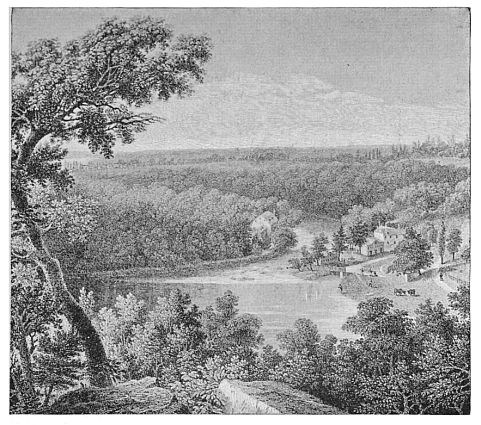
VIEW OF BRANDYWINE BATTLEFIELD
Battle of the Brandywine, Sept. 11, 1777
This was a very strong position. On the left it was practically inaccessible. To try storming it in front would be a doubtful experiment, sure to result in terrible loss of life. The only weak point was the right, which could be taken in flank by a long circuitous march through the woods. Accordingly, on the morning of the 11th of September, the British right wing, under Knyphausen, began skirmishing and occupying Washington’s attention at Chadd’s Ford; while the left column, under the energetic Cornwallis, marched up the Lancaster road, crossed the forks of the Brandywine, and turned southward toward Birmingham church, with the intention of striking the rear of the American right wing. It was similar to the flanking movement which had been tried so successfully at the battle of Long Island, a year before. It was quite like the splendid movement of Stonewall Jackson at Chancellorsville, eighty-five years afterward. In Howe’s time such flanking marches were eminently fashionable. It was in this way that the great Frederick had won some of his most astonishing victories. They were, nevertheless, then as always, dangerous expedients, as the stupendous overthrow of the Austro-Russian army at Austerlitz was by and by to show. There is always a serious chance that the tables may be turned. Such flanking movements are comparatively safe, however, when the attacking army greatly outnumbers the army attacked, as at the Brandywine. But in all cases the chief element in their success is secrecy; above all things, the party attacked must be kept in the dark.
These points are admirably illustrated in the battle of the Brandywine. The danger of a flank attack upon his right wing was well understood by Washington; and as soon as he heard that Cornwallis was marching up the Lancaster road, he considered the feasibleness of doing what Frederick would probably have done, – of crossing quickly at Chadd’s and Brinton’s fords, in full force, and crushing Knyphausen’s division. This he could doubtless have accomplished, had he been so fortunate as to have inherited an army trained by the father of Frederick the Great. But Washington’s army was not yet well trained, and its numerical inferiority was such that Knyphausen’s division might of itself be regarded as a fair match for it. The British movement was, therefore, well considered, and it was doubtless right that Washington did not return the offensive by crossing the creek. Moreover, the organization of his staff was far from complete. He was puzzled by conflicting reports as to the enemy’s movements. While considering the question of throwing his whole force against Knyphausen, he was stopped by a false report that Cornwallis was not moving upon his flank. So great was the delay in getting intelligence that Cornwallis had accomplished his long march of eighteen miles, and was approaching Birmingham church, before it was well known where he was. Nevertheless, his intention of dealing a death-blow to the American army was forestalled and partially checked. Before he had reached our right wing, Washington had ordered Sullivan to form a new front and advance toward Birmingham church. Owing to the imperfect discipline of the troops, Sullivan executed the movement rather clumsily, but enough was accomplished to save the army from rout. In the obstinate and murderous fight which ensued near Birmingham church between Cornwallis and Sullivan, the latter was at length slowly pushed back in the direction of Dilworth. To save the army from being broken in two, it was now necessary for the centre to retreat upon Chester by way of Dilworth, and this movement was accomplished by Greene with consummate skill. It was now possible for Knyphausen to advance across Chadd’s Ford against Wayne’s position; and he did so, aided by the right wing of Cornwallis’s division, which, instead of joining in the oblique pursuit toward Dilworth, kept straight onward, and came down upon Wayne’s rear. Nothing was left for Wayne and Armstrong but to retreat and join the rest of the army at Chester, and so the battle of the Brandywine came to an end.
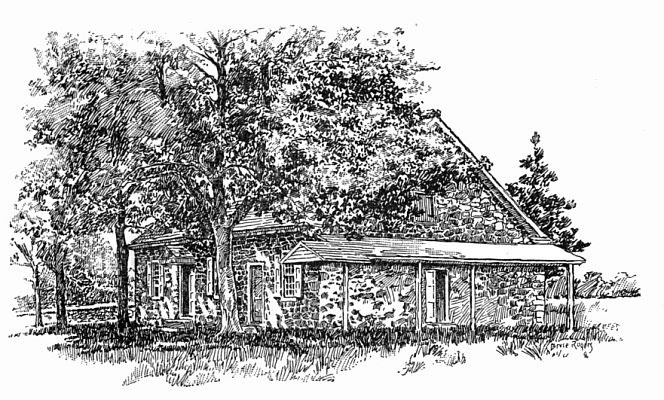
BIRMINGHAM MEETING-HOUSE
This famous battle was admirably conducted on both sides. The risk assumed in the long flanking march of Cornwallis was fully justified. The poor organization of the American army was of course well known to the British commanders, and they took advantage of the fact. Had they been dealing with an organization as efficient as their own, their course would have been foolhardy. On the other hand, when we consider the relative strength of the two armies, it is clear that the bold move of Cornwallis ought not simply to have won the field of battle. It ought to have annihilated the American army, had not its worst consequences been averted by Washington’s promptness, aided by Sullivan’s obstinate bravery and Greene’s masterly conduct of the retreat upon Dilworth. As it was, the American soldiers came out of the fight in good order. Nothing could be more absurd than the careless statement, so often made, that the Americans were “routed” at the Brandywine. Their organization was preserved, and at Chester, next day, they were as ready for fight as ever. They had exacted from the enemy a round price for the victory. The American loss was a little more than 1,000, incurred chiefly in Sullivan’s gallant struggle; rolls afterward captured at Germantown showed that the British loss considerably exceeded that figure.
Washington’s skill in detaining the enemySo far as the possession of Philadelphia was concerned, the British victory was decisive. When the news came, next morning, that the army had retreated upon Chester, there was great consternation in the “rebel capital.” Some timid people left their homes, and sought refuge in the mountains. Congress fled to Lancaster, first clothing Washington for sixty days with the same extraordinary powers which had been granted him the year before. Yet there was no need for unseemly haste, for Washington detained the victorious enemy a fortnight on the march of only twenty-six miles; a feat which not even Napoleon could have performed with an army that had just been “routed.” He had now heard of Stark’s victory and St. Leger’s flight, and his letters show how clearly he foresaw Burgoyne’s inevitable fate, provided Howe could be kept away from him. To keep Howe’s whole force employed near Philadelphia as long as possible was of the utmost importance.
The British enter Philadelphia, Sept. 26Accordingly, during the fortnight following the battle of the Brandywine, every day saw manœuvres or skirmishes, in one of which General Wayne was defeated by Sir Charles Gray, with a loss of three hundred men. On the 26th, while Howe established his headquarters at Germantown, Cornwallis entered Philadelphia in triumph, marching with bands of music and flying colours, and all the troops decked out in their finest scarlet array.
Significance of Forts Mercer and MifflinHaving got possession of the “rebel capital,” the question now arose whether it would be possible to hold it through the winter. The Delaware river, below the city, had been carefully obstructed by chevaux-de-frise, which were guarded by two strong fortresses, – Fort Mifflin on an island in mid-stream, and Fort Mercer on the Jersey shore. The river was here about two miles in width, but it was impossible for ships to pass until the forts should have been reduced. About the first of October, after a rough return voyage of four hundred miles, Lord Howe’s fleet appeared at the mouth of the Delaware. It was absolutely necessary to gain control of the river, in order that the city might get supplies by sea; for so long as Washington’s army remained unbroken, the Americans were able to cut off all supplies by land. Sir William Howe, therefore, threw a portion of his forces across the river, to aid his brother in reducing the forts. The quick eye of Washington now saw an opportunity for attacking the main British army, while thus temporarily weakened; and he forthwith planned a brilliant battle, which was, however, fated to be lost by a singular accident.
The situation at GermantownThe village of Germantown, by the bank of the Schuylkill river, was then separated from Philadelphia by about six miles of open country. The village consisted chiefly of a single street, about two miles in length, with stone houses on either side, standing about a hundred yards apart from each other, and surrounded by gardens and orchards. Near the upper end of the street, in the midst of ornamental shrubbery, vases, and statues, arranged in a French style of landscape gardening, stood the massively built house of Benjamin Chew, formerly Chief Justice of Pennsylvania. About a mile below, at the Market House, the main street was crossed at right angles by the Old School Lane. Beside the main street, running over Chestnut Hill, the village was approached from the northward by three roads. The Monatawny road ran down by the bank of the Schuylkill, and, crossing the Old School Lane, bore on toward Philadelphia. The Limekiln road, coming from the northeast, became continuous with the Old School Lane. The Old York road, still farther eastward, joined the main street at the Rising Sun tavern, about two miles below the Market House.
The British army lay encamped just behind the Old School Lane, in the lower part of the village: the left wing, under Knyphausen, to the west of the main street; the right, under Grant, to the east. A strong detachment of chasseurs, under Sir Charles Grey, covered the left wing. About a mile in advance of the army, Colonel Musgrave’s regiment lay in a field opposite Judge Chew’s house; and yet a mile farther forward a battalion of light infantry was stationed on the slight eminence known as Mount Airy, where a small battery commanded the road to the north.
Washington’s audacious planWashington’s plan of attack seems to have contemplated nothing less than the destruction or capture of the British army. His forces were to advance from the north by all four roads at once, and converge upon the British at the Market House. The American right wing, under Sullivan, and consisting of Sullivan’s own brigade, with those of Conway, Wayne, Maxwell, and Nash, was to march down the main street, overwhelm the advanced parties of the British, and engage their left wing in front; while Armstrong, with the Pennsylvania militia, was to move down the Monatawny road, and take the same wing in flank. The American left wing, commanded by Greene, was also to proceed in two columns. Greene, with his own brigade, supported by Stephen and McDougal, was to march down the Limekiln road, and assail the British right wing in front and in flank; while Smallwood and Forman, coming down the Old York road, were to strike the same wing in the rear. The flank attack upon the British left, entrusted as it was to militia, was intended merely as a demonstration. The attack upon their right, conducted by more than half of the American army, including its best troops, was intended to crush that wing, and folding back the whole British army upon the Schuylkill river, compel it to surrender.

JUDGE CHEW’S HOUSE AT GERMANTOWN
Battle of Germantown, Oct. 4
Considering that the Americans had not even yet a superiority in numbers, this was a most audacious plan. No better instance could be given of the spirit of wild and venturous daring which was as conspicuous in Washington as his cautious vigilance, whenever any fit occasion arose for displaying it. The scheme came surprisingly near to success; so near as to redeem it from the imputation of fool-hardiness, and to show that here, as in all Washington’s military movements, cool judgment went along with fiery dash. At seven in the evening of the 3d of October, the night march upon Germantown began, Washington accompanying Sullivan’s column. At sunrise a heavy fog came up, and the darkness went on increasing. Soon after the hour of daybreak the light infantry upon Mount Airy were surprised and routed, and the battery was captured. Musgrave was next overwhelmed by the heavy American column; but he, with a small force, took refuge in Judge Chew’s house, and set up a brisk fire from the windows. The Americans opened an artillery-fire upon the house, but its stone walls were too solid to be beaten down by the three-pound and six-pound field-pieces of that day; and so Maxwell’s brigade was left behind to besiege the house, while the rest of the column rushed on down the street. The chief effect of this incident was to warn the enemy, while retarding and somewhat weakening the American charge. Nevertheless, the fury of the attack was such as to disconcert Knyphausen’s veterans, and the British left wing slowly gave way before Sullivan. At this moment, Greene, who had also been delayed, attacked the right wing with such vigour as presently to force it back toward the Market House. The British ranks were falling into confusion, and Smallwood’s column had already arrived upon their right flank, when the accident occurred which changed the fortunes of the day. From the beginning the dense fog had been a source of confusion to both armies, and had seriously interfered with the solidity of the American advance. Now, as Stephen’s brigade, on the right of Greene’s column, came into the village, the heavy firing at Judge Chew’s seems to have caused him to diverge more and more to the west, in the belief that there was the thick of the battle. At the same time, Wayne, in driving the enemy before him, had swayed somewhat to the east, so that his brigade stood almost directly in the line of Stephen’s progress. In this position he was attacked by Stephen, who mistook him for the enemy. This lamentable blunder instantly ruined the battle. Wayne’s men, thus fiercely attacked in the rear, and struggling to extricate themselves, were thrown upon the left flank of Sullivan’s brigade, and a panic suddenly ran through the army. The confusion grew worse and worse, till a general retreat began, and Grey, who had come up to support the crumbling right wing of the British, was now able to lead in the pursuit of the Americans. He was joined by Cornwallis, who had sprung from his bed in Philadelphia at the first sound of the cannon, and had brought up two battalions with him at double-quick. But the panic had subsided almost as soon as the golden moment of victory was lost, and the retreat was conducted in excellent order. One regiment in Greene’s column was surrounded and captured, but the army brought away all its cannon and wounded, with several cannon taken from the enemy. The loss of the Americans in killed and wounded was 673, and the loss of the British was 535.
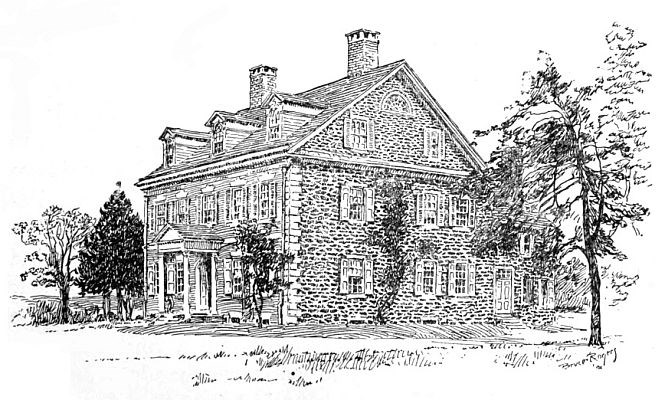
HOUSE AT GERMANTOWN OCCUPIED BY THE BRITISH
The fog which enshrouded the village of Germantown on that eventful morning has been hardly less confusing to historians than it was to the armies engaged. The reports of different observers conflicted in many details, and particularly as to the immediate occasion of the fatal panic. The best accounts agree, however, that the entanglement of Stephen with Wayne was chiefly responsible for the disaster. It was charged against Stephen that he had taken too many pulls at his canteen on the long, damp night march, and he was tried by court-martial, and dismissed from the service. The chagrin of the Americans at losing the prize so nearly grasped was profound. The total rout of Howe, coming at the same time with the surrender of Burgoyne, would probably have been too much for Lord North’s ministry to bear, and might have brought the war to a sudden close. As it was, the British took an undue amount of comfort in the acquisition of Philadelphia, though so long as Washington’s army remained defiant it was of small military value to them. On the other hand, the genius and audacity shown by Washington, in thus planning and so nearly accomplishing the ruin of the British army only three weeks after the defeat at the Brandywine, produced a profound impression upon military critics in Europe. Frederick of Prussia saw that presently, when American soldiers should come to be disciplined veterans, they would become a formidable instrument in the hands of their great commander; and the French court, in making up its mind that the Americans would prove efficient allies, is said to have been influenced almost as much by the battle of Germantown as by the surrender of Burgoyne.
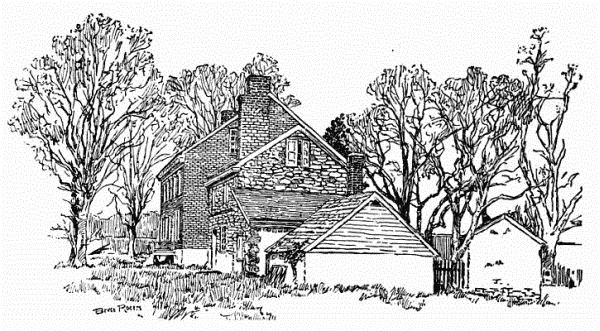
WHITHALL HOUSE AT FORT MERCER WHERE DONOP DIED
Howe captures Forts Mercer and Mifflin
Having thus escaped the catastrophe which Washington had designed for him, the British commander was now able to put forth his utmost efforts for the capture of the forts on the Delaware. His utmost efforts were needed, for in the first attack on Fort Mercer, October 22, the Hessians were totally defeated, with the loss of Count Donop and 400 men, while the Americans lost but 37. But after a month of hard work, with the aid of 6,000 more men sent from New York by Clinton, both forts were reduced, and the command of the Delaware was wrested from the Americans. Another month of manœuvring and skirmishing followed, and then Washington took his army into winter-quarters at Valley Forge. The events which attended his sojourn in that natural stronghold belong to a later period of the war. We must now return to the upper waters of the Hudson, and show how the whole period, which may be most fitly described as a struggle for the control of the great central state of New York, was brought to an end by the complete and overwhelming victory of the Americans.
Burgoyne recognizes the fatal error of GermainWe have seen how it became impossible for Howe to act upon Lord George Germain’s order, received in August, in Chesapeake Bay, and get back to the Hudson in time to be of any use to Burgoyne. We have also seen how critical was the situation in which the northern general was left, after the destruction of Baum and St. Leger, and the accumulation of New England yeomanry in his rear. Burgoyne now fully acknowledged the terrible mistake of the ministry in assuming that the resistance of the Americans was due to the machinations of a few wily demagogues, and that the people would hail the approach of the king’s troops as deliverers. “The great bulk of the country,” said he, “is undoubtedly with the Congress in principle and zeal, and their measures are executed with a secrecy and dispatch that are not to be equalled… The Hampshire Grants, in particular, a country unpeopled and almost unknown last war, now abounds in the most active and most rebellious race on the continent, and hangs like a gathering storm upon my left.” The situation had, indeed, become so alarming that it is hard to say what Burgoyne ought to have done. A retreat upon Ticonderoga would have been fraught with peril, while to cross the Hudson and advance upon Albany would be doing like Cortes, when he scuttled his ships. But Burgoyne was a man of chivalrous nature. He did not think it right or prudent to abandon Sir William Howe, whom he still supposed to be coming up the river to meet him. In a letter to Lord George Germain, written three days after the surrender, he says, “The difficulty of a retreat upon Canada was clearly foreseen, as was the dilemma, should the retreat be effected, of leaving at liberty such an army as General Gates’s to operate against Sir William Howe. This consideration operated forcibly to determine me to abide events as long as possible, and I reasoned thus: the expedition which I commanded was at first evidently intended to be hazarded; circumstances might require it should be devoted.”
Nevertheless he crosses the HudsonInfluenced by these views, which were supported by all his generals except Riedesel, Burgoyne threw a bridge of boats across the Hudson, and passed over with whole army on the 13th of September. The Americans had taken a strong position on Bemis Heights, where Kosciuszko had skilfully fortified their camp with batteries and redoubts. Burgoyne felt that the time for desperate fighting had now come, and it seemed to him that the American position might be turned and carried by an attack upon its left flank. On the morning of the 19th, he advanced through the woods, with the centre of his army, toward the point where the Quaker road passed Bemis Heights. The right wing, under Fraser, proceeded somewhat more circuitously toward the same point, the plan being that they should join forces and strike the rear of the American camp, while Riedesel and Phillips, with the left wing and the artillery, marching down the river road, should assail it in front.
First battle at Freeman’s Farm, Sept. 19; indecisiveThree heavy guns, announcing to the left wing the junction of Burgoyne and Fraser, were to give the signal for a general assault. American scouts, lurking among the upper branches of tall trees that grew on steep hillsides, presently caught glimpses of bright scarlet flitting through the green depths of the forest, while the long sunbeams that found their way through the foliage sent back quick burning flashes from a thousand bayonets. By noon the course of the British march and their plan of attack had been fully deciphered, and the intelligence was carried to Arnold, who commanded the left wing of the American army. Gates appears to have been unwilling to let any of the forces descend from their strong position; but the fiery Arnold urged and implored, until he got permission to take Morgan’s riflemen and Dearborn’s infantry, and go forth to attack the enemy. Arnold’s advance, under Morgan, first fell upon Burgoyne’s advance, at Freeman’s Farm, and checked its progress. Fraser then, hearing the musketry, turned eastward to the rescue, while Arnold, moving upon Fraser’s left, sought to cut him asunder from Burgoyne. He seemed to be winning the day, when he was attacked in flank by Riedesel, who had hurried up from the river road. Arnold had already sent to Gates for reinforcements, which were refused him. Arnold maintained that this was a gross blunder on the part of the commanding general, and that with 2,000 more men he could now easily have crushed the British centre and defeated their army. In this opinion he was probably right, since even as it was he held his own, in a desperate fight, for two hours, until darkness put an end to the struggle. The losses on each side are variously estimated at from 600 to 1,000, or from one fifth to one fourth of the forces engaged, which indicates severe fighting. Arnold’s command had numbered about 3,000, and he had been engaged, in the course of the afternoon, with at least 4,000 of Burgoyne’s army; yet all this while some 11,000 Americans – most of the army in short – had been kept idle on Bemis Heights by the incompetent Gates. Burgoyne tried to console himself with the idea that he had won a victory, because his army slept that night at Freeman’s Farm; but in his testimony given afterward before the House of Commons, he rightly maintained that his plan of attack had been utterly defeated by the bold and skilful tactics of “Mr.” Arnold.