Полная версия
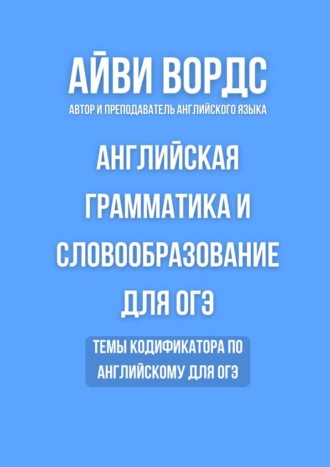
Английская грамматика и словообразование для ОГЭ. Темы кодификатора по английскому для ОГЭ

Английская грамматика и словообразование для ОГЭ
Темы кодификатора по английскому для ОГЭ
Айви Вордс
© Айви Вордс, 2026
ISBN 978-5-0069-1828-3
Создано в интеллектуальной издательской системе Ridero
Предисловие
Дорогие читатели!
Моя цель была проста, но амбициозна: собрать в одной книге грамматические темы и конструкции, которые необходимы для успешной сдачи ОГЭ, и сделать это понятно и удобно для школьников.
Я постаралась структурировать материал таким образом, чтобы каждая тема объяснялась максимально ясно на русском языке, подкреплялась примерами на английском, а упражнения помогали закреплять знания на практике. Особое внимание я уделила устойчивым сочетаниям слов, фразовым глаголам, употреблению артиклей, местоимений и числительных – тем аспектам, которые чаще всего вызывают трудности у учащихся.
Книга рассчитана на уровень B1 и подходит для самостоятельного изучения и повторения пройденного материала. Я включила примеры из повседневной жизни, истории и полезные списки, чтобы обучение было интересным и полезным.
Желаю вам успехов, уверенности и радости в изучении английского языка!
Vocabulary Units and Set Phrases
Grammar Focus
Лексические единицы и речевые клише – это слова, словосочетания и устойчивые выражения, которые часто используются в английской речи. Они помогают строить правильные и понятные предложения, делают речь естественной и логичной.
Примеры:
Good morning! – Доброе утро!
How are you? – Как дела?
I am interested in… – Я интересуюсь…
I like reading books. – Мне нравится читать книги.
It depends on the situation. – Это зависит от ситуации.
Правила и советы для школьников:
Используй речевые клише в повседневной речи, чтобы говорить естественно.
Лексические единицы часто входят в устойчивые выражения, которые не изменяются.
Повторяй слова и выражения в разных контекстах для лучшего запоминания.
Сочетай новые слова с уже известными выражениями, чтобы расширять словарный запас.
Story
Alex is a student who enjoys learning English. Every morning, he greets his classmates with «Good morning!» and asks, «How are you?» During the lessons, he often says, «I am interested in history» or «I like reading books.» When the teacher asks about his homework, he replies, «It depends on the situation.» At lunchtime, Alex talks with his friends and uses phrases like «I think this is a good idea» or «I don’t agree with you.» In the afternoon, he goes to the library and practices English by reading simple texts and repeating useful expressions. In the evening, Alex writes a diary in English, writing sentences such as «Today I learned new words» and «I am happy because I spoke with my friends in English.» By using set phrases and common vocabulary units, Alex feels more confident and can express his thoughts clearly. Using these expressions every day helps him remember them faster and speak naturally.
Useful Words and Expressions
Good morning! – Доброе утро!
How are you? – Как дела?
I am interested in… – Я интересуюсь…
I like reading books – Мне нравится читать книги
It depends on the situation – Это зависит от ситуации
I think this is a good idea – Я думаю, это хорошая идея
I don’t agree with you – Я не согласен с тобой
During the lessons – На уроках
At lunchtime – Во время обеда
In the afternoon – После обеда
In the evening – Вечером
To greet classmates – Приветствовать одноклассников
To practice English – Практиковать английский
To write a diary – Вести дневник
Useful expressions – Полезные выражения
Set phrases – Устойчивые фразы
To express thoughts – Выражать мысли
Confident – Уверенный
Naturally – Естественно
To remember words – Запоминать слова
Exercises
Exercise 1: Fill in the blanks
Insert the correct phrase from the box:
(Good morning! / I like reading books / How are you? / It depends on the situation)
– ___! – Hi, Tom!
– What do you enjoy in your free time? – ___
– Can we go to the park tomorrow? – ___
– ___ How is your day? – It is good.
Exercise 2: Multiple choice
Choose the correct answer:
Alex greets his classmates in the ___
a) evening
b) morning
c) night
To express your opinion politely, you can say:
a) I don’t agree with you
b) I am interested in
c) Both are correct
When talking about preferences, use:
a) I like reading books
b) Good morning
c) How are you?
To describe a situation that changes, use:
a) It depends on the situation
b) I think this is a good idea
c) Confident
Practicing expressions helps you speak ___
a) naturally
b) quickly
c) loudly
Exercise 3: Personal questions (Answer in 2—3 sentences)
Which phrases do you use every day in English?
What expressions help you communicate with classmates?
How do you remember new words and phrases?
Do you like using set phrases in your speech? Why?
What is your favorite phrase from today’s story? Why?
Answer Key
Exercise 1:
Good morning!
I like reading books
It depends on the situation
How are you?
Exercise 2:
b) morning
c) Both are correct
a) I like reading books
a) It depends on the situation
a) naturally
Exercise 3:
I use «Good morning!» when I see my classmates in the morning. I also say «How are you?» to ask about their day. These phrases help me start conversations politely.
Expressions like «I don’t agree with you» and «I think this is a good idea» help me express my opinion clearly. I use them during lessons and group activities. They make my speech more natural.
I repeat new words and phrases several times a day. I also try to use them in sentences or write them in my diary. This helps me remember vocabulary more effectively.
Yes, I like using set phrases because they make my speech fluent and understandable. They also help me feel confident when speaking English. I can express my thoughts more naturally with these phrases.
My favorite phrase is «It depends on the situation» because it is useful in many contexts. I can use it to give careful and accurate answers. It helps me communicate correctly.
Mini Tips for Students
Повторяйте речевые клише вслух каждый день.
Старайтесь использовать новые выражения в речи сразу после изучения.
Связывайте новые слова и фразы с реальными ситуациями для лучшего запоминания.
100 Лексических единиц и речевых клише
1. Приветствия и общение
Good morning! – Доброе утро!
How are you? – Как дела?
Nice to meet you – Приятно познакомиться
See you later – До встречи
Take care – Береги себя
How is your day going? – Как проходит твой день?
Long time no see – Давно не виделись
What’s up? – Как дела? / Что нового?
It’s nice to see you – Приятно тебя видеть
I’m glad to hear that – Рад это слышать
2. Выражение интересов и предпочтений
I am interested in… – Я интересуюсь…
I am keen on… – Я увлекаюсь…
I like doing something – Мне нравится делать что-то
I don’t mind doing something – Я не против что-то делать
I’d rather do something – Я бы предпочёл сделать что-то
My favourite… is… – Мой любимый…
I enjoy doing something – Мне нравится заниматься чем-то
I prefer doing something – Я предпочитаю делать что-то
I am fond of… – Мне нравится… / Я увлекаюсь…
I can’t stand doing something – Я не выношу делать что-то
3. Выражение мнения и согласия/несогласия
I think that… – Я думаю, что…
I don’t think that… – Я не думаю, что…
In my opinion… – По моему мнению…
I agree with you – Я согласен с тобой
I disagree with you – Я не согласен с тобой
That’s right – Верно
That’s not true – Это неверно
I see your point – Я понимаю твою точку зрения
I’m not sure – Я не уверен
As far as I know – Насколько я знаю
4. Просьбы и вежливые выражения
Could you please…? – Не могли бы вы…?
Would you like to…? – Хотели бы вы…?
I’d like to… – Я бы хотел…
Can I help you? – Могу я помочь?
Let me know – Дай мне знать
I’m looking forward to… – С нетерпением жду…
I am writing to… – Я пишу, чтобы…
Thank you for your help – Спасибо за помощь
Sorry for the delay – Извините за задержку
I’m afraid I can’t… – Боюсь, я не могу…
5. Учёба и работа
Do homework – Делать домашнее задание
Take notes – Делать заметки
Prepare for a test – Готовиться к тесту
Work in a team – Работать в команде
Make a presentation – Делать презентацию
Give a speech – Выступать с речью
Read a text aloud – Читать текст вслух
Write an essay – Писать эссе
Ask a question – Задать вопрос
Answer a question – Ответить на вопрос
6. Повседневные действия
Get up early – Вставать рано
Go to bed late – Ложиться спать поздно
Watch TV – Смотреть телевизор
Listen to music – Слушать музыку
Play computer games – Играть в компьютерные игры
Spend time with friends – Проводить время с друзьями
Go shopping – Ходить за покупками
Cook dinner – Готовить ужин
Go for a walk – Идти на прогулку
Do sports – Заниматься спортом
7. Время и даты
At the weekend – В выходные
In the morning / afternoon / evening – Утром / днем / вечером
On Monday / Tuesday – В понедельник / во вторник
Last week / last month – На прошлой неделе / в прошлом месяце
Next week / next year – На следующей неделе / в следующем году
Every day / every week – Каждый день / каждую неделю
Once a week – Раз в неделю
Twice a month – Два раза в месяц
At the same time – В то же самое время
From time to time – Время от времени
8. Логические связки
First of all – Прежде всего
Secondly – Во-вторых
Finally – Наконец
However – Однако
Therefore – Поэтому
Because of – Из-за
As a result – В результате
On the one hand – С одной стороны
On the other hand – С другой стороны
In conclusion – В заключение
9. Эмоции и чувства
Be happy about something – Радоваться чему-то
Be sad about something – Грустить из-за чего-то
Be excited about something – Быть взволнованным из-за чего-то
Be angry with someone – Сердиться на кого-то
Be worried about something – Волноваться из-за чего-то
Feel tired – Чувствовать усталость
Feel bored – Чувствовать скуку
Be surprised at something – Удивляться чему-то
Be proud of someone – Гордиться кем-то
Be confident in something – Быть уверенным в чем-то
10. Количество, степень и частота
A lot of / lots of – Много
Many / much – Много
A few / few – Несколько / мало
A little / little – Немного / мало
Some / any – Немного / любой
Every / each – Каждый
Almost all – Почти все
More than – Больше чем
Less than – Меньше чем
As much as – Столько же сколько
Linking Words for Text Coherence
Grammar Focus
Средства связи (linking words / connectors) помогают сделать текст логичным, связным и понятным. Они показывают порядок мыслей, причины, следствия или противопоставления.
Основные группы:
Для перечисления и порядка мыслей:
firstly / first of all – во-первых
secondly – во-вторых
finally / at last – наконец
Для противопоставления:
however – однако
on the other hand – с другой стороны
although – хотя
Для причинно-следственных связей:
because – потому что
therefore – поэтому
as a result – в результате
Примеры:
Firstly, I wake up early in the morning. – Во-первых, я встаю рано утром.
I like reading books; however, I prefer watching films. – Мне нравится читать книги; однако я предпочитаю смотреть фильмы.
She didn’t study for the test; as a result, she failed. – Она не готовилась к тесту; в результате она провалилась.
Советы для школьников:
Используй linking words в начале предложений, чтобы показать логическую связь.
Не злоупотребляй одним словом – чередуй их.
Старайся использовать хотя бы 3—4 разных связки в небольшом тексте.
Story
A Day in My Life
Firstly, I wake up at 7 a.m. and have breakfast. After that, I brush my teeth and get dressed. Secondly, I go to school by bus. I like studying English because it is interesting and useful. However, some subjects are difficult for me. For example, I don’t like mathematics very much, although I try to do my best.
At school, we have lessons from 8:30 a.m. to 3:00 p.m. Firstly, we start with English, then we have history and science lessons. During lunch, I eat with my friends and talk about our hobbies. After school, I go home and do my homework. Sometimes, I feel tired; however, I continue studying because I want good grades.
Finally, in the evening, I watch TV or read a book. I always prepare for the next day and plan my tasks. At last, I go to bed at 10 p.m. I feel happy because I finished everything I needed. As a result, I can sleep well and have energy for the next day.
Useful Words and Expressions
firstly – во-первых
second (ly) – во-вторых
finally – наконец
at last – наконец
however – однако
on the other hand – с другой стороны
although – хотя
because – потому что
therefore – поэтому
as a result – в результате
after that – после этого
then – затем
during – во время
sometimes – иногда
at school – в школе
at home – дома
go to bed – ложиться спать
get dressed – одеваться
do homework – делать домашнюю работу
talk about – говорить о
Exercises
Exercise 1: Fill in the blanks
Choose the correct linking word: firstly / however / finally / because / as a result / although.
I like English, ______ I find grammar difficult.
______, I wake up at 7 a.m. every day.
She didn’t do her homework; ______, she failed the test.
I enjoy reading, ______ I prefer watching films.
______, I go to bed at 10 p.m.
Exercise 2: Multiple choice
Choose the best option:
«I was tired, ______ I continued working.»
a) firstly
b) however
c) finally
«We have three lessons today. ______, we have English.»
a) Finally
b) Firstly
c) Although
«I forgot my homework; ______, I explained the situation to the teacher.»
a) as a result
b) because
c) however
Exercise 3: Personal questions
Answer in 2—3 sentences:
What do you do first in the morning?
Do you sometimes feel tired at school? What do you do then?
What do you usually do after school?
Which subject is difficult for you, and why?
How do you finish your day?
Answer Key
Exercise 1:
although
Firstly
as a result
however
Finally
Exercise 2:
b) however
b) Firstly
c) however
Exercise 3: (пример ответов, академичный стиль)
First, I wake up and have breakfast. Then I brush my teeth and get dressed.
Yes, sometimes I feel tired at school. I try to rest a little or focus on easier tasks.
After school, I usually do my homework and then spend time with my friends.
Mathematics is difficult for me because it requires a lot of concentration and practice.
I finish my day by preparing for tomorrow and going to bed at a regular time.
Mini-tips for remembering linking words:
Сделай маленькие заметки с каждой группой (перечисление, противопоставление, причина/следствие).
Попробуй написать мини-текст с 5—6 разными связками.
Читай свои тексты вслух, чтобы услышать логичную последовательность.
Средства связи для логичности текста (Linking Words)
1. Для порядка мыслей / перечисления
firstly / first of all – во-первых
secondly – во-вторых
thirdly – в-третьих
finally – наконец
at last – наконец
next – затем
then – потом
after that – после этого
last but not least – и наконец, но не менее важно
2. Для противопоставления / контраста
however – однако
although – хотя
though – хотя
on the other hand – с другой стороны
in contrast – в отличие
whereas – тогда как
nevertheless / nonetheless – тем не менее
yet – всё же, однако
3. Для причин и следствий
because – потому что
as / since – так как
therefore – поэтому
so – поэтому
thus – таким образом
as a result – в результате
due to – из-за
owing to – благодаря, из-за
4. Для добавления информации
moreover – более того
in addition – вдобавок
besides – кроме того
also – также
too – тоже
what’s more – более того
5. Для уточнения / пояснения
in other words – другими словами
that is – то есть
for example / for instance – например
such as – такие как
namely – а именно
6. Для временной последовательности
before – до того как
after – после того как
when – когда
while – в то время как
until / till – до того как
as soon as – как только
meanwhile – тем временем
7. Для суммирования / заключения
in conclusion – в заключение
to sum up – подводя итог
in short – вкратце
all in all – в целом
overall – в целом
Советы по использованию:
Вставляй linking words в начале предложения или в середине, чтобы подчеркнуть логику.
Не повторяй одно и то же слово слишком часто – чередуй синонимы.
Учить лучше фразы целиком, а не отдельные слова, и сразу использовать в предложениях.
Word Meanings, Synonyms and Antonyms
Grammar Focus
Многие английские слова имеют несколько значений (polysemy). Это значит, что одно и то же слово может использоваться в разных ситуациях с разным смыслом. Знание синонимов и антонимов помогает разнообразить речь и правильно понимать тексты.
Примеры многозначности:
run
I run every morning. – Я бегаю каждое утро.
The river runs through the city. – Река протекает через город.
light
Turn on the light. – Включи свет.
This bag is light. – Эта сумка лёгкая.
Синонимы – слова с похожим значением:
big → large, huge, enormous
happy → glad, joyful, pleased
Антонимы – слова с противоположным значением:
hot ↔ cold
easy ↔ difficult
full ↔ empty
Советы для школьников:
Записывай основное и переносное значение слова отдельно.
Используй синонимы, чтобы избежать повторов в сочинениях.
Учись различать антонимы, так как они часто встречаются в заданиях на понимание текста.
Story
A Busy Day
I had a very busy day yesterday. In the morning, I ran to the bus stop because I didn’t want to be late. The sun was shining, and the streets were full of people. At school, we learned new words in English. Some words have many meanings. For example, the word «light» can mean something bright, like the sun, or something not heavy, like my bag.
During the lunch break, I talked with my friends. We discussed our favourite hobbies. I like reading books, while my friend prefers playing sports. We used many synonyms in our conversation. For example, we said «happy» and «glad» several times. After lessons, I went home. The evening was quiet, and I felt tired but satisfied. I reflected on my day and noticed that using synonyms and understanding words with many meanings helps to express myself better. At last, I went to bed and slept well. I hope tomorrow will be as good as today.
Useful Words and Expressions
run – бегать; течь
light – свет; лёгкий
happy – счастливый
glad – радостный
big – большой
large – большой
huge – огромный
difficult – трудный
easy – лёгкий
full – полный
empty – пустой
tired – усталый
satisfied – довольный
many meanings – много значений
synonym – синоним
antonym – антоним
express yourself – выражать себя
prefer – предпочитать
while – в то время как
at last – наконец
Exercises
Exercise 1: Match the words with synonyms
happy →?
big →?
easy →?
tired →?
full →?
Options: large, glad, difficult, exhausted, huge
Exercise 2: Choose the correct meaning
The bag is light. (a) bright (b) not heavy
Run to the park. (a) flow (b) move fast on foot
The river runs through the city. (a) jogs (b) flows
Exercise 3: Personal questions
What is your favourite word in English? Does it have more than one meaning?
Give an example of a synonym for a word you often use.
Can you think of an antonym for «happy»?
Have you ever used a word incorrectly because of multiple meanings?
How do synonyms and antonyms help you in writing or speaking?
Answer Key
Exercise 1:
happy → glad
big → huge / large
easy → —
tired → exhausted
full → —
Exercise 2:
(b) not heavy
(b) move fast on foot
(b) flows
Exercise 3: (пример ответов, академичный стиль)
My favourite word is «run». It can mean to move fast or describe a river flowing.
A synonym for «happy» is «glad». I often use it in my writing.
An antonym for «happy» is «sad».
Yes, sometimes I thought «light» meant bright, but it meant not heavy.
Synonyms and antonyms help me make my texts more interesting and clear.