



 полная версия
The American Revolution
As the defeat of the Conway cabal marked the beginning of the decline of Congress, it marked at the same time the rise of Washington to a higher place in the hearts of the people than he had ever held before. As the silly intrigues against him recoiled upon their authors, men began to realize that it was far more upon his consummate sagacity and unselfish patriotism than upon anything that Congress could do that the country rested its hopes of success in the great enterprise which it had undertaken. As the nullity of Congress made it ever more apparent that the country as a whole was without a government, Washington stood forth more and more conspicuously as the living symbol of the union of the states. In him and his work were centred the common hopes and the common interests of all the American people. There was no need of clothing him with extraordinary powers. During the last years of the war he came, through sheer weight of personal character, to wield an influence like that which Perikles had wielded over the Athenians. He was all-powerful because he was “first in the hearts of his countrymen.” Few men, since history began, had ever occupied so lofty a position; none ever made a more disinterested use of power. His arduous labours taught him to appreciate, better than any one else, the weakness entailed upon the country by the want of a stable central government. But when the war was over, and the political problem came into the foreground, instead of using this knowledge to make himself personally indispensable to the country, he bent all the weight of his character and experience toward securing the adoption of such a federal constitution as should make anything like a dictatorship forever unnecessary and impossible.
CHAPTER X
MONMOUTH AND NEWPORT
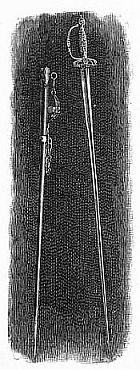
SWORD GIVEN TO WASHINGTONBY FREDERICK THE GREAT
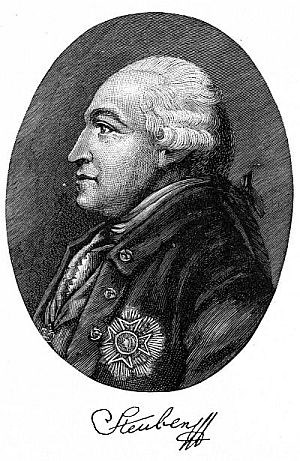
Baron Friedrich von Steuben
During the dreary winter at Valley Forge, Washington busied himself in improving the organization of his army. The fall of the Conway cabal removed many obstacles. Greene was persuaded, somewhat against his wishes, to serve as quartermaster-general, and forthwith the duties of that important office were discharged with zeal and promptness. Conway’s resignation opened the way for a most auspicious change in the inspectorship of the army. Of all the foreign officers who served under Washington during the War for Independence, the Baron von Steuben was in many respects the most important. Member of a noble family which for five centuries had been distinguished in the local annals of Magdeburg, Steuben was one of the best educated and most experienced soldiers of Germany. His grandfather, an able theologian, was well known as the author of a critical treatise on the New Testament. His uncle, an eminent mathematician, had been the inventor of a new system of fortification. His father had seen half a century of honourable service in the corps of engineers. He had himself held the rank of first lieutenant at the beginning of the Seven Years’ War, and after excellent service in the battles of Prague, Rossbach, and Kunersdorf he was raised to a position on the staff of Frederick the Great. At the end of the war, when the thrifty king reduced his army, and Blücher with other officers afterward famous left the service, Steuben retired to private life, with the honorary rank of General of the Circle of Swabia. For more than ten years he was grand marshal to the Prince of Hohenzollern-Hechingen. Then he went travelling about Europe, until in the spring of 1777 he arrived in Paris, and became acquainted with Franklin and Beaumarchais.
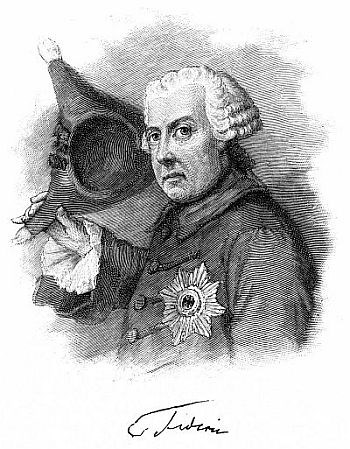
The American alliance was already secretly contemplated by the French ministry, and the astute Vergennes, knowing that the chief defect of our armies lay in their want of organization and discipline, saw in the scientific German soldier an efficient instrument for remedying the evil. After much hesitation Steuben was persuaded to undertake the task. That his arrival upon the scene might excite no heart-burning among the American officers, the honorary rank which he held in Germany was translated by Vergennes into the rank of lieutenant-general, which the Americans would at once recognize as more eminent than any position existing in their own army except that of the commander-in-chief.
Steuben arrives in AmericaKnowing no English, Steuben took with him as secretary and interpreter the youthful Pierre Duponceau, afterward famous as a lawyer, and still more famous as a philologist. One day, on shipboard, this gay young Frenchman laid a wager that he would kiss the first Yankee girl he should meet on landing. So as they came ashore at Portsmouth on a frosty December day, he gravely stepped up to a pretty New Hampshire maiden who was passing by, and told her that before leaving his native land to fight for American freedom he had taken a vow to ask, in earnest of victory, a kiss from the first lady he should meet. The prayer of chivalry found favour in the eyes of the fair Puritan, and the token of success was granted.
At Boston John Hancock furnished the party with sleighs, drivers, and saddle-horses for the inland journey of more than four hundred miles to York. During this cheerful journey, which it took three weeks to perform, Steuben’s heart was warmed toward his new country by the reminiscences of the Seven Years’ War which he frequently encountered. The name of Frederick was deservedly popular in America, and his familiar features decorated the sign-board of many a wayside inn, while on the coffee-room walls hung quaint prints with doggerel verses commemorating Rossbach and Leuthen along with Louisburg and Quebec.
and visits Congress at YorkOn arriving at York, the German general was received by Congress with distinguished honours; and this time the confidence given to a trained European soldier turned out to be well deserved. Throughout the war Steuben proved no less faithful than capable. He came to feel a genuine love for his adopted country, and after the war was over, retiring to the romantic woodland near Oriskany, where so many families of German lineage were already settled, and where the state of New York presented him with a farm of sixteen thousand acres in acknowledgment of his services, he lived the quiet life of a country gentleman until his death in 1794. A little village some twelve miles north of the site of old Fort Stanwix still bears his name and marks the position of his estate.
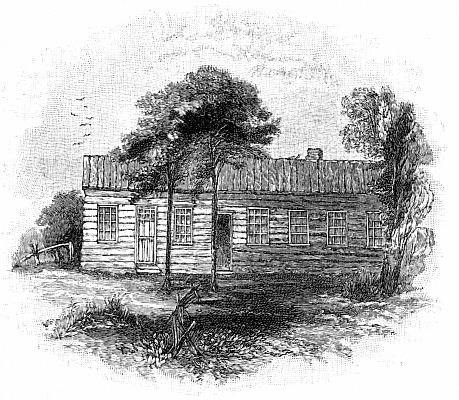
STEUBEN’S RUSTIC HOUSE AT ORISKANY
Steuben at Valley Forge
After his interview with Congress, Steuben repaired at once to Valley Forge, where Washington was not slow in recognizing his ability; nor was Steuben, on the other hand, at a loss to perceive, in the ragged and motley army which he passed in review, the existence of soldierly qualities which needed nothing so much as training. Disregarding the English prejudice which looked upon the drilling of soldiers as work fit only for sergeants, he took musket in hand and showed what was to be done. Alert and untiring, he worked from morning till night in showing the men how to advance, retreat, or change front without falling into disorder, – how to perform, in short, all the rapid and accurate movements for which the Prussian army had become so famous. It was a revelation to the American troops. Generals, colonels, and captains were fired by the contagion of his example and his tremendous enthusiasm, and for several months the camp was converted into a training-school, in which masters and pupils worked with incessant and furious energy. Steuben was struck with the quickness with which the common soldiers learned their lessons. He had a harmlessly choleric temper, which was part of his overflowing vigour, and sometimes, when drilling an awkward squad, he would exhaust his stock of French and German oaths, and shout for his aid to come and curse the blockheads in English. “Viens, mon ami Walker,” he would cry, – "viens, mon bon ami. Sacre-bleu! Gott-vertamn de gaucherie of dese badauts. Je ne puis plus; I can curse dem no more!” Yet in an incredibly short time, as he afterward wrote, these awkward fellows had acquired a military air, had learned how to carry their arms, and knew how to form into column, deploy, and execute manœuvres with precision. In May, 1778, after three months of such work, Steuben was appointed inspector-general of the army, with the rank and pay of major-general. The reforms which he introduced were so far-reaching that after a year they were said to have saved more than 800,000 French livres to the United States. No accounts had been kept of arms and accoutrements, and owing to the careless good-nature which allowed every recruit to carry home his musket as a keepsake, there had been a loss of from five to eight thousand muskets annually. During the first year of Steuben’s inspectorship less than twenty muskets were lost. Half of the arms at Valley Forge were found by Steuben without bayonets. The American soldier had no faith in this weapon, because he did not know how to use it; when he did not throw it away, he adapted it to culinary purposes, holding on its point the beef which he roasted before his camp-fire. Yet in little more than a year after Steuben’s arrival we shall see an American column, without firing a gun, storm the works at Stony Point in one of the most spirited bayonet charges known to history.
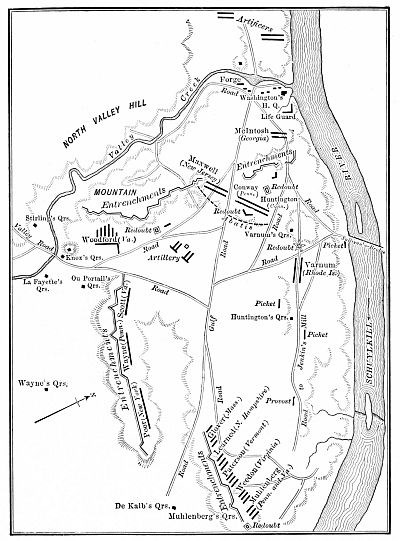
ENCAMPMENT AT VALLEY FORGE, 1777-1778
Steuben’s manual of tactics
Besides all this, it was Steuben who first taught the American army to understand the value of an efficient staff. The want of such a staff had been severely felt at the battle of Brandywine; but before the end of the war Washington had become provided with a staff that Frederick need not have despised. While busy with all these laborious reforms, the good baron found time to prepare a new code of discipline and tactics, based on Prussian experience, but adapted to the peculiar conditions of American warfare; and this excellent manual held its place, long after the death of its author, as the Blue Book of our army. In this adaptation of means to ends, Steuben proved himself to be no martinet, but a thorough military scholar; he was able not only to teach, but to learn. And in the art of warfare there was one lesson which Europe now learned from America. In woodland fights with the Indians, it had been found desirable to act in loose columns, which could easily separate to fall behind trees and reunite at brief notice; and in this way there had been developed a kind of light infantry peculiar to America, and especially adapted for skirmishing. It was light infantry of this sort that, in the hands of Arnold and Morgan, had twice won the day in the Saratoga campaign. Reduced to scientific shape by Steuben, and absorbed, with all the other military knowledge of the age, by Napoleon, these light-infantry tactics have come to play a great part on the European battlefields of the nineteenth century.
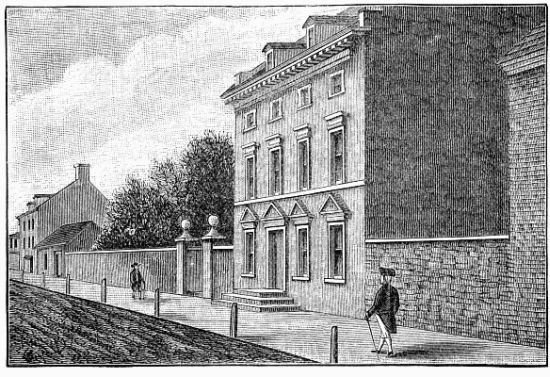
HOWE’S HEADQUARTERS IN PHILADELPHIA
Sir William Howe resigns his command
Thus from the terrible winter at Valley Forge, in which the accumulated evils of congressional mismanagement had done their best to destroy the army, it came forth, nevertheless, stronger in organization and bolder in spirit than ever before. On the part of the enemy nothing had been done to molest it. The position at Valley Forge was a strong one, and Sir William Howe found it easier to loiter in Philadelphia than to play a strategic game against Washington in the depths of an American winter. When Franklin at Paris first heard the news that Howe had taken Philadelphia, knowing well how slight was the military value of the conquest, he observed that it would be more correct to say that Philadelphia had taken General Howe. And so it turned out, in more ways than one; for his conduct in going there at all was roundly blamed by the opposition in Parliament, and not a word was said in his behalf by Lord George Germain. The campaign of 1777 had been such a bungling piece of work that none of the chief actors, save Burgoyne, was willing frankly to assume his share of responsibility for it. Sir William Howe did not wish to disclose the secret of his peculiar obligations to the traitor Lee; and it would have ruined Lord George Germain to have told the story of the dispatch that never was sent. Lord George, who was never noted for generosity, sought to screen himself by throwing the blame for everything indiscriminately upon the two generals. Burgoyne, who sat in Parliament, defended himself ably and candidly; and when Howe heard what was going on, he sent in his resignation, in order that he too might go home and defend himself. Besides this, he had grown sick of the war, and was more than ever convinced that it must end in failure.
The Mischianza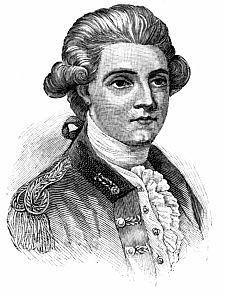
MAJOR ANDRÉ
On the 18th of May, Philadelphia was the scene of a grand farewell banquet, called the Mischianza, – a strange medley combining the modern parade with the mediæval tournament, wherein seven silk-clad knights of the Blended Rose and seven more of the Burning Mountain did amicably break lances in honour of fourteen blooming damsels dressed in Turkish costume, while triumphal arches, surmounted by effigies of Fame, displayed inscriptions commemorating in fulsome Latin and French the glories of the departing general. In these curious festivities, savouring more strongly of Bruges in the fifteenth century than of Philadelphia in the eighteenth, it was long after remembered that the most prominent parts were taken by the ill-starred Major André and the charming Miss Margaret Shippen, who was soon to become the wife of Benedict Arnold. With such farewell ceremonies Sir William Howe set sail for England, and Sir Henry Clinton took his place as commander-in-chief of the British armies in America.
The British evacuate Philadelphia, June 18, 1778Washington’s position at Valley Forge had held the British in check through the winter. They had derived no advantage from the possession of the “rebel capital,” for such poor work as Congress could do was as well done from York as from Philadelphia, and the political life of the United States was diffused from one end of the country to the other. The place was worthless as a basis for military operations. It was harder to defend and harder to supply with food than the insular city of New York; and, moreover, a powerful French fleet, under Count d’Estaing, was approaching the American coast. With the control of the Delaware imperilled, Philadelphia would soon become untenable, and, in accordance with instructions received from the ministry, Sir Henry Clinton prepared to evacuate the place and concentrate his forces at New York. His first intention was to go by water; but finding that he had not transports enough for his whole army, together with the Tory refugees who had put themselves under his protection, he changed his plan.
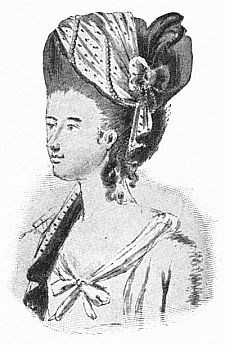
MISCHIANZA HEADDRESS
The Tories, to the number of 3,000, with their personal effects, were sent on in the fleet, while the army, encumbered with twelve miles of baggage wagons, began its retreat across New Jersey. On the morning of the 18th of June, 1778, the rear-guard of the British marched out of Philadelphia, and before sunset the American advance marched in and took possession of the city.
Arnold takes command at PhiladelphiaGeneral Arnold, whose crippled leg did not allow him to take the field, was put in command, and after a fortnight both Congress and the state government returned. Of the Tories who remained behind, twenty-five were indicted, under the laws of Pennsylvania, for the crime of offering aid to the enemy. Two Quakers, who had actually conducted a party of British to a midnight attack upon an American outpost, were found guilty of treason and hanged. The other twenty-three were either acquitted or pardoned. Across the river, seventeen Tories, convicted of treason under the laws of New Jersey, all received pardon from the governor.
Return of Charles LeeThe British retreat from Philadelphia was regarded by the Americans as equivalent to a victory, and Washington was anxious to enhance the moral effect of it by a sudden blow which should cripple Sir Henry Clinton’s army. In force he was about equal to the enemy, both armies now numbering about 15,000, while in equipment and discipline his men were better off than ever before. Unfortunately, the American army had just received one addition which went far to neutralize these advantages. The mischief-maker Lee had returned. In the preceding summer the British Major-general Prescott had been captured in Rhode Island, and after a tedious negotiation of nine months Lee was exchanged for him. He arrived at Valley Forge in May, and as Washington had found a lenient interpretation for his outrageous conduct before his capture, while nothing whatever was known of his treasonable plot with the Howes, he naturally came back unquestioned to his old position as senior major-general of the army. What a frightful situation for the Americans; to have for the second officer in their army the man whom the chances of war might at any moment invest with the chief command, such a villain as this who had so lately been plotting their destruction! What would Washington, what would Congress have thought, had the truth in its blackness been so much as dreamed of? But why, we may ask, did the intriguer come back? Why did he think it worth his while to pose once more in the attitude of an American? Could it have been with the intention of playing into the hands of the enemy? and could Sir Henry Clinton have been aware of this purpose?
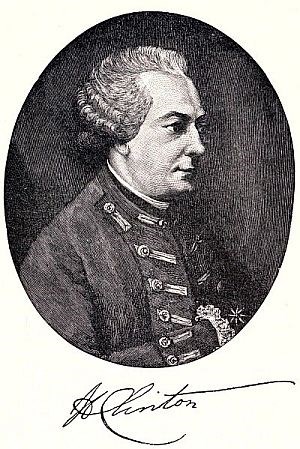
Such a hypothesis, implying direct collusion between Lee and the British commander, is highly improbable. We must remember that Sir William Howe, the Whig general, had just gone home to defend his military conduct against the fierce attacks of the King’s party; and his successor, Sir Henry Clinton, was not only a Tory, but the personal relations between the two men were not altogether friendly. It is therefore hardly credible that Clinton could have known anything about Lee’s coöperation with Howe. If he had known it, we may be sure that the secret would not have lain buried for eighty years. It is much more likely that since the disastrous failure of Lee’s military advice he was reduced to painful insignificance in the British camp, and was thus prepared to welcome an opportunity for trying his fortune once more with the Americans. Indeed, the circumstances were such as hardly to leave him any choice in the matter. As a prisoner of war, he must submit to exchange. The only way to avoid it was to make a public avowal of having abandoned the American service and cast in his lot with the British. But such an avowal would at once withdraw from him General Washington’s protection, and thus leave him liable to be tried as a deserter and shot for the gratification of George III. On the whole, as the event proved, there was more safety for Lee in following Fortune’s lead back into the American camp. He came with the renewed hope of supplanting Washington uppermost in his breast. As for Clinton, there is nothing to indicate collusion between him and the traitor, but he had probably seen and heard enough to confirm the declared opinion of Sir Joseph Yorke, that such a man as Charles Lee was “the worst present the Americans could receive.”
Washington pursues the BritishWhen Philadelphia was evacuated, Lee first tried to throw Washington off on a false scent by alleging reasons for believing that Clinton did not intend to retreat across New Jersey. Failing in this, he found reasons as plentiful as blackberries why the British army should not be followed up and harassed on its retreat. Then when Washington decided that an attack must be made, he grew sulky and refused to conduct it. Washington was marching more rapidly than Clinton, on a line nearly parallel with him, to the northward, so that by the time the British general reached Allentown he found his adversary getting in front of him upon his line of retreat. Clinton had nothing to gain by fighting, if he could possibly avoid it, and accordingly he turned to the right, following the road which ran through Monmouth and Middletown to Sandy Hook. Washington now detached a force of about 5,000 men to advance swiftly and cut off the enemy’s rear, while he designed to come up and support the operation with the rest of his army. To Lee, as second in rank, the command of this advanced party properly belonged; but he declined to take it, on the ground that it was sure to be defeated, and Washington entrusted the movement to the youthful Lafayette, of the soundness of whose judgment he had already seen many proofs. But in the course of the night it occurred to Lee, whatever his miserable purpose may have been, that perhaps he might best accomplish it, after all, by taking the field. So he told Washington, next morning, that he had changed his mind, and was anxious to take the command which he had just declined. With extraordinary forbearance Washington granted his request, and arranged the affair with such tact as not to wound the feelings of Lafayette, who thus, unfortunately, lost the direction of the movement.
His plan of attackOn the night of June 27th the left wing of the British army, 8,000 strong, commanded by Lord Cornwallis, encamped near Monmouth Court House, on the road from Allentown. The right wing, of about equal strength, and composed chiefly of Hessians under Knyphausen, lay just beyond the Court House on the road to Middletown. In order of march the right wing took the lead, convoying the immense baggage train. The left wing, following in the rear, was the part exposed to danger, and with it stayed Sir Henry Clinton. The American advance under Lee, 6,000 strong, lay about five miles northeast of the British line, and Washington, with the main body, was only three miles behind. Lee’s orders from Washington were positive and explicit. He was to gain the flank of the British left wing and attack it vigorously, until Washington should come up and complete its discomfiture. Lee’s force was ample, in quantity and quality, for the task assigned it, and there was fair ground for hope that the flower of the British army might thus be cut off and captured or destroyed. Since the war began there had hardly been such a golden opportunity.
Battle of Monmouth, June 28, 1778Sunday, the 28th of June, was a day of fiery heat, the thermometer showing 96° in the shade. Early in the morning Clinton moved cautiously. Knyphausen made all haste forward on the Middletown road, and the left wing followed till it had passed more than a mile beyond Monmouth Court House, when it found itself outflanked on the north by the American columns. Lee had advanced from Freehold church by the main road, crossing two deep ravines upon causeways; and now, while his left wing was folding about Cornwallis on the north, occupying superior ground, his centre, under Wayne, was close behind, and his right, under Lafayette, had already passed the Court House, and was threatening the other end of the British line on the south. Cornwallis instantly changed front to meet the danger on the north, and a detachment was thrown down the road toward the Court House to check Lafayette. The British position was one of peril, but the behaviour of the American commander now became very extraordinary. When Wayne was beginning his attack, he was ordered by Lee to hold back and simply make a feint, as the main attack was to be made in another quarter. While Wayne was wondering at this, the British troops coming down the road were seen directing their march so as to come between Wayne and Lafayette. It would be easy to check them, but the marquis had no sooner started than Lee ordered him back, murmuring about its being impossible to stand against British soldiers.