
Полная версия
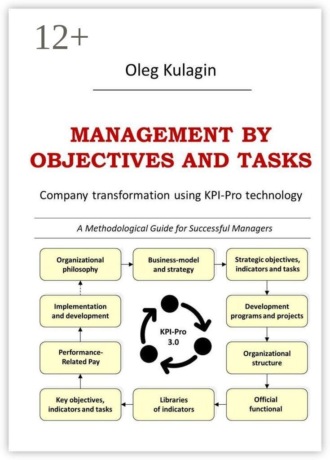
Management by Objectives and Tasks. Company transformation using KPI-Pro technology
5. Types of activities. What are the key processes that create our value propositions?
6. Key resources. What key resources are important or essential to creating the organization’s value proposition and operations? What tangible and intangible assets do we have?
7. Partners and suppliers. Who are our key partners? Who are our main suppliers? What resources or services do we receive from our partners and suppliers? How do we interact with them?
8. Revenue structure. What exactly do our clients currently pay us for? How do they pay? What are they really willing to pay for? What are the main and additional revenues of our company?
9. Cost structure. What are the most important expenses within our business model? Which functions or processes require the most cost?
In practice, it is convenient to answer these questions by filling out a business model template. It is better to do this in the management team, involving all key managers and specialists in the discussion. This template (called Canvas) was proposed in the well-known book by A. Osterwalder and I. Pigneur, “Business Model Generation” [18]. Indeed, by filling in the blank template, we, like an artist, step by step create a visual picture of our business. This template is actually a convenient and popular tool for collecting and reflecting the ideas of all participants in the discussion.
But of course, the CANVAS template itself is not a planning tool. It serves only as a convenient means for visualizing and recording strategic or tactical decisions made by managers using intuition, experience, personal values (which is what most often happens in practice) or based on well-known methods (for example, good old SWOT analysis and other strategic planning methods). However, experience shows that this template has a number of disadvantages and limitations.
3.5. New business-model template

The Canvas template is very convenient and popular all over the world. However, it significantly simplifies reality and does not always cope with building complex business models. This is reflected, in particular, in the fact that this template does not allow to display product categories and business geography, as well as a unique sales proposition, i.e. the company’s competitive strategy for different types of activities and target groups of customers. To overcome these limitations, we can use a modified business model template. Let’s call it Canvas+, for example. With the help of the new template, we get the opportunity to reflect both the corporate strategy (types of activities — products — customers — regions) and the competitive strategy (focus of competition — value proposition — unique sales offer) for each type of enterprise activity. In addition, the new template retains all the advantages and convenience of CANVAS. Let’s look at how it fills up.
3.6. Building a business-model

By filling out the business model template “as is”, we first create the so-called point A, reflecting the current state of the business and our organization. You can fill out the template in any order, but it is better to follow the logic of the business cycle and go in the following order: types of activities, products, clients, regions, sales channels, interaction with clients, competitive focus, customer value proposition, unique selling proposition, key resources, partners and suppliers, revenue structure, expense structure. We will move along the CANVAS+ template, starting with a description of the types of activities, in this exact sequence.
3.6.1. Types of activities

First, we fill out the “Types of activities” section. Here we list all the businesses the company operates in. It’s no secret that within a single organization, i.e., “under one roof,” different businesses can coexist, but for some reason, they’re often not separated from one another. It is important to do this because different types of activities may have different customers, different products, different sales channels, different communication channels, different value propositions, etc. In general, these are usually different business models. Why mix them, even if they operate under the same brand?
Конец ознакомительного фрагмента.
Текст предоставлен ООО «Литрес».
Прочитайте эту книгу целиком, купив полную легальную версию на Литрес.
Безопасно оплатить книгу можно банковской картой Visa, MasterCard, Maestro, со счета мобильного телефона, с платежного терминала, в салоне МТС или Связной, через PayPal, WebMoney, Яндекс.Деньги, QIWI Кошелек, бонусными картами или другим удобным Вам способом.