



Полная версия
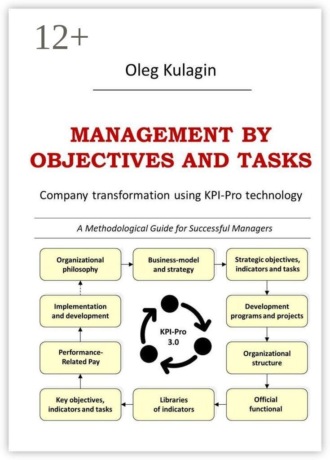
Management by Objectives and Tasks. Company transformation using KPI-Pro technology
The first level is basic values. These are values that are vital and necessary for the survival of the company. The second level is applied values. These values are important for the success of the company. Applied values highlight certain critical success factors, taking into account the specifics of the company’s industry and market. The third level is values-ideals. They are important not for the survival or success of organizations, but because the owners or managers consider them important. No comment. These are missionary values.
This is how corporate ideology is formed. It is a system of ideals, applied and basic values that determine the goals and destiny of the enterprise. Values are what is important for a business. This is what ensures its survival, success, and fulfillment of the organization’s mission.
2.6. Strategic vision

So, we have dealt with the concepts of “mission” and “values”. But organizational philosophy also includes a strategic vision or an image of the desired future of the company.
When an organization has VISION, a metaphysical mechanism of self-fulfilling prophecies or the Pygmalion effect is activated, for, as the well-known Eastern wisdom says, “it is not we who move toward the future, pushing off from the past, but the future that pulls us out of the past and attracts us to itself.” And if this image exists not only in the owner’s head, but is also developed “by the whole world” or at least replicated throughout the entire organization, then the Pygmalion effect is complemented by a synergy effect, when all employees begin to subconsciously act, think, stand, sit, lie down in the direction of one common goal.
How do you develop a VISION? It’s very simple. To do so, you just need to answer one main question: what do we want our company to be like in 8, 10, 15, or more years? The goal-setting horizon can be chosen based on the company’s size, market dynamics, and the ambitions of the owners and top managers. This is creative work. As a result, we should get an interesting, easy-to-read and inspiring text with unexpected metaphors, convincing arguments and reliable facts. A strategic vision is not a dry strategic plan with schedules, calculations, and deadlines. This text should be read in “one breath”, like a gripping novel.
You can practically write or draw VISION anywhere and however you like: on your knee, on a napkin, on toilet paper, in a text editor, on sticky notes, etc. Free your mind, give free rein to creativity and even imagination, and try to answer the main question. And if consciousness is not liberated, and the question is “not answered”? Then a special technique can come to the rescue, according to which a strategic vision is developed in four dimensions:
1. Strategic challenges.
2. Business scale.
3. Competitive appearance.
4. Strategic changes.
Create a VISION in the form of an interesting, elegant, emotional and metaphorical text. Complete it with some diagrams, pictures, drawings. This text can take 2-3-4 pages of A4 format, but in this case the size does not matter. The main thing is that he captivates and “catches” his readers. VISION should be ambitious and inspiring. It shouldn’t be tied to the company’s current capabilities, but rather, as far away from them as much as possible. This is a break from current reality, a huge and significant one.
When there is a VISION, our concern is to refine, change, and develop it. This is not a one-time action, but an ongoing process. If we “serve” him well, it will serve us and do everything else for us. Let’s trust our VISION.
2.7. How to develop VISION?

How do you develop a VISION? To do this, you can use a special methodology, according to which a strategic vision is developed in four dimensions. This structure of strategic vision is not a dogma. And it’s not necessary to answer every question in detail. If answers to a particular question arise, write them down. If not, skip them. Or describe them in general terms. First, individually, i.e. conduct a “brain siege”. And then discuss them with the management team. Conduct a collective brainstorming session. Complete each participant’s vision with new ideas. Describe your desired future for your organization, not based on what you would like, but as if you already have it. Imagine that the future has already become the present. A vision is always written in the present tense.
2.7.1. Strategic challenges

In the “Strategic Challenges” section, we include the company’s most important and ambitious objectives. These objectives should be inspiring and breathtaking, but they must be achievable. For example:
— Become a company with an annual turnover of 30 billion.
— Become one of the top three market leaders.
— Become a global company.
— Increase market share by 20%, etc.
You can “digitize” some of these objectives. Most often, these are financial or market objectives (revenue, profit, business value, market share, customer loyalty, etc.). However, strategic challenges are usually formulated qualitatively, verbally, creating an image of the desired future of the organization.
2.7.2. Business scale

In the “Business Scale” section, we include answers to questions about the company’s future market position. For example: Who are our target customers? What customer problems do we solve? What needs do we satisfy? What do we do? What products do we produce and sell? What services do we provide? What is the geographic scope of our business? Which cities, regions, and countries do we operate in? How do we interact with our clients? How do we attract and retain them? Who are our competitors? What market share do we hold? What are our differences and competitive advantages? Who do we interact with in the market and how do we interact? Who are our partners and suppliers? How do we promote and sell our products and services? What distribution channels do we use? And other questions.
2.7.3. Competitive appearance

In the “Competitive appearance” section, we describe the vision of the organization “from the inside”, its structure, processes, resources, technologies, answering, for example, the following questions: What does the organizational structure of our company look like? What are the main divisions it includes? What are the key processes underlying the activities of our organization? How are they structured and interconnected? How is our organization’s management system structured? What management technologies do we use? What does our corporate culture look like? What values is it based on? What technology platform are we working on? What technologies are we using? What is the infrastructure of our organization? What material resources do we have? What are our key non-material resources? What kind of people work for us? What knowledge, qualities, and competencies do they possess? And other questions.
2.7.4. Strategic changes

The “Strategic Changes” section may describe the key areas of change that we believe are necessary to achieve our strategic vision and transform our company. For example, “From broad market coverage to profitable and large clients”, “From manual control to regular management”, “From an authoritarian leadership style to a management team”, “From functional disunity to effective interaction and targeted business management”, “From paranoia and competition to trust and cooperation”, “From a bureaucratic structure to a network organization”, “From incentives and coercion to creating a motivating environment”, “From standard services to individual customer service”, and others.
2.8. Business-idea

In concluding this chapter, we will also consider two important strategic propositions that are not typically included in the concept of organizational philosophy, but are close in generality to it, as they reflect, in a nutshell, all the results of the company’s strategy development. These are the business-idea and the strategic principle.
What is a business-idea? This is the definition of your business. It’s like a mini-VISION in terms of its market component. A strategic vision can cover a variety of aspects: long-term financial objectives, the company’s market position, organizational design, and key company resources. A business-idea is a brief description of the VISION market projection.
A business-idea, by the way, is often confused with a mission. While a mission, as we know, should extend beyond the market and demonstrate the organization’s impact on social development, a business idea defines the functions of your business and generally answers the following questions:
1. What do we do? What types of activities are we engaged in? What products do we produce and sell? What groups or categories can they be divided into? Here you should briefly describe your activities and the main products you offer to the market.
2. Who are we making this for? Who are our target customers? Where are they located? In this section of your business idea, you should clearly define who you are producing your products for, who your customers are, and where (in which cities, countries, or regions) they are located. Thus, in addition to the consumer market segments, you can also determine the geographic scope of your business.
3. What’s the benefit? What value do our products provide to customers? What needs do they satisfy? What problems do they solve? This is where you can describe your customer value proposition (CVP), identifying the key benefits you create for consumers through your products, customer service, the personal and professional qualities of your staff, company brand and price characteristics.
4. What is our uniqueness? How do we differ from our competitors? What are our competitive advantages? Why is it more profitable for customers to buy from us? Here you can reflect your unique selling proposition.
Formulate your company’s business idea and format it as a short text (no more than half a page), familiarize all employees with the business idea, bring it to the attention of your regular and potential clients, place it on the main page of the website, booklet and other advertising materials. Broadcast your business idea to the outside world through all communication channels so that the market clearly positions your company and understands why it needs you and why it is better to buy from you than from your numerous competitors (even if you suddenly discovered the “blue ocean”).
2.9. Strategic principle

Along with the mission and business idea, another message for both the external and internal environment of the company is the strategic principle [22]. This is an even shorter (compared to a business idea) expression of the essence of the strategy, reminiscent of a brand slogan, but intended not to create an image and attract attention to the brand, but to convey information about the features and essence of the organization’s strategy. This is especially important and useful for large and geographically distributed companies to formulate a short strategic message and communicate it to all employees of the organization.
When formulating a strategic principle, it is necessary to identify and reflect the corporate “genetic code” that distinguishes your company from its competitors. In this sense, the strategic principle serves to “highlight” the uniqueness of your company, “detach” it from competitors and establish a clear position in the minds of customers. And not only buyers, but all interested parties: partners, investors, suppliers, government agencies, and employees of the organization. A clear and precise formulation of strategic principles is especially important for managers and employees in the context of rapid business growth, decentralization of management and expansion of employee authority, rapid technological change, and increasing instability within the organization. It can be said that this is a kind of connecting idea that unites employees of large and growing enterprises.
It’s a tool designed for long-term benefit. Its purpose is to convey the meaning of a company’s strategy to employees in a concise, memorable phrase, because “even the most brilliant and brilliant strategy is useless until people understand it well enough to act flexibly in accordance with it in both expected and unexpected situations” [22]. After all, ordinary employees don’t read complex and lengthy strategic documents or delve into the details of strategic plans. They value a concise and simple formulation of the strategy’s essence in one sentence. Two sentences, maximum. In this case, the strategic principle penetrates deeply into people’s consciousness and is easily remembered. Thus, it serves as a convenient means of rapid strategic communication within the company.
The strategic principle supports the focus of a growing company on the implementation of the chosen strategy and, at the same time, within the designated boundaries, in no way restricts managers and employees “on the ground” in creative flexible decision-making, taking into account emerging threats and opportunities.
One could say that the strategic principle establishes a clear rule: “What is not prohibited is permitted”. And everything that complies with this principle is not prohibited. Adhere to the strategic principle and act at your own discretion.
Chapter III. BUSINESS-MODEL AND STRATEGY

The second stage of KPI-Pro technology is the development of a company’s business-model and strategy. The organizational philosophy we discussed above is the top level of strategy, but the detailed development of strategy and the choice of the company’s business-model occur at the second stage. Based on its results, all components of the organizational philosophy can be adjusted. After all, KPI-Pro is a flexible and nonlinear technology, allowing for revisiting previous steps and modifying previously made decisions. So, at this stage we determine the form and “pump up” all the elements of the company’s current business-model. At the same time, in the process of filling out the CANVAS+ template, we formulate the company’s corporate strategy and competitive strategies for each type of activity, describe sales and communication channels, the company’s key resources, systematize partners and suppliers, and, most importantly, build a “bridge” from the present to the future, designing the target business-model of our enterprise. This is a large and painstaking work that must be completed before we can begin formulating company objectives. Let’s get started.
3.1. What is a business-model?

Let’s start with the concept of a business-model. Simply transposing these two words, we get that a business model is a model of a business. Using a model, we design our business, make the necessary decisions, and then test and implement them in practice. A business-model shows the structure of your business and reflects the logic of the organization’s actions to make a profit. Our business-model is a picture of how we operate and make money. It’s a kind of “framework” within which all of the organization’s work processes operate. It’s possible to manage a company very effectively with a poor business-model. There will be no result. And it also happens that even without any reasonable management, the company has tremendous success and super profits. Why? Due to a successful business-model! This is the foundation for an organization’s management system.
3.2. Business cycle of an organization

Since a business-model is a model of a business, it is important to understand how this business works in order to build it. All businesses operate in different ways. But at the same time, they all have a common logic that unites them. This logic can be represented in the form of an organization’s business cycle:
1. We know that the main goal of any business (or rather, the goal of the business owners) is to make a profit. And the more, the better.
2. To make a profit, sales revenue is required.
3. Sales revenue can only come from our clients or customers. They hold our money, which they owe us in exchange for satisfying their needs, achieving their goals, and solving their problems.
4. To do this, our customers must somehow get into our sales channels. This is some kind of real or virtual space where buying and selling occurs and, moreover, money is often transferred.
5. But in order for customers to “come” to our sales channel, it is necessary to work with them regularly and use various methods of customer interaction. These include methods of attracting new customers, as well as methods of working, retaining, and returning “old” customers.
6. First of all, this is necessary to convey our value proposition to their conscious or subconscious and use it to attract new and retain loyal customers. A value proposition is what our customers value; what’s important to them and what allows them to satisfy certain personal or business needs.
7. A value proposition is created in various types of company activities. This is the production of something or the provision of any services, including sales services. At the same time, within the framework of each type of activity, the company produces certain products (products or services).
8. To operate, an organization requires a variety of resources, both tangible and intangible. Without them, life is impossible.
9. We can obtain or create resources only with the help of our partners and suppliers.
10. And the acquisition, creation and preservation of resources is inevitably associated with costs.
The circle is complete. If expenses are subtracted from revenue, we get profit. Maximizing profit requires optimal organization of the entire value chain. But this can only be achieved by building and optimizing a company’s business model.
3.3. Forms of business-models

When building a business-model, it is very important to understand what kind of business you want to build, what value to create for your customers by satisfying their needs, and, as a result, how you plan to make money. There are an infinite number of possible options, and to understand all this diversity, it is useful to know the basic forms of business-models. Then you will be able to more accurately and consciously determine where you are now and plan a possible route for the transformation of your company in the future.
The typology of business-models can be developed according to two criteria: transaction coverage and customization of offers. Transaction coverage is the scale and frequency of interactions between a company and its consumers. Customization is the degree of adaptation to customers and taking into account their individual needs and characteristics. Then we get four forms [5]:
1. Product-oriented business-model: standard products and services offered in large volume and to many customers. For example, the construction of standard country houses based on standard projects.
2. Platform-oriented business-model: unites a large number of independent suppliers and buyers of standard products and services. For example, the creation of a marketplace that unites a large number of potential buyers of real estate and construction companies offering standard country houses based on standard designs.
3. Project-oriented business-model: customized product or service offerings, typically developed with active client participation. For example, building country houses based on custom client designs.
4. Solution-oriented business-model: customized integrated solutions for customers, including a wide range of products and services (the “one-stop shop principle”). For example, the providing a full range of services related not only to construction, but also to the design and landscaping, interior design, purchase of furniture, etc.
Once you have identified your “square” where you are now, you can think through a plan to transform your business-model either vertically (towards the south or north), or horizontally (towards the east or west), or even diagonally (for example, to the northeast, etc.).
Of course, mixed business-models are possible, including elements of some or even all four forms. But it’s very difficult and risky. If you thoughtlessly overcomplicate your business model, your company could simply explode from within. So, choose your base type and gradually increase complexity as needed, but don’t get carried away. There’s power in simplicity.
3.4. CANVAS template

In accordance with the logic of the business cycle described above, the business model describes the key elements of a real business system and the links between them [18]:
1. Target customer groups. For whom are we creating a value proposition? Which customers are most important to us?
2. Interaction with clients. How do we attract and retain customers? What kind of relationship have you established with them?
3. Sales channels. What sales channels are desirable for our customers? How do we interact with them? Which of them are the most profitable?
4. Value proposition. What value do we offer to consumers? What problems do we help solve for our clients? What needs do we satisfy?