



Полная версия
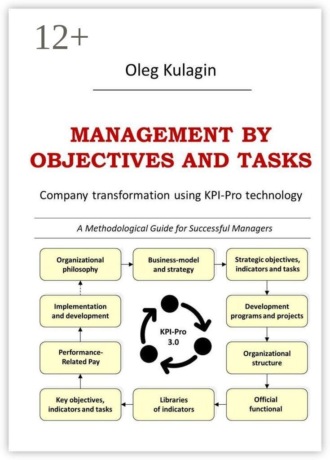
Management by Objectives and Tasks. Company transformation using KPI-Pro technology
But the highest level of quality is proactive objectives. These objectives are formulated based on the values, mission, and vision of the organization. These are objectives that no one forces us to achieve. We choose them, not as a reaction to something, but of our own understanding, will, and initiative. Why?
First, proactive objectives are the continuation and concretization of the values of the company, the owners, and the staff. For example, if there is such a value as innovation in the ideology of a company, then objectives for the development of innovative products or technologies are formulated in line with this value. Secondly, proactive objectives are a reflection of the company’s mission. If a company has a mission that goes beyond business and even beyond the life of the organization, then business objectives are defined as a means of fulfilling that mission. Third, proactive objectives are the concretization of a vision — an image of the organization’s desired future. It is through proactive, ambitious objectives that the company’s vision of the future gradually becomes a reality.
1.8. The phenomenon of objective dispersion

So, we talked about the balance and the quality of the organization’s objectives. In fact, even with these requirements in mind, it is not difficult to formulate the company’s objectives if you act according to a certain and proven methodology. As they say, everything is simple if you know how. And we will study this technique in detail in the future. But the most “unpleasant troubles” and “complex difficulties” in management by objectives begin later, when we begin to “distribute” responsibility for certain objectives and do something to achieve them. Therefore, even high quality and balance of objectives are not a guarantee that they will be achieved. And one of the main reasons for this is the phenomenon of objective dispersion.
I first learned about this phenomenon from the works of my teacher, Professor A.I. Prigogine [19—21]. Later, working as a management consultant in a wide variety of organizations, observing the work of enterprises and communicating with managers at various levels, I personally became convinced that this phenomenon is not just a beautiful metaphor, but a really serious organizational pathology that spoils the lives of many enterprises. What does it consist of?
Everyone knows that an organization’s objectives (financial, market, etc.) can only be achieved through work processes involving the company’s divisions and employees. Therefore, they must somehow be communicated downwards to lower management levels. If this is done correctly, each department and employee should have their own objectives, the achievement of which ensures the achievement of the overall organizational objectives. It’s all clear, it’s all correct. In theory. But in practice, this doesn’t happen. Or it does, but still results in significant deviations from the planned results. Why? The reason for everything is the dispersion of objectives.
What does this mean? The fact is that when objectives are transmitted from the upper level downwards, they gradually become blurred, distorted, and even lost. In short, they become dispersed. As a result, the objectives of the organization either do not reach the performers at all, i.e. they get stuck or lost somewhere, or they “reach” the employees in such an unsightly form that if you put them together like child’s puzzles, the overall picture does not add up. And, as a result, the initially formulated general objectives of the company are not achieved.
Things are bad. This is a sure sign of organizational unmanageability. And unmanageability is a serious and deadly disease, leading first to a decrease in efficiency, then to a decrease in competitiveness, and finally to the disappearance of the company and its business. An unpleasant prospect. So what’s the deal? Where are the roots of the objective dispersion phenomenon? Why is this happening and, as a result, the organization begins to skid like an out-of-control car on a slippery road? And this happens for a variety of reasons.
1.9. Reasons for the objective dispersion

What are the reasons for the dispersion of objectives? There are several of them [19].
Firstly, when transmitting information from supervisors to subordinates, there is a “vibration”, i.e. a distortion of objectives, as in the children’s game “damaged phone”. Information is inevitably distorted during transmission.
Secondly, communication “clots” can occur, i.e. information can get stuck somewhere and disappear. For example, after receiving a objective from their boss, a department head might actually forget to formulate objectives for their employees or put off this management task until later, and then it might get completely lost in the flow of other tasks.
Thirdly, the employees themselves, having received objectives from their managers, impose their personal interests on them and reformulate them “for themselves”. After all, if an organization doesn’t take proper care of its employees, they have to take care of themselves. And often at the expense of the organization.
Fourth, this is a well-known phenomenon of bureaucracy. This is a acquisition of power on oneself in order to raise one’s own status and importance within the company, using one’s official position and authority. One could say that this is one of the manifestations of the previous reason, i.e. personal interest.
Fifth, these are diverse cliques. A clique is a conspiracy of certain employees within an organization to use its resources and capabilities (material assets, reputation, connections, client base, etc.) to achieve their own goals contrary to the interests of the organization.
The sixth reason is “structural fetishism”. This phenomenon leads to the fact that the internal, “structural” objectives of the organization begin to prevail and gradually displace the external goals of the organization.
The seventh reason is positional conflicts, i.e. basic contradictions between the interests of various positions and departments. These contradictions are already embedded in the very nature of organizations and it is impossible to completely get rid of them.
And finally, positional conflicts degenerate into the so-called autarky of units. This is the isolation of departments, their focus on solving their own problems and tasks, separate from the overall objectives of the company. As a result, each department, section, and workshop works exclusively for itself, unaware of and poorly understanding what is happening around it and what objectives the organization faces in general. As a result, there is no proper interaction between departments or employees, and the business process stops. Where a stormy streamlet should flow, there are dams and a swamp.
These phenomena do not exhaust all reasons for the dispersion of objectives. But how to deal with all this? But more on that later.
1.10. Management-by-Objectives method

So, we’ve discussed why business objectives are scattered. But what to do about it? Is it possible to completely eliminate the dispersion of the organization’s objectives? Unfortunately, it is impossible. This is an incurable disease. But, fortunately, it is possible to reduce its severity by applying the management-by-objectives method. We will further consider the features and nuances of management by objectives, but for now we will only consider the basic idea of the method. I am convinced that organizations that don’t use this method are doomed to chaos and degradation. The idea for this method was first formulated by the classic management theorist Peter Drucker back in the 1950s. The essence of the method is simple.
First, for an organization’s objectives to be achieved, they must be clearly defined and formulated. These objectives should be not only financial but also non-financial, reflecting various aspects of the organization’s activities: market position, efficiency of production, sales, human resources management, innovations and development, etc. In other words, the objectives system must be balanced.
Secondly, organizational objectives must be clearly and accurately communicated to departmental levels in accordance with the organizational structure. This results in the so-called cascading of objectives and their distribution across departments. But at the same time, departments must know not only their own objectives, but also the overall objectives of the organization, and interact with each other in a coordinated manner to achieve them.
Third, departmental objectives can be communicated to employees. As a result, each employee receives their own objectives, the achievement of which should ensure the achievement of departmental and organizational objectives.
But this method is not perfect. It has been, and continues to be, subject to harsh criticism. But under the influence of this criticism, management by objectives has been constantly improved, honed, and transformed so much that Peter Drucker would probably hardly recognize his brainchild. Currently, various technologies are known that are built on the basis of classical management by objectives: “Key Performance Indicators”, “Performance Management”, “Balanced Score Card”, “Objectives and Key Results” and their modifications.
The KPI-Pro technology presented in this book combines all known objectives management methods, enriching them with the author’s discoveries and developments tested in the “field conditions” of Russian business. Let’s start studying it.
1.11. KPI-Pro Technology

So, what is KPI-Pro? It’s a professional approach to objective-based organizational management. This technology includes a series of mandatory steps that must be completed to build a harmonious and streamlined management system that ensures the achievement of business objectives. If we forget or skip any of these steps, we will get, at best, a broken system, and at worst, a “crooked” system that leads the organization away from achieving its objectives. So, let’s not skip anything, but rather act consistently and professionally. After all, objective management is a complex and sharp tool that can easily turn from a panacea into a headache if you do not know how to use it and do not understand all its subtleties, tricks, opportunities and limitations.
Chapter II. ORGANIZATIONAL PHILOSOPHY

The first step in the KPI-Pro technology is developing an organizational philosophy. But is it possible without one? Of course it is. After all, many companies don’t have one and, what’s more, don’t feel the slightest need for one. For the time being. In fact, an organization always has a philosophy, if not on paper, then somewhere deep in the subconscious of the owners and managers of companies. But a conscious organizational philosophy insures us to a large extent from the predominance of passive and reactive objectives, i.e. objectives of lower quality levels, and forces us to formulate ambitious, noble and breathtaking, proactive objectives and move towards their achievement, applying super efforts and managerial will combined with creativity, innovation and inventiveness. And that’s a good thing. This is the only way to achieve significant results in business, and in life in general.
Thus, in the context of management by objectives, organizational philosophy helps us formulate higher-quality objectives. But since organizational philosophy represents the highest level of strategy, let’s first consider the concept of strategy in more detail.
2.1. The concept of strategy

To begin, I’d like to express the seditious idea that having a strategy isn’t a necessary or indispensable condition for a company’s success in general, or for management effectiveness in particular. All of this can happen without a strategy. We know many businesses that “caught the wind in their sails” by being in the right place at the right time, and are still feeling great. However, intuition and common sense suggest that “successful success” cannot continue indefinitely. Having a strategy, even in its most general form, increases an organization’s chances of success and survival in this complex and changing world. After all, strategy is a system of priorities. But how can we live without priorities? How can we make decisions? After all, our resources are always limited. Therefore, a long-term strategy is vital, even if everything is going well and wonderfully right now. However, strategy should not be a “straitjacket” that limits a company’s capabilities. It must be flexible and sensitive to changes in the market and far beyond.
A good strategy should answer three sets of questions:
1. Where are we now? What are we doing? What kind of business do we do? What is happening in our environment? What changes in the external environment threaten us or, on the contrary, create new opportunities? What are we like? What are our competitive advantages and disadvantages? In answering questions like these, we look around and assess ourselves to understand our initial strategic position as a starting point for moving forward.
2. Where do we want to be in the future? What do we want to do? What market position do we want to occupy? What do we want to be like? What advantages do we plan to have? What do we want to have or not have? With whom will we befriend or compete? And so on. These are questions that help us understand our desired future as the most general goal of the company.
3. What actions must be taken to move from the present to the desired future? How can we transform our business? What changes does the company need? What projects need to be funded and implemented to achieve these changes? What difficulties and obstacles might arise along the way, and how can they be overcome?
Strategy isn’t what we do or how we live now. Strategy is how we want to live in the future and the development steps we take to achieve that. Having recognized our initial strategic position, we strive to achieve a desired future — a strategic vision — by achieving strategic objectives through planning and implementing strategic projects, realizing our business idea and strategic principle, and guided along the way by the organization’s mission and values.
2.2. Four levels of strategy

In its most general form, a company’s strategy includes four levels.
An organizational philosophy is a mission, values, strategic vision, business idea, and strategic principle. At this level, the strategy answers the questions: what is the meaning of our company’s activities, what is really important to us, where are we going, what is our uniqueness, what kind of company do we want to build? We will study these concepts in more detail below.
A corporate strategy helps us answer the questions: What do we plan to do and what products will we produce? Who are our target clients? What regions do we plan to operate in? In other words, a corporate strategy answers the questions: What do we plan to do, for whom, and where? A corporate strategy may include the selection of various activities (i.e., the company’s business portfolio) and various product categories within a single business.
Competitive strategy helps us stand out from the competition and focus our activities on creating sustainable competitive advantages. If we succeed in this, we will create a unique selling proposition (USP) that not only creates value for our customers, but also provides a competitive advantage in one way or another. These can be unique products (“blue ocean”), differentiation (in terms of quality, service, assortment, relationships, etc.) or lower prices. The choice of competitive strategy depends on what you produce and who you sell it to. If a company carries out several types of activities in different market segments, then, generally speaking, its own competitive strategy can be developed for each of them. A competitive strategy (or, in other words, a business strategy) answers the question: how do you plan to compete, survive, and succeed in the market?
Functional strategies define the basic principles, objectives and plans for the company’s activities in various functional areas. Otherwise, they are also called “special policies” (production policy, marketing policy, service policy, personnel management policy, technical policy, assortment policy, quality policy, safety policy, environmental policy, financial policy and others).
The implementation of any strategy is carried out on the basis of the fulfilment of development programs and projects in order to bridge the gap between what is and what should be in terms of the quality and quantity of the company’s resources: human, material, technological, informational, etc. In other words, to implement the strategy, we must improve and “pull up” our resources to the necessary and sufficient level. Strategy is always about development.
2.3. What is organizational philosophy?

Organizational philosophy is the highest level of a company’s strategy. It comprises a series of general statements and propositions addressed to the external environment and the organization’s employees, defining the meaning, principles, key objectives, activities, and essence of the company’s strategy. An organizational philosophy is not vital to the success of a business in the here and now, but it is extremely important and useful for the sustainability and viability of the organization in the long term. The quality and depth of an organizational philosophy is a key indicator of an enterprise’s level of maturity.
2.4. Mission of the organization

So, the first element of organizational philosophy is mission. What is it?
A mission is a statement of purpose. But the question is what is meant by a company’s purpose. Most often, a mission is formulated as a set of the organization’s most general objectives or as a value proposition for consumers. This is a mistake. In this form, it’s not a mission statement, but rather a business idea. We’ll discuss how to formulate a business idea below.
But if mission, objectives, and value proposition are different words, then their meanings should be different. If they have the same meaning, then let’s use one of them. For example, let’s leave mission alone and talk only about objectives. But if we still like the beautiful word “mission,” let’s agree on what it is and how it differs from the company’s objectives and value proposition.
A mission must go beyond business! It must demonstrate how we want to make this world a better place! That’s all. If you want to improve the lives of your consumers and make money doing so, that’s fine too. This may be quite enough. But then you don’t need any mission. Work, achieve your goals, and be happy.
The mission shows the organization’s contribution to the development of the industry, city, country, and society. This is not charity or social responsibility. Although they are certainly important as a means of achieving the mission. The core of mission is impacting the world through its activities. Missionary businesses also make money by meeting the needs of their clients and customers. But the influence of such organizations extends beyond simply solving clients’ problems. They claim a special social role in society.
Does a mission have practical significance? Of course. A bright and memorable mission creates a unique image for a company, distinguishing it from competitors; attracts the attention of clients, partners, investors, and suppliers; increases trust in the organization; and creates additional energy and motivation among employees… All this, through a simple chain of causal relationships, leads to an increase in financial results. Not immediately, of course. But still.
The mission may be impossible. It’s not a big deal. That’s not the goal. It’s a process, it’s a path. But having a mission presupposes that you’re doing SOMETHING else besides what everyone else is doing, and SOMEHOW doing what others are doing differently.
Don’t rush to formulate a mission statement just because it’s written in management textbooks. Think about it, do you need it now? If the mission is formulated vividly and deeply, it will serve you honestly for many years and slowly but surely lead your company to prosperity and success. It is a very powerful but inertial management tool.
2.5. Corporate values

So, above we have considered the concept of mission. But the mission (if there is one) is inseparable from the value system. Our lives are governed by values. We may or may not be aware of them, but values, nevertheless, invisibly lead us along the path of life and lead to the achievement of quite visible results. Or they don’t. But that’s not the point now.
Let’s discuss the phenomenon of corporate values. What is it? In short, this is something very important for the survival and success of an organization. These are the most general principles and priorities of organizational life, governing attention and shaping habits in people’s behavior.
Whether we like it or not, the value system develops spontaneously and involuntarily in any organization. Values collide, conflict, and struggle. New values are born out of this struggle. This is how organizational culture is formed and evolves. It’s a long and thorny path. It is no secret that most businesses created along this path do not survive to see a happy and bright future. But perhaps it makes sense for business organizations to recognize and formulate their values, rather than leaving them to chance and “natural selection”? Who should do this? Only managers. That is, the people who are involved in the business on a daily basis and are acutely aware of its nuances and moods. Consultants are powerless here. They can only suggest a methodology, but they cannot fill it with content.
To bring order to your values, it’s helpful to first organize them into a system. For example, you can create a value hierarchy. The company’s hierarchy of values is in many ways reminiscent of Abraham Maslow’s hierarchy of needs. After all, needs and values are “birds of a feather”. And any enterprise, as a social organism, is like a living organism, since it is born, lives, and develops according to the same laws. There’s a beautiful metaphor for this. And it helps us better understand the nature of organizations. Let’s consider the hierarchy of values and divide them into three levels [21].