


Полная версия
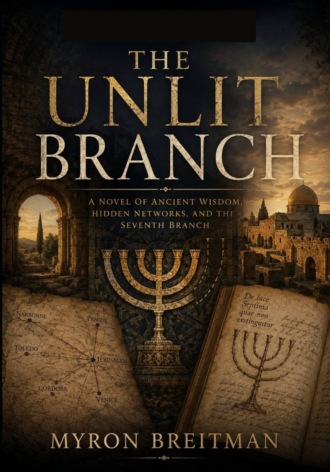
The Unlit Branch
"That," Eli said, "is something your enemies would also say."
The man's expression did something subtle — not quite a smile, not quite acknowledgment, something that recognized the validity of the point without conceding it. "Your work has attracted attention from people who don't have your scholarly intentions. We can discuss who they are, if you'd like."
"Who are you?"
"People with the same interest in keeping this research from reaching the wrong hands."
"Whose hands are the right ones?"
The man seemed to genuinely consider this question, which was itself unexpected. "That depends on what you find. Which is why the conversation is necessary."
Students moved around them in the corridor, oblivious. The cat from the courtyard was apparently somewhere indoors now — it appeared at the edge of a doorway, looked at the group of humans with feline indifference, and disappeared again.
"Your office was broken into," the tall man said. "We didn't do that. We can tell you who did."
"And in exchange?"
"A conversation. That's all. An exchange of information."
Eli looked at him — really looked, the way archaeologists learn to look at objects, attending to surface condition and underlying structure and the signs of previous handling. The man was composed, professional, and doing something with his eyes that suggested genuine rather than performed seriousness. He did not look like someone who needed anything from Eli. He looked like someone who was offering something to Eli while being careful not to seem like he needed the offer accepted.
Which was its own kind of information.
"Not tonight," Eli said. "And not here."
The man reached into his jacket and produced a card. Plain white, single phone number, no name. "When you're ready."
From somewhere behind Eli came the sound of more students emerging from another seminar. He took the card, put it in his pocket, and turned toward the building's main exit without hurrying, and no one stopped him.
Avraham Levin lived in the German Colony in a stone house that had been built in the 1920s and had gradually, over the following century, absorbed the quality of the person who lived in it — patient, dense, full of things that rewarded close attention. Avraham himself was seventy-three, retired from the Hebrew University's art history department, and possessed of the particular authority that comes not from institutional position but from decades of thinking carefully about difficult things and being right more often than average.
He opened the door before Eli knocked.
"I heard the gate," Avraham said. "You walk like someone who's been running."
"I wasn't running."
"You were thinking about running. Same gait." He stepped back to let Eli in. "Come. I have tea."
The study was a room that existed in comfortable contradiction to the digital age — floor-to-ceiling bookshelves, a desk covered with the kind of physical paper that academics who started their careers before computers still produce, a brass lamp that had been old when Avraham bought it. On the desk, a pair of reading glasses sat folded on top of an open volume of responsa literature. The room smelled of old paper and something warm and indefinably Levantine, the particular combination of wood and spice and dust that certain houses accumulate when they have been lived in intelligently for a long time.
Eli sat in the chair across from the desk and spread what he had on the cleared end of the table — the laptop, the photographs, the printout of Müller's article with its highlighted passages — and told Avraham everything. He told it in order, as he had learned to organize field reports: chronologically, with evidence cited at the point where it was acquired, with interpretations clearly labelled as interpretations rather than facts. It took twenty minutes. Avraham listened the way he listened to everything, with a quality of complete attention that never manifested as interruption.
When Eli finished, Avraham stood and went to the bookcase with the certainty of a man who knows where every volume lives and has known this for years. He returned with a small book, its cover worn to an undifferentiated brown, its spine cracked in the way of books that have been opened many times at the same pages.
"Sit with this for a moment." He placed the book on the table and opened it to a page near the middle. The page contained an engraving — eighteenth century, Eli estimated, possibly older, rendered in the dense crosshatching style that preceded photographic reproduction. It depicted a group of men in what appeared to be a synagogue interior, gathered around a table on which something lay that the engraver had rendered with special care, in finer lines than the surrounding details.
A Menorah. Six branches. An asymmetric base.
Eli looked up from the book to Avraham.
"The Keepers of Memory," Avraham said. He sat back down and folded his hands on the desk with the deliberateness of a man preparing to say something he has thought about for a long time. "This is what you've found the traces of, Eli. Not a stylistic tradition. Not a regional variation. A network."
Eli said nothing. He was still looking at the engraving.
"After the Temple's destruction," Avraham continued, "in the years when the rabbis at Yavne were reconstructing everything — the calendar, the prayer, the entire infrastructure of Jewish life without a Temple to anchor it — there were certain things that could not be reconstructed through texts. Things that required physical continuity, object continuity. Things that, if they existed only in writing, could be destroyed with the writing."
"What things?"
"The sources disagree. Some say the exact proportions of the Temple vessels. Some say Kabbalistic knowledge that predated the Temple itself." Avraham paused. "Some say the Menorah itself. Not a copy. The original. The one that was not in the Temple when the Romans came."
The room was very quiet. From the street outside came the faint sound of a car, then silence again.
"If you understand the system — if you understand that the network of synagogues was not a collection of independent anomalies but a single distributed archive, each location holding one component — then you understand what the center of that archive must contain." Avraham looked at the map on Eli's laptop screen. "Not just a piece of the puzzle. The key to all the pieces. The thing that makes the rest legible."
"And it's in Spain," Eli said.
"Your lines suggest Spain. Your Spanish colleague's documentation suggests Spain. The correspondence she found — ha-makom, the place — suggests Spain." Avraham's voice was careful, precise, the voice of a scholar who distinguishes between evidence and conclusion. "Somewhere in Spain, at the center of a network that was built over a thousand years, across three continents, by communities that had every reason to fear and every reason to preserve — yes. Something is waiting."
Eli looked at the marked points on his map, the converging lines, the rough intersection in the center of the peninsula. He thought about the monk in Toledo who had copied a synagogue floor plan in the years after the expulsion and added a notation in Latin at the bottom: lumen non extinctum est, sed fractum et in lapide absconditum. The light has not gone out, but is broken and hidden in stone.
The monk had known what he was copying. Or had guessed. Or had been told.
"Who are the men following me?" he asked.
Avraham's expression shifted — not quite discomfort, but something adjacent to it, the expression of someone who has more to say than they have decided to say. "There are people who have known about the Memory Keepers for a very long time. Not archaeologists. Not academics. People whose knowledge comes from a different kind of transmission — oral, familial, institutional in ways that don't leave paper trails in university archives."
"Guardians."
"Possibly. Or people who believe themselves to be guardians, which is not always the same thing." He paused. "And then there are others. People who have been looking for the center of this network for reasons that have nothing to do with preservation."
"What reasons?"
"The same reasons that have always made hidden things attractive." Avraham's voice was flat, factual. "Power. Proof. The ability to claim authority by possessing something ancient and unique." He looked at Eli directly. "If you found the original Menorah — the one that the Romans didn't take, that no conqueror has ever touched, that has been hidden for two thousand years — what would that mean? Politically. Theologically. To certain kinds of people."
Eli did not answer this question out loud, because it did not need answering out loud.
He thought about the men in the library corridor. The card with the phone number and no name. We can tell you who broke into your office. The offer of information in exchange for a conversation. The sense that they, whoever they were, occupied a third position — neither the people who had broken into his office nor the people who had simply sent an academic invitation to a conference.
Three different groups, possibly more, all converging on the same archive. All moving toward the same center of the same map.
And in the middle: Eli Navon, who had crouched before a mosaic floor three weeks ago with a measuring tape and counted six branches instead of seven and had not yet understood that counting was the beginning of a journey he had not planned to take.
Avraham retrieved something from a cabinet beside the bookcase — two phones, old models, prepaid. He set them on the desk.
"Use these when you meet your colleague at the airport," he said. "Not your regular number. Assume your regular number is being monitored."
"Is that an assumption or a fact?"
"At this point, better to treat assumptions and facts as the same category and err in the cautious direction." He also produced a folded piece of paper, which he slid across the desk. "These are colleagues of mine — scholars in France, Italy, Germany, Austria. Some of them know about the Keepers. All of them care about what you're trying to protect. If you need help abroad, they will provide it."
Eli looked at the list. He recognized three of the names from the literature — good scholars, serious people, the kind whose work he had cited in papers and whose thinking he trusted.
"Avraham." He folded the paper and put it in his pocket beside the card with the unknown number. "What do you think the Menorah actually is?"
The old professor was quiet for a moment. The lamp made its warm light across the desk and the books and the years of accumulated thought that the room contained.
"I think," Avraham said finally, "that the people who built this network knew something that we have forgotten. That preservation is not about the object. It's about the knowledge of the object — the understanding, the capacity to read what the object means. A Menorah in a museum is a beautiful ancient artifact. A Menorah understood — its proportions, its astronomical alignments, its encoded relationships between light and shadow and the structure of time — is something else."
He looked at Eli steadily.
"The light has not gone out," he said. "That's what your monk wrote. The light is not in the object. The light is in the understanding of the object. And the understanding has been waiting for someone patient enough, curious enough, stubborn enough to sit in front of a mosaic floor and count the branches and refuse to accept that the master made a mistake."
Eli sat with this for a long moment.
Outside, Jerusalem was doing what it did at night — spreading its lights across the hills in the particular pattern that made it look, from any elevation, like a map of something sacred, though what exactly had never been agreed upon. The cats moved between the stone walls. The ancient city breathed its ancient breath. Somewhere in an archive in Madrid, copies of correspondence between communities long gone lay waiting to be carried onto a plane and brought here, to be held beside a photograph of a mosaic floor in Galilee, to be compared and cross-referenced and slowly, carefully, read.
Sara's flight landed day after tomorrow at four-twenty.
Between now and then: one day. One day to prepare, to think, to decide how much of what he was carrying could be shared and with whom, and to sit with the question that had been following him since Zippori, since the eleven minutes when the seventh branch appeared in shadow and then dissolved again into the ordinary indifferent light.
What were they keeping?
What had been worth two thousand years of patient encoding, of broken Menorahs and asymmetric bases and monks' notations and fourteenth-century correspondence and a dying rabbi's whisper in the dark of a Galilean night?
He did not yet know.
But the map was beginning to speak.
Chapter Three: The Conference
Ben Gurion Airport.
Three days later.
The arrivals board said Delayed in the flat red certainty of institutional typography, and Eli stood beneath it and watched the word the way you watch weather — as something that has decided what it will do and will not be persuaded otherwise.
Around him the arrivals hall conducted its ordinary theater. Families with handwritten signs. Drivers holding tablets with surnames on them, the surnames of strangers they had agreed to collect. Children who had been patient for as long as children are capable of being patient and were now finished with that. The particular quality of anticipation that collects in arrivals halls — thicker than ordinary air, charged with the specific emotional frequency of people about to be reunited with someone they have been missing — pressed against Eli without touching him, the way a crowd presses against a man who is thinking about something else.
He was thinking about the card in his jacket pocket. Plain white, single phone number, no name. The taller man in the library corridor, three nights ago: We can tell you who broke into your office. He had not called the number. He had turned it over in his mind every night since, holding it at different angles, trying to read the shape of the offer. An exchange of information. A conversation, they had said. All very reasonable and all, in Eli's experience, the language of people who want something they believe they can get more efficiently through apparent reasonableness than through force.
He had not called. He was not sure yet whether this was wisdom or avoidance.
The board changed. Landed in white. Eli folded his thoughts away and watched the customs doors.
She came through twenty minutes later, in the middle of a cluster of other passengers, and he recognized her before she saw him — from the conference photographs he'd found online, yes, but also from something less cataloguable, the way certain people move through spaces, with the particular self-possession of someone whose attention is almost always on something other than the immediate environment. She was taller than the photographs suggested. Dark hair in a practical knot, wire-rimmed glasses, a shoulder bag worn cross-body with the unconscious security-consciousness of someone who has spent years in archives and knows that things left loose get lost. She was pulling a wheeled suitcase and reading something on her phone simultaneously, and when she looked up and found him in the crowd, her expression did something quick and complicated — relief, assessment, the rapid recalibration of a mental image against a physical reality — and then settled into something direct and warm.
"Eli."
"Sara."
They shook hands, which was formal, and then did the European cheek-kiss thing, which was less formal, and arrived at something approximately appropriate for two people who have been talking every day for two weeks and are meeting for the first time. She handed him the wheeled suitcase without being asked, which he interpreted as a sign of trust, or at least of pragmatism.
"How was the flight?"
"Endless." She adjusted the shoulder bag and started walking, and he matched her pace, which was brisk. "But I had time to read everything I hadn't sent you yet. Eli, I found something on the plane. In material I've had for weeks but hadn't looked at carefully."
"Tell me in the car."
"Yes." She glanced sideways at him, and the glance contained a specific quality — the quality of someone who has been careful about what they say out loud since understanding that they are being watched. "Better in the car."
The car was a rental, anonymous in the way that all white sedans are anonymous, which was the point. He had paid cash at the desk, which had required a conversation with the rental agent that he had handled by being very pleasant and very patient, two things that cost him more than usual given the specific quality of the previous three days. They moved through the airport's spiral of exits and joined the highway heading north toward Jerusalem, and the Judean foothills opened around them in the late afternoon light, the limestone doing what limestone in this country does at this hour — absorbing the gold and giving it back in a way that makes every rock surface look like it is illuminated from within.
Sara had her folder open on her lap before they reached the highway.
"The eight points," she said. "Not seven." She produced her tablet and angled it so he could see it at the red light. The map showed his original six Spanish locations plus Zippori, but now there was an eighth mark, positioned in northeastern Italy, above the Adriatic. "Venice. Specifically the Ghetto Nuovo."
The light changed. He drove and listened.
"There's a document in the Venetian community archive — sixteenth century, though it references events it describes as much older. It's in Judeo-Italian, the community's vernacular, with Hebrew characters for certain terms." She found the page in her folder, a photocopy of a photocopy, the text faded to a pale gray that required the effort of dedicated attention to read. "The relevant phrase: Quando i sette si uniscono, l'ottavo aprirà la via al principio. When the seven unite, the eighth will open the way to the beginning."
The highway curved and Jerusalem appeared below them, spread across its hills in the particular way that it appears when you come from the west — not a city that reveals itself gradually but one that presents itself all at once, complete, requiring you to take it in whole or not at all.
"The eighth branch," Eli said.
"That's what I thought. But look at where it sits on the map." She held the tablet closer. "It's not a branch in the geometric sense. It's off-axis. The seven Spanish and Israeli points form something — a rough Menorah shape, if you're generous about the geometry. But the Venice point doesn't fit the candelabra form. It sits outside it."
"Da'at," Eli said.
"What?"
"The hidden branch. Da'at — knowledge. In the Kabbalistic mapping of the Menorah, Da'at is the sefirah that exists between the upper and lower worlds but is never counted among them. Present but concealed. The branch the earthly Menorah left out because it cannot be made — only found." He glanced at the tablet. "The seventh location is not inside the pattern. It is what the pattern produces in whoever moves through it correctly."
Sara was quiet for a moment. "So the eighth location isn't part of the pattern. It's the key to the pattern."
"That's one interpretation."
"What's another?"
He thought about this, watching the road and watching, with a different part of his attention, the cars behind them. A black SUV had been consistent in his mirrors since the airport exit, maintaining a distance that was neither too close nor too far, the particular distance that you choose when you want to follow without appearing to follow. He had noted it without reacting to it. Reacting to it would have required telling Sara, and telling Sara right now, in this first hour of their first face-to-face meeting, before they had established a working rhythm, before he understood how she moved through stress — this was not the right moment. He filed it.
"The Venice document also mentioned 1492," Sara continued. "The expulsion. It said — I'm translating loosely — that what had been kept in seven places was prepared to outlast the catastrophe because the keepers had known it was coming."
"How could they have known?"
"The same way anyone knows a catastrophe is coming. Because they had been watching the signs for years. The pogroms of 1391. The forced conversions. The trial of conversos. The trajectory was legible to anyone paying attention and willing to believe what they saw." She closed the folder. "I think the expulsion wasn't the crisis that prompted the network. I think the network already existed, and the expulsion was the event that completed it — that forced its final consolidation, that distributed the last pieces to the last locations."
Eli pulled off the highway at the Jerusalem exit and began navigating the city streets, which in the evening traffic had the quality of a puzzle that is always slightly harder than you remember. The black SUV was no longer in his mirrors. Either it had turned off or it had been replaced by something else.
"I think you're right," he said. "And I think Venice was the last piece placed. The final redistribution, just before the community dispersed."
"Which means Venice might be where the key is. Not the answer, but the thing that makes the other answers readable."
"Which means whoever is following us probably knows about Venice."
He said it quietly, without emphasis, and felt rather than saw Sara's posture change. "Following us," she said. "Not following you."
"A black SUV, consistent distance, Ben Gurion to the city. It's gone now or changed vehicles, I can't confirm."
A silence that had a particular texture — not fear, he thought, but the specific recalibration of someone adjusting their model of the situation. Adding a variable. "How long have you known you were being followed?"
"Since Haifa. Possibly before, but Haifa was when I was certain."
"And you didn't tell me on the phone."
"I assumed the phone wasn't secure." He paused. "Was that incorrect?"
"No." She looked forward through the windshield. "No, that was correct." Another pause, shorter. "The journalist who came to my apartment in Madrid. He knew about my research. He knew I was coming here. He asked about international collaborators."
"What did he look like?"
"Fifties. Mediterranean coloring, could have been Spanish or Italian or North African. Very composed. The kind of composed that isn't a personality trait." She turned to look at him. "Professional."
"Did he threaten you?"
"No. He was extremely polite. That was the most frightening thing about him."
The hotel appeared on the left — a practical business hotel rather than one of the grand ones, which was the point. Eli pulled into the drive and stopped the car and they sat for a moment without getting out, the engine cooling, the evening sounds of Jerusalem coming through the closed windows as a muffled continuous presence.
"Tomorrow," Sara said.
"Tomorrow," Eli confirmed. "Tonight we prepare. And I want to show you something I found in the literature that changes the frame of the whole thing."
They worked at the desk in Eli's room, because his room was slightly larger and because he had already established the physical organization of the materials there — photographs pinned to the corkboard he had propped against the wall, the astronomical calculation printouts arranged by date along the windowsill, the enlarged image of the Müller article passage in the center where it could be referred to without moving anything else.
Sara looked at the Müller passage for a long time.
"He saw it in 1995," she said. "Thirty years ago."
"Saw the edge of it. He didn't have the astronomical dimension — he was working from photographs, not from direct observation, so he couldn't know about the light effects. He didn't have the Spanish material because he was working entirely from the Ashkenazic corpus. But he reached the same conclusion from a different direction." Eli leaned against the windowsill. "Negative space. He called it negative space."