Полная версия
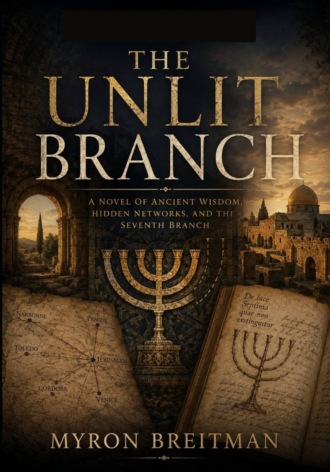
The Unlit Branch
The pattern did not speak. Not yet.
He was still staring when Miriam arrived.
She came up the path from the parking area with the slightly breathless efficiency of a person who has misjudged how early she needed to leave, her camera bag swinging at her hip, her dark hair pulled back in the kind of knot that starts the day precise and gradually, through the business of living, becomes something else by afternoon. Miriam Cohen was twenty-six and two years into her doctorate on Byzantine-era synagogue art, which meant she was at the stage of academic formation where everything was still interesting — where the world of her subject had not yet contracted into specialization but was still wide open, still producing surprises daily, still capable of the particular joy that comes from not yet knowing what you don't know.
Eli valued this in her. He valued it partly because competent enthusiasm is the rarest and most useful combination in a field researcher, and partly because he remembered being that way himself, and the memory was both warm and slightly painful, the way most useful memories are.
"You've been here since dawn," she said, not quite accusingly.
"The light is different at dawn."
She set her bag down and looked at the mosaic, then at him, then back at the mosaic. "The Menorah again."
"The Menorah again." He stood and gestured for her to come close. "Count the branches."
She counted. He watched her face while she did it — the slight frown of concentration, then the frown of something else, the frown of encountering a number that doesn't agree with expectation. "Six," she said.
"Six."
"Could the seventh be under that white section? A repair, maybe? Or something that was damaged and —"
"The white tesserae are original. Same age, same setting method, same mortar composition as the rest. Whatever is absent was intended to be absent." He paused. "Look at the base."
She looked. He watched the same process of noticing happen in her face, the progression from observation to recognition to the moment where recognition becomes something larger, something that doesn't yet have a name.
"The proportions are wrong," she said slowly. "Not wrong like a mistake. Wrong like —" She stopped.
"Like something else is being said."
She looked up at him. "You think this is intentional."
"I think," Eli said carefully, "that the person who laid this floor was a master craftsman working in a major synagogue in the capital city of Jewish Galilee under Roman rule. I think he spent months on this floor. I think he knew exactly what a Menorah looked like. And I think the floor we're looking at is exactly what he intended to lay."
Miriam was quiet for a moment, looking at the mosaic with new eyes — not the eyes that catalog, but the eyes that listen. "So what is he saying?"
"That," Eli said, "is the question I've been sitting with since sunrise."
He told her his idea about the light. It had come to him an hour earlier, looking at the shadow his own body threw across the mosaic as the sun climbed, watching the way the colored stones changed quality as the angle of illumination shifted. The synagogue walls were ruins, but their orientation was preserved — the building had faced east in the standard Jewish practice, and the spacing of the window openings along the southern wall was documented in the excavation records. He'd pulled the records on his phone and done rough calculations, and what the calculations suggested made the back of his neck do something that he associated with important discoveries: a kind of electrical stillness, as though his body was holding its breath.
"Set up the tripod," he said. "Exactly there." He pointed to the position that the calculations suggested. "And wait."
Miriam set up the tripod with the practiced efficiency of someone who has done it in the field several hundred times. She attached the camera and leveled the head and stepped back, and they both looked at the mosaic, and they waited.
The sun climbed.
The Galilean hills in October held their color until the last moment — still green-gold along the ridges, still thick with the carob and terebinth that had grown on these slopes since before anyone in this city had been born. The light came over the eastern ridge and dropped into the valley and climbed the ruins and reached the mosaic at an angle that was specific to this latitude, this month, this time of morning, this particular arrangement of stone and sky that had never existed before in exactly this combination and would never exist again.
And the mosaic changed.
What happened was this: the shadow of a broken column fragment at the southeastern corner of the ruin, positioned at a distance and angle that seemed coincidental until you recognized that nothing about this floor was coincidental, fell across the white tesserae at the left side of the Menorah. The shadow was not dark enough to fill the space entirely. It was the shadow of a column, partial and irregular, and where it fell, it fell along the exact curve that a seventh branch would have made had it been rendered in stone. The white field became the negative space of a branch — visible not by the presence of color but by the presence of shade.
For approximately eleven minutes, the Menorah had seven branches.
Miriam's breath went out of her in a sound that was not quite a word. She triggered the camera. She triggered it again and again, working through angles, adjusting without being asked because her photographer's instinct had taken over from her archaeologist's instinct and both were telling her the same thing: document this, document all of it, document it now before the sun moves and the moment closes.
Eli didn't move. He stood at the edge of the mosaic floor and looked at the seven-branched light and felt the specific vertigo that comes from encountering evidence that someone, two thousand years ago, thought in a more complex way than you had allowed them to think.
"They calculated this," Miriam said, her voice quieter than it had been. "The column placement. The window orientation. The exact proportions of the white field." She lowered the camera. "Professor — this isn't just artistic sophistication. This is engineering."
"It's more than engineering." Eli crouched beside the mosaic and placed his palm flat against the white tesserae, feeling the stone's coolness, its patience, its absolute indifference to whether or not he understood it. "Engineering solves a physical problem. This solves a different kind of problem." He lifted his hand. "How do you preserve something when the thing itself can be destroyed? When armies can take your objects, burn your buildings, scatter your people? How do you keep a light burning when every vessel that held it is gone?"
Miriam sat down on the edge of a fallen column drum and looked at him with the expression of someone who is simultaneously fascinated and slightly frightened — the correct expression, Eli thought, for the situation.
"You build the light into the world," he said. "You encode it in stone and angle and shadow. You make the information so distributed, so embedded in the physical environment, that no one can carry it off because no one can carry off the geometry of the sun."
The eleven minutes passed. The shadow moved with the unhurried precision of celestial mechanics. The seventh branch dissolved. The Menorah was six again, incomplete again, a puzzle with one piece withheld.
"We need astronomical calculations," Eli said, standing. "How the effect changes across the year. Whether the equinoxes produce something different. Whether there are other significant dates in the Jewish calendar that might reveal other configurations."
"And we need to check other sites." Miriam was already making notes. "If this is a system — if this was done in one synagogue, it might have been done in others."
"It was done in others." He said it with a certainty that surprised him even as he said it. It was the certainty of someone who has seen the logic of a thing and understood that logic is not local — that if something makes sense in one place, it makes sense everywhere the same conditions apply. "I just don't know how many others yet."
The drive back to Haifa took forty minutes on the highway that cut through the Jezreel Valley, past the fields that in October were between harvests — stubbled and dry, waiting in the way that the land here always seemed to be waiting, with a patience that had been practiced for so long it had become indistinguishable from certainty. Eli drove and thought about light. He thought about the specific quality of intelligence required to design what he had seen — not intelligence as a static quality, as something a person possesses, but intelligence as a kind of long-distance communication, a message sent across centuries with the expectation that someone on the receiving end would know how to read it. The designers of that floor had trusted the future. They had believed that the future would contain someone curious enough, patient enough, attentive enough to stand in the right place at the right time and look in the right direction.
He found this, obscurely but genuinely, moving.
His office in the archaeology department at the University of Haifa occupied the corner of the third floor of a building that had been designed in the 1960s with the brutalist confidence of an era that believed concrete was the answer to most questions. It was not a beautiful building. What it was was a building full of people who thought carefully about beautiful things, which Eli had decided long ago was a sufficient substitute. His office itself was the kind of organized chaos that other academics recognized as a working system: books in stacks that were topographical rather than alphabetical, photographs pinned to a corkboard in clusters that corresponded to his internal categories, a desk buried under site reports and journal articles and the accumulated paper evidence of two decades of looking at what other people had left behind.
He spread the Zippori photographs across the desk and opened his astronomy software and began calculating.
The software was designed for amateur stargazers — clean interface, drag-and-drop location input, a calendar that showed the position of celestial bodies at any date and time in history. Eli used it for site work, running simulations of ancient lighting conditions, checking whether a window orientation or a chamber alignment might have astronomical significance. He had used it many times before. What he got from it tonight made him set his coffee down very carefully, the way you set something down when your hands have become unreliable.
The seventh-branch effect that he had witnessed in the morning was not singular. At the spring equinox, the shadow configuration changed completely — a different angle, a different partial illumination, what his calculations suggested would produce not one additional branch but two, creating a momentary image of what he thought — though he could not be certain without being physically present — might be the full seven-branched form, symmetric and complete, for exactly the duration of a certain prayer.
At the winter solstice, nothing. The sun too low, the angle insufficient.
At specific dates in the Hebrew calendar — he cross-referenced, double-checked, ran the simulation three times from three different starting assumptions — there were four moments in the year when the mosaic, in the presence of correct natural light, became fully legible. As if it were a text written not in ink but in the position of the earth relative to the sun. As if it were a page that could only be read on schedule.
His phone rang. He looked at the screen: Sara Márquez, Madrid.
He and Sara had met at a conference in Barcelona two years earlier — a small specialized gathering on Mediterranean synagogue architecture, the kind of academic event attended by perhaps sixty people worldwide who cared deeply about something the rest of the world found obscure to the point of eccentricity. Sara was an archivist at the Biblioteca Nacional, Spanish by birth but Israeli-educated, trilingual in the way that people from certain backgrounds are trilingual — not as an achievement but as a basic condition of self, the way some people are left-handed. She had been presenting on a cache of medieval documents relating to the forced conversions of 1391, and Eli had asked her a question after her talk that had led to a three-hour conversation in a tapas bar that both of them had, afterward, cited as one of the better conversations of their professional lives.
He had mentioned the Zippori anomaly to her in passing, three weeks ago, not expecting anything. Sara's specialty was medieval Spain, not Roman-era Galilee. But Sara had the quality that the best archivists share with the best detectives: she noticed when something she was looking at was the same shape as something she had seen before.
"Eli." Her voice on the phone carried the particular texture of suppressed excitement, the tonal equivalent of a person who is walking quickly and pretending not to be running. "Tell me exactly what the base of your Menorah looks like."
He described it. The stepped platform, the asymmetry, the sequence of slightly darker tesserae along the lowest step. He heard her breathing change as he spoke.
"I'm sending you something," she said. "Right now. Open your email."
He opened his email on the laptop while still holding the phone. The attachment loaded slowly — a scanned document, high resolution, the kind of careful scanning that archivists do when they want to preserve every surface quality of an original. It was a drawing: architectural, medieval, ink on paper that had been good quality once and was now the color of old tea. A synagogue floor plan, with detail drawings at the margins. And in the lower right corner, a rendering of a Menorah.
Six branches. An asymmetric base. Along the face of the lowest step, a sequence of slightly darker marks that in the drawing were rendered as small crosses but which had, unmistakably, the rhythm of the sequence he had photographed in Zippori that morning.
"Toledo," Sara said. "A synagogue in Toledo. The drawing is fourteenth century, but the building it documents is older — the annotations suggest eleventh or twelfth century, though I haven't confirmed that. The draughtsman was a monk at a nearby monastery who was making records of Jewish buildings in the years after the community was expelled." She paused. "Eli, the monk added a note. In Latin. At the bottom of the drawing."
"I see it." He was enlarging the image, the medieval handwriting coming into uncertain focus. "Can you read it?"
"I've been staring at it for two hours." Another pause, longer. "Lumen non extinctum est, sed fractum et in lapide absconditum."
The Latin settled into the room.
Eli set down the phone — not ending the call, just placing it on the desk — and looked at the photograph of the Zippori mosaic pinned to his corkboard, and looked at the drawing on his laptop screen, and held the Latin phrase in his mind the way you hold a flame near something you're trying to read.
The light has not gone out, but is broken and hidden in stone.
The same words. Not the same language — the rabbi in the prologue of every story had said them in Aramaic, or perhaps Hebrew, or perhaps simply in the language of the dying which is beyond translation. But the same words. Said two thousand years apart by people who could not have known each other, could not have compared notes, could not have coordinated across the gap of centuries — except through the stones themselves. Except through the image that both of them, somehow, had known to preserve.
He picked up the phone. "Sara. I need to see the original."
"I know. I've already requested a travel authorization from the library."
"This is not a coincidence."
"No," she said. "I don't think it is. Eli — if this is what it looks like — if there's a consistent pattern, a shared system across different centuries and different countries — then we're not looking at an artistic anomaly. We're looking at a network."
The word landed with a weight that seemed disproportionate to its syllables. He turned it over in his mind, examining it. Network. Not accident, not tradition, not the natural convergence of craftsmen working in the same symbolic vocabulary. Network: deliberate, designed, distributed. A system of meaning that had been built into the physical fabric of synagogues across the Mediterranean world and had been waiting, patient as stone, for someone to read it.
"I'll come to Madrid," he said. "End of the week."
He ended the call and sat for a long time in his office with the documents arranged around him on the desk, the astronomical calculations on his laptop, the photographs on his corkboard, the Galilean darkness outside the window where the streetlamps cast their orange light onto the parking lot below.
Then the electricity went out.
Not gradually. Not with the flicker of an overtaxed system or the warning of a brownout. The lights went out completely and instantly and the hallway beyond his office door went out simultaneously, which ruled out a local circuit and suggested either the building's main supply or something more deliberate than infrastructure failure.
Eli sat in the dark for three seconds, counting. The calculation was not conscious — it was the calculation of a man whose instincts had been educated by twenty years of working in countries where instability was not theoretical.
He took out his phone and activated the flashlight and stood and went to the window.
In the parking lot below, under the sodium lamp that ran on its own circuit, a car was parked at an angle that was not the angle of someone who had parked there to go into the building. It was the angle of a car that was watching the building. A dark sedan, the color indeterminate in the orange light, windows tinted past the legal limit. Inside, visible only as two small orange points, the glow of cigarettes.
People who work in offices do not sit in parked cars smoking and watching in the dark.
Eli crossed the room in seven steps and gathered the documents from his desk with the practiced speed of a man who has learned that the difference between a good outcome and a bad one is often the forty-five seconds it takes to do the obvious thing. Photographs, site logs, the astronomical calculations, the printout of Sara's scanned drawing. He stuffed them into his backpack without organizing them, then went to his desk drawer and took out the USB drive on which he backed up his field data every evening and put that in his pocket.
Then he called Miriam.
She answered on the second ring, which meant she was awake, which meant she had also been thinking about the day's discovery and had not yet managed to stop.
"Miriam. The materials we photographed today — everything from the site."
"Already backed up," she said. "Cloud and external drive. I uploaded them when I got home."
"Delete them from the cloud. Tonight. Back them up to a physical drive and take the drive out of your apartment."
A silence on her end. Not the silence of incomprehension — Miriam was not someone who needed things explained twice — but the silence of a person recalibrating their understanding of the situation they were in.
"What happened?" she said.
"I'm not sure yet. But someone is sitting in the parking lot outside my office at nine-thirty in the evening, and the electricity in this building went out ten minutes after I received something from Sara Márquez that might be the second point in a pattern." He looked at the window. The sedan had not moved. "I might be constructing a narrative. I might be wrong about what this means. But the cost of being wrong in the cautious direction is a mildly inconvenient evening, and the cost of being wrong in the incautious direction is something I'm not prepared to calculate."
Another silence. Then: "I'll move the files."
"Good. And Miriam —" He hesitated. "Don't tell anyone what we found today. Not yet. Not until I understand what we're dealing with."
"Understood."
He took the service stairs. The building's back exit opened onto an alleyway that ran parallel to the main street, between the archaeology building and the engineering faculty, and he moved through it at a pace that was not running but was not the pace of a man who believed he had unlimited time. At the end of the alley, he stopped and looked back along the building's facade.
His office window was the third from the left on the third floor. While he watched, a light came on in it.
Not his ceiling light — the power was still out. A flashlight. Or a phone, held up and moved slowly across the room in the way that people move light across a room when they are looking for something specific.
Eli's office had been unlocked. He left it unlocked always, the habit of someone who had nothing there worth taking — no expensive equipment, no personal valuables, only paper and books and the things that mattered only to people who already knew what they were looking for.
Now someone was in it, looking.
He walked to his car with the specific quality of normalcy that people perform when they want to appear unremarkable — not too fast, not too slow, the gait of a man returning to his car at the end of a late evening at the office, shoulders relaxed, keys already in hand. He got in. He started the engine. He pulled out of the lot in the direction away from the main entrance, taking the service road that exited on the far side of the campus.
As he drove, he thought about what Sara had read to him from the medieval monk's notation.
The light has not gone out, but is broken and hidden in stone.
Two thousand years of hiding. Two thousand years of patient, distributed preservation — the same information encoded into synagogue floors in Galilee and Toledo and how many other places he did not yet know, waiting in stone for the correct question to find it.
And now, within hours of that question being asked — within hours of the second data point being found, the shape of the network becoming visible — someone had come looking.
Not for the stone. Not for the photographs of the stone. For the understanding of the stone, the digital files, the analytical framework, the beginning of the map that the stones together composed.
Someone already knew the stones were there.
What they didn't know — what they needed, urgently enough to sit in a parking lot on a Tuesday evening in October — was whether anyone had begun to read them.
Eli drove south through the Haifa night, the harbor lights below him making their ordinary reflections on the dark water, and he thought about the difference between a secret that survives because no one thinks to look for it and a secret that survives because it has been made to survive — deliberately, ingeniously, with the kind of long patience that plans for centuries rather than lifetimes.
He thought about the dying rabbi in Zippori, eighteen hundred years ago, handing a fragment of mosaic to a young man with ink-stained hands.
He thought: someone has been keeping track.
The question — the question that would not leave him alone as he drove, the question that would follow him into his apartment and through the restless hours of the night that remained — was not whether he was being watched. That much was clear. The question was whether the people watching him were the same people who had been keeping the secret — guardians, preservers, the latest in a chain of custody stretching back to a Tuesday in 78 AD when the light went underground — or whether they were something else entirely. Something that the dying rabbi had also anticipated, and feared, and tried to warn against.
Beware of those who seek the seven branches for power.
He hadn't read that anywhere in the documents. It had come from the prologue that existed only in his imagination, the story he had been composing in his mind for three weeks without knowing it — the story that the mosaic had been telling him, one shadow at a time, every morning since he'd first crouched before it with his measuring tape.
But now, driving through the night with someone's flashlight sweeping through his office behind him, the warning felt less like imagination and more like instruction.