


Полная версия
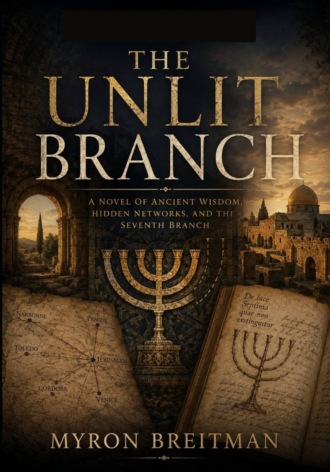
The Unlit Branch

Myron Breitman
The Unlit Branch
Prologue
Zippori, Galilee
78 AD
Eight years after the destruction of the Second Temple
The wind came down from the north that night, carrying the smell of rain that would not fall.
It moved across the Galilee hills the way old grief moves — without announcement, without apology — pressing its cold mouth against every stone wall, every doorframe, every window sealed with rags and wishful thinking. The carob trees along the ridge bent and recovered, bent and recovered, patient as men who have learned that suffering is cyclical and that resistance, in the end, is a kind of prayer.
Inside the house on the eastern slope, a lamp burned.
Not brightly. Nothing burned brightly anymore in the years since the legions came, since the smoke of Jerusalem had risen high enough to be seen from the sea, since the world had cracked along a fault line that no one had thought to mark on any map. The lamp burned the way old men burn — with great deliberateness, spending itself carefully, unwilling to surrender more light than was absolutely necessary to the surrounding dark.
Rabbi Yochanan ben Zakkai lay on his sleeping mat and listened to the wind and thought about fire.
He had been thinking about fire for eight years. He thought about the fire that had consumed the cedar beams of the Temple portico, how they had screamed — yes, screamed, he would swear it to anyone who asked — as the flames reached the wood that had grown for a hundred years on the slopes of Lebanon before being carried to Jerusalem on the backs of ten thousand men. He thought about the fire in the eyes of the Roman soldiers who ran through the courtyards of the holy place with their torches held aloft like offerings to a god who collected ruin. He thought about the fire that had not burned. The fire inside the thing he had carried out of the city in a clay pot wrapped in sailcloth, hidden beneath grain sacks in a merchant's wagon, rattling through the checkpoints while his heart became something small and cold inside his chest.
His fingers moved now to the loose stone beneath the sleeping mat. The motion was habitual, unconscious, the way a man's tongue finds a missing tooth. The stone lifted. Beneath it, wrapped in the same linen that had wrapped it for eight years, was the fragment.
He drew it out and held it above the lamp flame.
In the unsteady light it seemed to breathe.
The mosaic was no larger than his two palms pressed together, a section of something once much greater. It was old — older than the Temple as Herod had rebuilt it, older perhaps than the Temple as Solomon had first conceived it — and its colors were impossible, the blue of it too deep to be merely mineral, the gold of it too warm to be merely stone. Whoever had set these tesserae had understood something about light that modern craftsmen had forgotten, or perhaps never known: that the purpose of color is not decoration but memory. That certain shades, arranged in certain ways, could hold a vision the way an amber holds an insect — perfectly, permanently, alive inside its own frozen moment.
The image it depicted was a Menorah.
But not the Menorah that Titus had carried off in triumph through the streets of Rome, the one that would be carved into the arch that still stood in the forum, the image reproduced on ten thousand coins and amulets and commemorative medallions distributed to Roman veterans as proof of their victory over a people who refused, even in defeat, to become merely a footnote. That Menorah was beautiful, certainly. That Menorah was perfectly proportioned, its seven branches curving upward in the graceful symmetry that every craftsman knew, every child could draw.
This Menorah was different.
It had seven branches, as every Menorah had seven branches — as every synagogue floor and every child's drawing and every stone carving showed seven branches. But in the space between the third branch and the fourth, in the interval that every craftsman for a thousand years had left empty, something occupied the emptiness.
Not a branch. The tesserae were too finely worked for an error, too deliberately placed for accident. What appeared in that space was more like a shadow of a branch — the outline of something present in the heavenly template but absent from the execution, the way a blueprint shows a wall that was never built because the builder understood that some structures are more essential as possibilities than as stone.
Yochanan had spent eight years attempting to name what it depicted. The closest word he had found, in the tradition he had spent his life inside, was one that the teachers of the Zohar had not yet written — would not write for another eleven centuries — but that he recognized the way honest thought recognizes its own conclusions before it can articulate them: da'at. Knowledge. Not the knowledge that can be transmitted through teaching, but the knowledge that can only be accumulated through the specific quality of direct encounter with what is true. The knowing that does not come from being told. The branch that the earthly Menorah left out because some lights cannot be made, only found — the hidden sefirah, present but not counted, the bridge between what the eye can see and what it cannot.
In the Talmud, the sages recorded that Moses forgot the Menorah's design three times. Three times God showed him and three times the details slipped from his mind when he returned to the camp, like water cupped in hands that opened before they reached the vessel. What Moses kept forgetting, Yochanan had come to believe, was not the curve of the branches or the weight of the gold. It was this. The eighth. The one that existed only in the space between the others, that required a different order of attention to perceive, that no earthly craftsman could render directly because it was not a physical thing but the quality of knowing that made the physical thing holy.
The base of the Menorah in the mosaic, instead of the tripod style that every depiction in every synagogue showed, was shaped like something else entirely: a stepped platform, narrowing as it rose, inscribed with markings that he had spent eight years attempting to read without success. The markings were not Hebrew letters, though they borrowed their shapes from Hebrew letters the way a dream borrows the faces of the living. They were something older. Something that remembered being written before language had fully decided what it was.
And the seven branches were not all gold.
Six were gold. The seventh — the one farthest to the left, the one that should have been the mirror image of its partner on the right — was rendered in a slightly different stone, a shade that shifted between amber and a brown that was almost red, depending on the angle of the light. Depending, perhaps, on something other than the angle of the light.
"Rabbi."
Yochanan did not startle. He was past startling. He folded his hands over the fragment and looked up.
His disciple stood in the doorway between the sleeping room and the main room, his shadow falling long and thin across the floor. Eliezer was young — twenty-three, perhaps twenty-four — with the dark eyes of a man who had seen things he would spend the rest of his life trying to arrange into some coherent order. His hands, in the lamplight, showed the blue-black staining of ink that no amount of washing entirely removed. He had been copying texts all evening, working by candlelight in the outer room the way he worked every evening, because the work of transcription was the work of survival. What was not written was forgotten. What was forgotten was lost. What was lost was as if it had never been.
Or so they told themselves.
"Come here," Yochanan said. His voice was quiet in the way that rooms go quiet when a window is opened in winter — not the absence of sound, but the presence of something that displaced sound.
Eliezer crossed the room and knelt beside the mat. He smelled of lamp oil and cedar and the particular dry, papery scent of old scrolls, and beneath that something else — the scent of a young man who was frightened and refusing to show it, which was its own kind of courage.
Yochanan held up the mosaic fragment.
In the lamplight, between their two pairs of hands — the old man's knobbed and spotted with age, the young man's long-fingered and ink-stained — the fragment glowed.
"The light," Yochanan said, "has not gone out."
Eliezer opened his mouth, then closed it. He had learned, in his years as the rabbi's disciple, that the most important things required a different quality of listening than ordinary speech demanded. You did not respond to them immediately. You let them land and settle, the way snow lands and settles, and then you waited to see what shape they revealed.
"The Temple was not the light," Yochanan continued. "Herod's marble was not the light. The cedar beams and the silver vessels and the curtain of Babylonian tapestry — none of those things were the light. The light was older than all of that." He lowered the fragment gently to his chest, cradling it. "When Solomon built the first house, the sages already knew what the prophets had always known. That everything built by human hands would, in time, be unmade by human hands. That stone and wood and gold are faithful only to gravity. So before the walls were even finished — before the mortar had cured, before the scaffolding came down — they did something."
He paused. Another fit of coughing came and he rode it with his eyes closed, patient, waiting for his body to finish its protest before continuing.
"They made a second Menorah," he said, when the coughing released him. "Not a copy. Not a lesser version. The true one. The first one, the pattern from which all others would be drawn. And they divided it into seven parts, and they hid each part in a different place, and they recorded the locations in a way that could only be read by someone who already understood what they were looking for."
Eliezer looked at the mosaic fragment with new eyes.
"This is the first part," he said. It was not quite a question.
"This is the beginning of the first clue to the first part," Yochanan corrected him gently. "There is a difference. The Babylonians came and the Menorah was already gone. Antiochus came and the Menorah was already gone. The Romans came —" His jaw tightened. "And the Menorah was already gone. What they carried off through the streets of Rome, what they put on their coins, what they carved into that arch in their forum — it was a beautiful object. Exquisitely made. But it was a vessel without the thing that made the vessel holy. A lamp without a flame."
From somewhere outside, at some distance but not enough distance, the measured sound of footsteps reached them. The hard rhythmic precision of hobnailed sandals on stone. A Roman patrol. After the Great Revolt, after the fall of Jerusalem, after the desperate last resistance at Masada — the soldiers had grown more methodical. They checked the Jewish houses at intervals through the night, listening at doors, noting which windows stayed lit too long.
Eliezer's eyes went to the wall, then back to the rabbi's face.
Yochanan raised one hand — slowly, without alarm, the gesture of a man who has decided what matters and what does not.
"There is a papyrus," he said. "In the linen bag under my winter robe. I want you to take it."
"Teacher —"
"I am not asking you to do something difficult. I am asking you to do something important. Those are different things." He looked at Eliezer steadily. "The papyrus contains the symbols that identify each fragment. It contains the names of the cities where the other six are hidden. Not in plain language — nothing in plain language survives the attention of people who want things — but in a code that the Temple guardians developed over three generations. You are clever enough to learn it. I have been teaching you to read it for six years without telling you what you were learning."
Eliezer stared at him.
"The letters I taught you in the third year," Yochanan said. "The ones you thought were a variant Aramaic script."
A long pause. Then, very quietly: "Those were not a variant Aramaic script."
"No."
The footsteps outside were closer now. Voices in Latin, flat and functional, a centurion giving quiet orders. The kind of orders that did not need to be given loudly because they had been given many times before.
Eliezer reached beneath the winter robe folded at the foot of the mat and drew out the linen bag. It was small — smaller than he had expected for something that contained whatever it contained. He held it in both hands and felt its weight, which was not the weight of papyrus alone.
"Go through the back door," Yochanan said. "Rabbi Akiva is waiting at the well with a donkey. He knows the road to Yavne. He will take you as far as you need to go."
"I can't leave you."
"You cannot stay." The old man's voice was not harsh. It was simply accurate, the way the sky is simply accurate about weather. "I am an old sick man who has done what he came to do. You are a young man at the beginning of what you came to do. These are not the same situation."
"Teacher." Eliezer's voice broke on the word, just slightly, like a stone thrown against another stone. "Tell me the rest of it. Tell me everything."
Yochanan was quiet for a moment. Outside, the Latin voices grew briefly louder, then receded somewhat. Not gone. Moving around the perimeter of the house.
"The fragments do not give power," the rabbi said finally. "That is the first thing. People who look for power will look in the wrong direction and never find them. The fragments test. That is what they do. They test the quality of the seeker — not his intelligence, not his learning, not his righteousness as measured by external observance — but the quality of something that has no good word in any language, something between courage and humility, the willingness to receive light without using it to cast shadows on others." He paused. "If someone collects all seven with a pure heart, what is lit cannot be extinguished. If someone collects all seven with a corrupted one — "
He did not finish the sentence. Some things were better left as implications. Some fires were better described by their aftermaths.
"How will I know?" Eliezer asked. "When I find someone worthy to pass this to — how will I know them?"
"You will look at how they treat the unimportant," Yochanan said. "The servant. The stranger. The question that seems beneath them. Power reveals itself in grand gestures. Character reveals itself in small ones."
A heavy fist struck the outer door. Once, twice. Then a voice in Latin, flat and carrying: Aperite. Open in the name of Caesar.
The two men looked at each other.
Something passed between them in that look that had no content, no translatable meaning — only weight, only duration, only the specific quality of love that accumulates between a teacher and a student over years of shared difficulty and shared wonder. The look of two people who have read the same book and understood it differently and spent years arguing about which of them was right, and who know now that the argument was the point, and that the point was the love.
Eliezer bent and pressed his lips to the back of the rabbi's hand. The skin there was thin as old parchment, mapped with veins, warm.
He tucked the linen bag beneath his tunic, against his skin. He rose.
"The light has not gone out," Yochanan said. His eyes were already closing. "It is simply waiting."
Eliezer moved through the inner room, through the kitchen, through the back door that opened onto the alley behind the house. The cold hit him like a hand pressed flat against his chest. Above the roofline, the sky was vast and starless — clouds had come in from the north, the same clouds that carried the cold-smelling air that wasn't quite rain.
Rabbi Akiva was at the well, as promised, with a gray donkey that regarded Eliezer with the philosophical detachment common to donkeys and very old men. Akiva himself said nothing. He had learned, over many years, that the moments immediately following a great loss were not the right moments for words.
They rode up the mountain path in silence, the donkey picking its way with the unhurried confidence of an animal that knew this road well.
Before the path turned and the house fell out of sight behind the ridge, Eliezer looked back.
The lamp was still burning in the window.
And beside it, barely visible through the glass — a shadow. A shape. An old man's outline, upright against the wall, holding something to his chest.
Shema Yisrael. Hear, O Israel.
The last prayer of the last guardian.
Eliezer faced forward. The donkey continued its patient ascent. Below them, in the valley, the fires of the Roman camp burned orange through the dark, and the soldiers who had burst through the rabbi's door were searching a house that had already yielded everything worth carrying, and the wind continued to move across the Galilee hills, carrying the smell of rain that would not fall, indifferent to all of it, the way the wind is indifferent to everything that is not the wind.
In the bag against his chest, a mosaic fragment pressed its edge into his ribs like the corner of something ancient and unfinished.
The first key.
The first step in a journey that would take him to Alexandria, to Rome, to cities that did not yet have the names they would eventually carry. A journey of forty years and ten thousand miles and more copied scrolls than any man should have to copy in a single lifetime. He would leave traces in the architecture of synagogues in places he could not have named on any map he had ever seen. He would die in Toledo, an old man with ink-stained hands, bequeathing a strange architectural drawing to a rabbi who would not understand it for thirty years.
And almost two millennia after that, on a cold morning in Zippori, an archaeologist named Eli Navon would press the blade of a shovel into the earth on the eastern slope, and the shovel would strike stone, and the stone would be the one beneath which a dying rabbi had once kept the beginning of a secret too large for any single lifetime to contain.
But that was later.
For now there was only the donkey and the dark and the path going up, and a young man with his hand pressed flat against his ribs, feeling the shape of something ancient and patient and extraordinarily heavy, waiting in the dark to be found by someone worthy of its light.
Seven branches.
And the eighth, hidden within them — waiting to be found by someone who understood that what it encoded was not power but the quality of knowing that made power unnecessary.
Waiting.
Chapter One: Anomaly in the Stone
Zippori, Galilee.
Early October.
The shovel had found it on a Tuesday, which Eli Navon would later think was exactly the kind of day on which the world rearranged itself without warning — a Tuesday, ordinary and unremarkable, the kind of day that had no mythology attached to it, no gravity, no expectation of significance. A Monday would have been too deliberate. A Friday too elegiac. But Tuesday carried no weight at all, which meant that what landed on it landed without cushioning, without ceremony, directly against the unguarded part of the mind.
He had been working the Zippori site for three weeks when the stone came up.
The site itself was not new — archaeologists had been excavating in Zippori since the 1970s, peeling back the centuries with the patience that only people who measure time in millennia can genuinely sustain. The ancient city yielded itself reluctantly, layer by layer, century by century: Byzantine coins beside Crusader pottery beside Roman glass beside something older still, something that predated Rome's interest in the place, predated even the Greek names that had been painted over the Hebrew ones like whitewash over an argument. The ground here was an argument. It was two thousand years of people insisting on different truths about the same piece of earth.
The synagogue ruins were in the northeastern quarter of the site, partially exposed, partially still buried under the brown Galilean soil that smelled, in autumn, of something between iron and rain. The mosaic floor had been uncovered incrementally over the previous decade, each season adding another meter or two of colored stone to the visible record. It was beautiful work — genuinely, arrestingly beautiful, the kind of thing that made Eli pause, even after twenty years of seeing ancient mosaics, because beauty in survival has a different quality than beauty in completion. This floor had survived the burning of the building above it, the collapse of the roof, the settling of the earth, the roots of three generations of carob trees, and the general indifference of time. It had survived all of that and it was still beautiful. This seemed to Eli, on certain mornings, like the most important thing anyone had ever told him.
He was measuring the central panel when he noticed the anomaly.
The measuring tape lay across the mosaic at a twenty-degree angle, and he was recording the distance between the outer branches of the Menorah when something in the proportion stopped his pencil mid-notation. He stayed where he was, crouched, his knees on the foam pad he brought to every site, and looked at the image with the specific quality of attention that archaeologists develop over years — not the attention that seeks confirmation of what is already known, but the attention that notices when what is known and what is present have quietly, unexpectedly, begun to differ.
He counted the branches.
One. Two. Three. The central stem. Four. Five. Six.
He counted again, this time touching each branch lightly with the eraser end of his pencil, the way a man counts his change after a transaction that doesn't feel right.
Six.
He sat back on his heels and looked at the mosaic the way you look at a sentence that seems grammatically correct but means something impossible. The Menorah in Jewish art always — always, without recorded exception in the entire corpus of ancient Jewish iconography — had seven branches. The number was not decorative. The number was the point. The seven branches corresponded to the seven days of creation, to the seven classical planets, to the structure of sacred time itself. To paint or carve or tile a Menorah with six branches was not an artistic choice. It was an error so fundamental that it would be like a medieval Christian painter depicting the crucifixion with four apostles.
Masters did not make this error.
Eli stood up slowly and walked the perimeter of the mosaic, looking at it from each cardinal direction in turn. From the east, the anomaly was even more pronounced: the right side of the image was symmetrical, the three branches curving outward from the central stem in their correct progression. The left side had two branches instead of three, and the space where the third should have been was occupied by a stretch of plain white tesserae — not a gap, not a repair, but a deliberate field of white stone, precisely cut and precisely laid, as though whatever was absent had been absent by design.
And the base.
He hadn't looked carefully enough at the base before. He'd catalogued it as unusual, noted the asymmetry in his field log, attributed it provisionally to regional artistic variation. But now, crouching again and bringing his eye level down to the mosaic's own plane, he saw that the base was not merely asymmetrical. It was shaped. The stepped platform rose in a way that suggested not random variation but specific intention — three steps on the right side, two on the left, and along the face of the lowest step a line of small stones that were slightly darker than their neighbors, arranged in a pattern that was almost — almost — a sequence.
He photographed the base with his phone, standard-field shot, then close-up, then extreme close-up until the screen showed him only stone and the spaces between stone. He sent the extreme close-up to his laptop via Bluetooth and opened it at maximum resolution, and then he sat in his camp chair for a long time and stared at the sequence of darker stones with the particular quality of attention that is actually a form of patience — waiting for the pattern to speak rather than forcing it to.