Полная версия
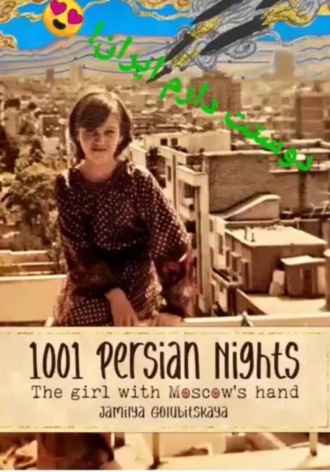
1001 IRANIAN NIGHTS: GIRL WITH MOSCOW'S HAND
I liked the Dodgers less. Who knew that by the time I grew up, the mysterious DOSAAF would disappear into thin air like a ghost, and the «khanum» cars from my childhood would become collector's rarities and would hardly ever be affordable for me.
But thanks to my grace, our Peugeot has remained an «ass» forever. Even my mother called it that, despite the fact that my unintentional mistake caused her to have indecent associations.
The Shah's Tehran was an amazing Babylon of its time: it was especially loved by «firmies» from Germany and Turkey, they owned part of the shops, many were married to Persian women and did not leave even after the victory of the Islamic Revolution. At least not right away. The signs of the Shah's notorious «Westernism», for which Tehran was nicknamed the «Paris of the East», disappeared gradually: the rich Tehran stalls emptied slowly — apparently, the stocks were not small. Modern glass and concrete buildings and avant-garde multi-level overpasses were covered with «graffiti» of religious appeals written in careless large script.
Tehrani are used to Dutch butter, milk and cheeses, Danish yoghurts, ice cream and cakes, English oatmeal and tea, French cosmetics and perfumes, American jeans and chewing gum, and Japanese appliances. They also didn't seem to realize that it was over. In the winter of '80, on Khiyaban-e-Pahlavi (the central and longest street of the Iranian capital, named after the Shah) Studio cassettes with European and American pop music were also freely sold — and no one pointed a finger at those who bought them. They cost pennies, my parents didn't deny me that, and I was very proud of my collection, which included ABBA, Rod Stewart, the Bee Gees, Pink Floyd, and the Rolling Stones. Sometimes the sellers themselves even gave them to me, and this is another memorable sign of Tehran. A child on the shopping streets of the Iranian capital has never been left without a gift: even a sticker, even a piece of chewing gum, but something will definitely be given. At first, my mother tried to forbid me to accept these gifts according to the principle of the Moscow rule «do not take anything from unknown adults.» But soon even she realized that in the East, making offerings to other people's children is an absolutely normal gesture that has no underlying meaning. Iranians are just very fond of children and giving gifts. They do this from the bottom of their hearts and are sincerely offended if their gifts are rejected.
Apart from the «Geupeots» and elegant shop windows, which I had never seen in Moscow, the most from our Tehran life before the Shah’s overthrow I remember meeting his wife when I was eight years old. Once I had a chance to observe Shahbanu with my own eyes, and not alone, but with her youngest daughter. She came to our class while the Persian monarchy and the school at the Soviet embassy were still available. For closer communication, the monarch's wife chose us, the second graders, as she brought eight-year-old Leila with her.
According to the memoirs of Shahbanu herself, at that time she was concerned about the introduction of universal secondary education in Iran and was interested in the foreign experience, attending elementary schools at foreign embassies in Tehran. But at the age of 8, of course, we didn't know about it.
We were warned a week in advance that Shahbanu and a real princess of our age would visit us. We were told not to embarrass ourselves in front of the crowned heads and to behave as we were instructed.
Then a man from the embassy came to us and said that we should be courteous, smile and answer all the questions that would be asked of us. But we had to only answer in Russian, even if one of us suddenly could speak English. The embassy's best translator would be sent to us so that Shahbanu and her daughter wouldn't find out what a terrible English pronunciation we had.
I knew what Leila Pahlavi looked like: Dad showed her to me in a Shah's family photo in a pre-revolutionary magazine. The picture was from Leila's birthday party. That's how I found out that she was born the same year as me, only in March.
I was also surprised: only 7 months older than me — and a real princess!
Mom said back then that I was already slacking off like a princess. It would have been better if I had studied more according to Soviet textbooks and dreamed of becoming an educated person instead of an airheaded princess.
But I still wondered how real princes and princesses and their parents, kings and queens, live.
In the picture of the Shah's family, I liked one of Leila's brothers the most, with an open smile, he was much prettier than the boys from our class. From the caption under the photo, I found out that his name was Ali-Reza and he was 12 and a half years old, older than me by 5 years, just like my dad is older than my mom! Since then, I've always looked in the English-language magazines that Dad brought from the embassy to see if there was anything new about Ali Reza. If I came across his photos, I cut them out and put them in a wooden Khokhloma box that my grandmother sent me for my birthday.
The first beauties of our class, the daughters of the ambassador's advisers, immediately assumed that the princess was terribly conceited, and deliberately agreed not to answer her questions.
«She'll probably wear a crown again!» Julia, the daughter of the ambassador's cultural adviser, snorted. — My mother and I saw a photo of her older sister Farahnaz in a magazine. In the picture, she's still in diapers, and she's already wearing such a crown, bigger than herself! Mom said it cost the budget of a small African country!
«She's supposed to question us according to protocol,» expertly said Lenochka, the daughter of the ambassador's adviser on diplomatic protocol. — And if we keep silent, it will be a failure for her, a diplomatic fiasco! Who's in favor of boycotting this stupid Persian princess?
To be honest, I didn't suffer much when the embassy school closed. At our Moscow English school, at least after I joined it, no one remembered every day who someone's dad was. At the embassy school, day after day, the dads were invisibly with us. All the children were polite and well-mannered, but the attitude towards the offspring, for example, of the ambassador's attaché and the commandant of the embassy was subtly different. Even though we were very small, we felt this difference, and it influenced our attitude towards each other and the world around us.
Everyone agreed to boycott the foreign princess, but when they saw Leila, even the heir to the throne of the ambassador's adviser on protocol relented. She was taller than everyone in our class, even the boys, and she was shy about it, even though she tried to be brave. And the «stupid Persian princess» turned out to be even taller than her, and also much simpler and friendlier!
She came without a crown, in ordinary American jeans, which we all bought in Tehran stores, and behaved as if she did not know that she was a princess.
I remember Leila as thin, lanky, and agile. The princesses of our class found her not very beautiful and therefore not even worthy of a boycott on their part. The princess informed us that she, her older sister Farahnaz and her brother Ali-Reza studied ballet with a Russian teacher named Inga. She was a real choreographer, she and her husband worked under contract at the Tehran Imperial Opera. Madame Inga came directly to their house several times a week and they had great success! But now Madame Inga has gone home, which Leila grieved very much. The princess said that she has been practicing ballet since she was four years old and was not going to give up, so she hoped that she would find a new teacher for herself. But she wanted a choreographer from the Soviet Union! Madame Inga said that Leila had abilities, and the Russian ballet school was the best school!
At that time, I still had no idea that we would move to Bimarestan-e-Shuravi, and miss Tanya would be there, who would practice ballet with me. But I was looking at the little princess, my age, and I decided that I also love ballet and was proud of the Russian ballet school.
Then Leila handed each of us a gift from the Shah's family — a large bright box with the image of a Japanese woman in a colorful kimono. She explained that these were Japanese sets for «sumi-e» — ink drawing on rice paper, her favorite hobby. And she immediately rushed to show us how to use them.
The sets were a real miracle: a huge palette of paints, including the most outlandish colors like «smoked rose», an easel with a stand, 12 brushes of different thicknesses, rolls of delightfully rustling rice paper and stencils for coloring. And everything was so beautiful, glossy, and fragrant that I wanted to start painting immediately, which Leila did. But we held back, as befits happy Soviet children who are not surprised by anything.
While Leila was enthusiastically drawing, Shahbanu explained to our teachers through the «best translator», that sumi-e is an ancient Japanese drawing technique, and it’s very useful for elementary school children. It develops fine motor skills and perseverance, stabilizes the nervous system, promotes the development of taste, a sense of color and harmony. It sounded so convincing that from that moment on, all our parents began to receive sumi-e pictures for all holidays instead of hand-drawn postcards, as was customary before.
Of course: before that, the teacher, in order to protect, as they said then, «her pedagogical reputation in the conditions of a business trip abroad,» had to work with each of us separately, checking our homemade greeting cards to parents. Because if on of us suddenly drew some kind of messy scribble to our attaché dad and signed «CONGRADULASHINS!» under it, and dad turned out to be in a bad mood, the teacher's business trip may have ended there. But here the stencils were ready to use, to color them to your soul’s content. And there were even ready–made signatures — «For My Dear Mummy» and «For My Dear Daddy» in English.
Shahbanu herself seemed incredibly beautiful to me. She was wearing a beautiful dress (our teachers later whispered that it was from Valentino), a kind smile and a beautiful lush hairstyle. Shortly before that, she had achieved the abolition of headscarves for women at the state level and herself served as a clear proof of the freedoms achieved. Her head was uncovered. As our embassy said later, it was with this that Shahbanu provoked the most acute wave of popular discontent. In general, she was loved, she helped the sick and the poor a lot, traveled to hospitals herself, and was not afraid to visit villages affected by plague, cholera, and leprosy.
As the embassy instructor had warned, Shahbanu asked about our lives in English, and we answered in Russian. She listened attentively to our answers.: She looked into the eyes of the person answering and nodded in the right place — even before the translator finished the sentence. I've noticed for a long time that not all adults nod in the right place, even if you speak the same language with them. And Shahbanu's interest in us was sincere: I felt it with some organ that was not reflected in the anatomical reference book. And suddenly I felt such trust in this beautiful stranger, as if I had known her all my life.
Farah Khanum was so exquisite, fragrant and shiny, like a big doll. Standing next to her, I thought that I would grow up and definitely become the same.
Shahbanu wasn't wearing any complicated clothes, but how she had a lot of style! Now I know that it's art — anyone with money can dress expensively, but only a person with innate taste can dress in such a way that the source of your special charm stays elusive.
Shahbanu said that besides the youngest daughter, Leila, our age, whom we have already met, she also has an older daughter, Farahnaz, who is seven years older than us, and two sons– Ali-Reza, who is almost 13, and Reza-Cyrus, who is already as much as 18.
She shared that her children don't always study well, but their Shahanshah dad is very worried about poor grades, so they try not to upset him.
At this point, Leila raised her head from her drawing and made a funny face, depicting how «Shahanshah» was unhappy.
It made me laugh, and once again I found myself feeling as if I had already met this cheerful Leila and her elegant mother somewhere. On the day when Shahbanu and her daughter were drawing in our class, we would never have believed that in less than two years, the crowned father of the little princess would suddenly die in exile, and she herself would be found dead in a London hotel room just twenty-three years later, when she and all of us sitting in this class would be 31 years old. And that since her family's flight from Tehran, Leyla will never see her homeland again in her short-lived life.
As a parting gift, Shahbanu and her daughter presented our school with an entire refrigerated truck filled with «family gallons» of English vanilla ice cream and crates of colorful yogurts with different flavors and pieces of fruit inside.
Shah's treats were given to us as school breakfasts for a long time. I loved pineapple yogurt the most.
Many years later, reading Farah Khanum's memoirs, published overseas (a former classmate brought them to me from the USA), that scene popped up in front of my eyes, as if it were yesterday. With what dignity and kindness Shahbanu communicated with us, how sincerely and openly she smiled, and how little Leila painted pictures given by her mother with us…
Whatever the Persian Shah was from a universal and political point of view, judging by how much his family loved him, he was a good husband and father. Shahbanu called her memoirs «Selfless Love» — for her husband, for her homeland, for her children and for everything she did. In them, she writes that she tried to put love into everything she had to do, and therefore she succeeded in many things. Personally, I believe her.
From Farah Khanum's memoirs, I learned the Pahlavi family's assessment of the events of that time, but it happened much later. And then, impressed by the royal visit to our school, I became interested in the Shahbanu, but I only learned what I could overhear in adult conversations.
The embassy wives gossiped that our singer Muslim Magomayev was in love with Shahbanu. And that said a lot: even my mom liked Magomayev. Almost as much as Vakhtang Kikabidze and Renat Ibragimov, from whom she generally went crazy.
It was also said that Farah Khanum had repeatedly shown noble fortitude and restraint. Envious people told Shahbanu all sorts of things about her husband, but she didn't believe anyone — only her beloved and her heart.
Bimarestan and bimarestants
Rumors of an evacuation to the Soviet Union, which spread in the early January days of the 80s, were soon confirmed. Our ambassador issued an official order to the wives and children of the staff to urgently pack up and make an appointment for the next flights, for which the Aeroflot representative office has allocated special quotas. It was announced that the school at the embassy would no longer open after the holidays. Our teachers, the head teacher and the principal also went home.
But my mom absolutely did not want to leave my dad alone in such a dangerous country. At first, they only wanted to send me back to the Union, but they quickly realized that no one was waiting for me at home. At the same time, it became clear who my mother was so categorical about.
My grandmother, my mother's mother, as categorically as my mother refused to leave Tehran, refused to take responsibility for the «heavy burden» in my person. On the phone, she sternly said that it would take a very long time for the «child» — that is, me — to get from her apartment at the University Street to the school №1, which we value so much. But grandma doesn't want to and can't move in with us either, because «she has her own affairs, habits, neighbors, friends, a clinic, a subscription to the conservatory and seven other grandchildren besides me.» Grandma was understandable, and Mom wasn't even offended by her.
My nanny, Aunt Motya, lived with us in Sokolniki. But she was already very old, she could hardly walk, and when we left, she was even afraid to stay alone in the apartment. She had no relatives, only an old friend, Aunt Asya, who lives near Mozhaisk. Aunt Motya moved in with her during our business trip. She once took me to visit Aunt Asya: she had a spacious house in the village and a large friendly family with children and grandchildren. There was always someone to go to the store, cook, clean, and look after the children and the elderly. We understood that our Aunt Motya would be better off there than alone.
As a result, the family council decided to look for a way to leave both my mother and me in «terrible Tehran», as Dad called it after the title of a famous Persian novel.
The only way wives could avoid being sent to the Soviet Union was by getting a job in one of the Soviet organizations that continue to work in Tehran. And children — only if, at their own risk, their own moms and dads hide them.
Of course, you can't just get a job at the embassy: all the vacancies that were appointed not from Moscow, but through the ambassador, were immediately filled by embassy wives who wanted to earn extra money. And there weren't many such places—a librarian, a bookstore clerk at the embassy club, and a secretary-typist at the embassy school's office. The first two places were occupied, and the school was completely closed.
There were also no vacancies in the trade mission and the State Committee for Economic Relations. There remained organizations like Sovexportfilm, representative offices of Aeroflot, SODa (Soviet Friendship Society) and the Soviet-Iranian bank. When Dad started asking about jobs there, it turned out that their women were also being sent home. There he was also told that the working wives of the Soviet hospital were not being evacuated because there were always not enough hands for the administrative routine conducted in Russian for reporting to the embassy.
As a true daughter of a medical family, my mother enthusiastically clung to this idea, asked my dad to take her to the Soviet hospital, and on the same day she settled into their emergency room, rather than be sent home. But with me, everything was solved even easier: a child at the age of nine will not live alone in a Moscow apartment, it's better not to go to school! That's exactly what my parents decided and kept me with them, under personal responsibility. Before themselves, of course, because the Motherland, represented by our ambassador, did not know about the violation of the order to evacuate children.
They've already had the experience. Shortly before his business trip to Iran, Dad managed to get a summer trip to a sanatorium, which was good for everyone, except that children were not allowed there. However, I had a good rest there with my parents for the entire 24 days. During my morning rounds, my parents hid me in the closet, just like Lillebror hid Karlsson, when Fröcken Bock, the nanny, came into the room. And in case I caught the eye of one of the staff during the day, I was forced to memorize a plausible answer — they say, I spend the night next door in the private sector, and during the day, of course, I resort to mom and dad. To make sure, my parents actually agreed with a woman from the village, to whom I was taken to drink goat milk in the evenings. In the case of a snitch, I could really go to spend the night with her — especially since her daughter Svetka was almost my age and we became friends. Ever since I was five, I've been taking jokes about lovers in the closet very literally, vividly imagining how cramped, stuffy and anxious the poor guys are there.
Thanks to my mother's activity, about a week after the attack on the embassy, the three of us moved from the embassy to Bimarestan-e-Shuravi, the Soviet Red Cross and Red Crescent hospital. The locals called it simply «Bimarestan,» and so did we. And by analogy, Soviet doctors who found themselves in the very heart of the Islamic republic jokingly called themselves «bimarestants.»
At that time, Bimarestan-e-Shuravi had been in existence for more than 30 years, the Tehrani knew it well and trusted the Soviet doctors.
Despite the ideological differences with Shuravi, the Iranians respected Soviet doctors. Our hospital supported itself at the expense of a paid department, where, if necessary, wealthy Iranians who had not left the country could admit themselves. Everyone knew that Soviet doctors had the most accurate diagnosis.
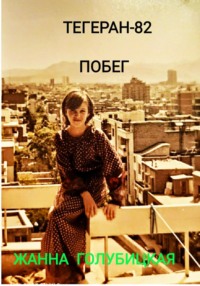
On the territory of the Soviet hospital, as well as in the embassy, the Soviet specialists had their own apartment building. But if the embassy's «housing sector» was located behind a high fence in the «embassy enclave» — the quarter where foreign embassies were concentrated — then the doctors' house stood in the very center of Tehran and was not guarded in any way. Its end faced the wide Karim Khan-Zand Boulevard with a space—like multi-level overpass (it was called «Shahanshakhskaya», since complex road junctions were one of the Shah's main hobbies), and the facade faced a quiet street with an almost Parisian name Villa Avenue. The courtyard of the doctors' apartment building was adjacent to the hospital, which was freely accessible.
But most importantly, what a house it was!
These are now office buildings made of glass and concrete and gray high-rise residential blocks with staircases leading out are considered «faceless», and in the late 70s of the last century they were the height of fashion, like plastics and synthetics.
Our «doctor's» tower, as the locals called it, was a typical representative of the then fashionable «American urban style» and was equipped with advanced earthquake prevention equipment at that time — underground springs. A fan of innovation, when building Tehran, the Shah borrowed the idea of earthquake-resistant «jumping towers» from his American friends. The Americans built such structures in their earthquake-prone areas, in turn, using the technologies of the Japanese, experienced in earthquakes. Even with the smallest tremors that occurred regularly in Tehran, the Doctor's tower began to bounce gently to the beat, which brought me indescribable delight.
Connoisseurs of architecture would have found our house ugly, but in comparison with Moscow's «khrushchevkas» and panel buildings it seemed very modern. Floor-to-ceiling sliding windows and a giant loggia were worth it!
I later met familiar «Tehran» apartment buildings on the outskirts of Manhattan Broadway, in the neighborhoods of London, Barcelona and Rio, built in the industrial 70s. Perhaps it's the open staircases — I find the «native» Tehran buildings in those megacities where there are no harsh winters. Or only there will I recognize it by sight, because for me it has always remained «southern», characteristic of those places where there is a lot of sun.
And then, in the 80s, it seemed to me that I had come to a fantastic city from Dunno on the Moon, where the writer Nosov described the life of lunar capitalists. But I liked everything in our new house — especially the panoramic windows, that were also balcony doors. And the bathroom was the size of the living room in our Moscow apartment and also had a huge window from which Damavand peak looked out at us (the peak of the Elburz Mountain range in the northeast of Tehran, it is also an extinct volcano with a height of 5,671 m, considered the tallest volcano in the entire Middle East).
I was so fascinated by the windows that I almost cried when, a few months after moving to Bimarestan, my mother and I used tailor's scissors to cut rolls of thick black cloth to cover the wonderful view of the north of Tehran and the mountains.
On the first day of the month of Farwardina, or March 21, 1980, together with the Iranians, who count the Solar Hijri, we entered their new 1360th year. And on the last day of the month of Shahrivar (September 22, 1980), the war with Iraq began. From now on, with the onset of dusk, we lowered the blackout curtains, and in conversations among ourselves we quickly got used to labeling the time of events as «before the war» and «at the beginning of the war.» When I said later in Moscow that I had graduated from two grades of school «before the war,» for some reason everyone laughed.