Полная версия
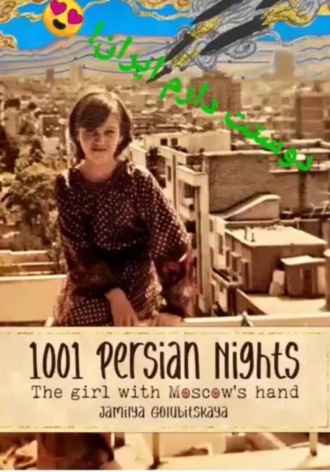
1001 IRANIAN NIGHTS: GIRL WITH MOSCOW'S HAND

1001 IRANIAN NIGHTS: GIRL WITH MOSCOW'S HAND
Soviet childhood in Islamic Tehran
«One thousand and one» is the Persian aphorism for «very much», «more than enough». Russians would say «a wagon and a small cart», the British «more than enough» or «a whole crapload».
How It All Started: An Introduction to the roaring 1360s
There is always an image of the narrator in Eastern prose, but don't let the pronoun «I» confuse you: my stories are not about me, but about those around me. As in the real One Thousand and One Nights, my eyes and mouth are needed here only to tell you first-hand what I saw with my own eyes.
In Russia, they didn't believe that I could remember that time so well more than 40 years later. But the Iranians believed it right away. They said it was no coincidence that I kept my Tehran diary at the age of 9, which is Aisha's age. And they believe that I understood everything exactly the way I'm telling you now. Thank them for that.
The Tehran period described below remains only in the dry exposition of textbooks on the history of the Middle East. To date, only three people have written impersonal memories of that controversial and difficult period of Soviet-Iranian cooperation — a former ambassador, a resident and a traitor (as you know, there are no former people in these fields, they are just dead).
The latter was a Soviet intelligence officer until the summer of Tehran in 1982, and in June, before our eyes, he turned into an English spy. In the Soviet Union, he was sentenced to death (in absentia, as he fled to London), and in the West he was declared a fighter against communism, who foresaw the imminent collapse of the rotten Soviet system. It is not known for certain whether he is alive now, but the «democratized» Russia has not forgiven the Soviet traitor and considers him dead.
As for the Soviet ambassador to Iran at that time and the resident of Soviet intelligence, the first died in his own bed, and the second shot himself in his office. But much later than the events described.
The memories of all three «exes» are contradictory for obvious reasons, but they are united in one thing — they all, each in their own way, speak in high words about things of, as Professor Preobrazhensky would say, «cosmic importance.» And now a fourth eyewitness is added to the company of the ambassador, the resident and the defector — a Moscow junior high school student who remembers them all perfectly. Unlike his predecessors, the fourth eyewitness saw all the same things with an untainted child's gaze. When he was little himself, he saw how the little people lived, how they coped, and how they saw this most «cosmically important» thing — not only because of their age, but also because of their ability to influence the situation (which is still classified as «secret» in the Russian Federation).
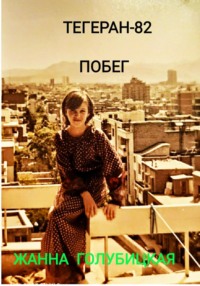
A nine-year–old schoolgirl went through this story, and as a 49-year-old journalist she put it down on paper — but it's still the same girl, it's just that today she has more life experience. But in her youth, she was much more prescient: in Tehran in the 1978-1982's, she scrupulously kept a personal diary, dated the pictures and carefully put them in a chronological photo album. That's why the atmosphere of that ambiguous time has been recreated down to the smallest detail: despite all its nightmares and bloodshed, the author remembers and loves that time — as we all love our childhood, happy or not.
* * *
Tehran, I'm dreaming about you.
The memories of you are dear to me. That's why I decided to write this book.
When I hear the adhan, the call to prayer, I still imagine a red ball that had heated up during the day and was now quietly smoldering, tiredly rolling over the dark gray broken line of the Elburz. And I see darkness descending on the city– sudden, as always in the east. It was this picture that I watched from the bathroom window day after day.
I have never seen windows in Moscow bathrooms. In Tehran, we had a huge bathroom with a large double hung window facing north. We lived on an elevated floor, and the bathroom had the best view of the northern fashionable areas in the foothills of Damavand (Damavand is a dormant volcano in the Alborz Mountain range in northern Iran, in Mazandaran province at an altitude of 5870 m above sea level, the highest point of Iran and the entire Middle East).
I liked to lock myself in the bathroom, turning on the water as if I were bathing (my mother forbade me to lean out of the window) and, dangling my legs, sit on the windowsill at sunset, when Tehranis came out with hoses to water the sidewalk in front of their houses.
By evening, the asphalt was hot as a stove, hissing and sending out clouds of steam. Steam rose into the air, mixing with the aromas of spices, the mountains in the north twitched with a haze, lilac-white and light, like the chador of an unmarried Persian woman.
And at the very moment when the smoldering disk was falling heavily behind Damavand, prayer was spreading over the city.
Echoing from speaker to speaker, the penetrating sounds went up to the mountains and disappeared somewhere where our prayers are taken into account.
Meanwhile, the city, bypassing the dull gray twilight, almost instantly, like a Persian girl putting on her chador, threw on a thick fragrant veil of a warm evening. These always sudden Tehran evenings, which turned into velvety nights, seemed to me multidimensional, mysterious and full of secrets. And as soon as a cunning crescent moon hung in the black, motionless sky, looking promisingly at our windows, we lowered the blackout curtains. Since the beginning of the war, this has become an indispensable ritual.
The war began on the last day of the month of Shahrivar and lasted for eight long years. But the evening adhan was still the most exciting.
The Adhan sung by Persian reciters is considered one of the most beautiful in the world. And in me, its sounds, both then and now, almost 40 years later, invariably awaken both anxiety and tenderness, quiet sadness and calm wisdom.… And some other feeling that I can't put a name on. Something similar to the «exit to the upper world,» as esoterics describe it today.
The sounds of the adhan still bring me back to that time and place.
Unfortunately, in all these years I have not been able to share my Tehran stories for various reasons. And hardly anyone, except for those who were there and then, would be able to appreciate their peculiar humor and adventurism.
I remember how my Tehrani friends and I had fun laughing at the story of how my mother brought the top of the Kurdish liberation movement out of hiding.
And a few years later, when I tried to make my peers in Moscow laugh with the same incident, they just stared at me, wondering if I was completely crazy or just an impudent liar.
But since I've carried my Tehran stories through almost four decades and they still bother me, it means that they need to be told. Moreover, the statute of limitations has long expired.
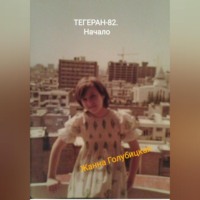
I lived in Tehran from 1357 to 1361.
The year 1357, according to the Solar Hijri, occurred in Iran on the first day of the month of Farvardin — March 21, 1978, by our standards.
And the Iranians celebrated their new 1361 on March 21, 1982.
I was born at the end of 1970, so it's more convenient for me to remember how old I am using the Solar Hijri. I was seven in 1357 and ten in 1360. The first jubilee in my life, the round date of the Solar Hijri, is a beautiful title for a book. But it describes not one year, but almost five.
These years were crucial for Iran — and for me too, because I observed all the Iranian «fractures» from the inside.
Our childhood games intertwined with reality, reflected it, sometimes forcing us to grow up ahead of time.
In 1358, I was eight, and I dreamed of a thick and beautiful American notebook with steel rings, which I spotted in a Tehran bookstore. Soviet children never dreamed of such things. It was quite expensive, and Dad said he would only buy it for me for something useful. I quickly blurted out that I was going to keep a personal diary. Dad bought a notebook, and I really had to start the diary.
That treasured notebook is still with me, and almost 40 years later, it began to irresistibly beg to be turned into a book. No wonder they say that times repeat themselves.
It can be seen that the wheel of history has turned, and what happened to Iran from 1357 to 1361, and to us from 1979 to 1982, is becoming relevant again.
Reference:
Tehran is the capital of the Islamic Republic of Iran (until 1935, Persia was one of the oldest states in the world, until 1979 Iran was a monarchy).
Shah of Iran Mohammad Reza Pahlavi, who ruled the country from 1941 to 1979, became the last monarch of Iran. The Shah's policy was aimed at actively modernizing the country and was considered "pro-Western" in religious circles. During the reign of Shah Mohammad Reza Pahlavi, Tehran became known as the "Paris of the East," and Shah Reza himself played a prominent role in the secular life of the whole world. All three wives of Shah Pahlavi were trendsetters not only in their own country, but also abroad – secular beauties from all over the world looked up to their exquisite dresses. For the first time in the history of the Persian monarchy, Shah Reza Pahlavi officially crowned a woman, his third wife Farah. Shahbanu (Empress) Farah Pahlavi will turn 80 on October 14, 2018.
Shahbanu actively developed culture, education, medicine in the country, defended the rights of women – in particular, she freed them from the mandatory wearing of "chador" – Muslim women's clothing common in Iran. This turned out to be one of the "last drops" in the cup of indignation of those who did not like that the shah's family was leading the country away from the titular religion.
As a result of the 1979 Islamic Revolution, spiritual leader Ayatollah Khomeini came to power. The shah's family and most of the intelligentsia fled the country. As is usually the case, the country, exhausted by the revolution, was immediately attacked by the territorial claims of its closest neighbor, Iraq. The Iran-Iraq armed conflict, known as the First Gulf War, broke out.
On November 4, 1979, Tehran students, followers of Ayatollah Khomeini, broke into the US Embassy in Tehran and took 66 people hostage. The reason was that the United States gave an entry visa to the fugitive Shah Pahlavi for medical treatment on their territory.
On January 1 and December 27, 1980, attacks took place on the USSR embassy, but there were no hostages.
But even then, many world politicians were sure that in Iran, which was already accustomed to the Western way of life, Islamization would fail miserably and the Shah would return, having received Western help (this had already happened in the 50s of the XX century).
However, today Iran has been an Islamic republic for almost 40 years.
Shah Mohammad Reza Pahlavi died in exile in Cairo in 1980.
Shahbanu Farah lives with her older children and grandchildren in the United States, where in 2003 she published her memoirs, Selfless Love, about her love for the motherland and for the late Shah. Formally, in Iranian immigration circles, the official heir to the Persian throne in exile is the eldest son of the Shah's couple, Reza Pahlavi. Informally, the diaspora considers Shahbanu Farah, who is approaching her 80th birthday, to be the head of the Pahlavi house. The living legend of the Persian monarchy tells her grandchildren about Iran and is very worried that they have never seen their homeland. Shahbanu herself and her children have not seen their native Tehran since that fateful year 1358.
Iran lives according to the solar calendar (the Solar Hijra is used only in Iran and Afghanistan, all other Muslim countries use the classical Islamic calendar – the Lunar Hijra).
According to the Solar Hijra, the Islamic Revolution won in Iran in 1357 (February 1979), 1358 (03/21/1979 – 03/21/1980) became a transitional year, and on the last day of Shahrivar 1359 (09/22/1980), the war with Iraq began, which lasted 8 years.
After 6 years, it turns out that, despite the hostage-taking of American diplomats in Tehran and the mutual hatred of the peoples, for all 8 years the United States secretly supplied Iran with weapons and spare parts for military equipment. And the Soviet Union, openly condemning Saddam Hussein's invasion of Iran, has been arming Iraq for 8 years, bound by the 1972 treaty of friendship and cooperation and its own interests in the Middle East region.
On March 20, 2024, the month of Farwardin of 1403 began in Iran.
Legends and Myths of the Soviet Embassy in Tehran
In 1978, the grandest adventure of my childhood awaited me — a trip to fabulous Persia, which in the process turned into a revolutionary, and then Islamic and war—torn Iran. My dad was sent there for work, and he took my mom and me with him. If for my parents, who were in their early 30s at the time, a period of 5 years was just a «long business trip,» then for me, who had lived in the world for only 8 years, it was not a trip, but a part of life comparable in importance to the previous one. It is believed that a child begins their «journey into society» (observes, evaluates and absorbs the vibrations of the environment not only inside their family, but also outside it), from about the age of three. That is, at the time of my departure to Tehran, out of my eight years, I had lived 5 conscious years in Moscow. And then exactly the same amount in Tehran. Thus, by the age of 13, Moscow and Tehran were equally familiar and unfamiliar to me. That is why I call the Iranian «five-year plan» not a trip, but an important part of my childhood, which influenced me no less than the Soviet part of it.
Now we can admit that it was me who brought two bottles of Soviet wheat vodka to the territory of the young Islamic Republic of Iran in 1979. They were in the bodies of two large walking dolls from the Detsky Mir on Dzerzhinsky. I turned nine the day before, and the dolls from my girly dreams were given to me for my birthday. I held the toys to my chest so touchingly at the customs inspection that it didn't even occur to the Iranian border guards to check if they had anything in their stomachs.
We were just returning to Tehran from vacation. Before the Islamic Revolution, there was no need for such smuggling: the Iranian capital was full of restaurants and liquor shops. But after the new government introduced prohibition, Russian vodka became the best gift to colleagues from homeland.
Then I was unknowingly used: of course, I didn't know about the alcoholic stuffing of my favorites. And I learned about my feat in the name of Russians’ love for booze much later. At the time, I was just surprised by the sudden generosity of my parents. Before my trip to Iran, I dreamed more than anything of a wonderful, magical doll that can walk if you put it on the floor and take it by the hand! I saw one first at a friend's place, and then several of them in the window of Detsky Mir, and I lost my peace. But then, no matter how much I begged, they didn't buy me a walking doll. After all, Lena, the one who is a little shorter and less elegant, cost as much as twelve rubles. And gorgeous Nina—all sixteen!
But after living in pre-revolutionary Tehran for a year, I saw and felt so many different «barbies» who bent and sang and had their own houses and cars that dolls from Detsky Mir no longer struck my imagination. But Hodja Nasreddin was right when he said: to get something, you have to lose interest in it! When I stopped dreaming about a walking doll, they suddenly bought me two at once — Lena and Nina. I was allowed to take them with me to Tehran, despite the fact that they took up a lot of space, and a year ago, my mother took almost all the toys I had collected out of the suitcase. And I don't know which one of my parents packed Lena and Nina for the road.
My parents and I lived in the embassy in the center of Tehran, where the Russian ambassador Alexander Griboyedov was killed in 1829 (later I will explain this point, which causes heated debate among those who are familiar with the history of the death of the Russian classic), and in 1943 the «big three» met. We, the embassy children, who played on the historic lawns, knew a little more than ordinary children: where Stalin spent the night, what Roosevelt drank, how Churchill had fun, where Griboyedov's imperial porcelain had gone, and what British intelligence was up to again.
Before the Islamic Revolution, the Tehran address of the Soviet embassy seemed strange to some — «USSR Embassy, Tehran-Iran, Churchill Street, corner with Roosevelt Avenue, 39.»
The Soviet embassy was located with one side «on Churchill» and on the other «on Roosevelt» due to the fact that during the legendary Tehran Conference in 1943, Roosevelt stayed at the Soviet embassy — in the very building where the conference itself was held. And Churchill spent the night at his embassy, which, as our diplomats joked, «is always close by.» Old-timers in Tehran say that the diplomatic missions of the USSR and Great Britain, despite the absence of any obvious ties, always stayed close to each other in Persia. And as soon as the Soviet, and before it, the tsarist diplomatic mission, slightly changed its location, an English neighbor soon appeared nearby under some pretext. Even Her Majesty's Ambassador ordered his summer residence to be set up next to Zargandeh, where we moved for the summer, led by our Extraordinary and Plenipotentiary. The British Embassy in Tehran is still located next door to the Russian one.
Of course, after such dignified overnight stays, the three streets closest to the epicenter of the historic event received the names of the participants of the «big three». The main entrance to our territory was from Churchill Street, and the small entrance was from Roosevelt Avenue, which is why the embassy's address sounded so strange. And opposite our small entrance, on the opposite side of Roosevelt Avenue, is the US Embassy.
Of course, Stalin was also involved: he, as we joked, lay directly perpendicular to Churchill.» The street on which our embassy club stood was named after him, in the building of which the Soviet leader spent the night in '43. It started from the main gate of the embassy and went towards the elegant Naderi shopping Avenue, named after the Persian Nader shah.
Given the close proximity of the Tehran «diplomatic enclave,» we were literally over the fence on that fateful November day when 66 employees of the American embassy were taken hostage. And on that joyous January day when they were released (the capture took place on November 4, 1979, and they were all released on January 20, 1981). For 52 of those captured (with the exception of 14 previously released women, black people, and one gravely ill American), their own embassy became a prison for 444 long days.
And even though the Americans were ideologically considered our enemies and were going to boycott our 1980 Olympics, we felt sorry for them. Just like us, they had families, children, and a school.… And then there were only hostages left, and we unwittingly projected their fate for ourselves. Although before the seizure of their embassy, it seemed to us that what was happening in Tehran did not particularly concern us foreigners. It was like watching an action movie through the bars of the embassy gate. Moreover, the first attempt to seize the American embassy took place under the Shah, in February 1978, and was unsuccessful. The attackers were quickly neutralized, and the local press accused a tiny group of «young people confused by communist ideas» from among students at the University of Tehran of organizing «hooliganism.» We believed it, because a year (minus one day) before the seizure of the American embassy, on November 5, 1978, the entire Soviet diplomatic corps watched in fascination as a student demonstration smashed restaurants and shops selling alcohol on Lalezar Street next to us. They poured alcohol right on the road, and our whole neighborhood breathed the fumes of that demonstration for a long time. The demonstrators threw several cans of imported beer over the fence of our embassy, shouting: «Choke on your poison, shaitans!»
The «Shaitans» embodied by our guards gladly drank these cans to Khomeini's health. Of course, good German beer was never seen in the Soviet Union.
After that, a platoon of the Shah's army was stationed on our territory for some time. The young soldiers, although they were Shah's, apparently also suspected shaitans in us. The girls and I went to the commandant's office on purpose to tease them, but they stood with stone faces, like steadfast tin soldiers. And we were very surprised when, three days later, we saw that the Shah's soldiers were kicking a ball around the playground with our boys. They didn't react to the girls' harassment, but they couldn't resist the offer to play football. After a friendly match, the soldiers even let our boys hold their guns.
Then the military government appointed by the Shah allegedly managed to stop the young revolutionaries by explaining to them the world rules of diplomatic relations. And we hoped that they would no longer attempt to assassinate foreign diplomats, bearing in mind our inviolability. But that was not the case, exactly a year later everything happened again.
The very next day after the capture of the American hostages, on November 5, 1979, the invaders descended onto our British neighbors. The windows of our apartment building overlooked the territory of the British embassy, and then we all, young and old, poured out onto the balconies and watched the attack with our own eyes. As the crowd stormed the gates, smoke bellowed from the main building of the British mission, as the British burned their secret documents. Then the gates collapsed and the black crowd, like a huge cloud, covered all the English lawns. It was especially scary when the invaders noticed us on the balconies, with cameras in our hands, and shouted: «Why take pictures, you're next, you'll see for yourself!» Fortunately, they did not take the British hostage, but they destroyed the embassy. They then spent a long time tinkering on their territory, repairing the damage.
We were nearby on the January day when the Shah's family fled the country (January 16, 1979), and on the February day when the spiritual leader of the revolutionaries, Ayatollah Khomeini, returned to Iran after 15 years of exile, and the Islamic revolution was declared victorious. At that time, our people were surprised that it took only a year for the elder Khomeini to overthrow the Shah, whose power seemed unshakable despite all the unrest.
Since January 1, 1980, in just one year we have experienced three attacks on our own embassy and the beginning of the Iran-Iraq war with endless airstrikes, the eerie wail of sirens and blackout. In the first months of the war, Iraq did not tire of bombing the Iranian capital, and it did so from airplanes with red stars on the side, bought from the USSR.
But for us, five children who, for purely familial reasons, were not evacuated to the Soviet Union, because of our age, all this were just everyday life «in the neighborhood,» and our children's games involuntarily echoed the harsh reality of non-children. So instead of the traditional cops and robbers for children, we played Khomeinists and Tudeists (supporters of Ayatollah Khomeini and the Workers' Party of Iran TUDEH). And when Iraq started bombing us, we started playing «Saddam.» There were plenty of topics for outdoor games for kids, for whom someone else's revolution and war had become a daily routine.