Полная версия
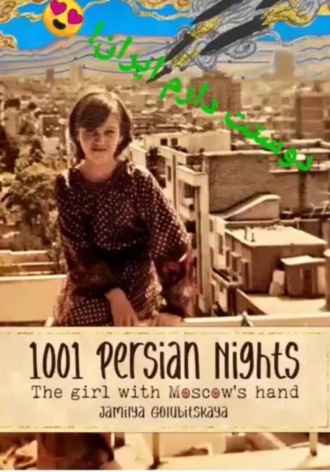
1001 IRANIAN NIGHTS: GIRL WITH MOSCOW'S HAND
The Islamic Revolution has also changed the toponymy of our area. After their victory, we, along with the French embassy, ended up at 39 Neauphle-le-Château. However, the new regime renamed our Churchill Street in the French manner not at all to please French diplomats, but in honor of the Paris suburb that briefly sheltered the fugitive Imam Khomeini. The Ayatollah lived in this town in the northern French department of Ile-de-France for three months in 1979, when Iraq had already sent him away, and Iran was not expecting him back yet. Straight from there, the holy elder returned to Tehran, thus marking the victory of the Islamic revolution in Iran.
On December 28, 1979, the Soviet invasion of Afghanistan, which began on December 25, ended, and on January 1, 1980, early in the morning, crowds of bearded men broke into the Soviet embassy in Tehran, tearing down the gates. First of all, they tore down and set fire to the Soviet flag. And a white banner with a black inscription «Allahu Akbar!» was hoisted on a high flagpole in front of the central entrance to the USSR Embassy.
While the Soviet diplomats were walking away from New Year's Eve, the barbarians smashed everything in their path and threw stones at our windows, shouting that they were «Afghan patriots outraged by the military invasion of their homeland by Shaitan Shuravi.»
At that time, the pasdars (pasdaran-e-engelob — guards of the Islamic Revolution) came to the aid of the guards of our embassy and managed to repel the attack fairly quickly, preventing particularly large-scale destruction. Only the entire commandant's office was blown to smithereens: furniture, telephones, security cameras, an alarm system — everything was blown to pieces.
The gates were later repaired, the windows were put in, the garbage was removed, and it was assumed that this was provocation. So far, they only wanted to scare us. Most likely, the attackers themselves received orders from above not to aggravate the situation. Otherwise, why would the Pasdars help the «little shaitan» embodied by us?! And what could a dozen of our guards do without them against an angry mob of religious fanatics?!
Our diplomatic corps gathered for an emergency meeting, where they announced that so far we are only being scared, and the worst, of course, is ahead. It all started the same way with the Americans, who are still being held hostage.
We children learned about what was happening around us from our parents' conversations and discussed it among ourselves as urgent news — there were no others.
On the second day of the new 1980 Olympic year for Moscow, rumors began to spread that repeated attacks were expected in Moscow, and our ambassador received a command to send all children and women who had not been sent by Moscow, but who had come as wives and mothers, to the Union on the next flights.
The adults again remembered the unfortunate American diplomats who were locked up two steps away from us, in our embassy district of Tehran, and recognized that this measure was justified. Apparently, a second attack on our embassy should be expected very soon.
We didn't know then that the first attempt to seize our embassy would take place on April 27, the anniversary of the Afghan revolution and two days after the American military operation to rescue the hostages had failed miserably. At that time, our embassy would be wrecked a little more than on January 1, 1980, but Khomeini's pasdars would once again help our guards escort the rampaging barbarians away.
But next new year, on the anniversary of the entry of Soviet troops into Afghanistan, no one will help us anymore.
On December 27, 1980, a crowd hundreds of times larger than the one a year ago broke into our territory, once again demolishing the gates, which had already been reinforced twice over the past year and eventually became completely metal. This time, the situation was much more serious. Afghan refugees, outraged by the occupation of their country, have joined the students, religious fanatics and migrant workers.
Gigantic crowds of angry people, like clouds of black locusts, destroyed everything in their path shouting «Marg bar Shuravi!» («Death to the Soviets!» — Persian), «Marg bar Amrika!» (Death to the Americans!) and «Allahu Akbar!».
They pushed through the barbed wire on our fence, feeling no pain and ruthlessly throwing and crushing each other. It was a small dogpile, terrifying in its folly, armed with clubs, stones and knives, and in linen trousers, such as are worn by holiday-makers today. They would resemble fairy-tale robbers if it wasn't so scary.
As we were later told, the news took three seconds on the Soviet «Vremya» program: «In Tehran, the USSR state flag was insulted, and the embassy building was damaged.» In fact, the invasion lasted for several hours.
The attackers slashed and burned our red flag, and then, in the middle of the working day, broke into the main building of the embassy, into the very reception hall where the historic Tehran meeting of the big three took place in 1943. To begin with, they smashed a marble memorial plaque dedicated to this historic event, and then they began to destroy everything that they could lay their hands on. They smashed a collectible porcelain set, from which Stalin, Churchill and Roosevelt helped themselves in '43, and knocked down a chandelier that still remembered Griboyedov.
Accustomed lately to bombing, blackout and attacks, Soviet diplomatic workers stole fragments of that rare lighting device right under the noses of the raging fanatics to have as keepsakes. But none of our people took the valuable paintings from the famous embassy hall home, and the barbarians cut up those rarities with knives.
In Iran, according to the accepted chronology of the solar calendar (Hijri), the year 1359 was then, it came on the first day of the month of Farwardin, which to us is March 21, 1980. It became the most fruitful in upheavals: by the beginning of the Iranian 1360th, which according to the Gregorian calendar fell on March 21, 1981, the attacks on foreign embassies, the civil war caused by the revolution, local civil strife and political assassinations had already died down — and exhausted by all this, Iran plunged headlong into the war that began in September 1980 with Iraq. But back then, no one even imagined that it would exhaust the country for eight long years.
We lived in the same embassy in the center of Tehran where Russian Ambassador Alexander Griboyedov was assassinated in 1829, and from November 28 to December 1, 1943, the first conference of the «big three» leaders of the three countries — Stalin, Roosevelt and Churchill — was held during the Second World War. There was a chandelier in the embassy's reception hall that remembered Griboyedov. All this was told to each newly arrived employee, and they, in turn, shared the place they had come to in letters to their relatives who remained in the Union. From time to time, there were particularly meticulous history experts who claimed that in 1829 there was no Russian embassy in the place where it is now. This means that neither Griboyedov could have been killed there, nor the chandeliers that remembered him could have hung there.
Of course, I am not a historian, and I have not studied the history of the death of Russian Ambassador Griboyedov in Tehran in depth, but I have been «soaking» in Tehran's realities for the whole five years, even as a child. Accordingly, without claiming to be the ultimate truth, I am passing on how this story was presented to us, the children of the staff of the USSR Embassy in Iran.
For all the Soviet people who worked in Tehran in the 70s and 80s of the last century, Griboyedov was not just a writer from a school curriculum, but a man who served the Motherland in the same place where they were. Even the embassy's kindergartens were shown the monument in front of the old embassy building and explained who it was and why it was sitting there. It was said that the Russian classical poet, composer, and friend of the Decembrists, Alexander Griboyedov, was also a diplomat, served as the envoy of the Russian Empire to Persia, and it was in Tehran that he died in the name of duty and Homeland.
As children, we associated him with our current ambassador, Vladimir Mikhailovich Vinogradov, the most important person in the embassy, and we understood how important and responsible, but also dangerous, his post was.
It is likely that this heroic picture had its own ideological and topographical distortions in favor of the morality of the builders of communism, but the truth is still somewhere nearby.
The bronze Alexander Sergeyevich Griboyedov is still sitting in his usual place in Tehran — in the embassy park, in an armchair opposite the entrance to the former main and now memorial hall of the old embassy building.
And near the entrance to this hall there are two memorial plaques, reminding of the events that took place in this place, which turned the course of history. One of them is dedicated to the legendary meeting of the «big three» in Tehran in 1943, and the other reports that Envoy Alexander Sergeyevich Griboyedov died here in the early morning of February 11 (January 30, old style), 1829, at the hands of an angry mob that attacked the Russian embassy.
Although, admittedly, there has been a debate among historians about the exact location of the Russian embassy in the 19th century and, accordingly, where exactly Griboyedov met his death, has been going on for the second century. The fact is that after the massacre in the building of the Russian mission in 1829, there was not a single living witness to the tragedy — with the exception of one traitor, who may have set it all up.
The few surviving documents of that time indicate a certain Baghe Ilchi Lane (translated from Farsi as the Ambassador's Garden) as the location of the very «mansion of the Russian mission», where the fatal February day in 1829 took place. According to these sources, the house of one of the Iranian nobles was located in this alley, which was provided to Griboyedov and the accompanying delegation of Russian diplomats only for the duration of their visit to Tehran (the permanent residence of the Russian diplomatic mission at that time was located not in Tehran, but in Tabriz, which at that time was the capital of Persia).
When I returned to Tehran for the first time 21 years after leaving in 2003, and again after 33 years, in 2015, I both times honestly asked the Tehran old-timers where the pile (lane) was located. But no one remembered such an alley. Nor could they show me the mansion, or even the place where it once stood. The most well-informed know only that «it seems that the Russian ambassador was killed somewhere in the area of the Bozorg bazaar.» But the huge Bozorg, in fact, is a city within a city in the very center of Tehran, and it begins not far from the street where our embassy was located during the meeting of the Big Three in 1943, and during the five years that I lived in Tehran, where it still operates today.
After the assassination of Griboyedov's envoy, the Persian Shah sent his own grandson as a messenger to the Russian tsar — a sign of reconciliation with many expensive gifts, among which was the famous Shah diamond (an 88.7 carat yellow diamond, mined in India, which first owner acquired around the year 1000). After receiving such a generous gift, Nicholas I replied to Shah Fath Ali's envoy that «the bloody incident has been forever forgotten.» In light of this, the new Russian ambassador, who replaced Griboyedov, who was literally torn to shreds, did not clarify the painful moments in the form of the exact location and circumstances of his predecessor's death. And he did not tell his subordinates to do it either, so as not to stir up the shaky Russian-Persian world once again.
The diplomats of Soviet Russia, who replaced the tsarist diplomatic mission after the revolution, allegedly inherited this position from their predecessors. Although, more likely, they weren't particularly interested in the specific site of the massacre. However, one of the Soviet ambassadors of the Brezhnev era, in order not to remind Iranian official visitors of the barbarity committed by their side, even removed the monument to Griboyedov from the entrance to the memorial hall. The bronze Alexander Sergeevich was then moved to the staff's apartment building — fortunately, not for long.
And the mansion where the massacre that claimed Griboyedov's life took place was most likely destroyed by the Persians themselves. For the same purpose, to not keep painful memories or pour salt on the barely healed «wounds» of Russian-Persian relations.
And since that street and that house have disappeared without a trace from the map of Tehran, I personally see no point in stirring ashes in disputes about the precise coordinates of the death of the Russian ambassador on the map of Tehran. Moreover, my novel does not pretend to be an accurate historical guide. The most important thing for me is that both Soviet and now Russian diplomats cherish the memory of Alexander Sergeyevich Griboyedov — a monument, a memorial plaque, and a separate lesson is still dedicated to the tragic massacre at the Russian mission in the embassy school.
And today, for compatriots working in Tehran, as well as for their family members, including the youngest, Alexander Griboyedov is not just a classic, but also a colleague who died in the line of duty.
It is no coincidence that when the Soviet embassy was attacked, now in my memories — first on January 1, and then on April 26 and December 27, 1980 — the entire Soviet colony first recalled the circumstances of Griboyedov's death. Angry crowds of religious fanatics also rushed in, destroying everything and everyone in their path. And here is the irony of fate — it was them who dropped and smashed the famous «Griboyedov» chandelier in 1980.
But where did it come from?
Again, without pretending to break the ultimate truth, I'll just tell you what was said about it at the USSR Embassy in Tehran in the 70s and 80s of the past century, and what was told to us, the children, so that we could feel the historical spirit of the place we are in, and could be proud and feel involved in great things. And, therefore, be more interested in native history.
Shortly after the tragic death of the Russian ambassador, the Russian diplomatic mission finally moved from Tabriz to Tehran, as the shah's court moved there and, accordingly, moved the capital. Along with other mission property, the so-called «Griboyedov» chandelier was also moved from the old residence to the new one. At the embassy school, we were told that the Russian tsar awarded his envoy to Persia with this huge and bulky structure made of especially valuable crystal for some special merits. We were even taken to the memorial hall to look at this chandelier as a museum exhibit, because it was so old that it even remembered candles and gas burners. And hanging in the negotiating room of the Russian embassy, it «watched» many people who have gone down in history — from its donor, Russian Emperor Nicholas I, the Persian Shah Fath Ali and his son Prince Mirza Abbas, with whom the diplomat Griboyedov negotiated, to all subsequent rulers of Persia and Russia's Extraordinary and Plenipotentiary Envoys in Tehran.
The urban — or rather, embassy — legends passed down from one embassy to another were not only about the chandeliers and fine china sets in the memorial hall, but also about the oldest embassy building.
In the first months after my arrival, I was enlightened about this by a nine-year-old friend, who at that time had been living with her parents at this embassy for the third year.
The Soviet embassy built a new office building only in the 70s of the past century. Before that, all our diplomats huddled in one room, which was rich in history, but not too spacious. At that time, the current memorial hall served not only for formal receptions, as it is now, but was an ordinary working space of the embassy.
As a friend told me, local construction workers were invited to erect a new office building, which was planned to be connected to the old building by a long corridor, and our staff monitored them in large numbers. From morning to evening, the site was crowded with a whole bunch of people — Soviet construction specialists, representatives of the economic and engineering departments of the embassy and the office of the military attaché. And all of them, according to her friend, saw the dead with their own eyes!
The remains of several people were discovered immediately when the bulldozer had just begun to dig the excavation.
— Apparently, these were the freshest of corpses! Elka suggested in an ominous whisper. — And then they went on to dig out skeleton after skeleton! It's been a long time coming. At that place, a hundred dead were buried in the ground! Now I'm afraid to go there at all!
— But how do our dads work there? I was worried. «They must be scared!»
— What's it to them? Elka waved her hand. «They're sitting on their bones and scribbling their papers.»
A friend told me that the embassy doctor at the time suggested that the excavated remains had been lying in the ground for several decades. The staff was alarmed and reported this to the ambassador. After learning what was going on, the ambassador gathered the entire team and officially forbade discussing this topic even among themselves. The case was silenced, so no one really knows who these corpses are or where they came from. But the rumors, despite the ban under threat of deportation to the Soviet Union, were still passed from mouth to mouth, from generation to generation of Soviet diplomats and embassy children.…
Impressed, before going to bed, I told my dad about the corpses under his workplace. I didn't even bother scaring Mom, but I felt it my duty to warn Dad. However, he took my warning lightly and said that it was all «children's fairy tales.»
It is possible that some of what was passed from mouth to mouth to each newcomer was actually more of an «urban legend» and an embassy story. And what was told about the joint Persian-Russian story to Soviet children at the school at the Soviet embassy, which performs its diplomatic function in the very place where this story unfolded, was ideologically «retouched.» But we didn't think about it: I think at that age, the history of relations between Persia and Russia would not have been interesting to me at all if I had been anywhere else in the world. But in Tehran, every story gained a special charm simply from the fact that you live your ordinary life right where such great things once happened.
A landmark in the sense of local «myths and legends» of the Soviet embassy in Tehran was Zargandeh, a place in an expensive area in the north of Tehran, where the summer residence of the Soviet embassy was located (and is located to this day). We moved there from May to September. Our people said about Zargandeh that, unlike the embassy's territory, it was «a piece of Soviet land», so these 20 hectares in an expensive picturesque area at the foot of the mountains were not provided to us by the Iranian side for summer residences, but even before the revolution of 1917, our Cossacks won from the Persians in a card game, whose brigade was stationed there. At the turn of the 19th and 20th centuries, the freelance units of the Cossack brigades of the Russian tsar actually served for hire in the Persian army, and their old stables were even preserved in Zargandeh. The Shah began to hire them after twelve Don Cossack regiments, two Black Sea regiments, Cossacks from the Caucasian line and several hundred Astrakhan Cossacks defeated his army in the Russian-Persian War of 1826-1828. Then, in February 1828, Russia and Persia signed the Turkmenchay Peace Treaty and never fought with each other again.
Whether it's true or a myth, the Iranians avoided Zarghandeh even during their revolution — that is, almost 70 years later. In the most acute political moments, they broke into the territory of the USSR embassy in the center of Tehran and destroyed it, but never in Zargandeh! Although they knew perfectly well that the same people were sitting there as in the embassy, along with their families. We believed that such an attitude was the respect of the Persians for gambling debt, and it was difficult to even think of another reason.
In our memory, only once did two local young men climb over the Zargandeh fence and climb into the cottage of one of our families. Everything was turned over, but nothing was stolen. They were probably hapless thieves who believed that Soviet diplomats lived very rich lives. But as they went through all their stuff, they didn't find anything interesting for themselves.
«GEUPEOT» and Shahbanu
Immediately upon arrival from Moscow, Dad was given an official Peugeot, which was very luxurious for its time. Our embassy has just purchased a batch of brand-new white Peugeot cars. I got into a foreign car for the first time in my life and I really liked everything. Especially the tape recorder, into which you could insert a cassette and drive to your favorite music.
In my very first letter from Tehran to my grandmother, I wrote: «We're fine, it's warm here, and we've been given an GEUPEOT car.» In Russian an inverted form of the French word «Peugeot» sounds like the swear word «ass».
I still don't understand what's wrong with that: it was difficult for a Soviet child to remember the French name. After reading the letter, my grandmother told my mother that the girl in my person had the wrong priorities in life:
— In her understanding, good is when it's warm and there's something to carry your ass!
I was deeply impressed by how the local «khanums,» as our people called them, reacted to minor accidents they created, and they created them with enviable regularity. Even after the revolution, Teheran women did not stop driving cars, except that now they did it with their heads covered. The rules of the road in Tehran then and still are truly Asian — that is, there’s none. The main argument is the horn, whoever beeps louder gets their way. The khanums kept up with the men in terms of brazen driving, and if they caused the screeching of brakes and the ominous screech of metal to be heard, they immediately leaned out the window with the most radiant smile and waved sweetly at the victim. After that, even the angriest male Tehran motorist would refuse the help of a traffic policeman and would generously forgive the delicate woman. Almost once a week, my dad humorously described how another local car enthusiast flew into him. I don't think he would have had so much fun in Moscow. But our hospital even had a separate budget item — the repair of official cars affected by khanums.
My parents then, for a long time, brought up this «Geupeot» every time they didn't like the way I was behaving.
After this incident, I began to diligently record the intricate names of cars in my notebook, a dictionary that was always with me, as my dad taught me. The pocket dictionary was used so that I could write down English words and expressions that were new to me, whenever I heard them. At that time, English was still the language of business communication in Tehran out of habit, so my travel notebook was regularly replenished. At home, I looked up the meaning of unfamiliar words in a thick English-Russian dictionary, carefully entered their translation into a notebook, and they were stored in my memory for the rest of my life — at least, dad hoped so, trusting the methodology that he himself was taught by, as he said, «a great man.» Well, I wrote down the names of the cars so that I could get one when I grew up. The ones I liked the most were mostly khanum women’s. The most beautiful of them drove long shiny American cars. Their yellow, red, cerulean, and even gold Fords, Dodges, Cadillacs, and Chevys reminded me of strange birds!
Reading these names now, I am once again convinced that in the 80th year I was an absolutely happy child. I sincerely saw no reason to doubt that, having received my DOSAAF license at the age of 18 (my dad told me about him), I would choose between a Ford Thunderbird, Cadillac Deville, Chevrolet Camaro and Corvette.