Полная версия
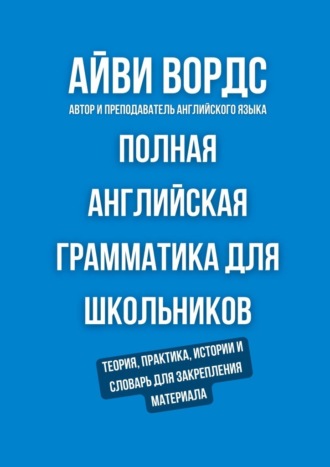
Полная английская грамматика для школьников. Теория, практика, истории и словарь для закрепления материала

Полная английская грамматика для школьников
Теория, практика, истории и словарь для закрепления материала
Айви Вордс
© Айви Вордс, 2026
ISBN 978-5-0069-1737-8
Создано в интеллектуальной издательской системе Ridero
Предисловие
Дорогие читатели,
Эта книга создана для школьников и начинающих изучать английский язык. Её цель – систематизировать ключевые темы английской грамматики, которые обычно изучаются в школе, и предложить удобный формат для самостоятельного изучения и закрепления материала.
Каждая глава построена по единой структуре. Сначала представлен грамматический блок с чётким объяснением темы на русском языке, сопровождаемый примерами на английском с переводом. Далее следуют практические советы по использованию грамматических конструкций, которые помогают школьникам легче усваивать материал.
В книге также включены истории на английском языке, соответствующие уровню А2. Тексты простые, но интересные и тематически связаны с повседневной жизнью. Они служат для закрепления грамматических правил и расширения словарного запаса.
Отдельное внимание уделено полезным словам и выражениям, а также упражнениям разного типа: на заполнение пропусков, выбор правильного варианта и ответы на вопросы по текстам. В конце каждой главы приведены полные ответы для самопроверки.
Кроме того, в приложении собраны списки неправильных глаголов, числительных, коллокаций и устойчивых выражений, которые будут полезны при подготовке к контрольным работам и повседневном использовании английского языка.
Я надеюсь, что эта книга станет для вас надёжным учебным пособием и поможет выработать систематический подход к изучению английского языка. Желаю успехов в обучении и уверенности при использовании английского в школе и за её пределами.
Parts of Speech in English
Grammar Focus
В английском языке части речи (parts of speech) – это группы слов, которые выполняют разные функции в предложении. Знание частей речи помогает понимать структуру предложения и правильно строить фразы.
Основные части речи школьной программы:
Noun (существительное) – называет предмет, человека, место или идею.
a book – книга
Verb (глагол) – показывает действие или состояние.
to read – читать
Adjective (прилагательное) – описывает существительное.
interesting – интересный
Adverb (наречие) – описывает глагол, прилагательное или другое наречие.
quickly – быстро
Pronoun (местоимение) – заменяет существительное.
he – он
Preposition (предлог) – показывает связь слов в предложении.
in, on, at – в, на
Conjunction (союз) – соединяет слова и части предложений.
and – и, because – потому что
Article (артикль) – стоит перед существительным.
a, an, the
Совет: сначала определяй глагол – он центр предложения.
Story
Every morning a young student wakes up early and prepares for school. The student takes a book from the table and reads a short text. The text is simple, but it is interesting and useful. Each word has a role in the sentence. A noun names a thing, and a verb shows an action. An adjective makes the noun clearer, and an adverb shows how the action happens.
The student writes sentences slowly and carefully. Sometimes the sentences are short, and sometimes they are long, but they are always clear. Pronouns help to avoid repetition, and prepositions show place and time. Conjunctions connect ideas and make the text smooth.
At school the teacher explains grammar rules and gives examples. The student listens внимательно and asks questions. Grammar is not difficult when it is clear and organized. Step by step, the student understands how words work together. By the end of the day, English feels more friendly and logical. Learning parts of speech helps the student read, write, and think in English with confidence.
Useful Words and Expressions
part of speech – часть речи
sentence – предложение
word – слово
noun – существительное
verb – глагол
adjective – прилагательное
adverb – наречие
pronoun – местоимение
preposition – предлог
conjunction – союз
article – артикль
role – роль
action – действие
idea – идея
clear – понятный
example – пример
rule – правило
connect – соединять
Exercises
Exercise 1. Match the word with its part of speech
quickly
book
and
she
interesting
a) adjective
b) noun
c) adverb
d) conjunction
e) pronoun
Exercise 2. Choose the correct answer
Which word is a verb?
a) table
b) read
c) interesting
Which word is an article?
a) the
b) in
c) quickly
Which part of speech connects ideas?
a) noun
b) conjunction
c) adjective
Exercise 3. Answer the questions
Why are parts of speech important in English?
Which parts of speech describe actions and things?
How do conjunctions and prepositions help in sentences?
What helps the student understand grammar better?
How does learning grammar change the student’s attitude to English?
Answer Key
Exercise 1:
1—c, 2—b, 3—d, 4—e, 5—a
Exercise 2:
1—b, 2—a, 3—b
Exercise 3 (Sample Answers):
Parts of speech are important because they show how words function in a sentence. They help learners understand sentence structure.
Verbs describe actions, and nouns name things or people. These parts of speech form the base of a sentence.
Conjunctions connect ideas, and prepositions show relationships of place and time. They make sentences clearer.
Clear explanations and examples help the student understand grammar better. Step-by-step learning is effective.
Learning grammar makes English feel logical and friendly. The student gains confidence in reading and writing.
Mini Tips
Найди глагол – это основа предложения.
Определи, что описывает глагол или существительное.
Запоминай части речи через примеры, а не отдельные слова.
The Verb «to be» (Present Simple)
Grammar Focus
Глагол to be – один из самых важных глаголов в английском языке. Он означает «быть, являться, находиться», но чаще всего не переводится напрямую на русский язык.
В Present Simple глагол to be имеет три формы:
am – используется с I
I am a student. – Я ученик.
is – используется с he, she, it
She is happy. – Она счастлива.
are – используется с you, we, they
They are at school. – Они в школе.
Глагол to be используется:
для описания кто мы или что это;
для указания состояния;
для обозначения места нахождения;
в конструкциях с возрастом, профессией, характеристикой.
Отрицание:
I am not tired. / He is not ready.
Вопрос:
Are you ready? / Is she at home?
Совет: формы am / is / are нужно запоминать сразу с местоимениями.
Story
Every day I am at school in the morning. I am a student, and my school is not far from my home. My classmates are friendly and helpful. Our teacher is kind and patient, and her lessons are always clear.
Today the weather is cold, but the classroom is warm. The windows are clean, and the desks are ready for work. I am calm and focused. English is my favorite subject, and grammar is interesting for me.
My best friend is in my class. He is very active and curious. We are always ready to help each other. Some students are tired in the morning, but they are still attentive.
After lessons, we are in the school library. The library is quiet and comfortable. Books are on the shelves, and everything is in its place. At the end of the day, I am happy because learning English is not difficult. It is clear and useful when the rules are simple.
Useful Words and Expressions
to be – быть
student – ученик
school – школа
classroom – класс
teacher – учитель
friendly – дружелюбный
kind – добрый
ready – готовый
tired – уставший
happy – счастливый
calm – спокойный
interesting – интересный
weather – погода
library – библиотека
quiet – тихий
useful – полезный
clear – понятный
Exercises
Exercise 1. Fill in the blanks with am, is, or are
I ___ a student.
She ___ my teacher.
They ___ in the classroom.
We ___ ready for the lesson.
The weather ___ cold today.
Exercise 2. Choose the correct answer
He ___ happy today.
a) am
b) is
c) are
We ___ at school now.
a) am
b) is
c) are
___ you tired after lessons?
a) Am
b) Is
c) Are
Exercise 3. Answer the questions
Who is the narrator of the story?
What is the teacher like?
Where are the students after lessons?
How does the narrator feel about learning English?
Why is learning English not difficult for the narrator?
Answer Key
Exercise 1:
am
is
are
are
is
Exercise 2:
1—b, 2—c, 3—c
Exercise 3 (Sample Answers):
The narrator is a student at school. The story is told from the student’s point of view.
The teacher is kind and patient. Her lessons are clear and easy to understand.
The students are in the school library after lessons. It is a quiet and comfortable place.
The narrator feels happy about learning English. English is interesting and useful for the student.
Learning English is not difficult because the rules are simple and clear. This makes grammar easy to understand.
Mini Tips
Запоминай to be вместе с местоимениями: I am, he is, they are.
Если в предложении нет другого глагола, чаще всего нужен to be.
В вопросах форма to be всегда стоит перед подлежащим.
Personal Pronouns
Grammar Focus
Personal pronouns (личные местоимения) используются для замены существительных и помогают избежать повторов в речи и на письме. В английском языке личные местоимения делятся на подлежащие и дополнения. В этой главе рассматриваются местоимения-подлежащие, которые стоят перед глаголом.
Личные местоимения-подлежащие:
I – я
you – ты / вы
he – он (для людей мужского пола)
she – она (для людей женского пола)
it – он / она / оно (для предметов, животных, идей)
we – мы
they – они
Местоимение it используется:
для предметов и вещей;
для животных, если пол не важен;
с погодой, временем, расстоянием.
It is cold today.
Важно: в английском языке I всегда пишется с заглавной буквы.
Совет: всегда проверяй, кто выполняет действие, и выбирай правильное местоимение.
Story
I am a student in a small town. Every morning I go to school and meet my classmates. They are friendly and helpful. My best friend is in my class. He is very active, and she is very calm. We work together and help each other every day.
Our teacher is kind and patient. She explains the rules clearly, and we understand her lessons well. When the weather is cold, it is still warm in the classroom. It is comfortable to study there.
At school we read texts and write exercises. I like English because it is interesting and useful. Sometimes the tasks are difficult, but they are always clear. When we make mistakes, the teacher helps us. She shows us the right way.
After school, I go home and do my homework. It is quiet at home, and I can focus. Learning English helps me feel confident. I know that with practice, I can use personal pronouns correctly and speak English better every day.
Useful Words and Expressions
personal pronoun – личное местоимение
subject – подлежащее
student – ученик
classmate – одноклассник
teacher – учитель
rule – правило
mistake – ошибка
lesson – урок
homework – домашнее задание
weather – погода
together – вместе
help – помогать
understand – понимать
comfortable – удобный
confident – уверенный
practice – практика
correctly – правильно
Exercises
Exercise 1. Match the pronoun with its meaning
he
she
it
we
they
a) мы
b) она
c) они
d) он
e) оно / он / она (предмет)
Exercise 2. Choose the correct pronoun
My teacher is kind. ___ helps us every day.
a) He
b) She
c) It
The book is on the table. ___ is new.
a) He
b) She
c) It
My friends and I are classmates. ___ study together.
a) We
b) They
c) You
Exercise 3. Answer the questions
Who is the narrator of the story?
Who helps the students understand the rules?
What does the pronoun «it» describe in the story?
Why does the narrator like English?
How does practice help the narrator?
Answer Key
Exercise 1:
1—d, 2—b, 3—e, 4—a, 5—c
Exercise 2:
1—b, 2—c, 3—a
Exercise 3 (Sample Answers):
The narrator is a student. The story is told from the student’s point of view.
The teacher helps the students understand the rules. She explains the lessons clearly.
The pronoun «it» describes the weather and the classroom. It is also used for objects.
The narrator likes English because it is interesting and useful. The lessons are clear.
Practice helps the narrator feel confident. It allows the student to use personal pronouns correctly.
Mini Tips
Если слово заменяет существительное, это местоимение.
Для предметов и погоды всегда используй it.
Проверяй, кто выполняет действие, перед выбором местоимения.
Possessive Adjectives and Pronouns
Grammar Focus
Possessive adjectives and possessive pronouns используются, чтобы показать принадлежность – кому принадлежит предмет.
Possessive Adjectives (притяжательные прилагательные)
Они стоят перед существительным и не используются самостоятельно.
my – мой, моя
your – твой / ваш
his – его
her – её
its – его / её (для предметов и животных)
our – наш
their – их
This is my book. – Это моя книга.
Possessive Pronouns (притяжательные местоимения)
Они заменяют существительное и используются без него.
mine – мой
yours – твой / ваш
his – его
hers – её
its – (почти не используется)
ours – наш
theirs – их
This book is mine. – Эта книга моя.
Важно:
После притяжательного прилагательного всегда есть существительное.
Притяжательное местоимение никогда не используется с существительным.
Совет: если после слова стоит предмет – это прилагательное; если предмета нет – местоимение.
Story
I am a student, and my school day starts early. I take my bag and check my books before leaving home. My parents help me every morning, and their support is important for me. At school I meet my friends and see their smiles. Our classroom is bright, and our desks are clean.
During the English lesson, the teacher checks our homework. My exercise is correct, but my friend has a mistake in his work. The teacher explains the rule again, and her explanation is clear. Everyone understands it.
After the lesson, I look for my notebook, but I cannot find it. My friend shows me a notebook on the table. It is not mine; it is hers. Then I see my notebook in my bag. The bag is mine, but the books inside are ours because we study together.
At the end of the day, we share our ideas and help each other. Learning English becomes easier when we understand how to use possessive adjectives and pronouns correctly.
Useful Words and Expressions
possessive – притяжательный
adjective – прилагательное
pronoun – местоимение
belonging – принадлежность
book – книга
notebook – тетрадь
bag – сумка
homework – домашнее задание
rule – правило
explanation – объяснение
correct – правильный
mistake – ошибка
support – поддержка
together – вместе
share – делиться
idea – идея
important – важный
Exercises
Exercise 1. Fill in the blanks with a possessive adjective
This is ___ book. (I)
She checks ___ homework every day.
We like ___ English lessons.
He puts ___ notebook on the desk.
They clean ___ classroom.
Exercise 2. Choose the correct answer
This pen is ___.
a) my
b) mine
c) me
That is ___ bag, not yours.
a) hers
b) her
c) she
These books are ___.
a) our
b) us
c) ours
Exercise 3. Answer the questions
What does the narrator check before leaving home?
Whose explanation helps the students understand the rule?
Why is the notebook on the table not the narrator’s?
What does the word «ours» describe in the story?
How does understanding possessive forms help students?
Answer Key
Exercise 1:
my
her
our
his
their
Exercise 2:
1—b, 2—b, 3—c
Exercise 3 (Sample Answers):
The narrator checks his or her bag and books before leaving home. This helps the student prepare for school.
The teacher’s explanation helps the students understand the rule. Her explanation is clear and simple.
The notebook on the table is not the narrator’s because it belongs to a friend. It is hers, not his.
The word «ours» describes the books the students use together. It shows shared belonging.
Understanding possessive forms helps students show belonging correctly. This makes English clearer and more accurate.
Mini Tips
My book → есть существительное, значит прилагательное.
The book is mine → существительного нет, значит местоимение.
Не используй the перед притяжательными формами.
Articles: a, an, the
Grammar Focus
Articles (артикли) – это служебные слова, которые стоят перед существительными. В английском языке есть два вида артиклей: неопределённые (a, an) и определённый (the).
Indefinite Articles: a / an
Артикли a и an используются:
когда мы говорим о предмете впервые;
когда предмет один из многих;
с профессиями.
a ставится перед словами, которые начинаются с согласного звука:
a book, a student
an ставится перед словами, которые начинаются с гласного звука:
an apple, an idea
She is a teacher.
Definite Article: the
Артикль the используется:
когда предмет известен говорящему и слушающему;
когда предмет упоминался раньше;
когда он единственный в ситуации.
The book is on the table.
Важно:
Артикли не используются с именами собственными, языками и большинством абстрактных понятий.
В русском языке артиклей нет, поэтому их нужно учить как правило.
Совет: если сомневаешься, задай вопрос: «Этот предмет конкретный или любой?»
Story
I am a student, and every school day starts in the same way. I take a bag and put a book and a notebook inside. On the table there is an apple and a glass of water. The apple is fresh and вкусный, so I eat it before leaving home.
At school I see a teacher in the corridor. She is a new teacher, and she teaches English. In the classroom there is a board, a desk, and a window. The desk is near the window, and the board is on the wall. The classroom is clean and comfortable.
During the lesson, the teacher opens a book and asks us to read a text. The text is about a student and a school day. After the lesson, we go to the library. The library is quiet, and the books are on the shelves.
At the end of the day, I understand that articles are important. They help me speak and write English correctly and clearly.
Useful Words and Expressions
article – артикль
noun – существительное
book – книга
notebook – тетрадь
apple – яблоко
teacher – учитель
classroom – класс
board – доска
desk – парта, стол
window – окно
library – библиотека
shelf – полка
text – текст
corridor – коридор
fresh – свежий
comfortable – удобный
important – важный
Exercises
Exercise 1. Fill in the blanks with a, an, or the
I see ___ student in the classroom.
___ student is my friend.
She has ___ apple in her bag.
___ apple is red and fresh.
There is ___ board on the wall.
Exercise 2. Choose the correct answer
He is ___ teacher.
a) a
b) an
c) the
___ book on the table is mine.
a) A
b) An
c) The
I eat ___ orange every day.
a) a
b) an
c) the
Exercise 3. Answer the questions
What does the narrator put in the bag in the morning?
Who is the teacher in the corridor?
What objects are in the classroom?
Where do the students go after the lesson?
Why are articles important for the narrator?
Answer Key
Exercise 1:
a
The
an
The
a
Exercise 2:
1—a, 2—c, 3—b
Exercise 3 (Sample Answers):
The narrator puts a book and a notebook in the bag. These items are needed for school.
The teacher in the corridor is a new English teacher. She teaches English at the school.
The classroom has a board, a desk, and a window. These objects are used during the lesson.
The students go to the library after the lesson. It is a quiet place to read.
Articles are important because they help the narrator speak and write clearly. They show if a noun is specific or general.
Mini Tips
a / an – первый раз, «любой».
the – «тот самый», уже известный.
Слушай звук, а не букву: an hour, a university.
There is / There are
Grammar Focus
Конструкция there is / there are используется, чтобы сказать, что что-то существует или находится где-то. Она часто переводится как «есть», «имеется», «находится».
There is – используется с единственным числом и неисчисляемыми существительными.