Полная версия
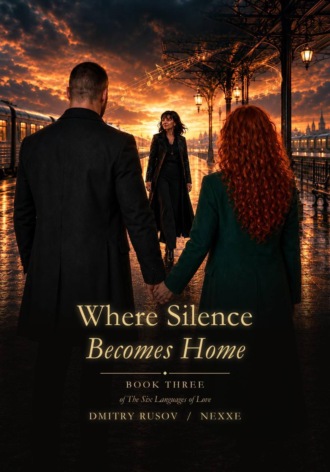
Where Silence Becomes Home. Tom 3


Ksyusha watched the brother and sister. They turned their heads the same way, interrupted each other mid-word, and both knew at which point in a story the other would lie to show off. Near Nonna, Dmitry seemed to grow younger. Or perhaps… freer? Now Ksyusha saw in him a complete stranger, a young man whose life she could know only from stories.
After supper Nonna washed up herself. Ksyusha dried the plates, and for a few minutes they shared a calm silence.
“I do not want to decide for you,” Nonna said suddenly, looking into the sink.
“But it seems you cannot help it.”
“I know. It is always like that with me… First I do things, then I explain why.”
“Could it be the other way round?”
Nonna thought.
“I could try.”
Nonna did not apologise, but at least she agreed to try talking before she started acting.
Ksyusha breathed out and went back to the plate. At the table Dmitry smiled into his cup.
“Here we go,” he said.
“Did you know it would be like this?”
“I knew there would be some version of this. I cannot predict the form. It never repeats itself.”
Outside it was getting dark. In the room with the sofa the suitcase zip creaked again, then Nonna demanded to be told where the spare hangers were. In a few hours she had managed to take up exactly as much space in the flat as she needed, and a little more — just in case.
Ksyusha took her a clean towel. The case lay open on the floor: clothes, two packets of tea, chargers, a book with dog-eared corners and a small cloth bag of unknown purpose. There were a great many things, but inside there reigned an order that only their owner understood.
“Is the shelf free?” Nonna asked.
“It is at your disposal.”
“Drop the ‘at your disposal’. If we are going to live in one flat, that sort of politeness will not last long.”
Ksyusha put the towel down on the edge of the sofa.
“The shelf is yours.”
Nonna held her gaze for a moment, listening to the tone.
“Good.”
She moved two piles into the wardrobe and stopped at the next shelf, where the box of cables stood.
“Can this be moved?”
“Better ask Dima.”
“So not without asking.”
Nonna closed the wardrobe door and did not touch the box.
“Do you really not know how long you have come for?” Ksyusha asked.
“The return ticket is in ten days. But a ticket is not a sentence.”
“And what is supposed to happen in those ten days?”
Nonna sat on the suitcase to press down a bulging pocket.
“I want to see how you live when you are not trying to show that everything is fine.”
“We are not trying.”
“Then we shall check.”
Ksyusha was already getting ready to object, but Nonna raised her palm first.
“Badly put. Not ‘check’. I shall look. And I shall try to keep my conclusions to myself at least until tomorrow.”
“A great sacrifice.”
“You have no idea.”
They both smiled. Ksyusha went out and pulled the door to behind her.
Late in the evening, when Nonna had at last shut the door of her room, Dmitry and Ksyusha went back to the kitchen on their own.
“Let us forget for a minute everything she said,” Dmitry suggested. “If she had not come, would you yourself want to be my wife?”
Ksyusha was silent for a long time. She needed to hear her own answer apart from Nonna’s pressure.
“I would,” she said. “But I do not want it to look as if Nonna married us off.”
“She can choose a venue, argue about flowers and announce deadlines. The one choice she cannot make for us is each other.”
“And you?”
“I want to marry you. Nonna has only made us stop walking round this conversation. For too long we thought that the main thing was already there and it was not necessary to name it.”
Ksyusha took his hand.
“June, then?”
“June. If it is our choice.”
“Ours.”
They did not wake Nonna. Dmitry took the lamp out of the cupboard, checked the oil and lit the five wicks. Ksyusha sat down beside him, resting her palm on the table. For a few minutes they were silent, getting used to the decision they had just made.
“We can change our minds about June,” Dmitry said. “About the format, the guests, the venue. About everything except that we are the ones making the decision.”
“Yes.”
“And if Nonna starts pushing, I shall stop her.”
Ksyusha looked at him.
“Not argue, but stop?”
“There is a difference.”
“Now I understand.”
They went over the main thing once more: for now June meant a direction; the venue, the format and the day they would choose together. Ksyusha said it again herself and only then relaxed. Nonna opened her door, put her head out and asked whether she might at least write down the month. Dmitry allowed it — in pencil only.
Before bed Dmitry put out the wicks, and they put the lamp away in the closed cupboard. In the room with the sofa the bed creaked, and Nonna’s muffled voice was heard:
“I am not asleep. And June is a good choice.”
Ksyusha covered her face with her hand. Dmitry laughed soundlessly.
On the kitchen calendar the word “June” appeared in pencil.
Chapter Three
A Kitchen for Three
On the table lay three notebooks, two phones and one list that no one could properly read any more, because three hands had written over it.
“The hall on the embankment is out,” Nonna said without raising her head. “Too open. The wind will spoil the sound.”
“What about an awning?” Ksyusha’s mother suggested.
“With an awning it is no longer a hall on the embankment, it is a marquee on a building site.”
Ksyusha wanted to put in that she actually liked that hall, but she did not get the chance — her mother was already nodding in agreement, as if the idea had been her own from the start.
“Then the veranda at the restaurant,” her mother said. “I asked; in June there is a covered terrace.”
“That terrace is what I told you about yesterday.”
“You told me about the hall.”
“I told you about the hall’s terrace.”
Ksyusha looked at them both.
“Could you at least sometimes make clear who said what?”
Both of them looked at her in unison with the same bewilderment. They were moving down the list so quickly that Ksyusha could barely bring the conversation back to her own wishes.
“We do make it clear,” Nonna said. “Between ourselves.”
“And where am I in that?”
“Ksyusha,” her mother said gently, “you are the bride. You choose the dress, the guests, the food. The rest is not your worry.”
“It is my wedding, actually.”
“That is exactly why,” Nonna answered imperturbably, “you should not waste your nerves on terraces and awnings.”
Ksyusha opened her mouth to object and turned to her mother for support.
“Mum, tell her…”
“Ksyushenka,” her mother covered her hand with her own, “Nonna is right. Let us deal with this. You and Dima have enough to worry about without it.”
Ksyusha looked at Nonna, waiting for at least some hint of disagreement with her mother. None came.
“Mum, do you really think so, or are you just agreeing with her?”
“I really do think so. That does not stop me agreeing with Nonna.”
“Did you arrange this in advance?”
“No,” they both answered at once, and it came out so perfectly in unison that they surprised even themselves.
Before Nonna arrived, Ksyusha had been sure she knew her mother’s way of making decisions. First a cautious question, then “I do not mind”, and ten minutes later everyone was somehow discussing the option she had chosen the day before. Nonna began with a ready answer and only then found out who agreed. Now one came straight at her and the other from the side, and as a result Ksyusha came to her senses only when half the list she had drawn up had already been crossed out.
“Stop. Let us take a step back,” she said. “There will be no final decision about the venue until Dima and I have seen it.”
Her mother was the first to put down her pen.
“Of course, Ksyushenka.”
Nonna kept her finger on the line with the address for a second longer, then took her hand away too.
“Go and see it. I have only booked a viewing, not the venue.”
“When?”
“On Tuesday.”
“On Tuesday I have a recording.”
“Then Wednesday.”
“Have you already moved it?”
“Not yet. But I have the number.”
Irritation rose in her throat again. Ksyusha laid her palms on the table and spoke while she could still speak calmly.
“Nonna, I do not want to choose from what you have left me. I want to be able to choose before you have managed to cross out half of it.”
Her mother looked at her more closely. Nonna did not look away.
“All right,” she said at last. “We put back what we crossed out. Except the ones who do not answer the phone.”
“Why except them?”
“Because if they do not answer before you pay, it will not get any better after.”
Ksyusha wanted to object, but stopped. There was logic in it.
“Fine. Those stay crossed out.”
Nonna silently pushed the list towards her and took her hand away.
Ksyusha leaned back in her chair.
“I feel superfluous at my own wedding.”
“Not superfluous,” Nonna at last looked up from her notebook. “Just freed. There is a difference.”
“Freed from what?”
“From what you have absolutely no need to do.”
“And if I want to do it?”
Nonna shrugged and turned the second sheet round to face her.
“If you want to, do it. Here is a list of florists; I have not looked at it yet. Take it on.”
Ksyusha looked at the list. Twelve items, half of them already crossed out in someone else’s hand.
“Half of them are crossed out already.”
“Bad options,” her mother explained briefly. “We weeded them out straight away.”
“You said I could take it on.”
“You can. From the remaining six.”
Ksyusha snorted. The anger was still there, but what was going on was beginning to amuse her.
At that moment the front door banged.
Dmitry came in, pulled off his shoes and felt the familiar atmosphere from the hall: the women in the kitchen were deciding something again.
He brought cold air in with him and the smell of wet leaves. A fine rain had begun outside, and a few drops had left dark marks on his shoulders. Ksyusha noticed that he was tired: his movements were slower than in the morning, but his eyes still went first to her, checking her mood, and only then to the papers spread out on the table.
“Hello,” he said, as if to the air. “How is it going?”
“It is going well,” Nonna answered without turning round.
He went into the kitchen, put the kettle on and looked over the shoulder of Ksyusha’s mother at the list.
“Why are the florists crossed out? Those ones had quite good work, I looked…”
“Dima,” Nonna did not let him finish, “keep out of it.”
“I only asked.”
“This is not a man’s business.”
“I am going to be at this wedding too, you know.”
“You will be present at the wedding itself. For now, do not get in the way.”
Dmitry glanced at Ksyusha, clearly counting on her support.
“Dima, do not interfere,” she said, trying not to smile with glee and not quite managing it. “Really, let them.”
He looked from Nonna to Ksyusha’s mother, then to his own bride, who five minutes earlier had been arguing with both of them.
“So,” he said slowly, “there are three of you now.”
No one answered — all three women were bent over the list again.
Dmitry took the boiled kettle, poured himself some tea to drink in solitude and, laying claim to nothing more, turned away.
“You know,” he said to nobody in particular, heading for the study door, “I always thought that even one was almost impossible to cope with.”
He stopped in the doorway and, after a dramatic pause, finished:
“I had no idea it could get worse.”
And, smiling at something of his own, he went off to work, leaving three women arguing about terraces and marquees again.
Ten minutes later Ksyusha closed her notebook.
“That is it. Enough for today.”
Nonna looked at her watch.
“We have only just started.”
“That is exactly why we must stop, while we are still talking and not ordering each other about.”
Her mother was the first to get up from the table. She gathered the empty cups and, passing her daughter, touched her shoulder lightly.
“You are right. I got carried away.”
Ksyusha expected Nonna to carry on the argument, but she neatly closed her notebook and laid her pen on top.
“Till tomorrow?”
“It does not have to be every day.”
“The day after tomorrow?”
“We shall see.”
“That is progress already,” her mother remarked, and they both laughed.
When the door had closed behind her mother, Nonna came back to the kitchen to clear away the papers. She sorted them by subject: venue, flowers, food, guests. Ksyusha stood beside her, neither helping nor leaving.
“Are you angry?” Nonna asked.
“Yes. A little.”
“With me or with Mum?”
“With both of you. And with myself, because first I let you decide everything and then took offence.”
Nonna straightened the edges of the pile.
“You did not let us. We took it. Those are different things.”
Ksyusha had not expected such precision and so did not answer at once.
“Then give it back.”
“We shall. But the help is not cancelled.”
“I am not asking for it to be cancelled.”
The rule was written on the top margin of the list: Nonna and Ksyusha’s mother gather information, ring round, check prices and dates, but book nothing without Dmitry and Ksyusha. First their wishes, then the options. Nonna called this bureaucracy, but she did not cross the note out.
Almost at once her phone rang. Nonna glanced at the number and mouthed: “Florists.”
“Will you take it?” Ksyusha asked.
“Under the new rules I first need written clearance.”
“Take it. Only do not confirm anything.”
Nonna put it on speaker. The woman at the other end named a free date and a minimum sum and offered to put a provisional booking in place until the evening. Nonna had already opened her mouth — Ksyusha saw the familiar expression with which she was about to answer for everyone — but Dmitry’s sister stopped herself.
“Thank you. We shall note the terms and ring back once the couple has decided.”
She ended the call and put the phone on the table.
“Did you see?”
“I saw.”
“It was physically painful.”
“But you survived.”
“I am not sure yet.”
Ksyusha wrote the price in the “checking” column. Nonna did not reach for the pen, although it lay right by her elbow. Ksyusha noticed the effort, but said nothing.
Dmitry came out of the study when the kitchen was already empty. He was holding his headphones, which he had evidently taken off only at the door.
“Everyone alive?”
“So far, yes,” Ksyusha said.
Nonna walked past him with a pile of papers.
“Do not overrate your importance. We managed without you.”
“So I noticed.”
When the door of the room with the sofa had closed, he sat down opposite Ksyusha.
“What really happened?”
She told him about the florists, the terrace and the new rule. Dmitry heard her out without interrupting once.
“A good rule,” he said. “Let us add another: if I go off to the study, it does not mean I do not care.”
“Then what does it mean?”
“That I decided you would manage on your own. But I should have asked first whether you needed me in that conversation.”
Ksyusha nodded.
“Today I managed.”
“I heard.”
“You were eavesdropping?”
“In this flat it is impossible not to overhear Nonna.”
He held out his hand across the table. Ksyusha put her palm in it. Beside them lay a sheet dented by a pen, and under the first rule there were two heavy lines.
The next day Nonna really did not open her notebook until supper.
But after supper she laid a blank sheet in front of Ksyusha.
“Your conditions for the venue,” she said. “Not options. Conditions first.”
Ksyusha looked at Dmitry. He was sitting by the window with his laptop, but he had already raised his head.
“Our conditions,” she corrected. “Dima, come here.”
They began not with the price and not with the address. Ksyusha needed natural light and a place where the guests would not be split into little groups. Dmitry needed decent acoustics, a way of setting up equipment without cables across the aisle, and no separate stage that would turn a family evening into a concert. Neither of them wanted a huge hall that would have to be filled with people for the sake of scale.
Nonna wrote without interrupting. Once she raised her pen, about to object about the stage, but Ksyusha said:
“Hear us out first.”
The pen went back to the paper.
Her mother joined them by video call. Her first question was where to put the flowers. Ksyusha answered that until the venue was chosen, the flowers did not exist. Her mother laughed and agreed.
Half an hour later there were seven requirements left on the sheet. Nonna crossed out three addresses, but this time she explained each one: one venue did not allow outside sound equipment, the second was too big, the third had no free dates in June. Ksyusha rang two of the places herself to confirm. The answers matched.
“Now they can be crossed out,” she said.
“That is why I crossed them out yesterday.”
“But yesterday it was your decision. Today it is ours.”
Nonna looked at her, then wrote beside each address the date of the call.
“Understood.”
Dmitry closed his laptop.
“Let us write down the budget as well.”
“I thought you wanted to look first,” her mother said from the screen.
“We should look at what suits us in price and conditions. Otherwise we shall waste time on an option we would never choose anyway.”
Together they named the sum they considered reasonable. Nonna tried to add a margin out of her own money; Dmitry refused at once.
“You can offer help,” he said. “But we do not want to increase the budget at your expense.”
“I am not buying myself a say.”
“I know. That is why I am saying it straight before we quarrel.”
His sister put the calculator away. Ksyusha’s mother did not insist either.
After the call her mother sent a spreadsheet of expenses she had drawn up overnight. Besides the venue and the flowers it already included an arch, matching chair covers and presents for the guests — things Dmitry and Ksyusha had not even discussed. For a few seconds Ksyusha looked at the screen, choosing between the habitual “fine” and the equally habitual “we do not need anything”. Then she rang her mother herself.
“Mum, the spreadsheet is good. Keep the transport and the food. Put the rest on a separate sheet for now.”
“Take it out altogether?”
“Do not throw it away. Just do not count it as decided.”
Her mother was silent for a moment, then asked what colour to mark the suggested but unapproved lines. Ksyusha chose grey. A minute later the spreadsheet came back with the new marking.
Nonna watched Ksyusha change the markings and did not correct her. Then she did say:
“You do not need an arch.”
“Possibly. But we are the ones who will say so.”
“I am learning.”
“Quickly?”
“I do not promise.”
By the evening a clean sheet with three columns had appeared on the fridge: “want”, “checking”, “not having”. Dmitry added a fourth — “do not know”. Nonna called it pointless, and five minutes later moved two addresses into it.
By the end of the evening four hands were mixed on the sheet: Ksyusha’s conditions, Dima’s technical notes, her mother’s questions and the dates of Nonna’s calls.
“So now there really are three of us?” Dmitry asked.
“Four,” her mother answered from the screen.
“I meant in the flat.”
“Then three. But do not get used to it, Dimochka — I shall be coming soon too.”
He covered his face with his hand. Ksyusha and Nonna laughed at the same moment.
Chapter Four
The Studio
Nonna had invited herself to the studio that morning — she wanted to “see how it is all done”. Now she had been sitting for the third hour in a corner of the control room on a hard chair that everyone else had long since left to chance visitors.
The professional studio was at the other end of the city, in a building with no sign, where the ground floor smelled of paint and damp concrete. On the way Nonna had asked twice why they could not record somewhere nearer, and both times Dmitry gave the same answer: the room here was right, and so were the equipment and the man who knew his requirements. The study at home was fine for drafts, arrangements and late work in headphones. The final recordings they made here.
Before going in, Nonna carefully read the signs on the doors, memorised where the fire exit was and only then took off her coat. Dmitry noticed but said nothing. His sister always studied a space first and only then allowed herself to relax in it.
She had been holding a cup of cold tea for nearly three hours without touching it.
“Once more from the bridge,” Dmitry said, without looking up from the monitor.
Ksyusha nodded, settled her headphones more comfortably and began singing again — the same passage, for the eighth or ninth time that morning, differing from the last by a fraction of a tone that no one but the three people in the room could catch.
The sound engineer recorded in silence, watching the screen where the track was running.
Between takes Ksyusha came out of the booth, listened to the notes, asked about breathing and the ends of phrases, then went back to the microphone. The eighth take no longer frightened her. The sound engineer was responsible for the recording, Dmitry heard the piece as a whole, and the final decision about the voice remained hers.
Nonna watched how Dmitry changed while he worked. At home he could sit motionless for hours, listening to one fragment in headphones. Here his whole body took part in the sound: his fingers counted beats on his knee, his shoulder rose almost imperceptibly before the right entry, his gaze grew sharp and focused. He did not order Ksyusha about. He asked her to try things, explained what he heard, and accepted her refusal if a suggested movement broke the meaning of a line.
“It does not need to be louder here,” he said after yet another take. “Imagine you have already decided everything but have not yet said it aloud.”
Ksyusha slipped one side of her headphones off.
“Then a longer pause before the word.”
“Try it.”
She tried. This time the sound engineer raised his thumb himself, without waiting to be asked.
Ksyusha came out of the booth and held out the spare headphones to Nonna.
“Do you want to hear the difference?”
“I heard it already.”
“Not that one. Between the seventh take and the last.”
Nonna put the headphones on with the mistrust of someone being offered a hearing test. Dmitry played the fragments one after the other. In the first Ksyusha took the note evenly and beautifully; in the second there was a short pause before the word, and the next phrase sounded more certain.
“Again,” Nonna asked.
Dmitry played them again.
“In the second she is tired,” his sister said.
“Technically, yes,” he answered. “But the tiredness took away some unnecessary caution.”
“So you sang eight times in order to get tired in the right way by accident?”
Ksyusha laughed.
“That is more or less what the profession looks like.”
Nonna handed back the headphones. Until then it had seemed to her that studio work consisted mainly of waiting: the same line, the same screen, the same notes. Now she understood why Dmitry did not settle for the first good take. The difference was tiny, but after the comparison the first version already seemed like someone else’s.
“And if I like the seventh?” she asked.
“Then you like the seventh,” Ksyusha said.
“And you will not keep it?”
“I shall listen to both again. But I shall not choose by a vote.”
Nonna looked at Dmitry. He did not intervene or try to win his sister over to the last take. He only noted the track numbers.
“Impractical,” Nonna concluded.
“But honest,” Ksyusha said, and went back into the booth.
After that Nonna began to watch the whole room. Here everyone answered for their own part of the work, and the final decision about the performance was Ksyusha’s.