Полная версия
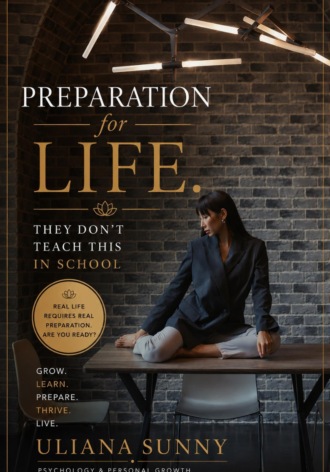
Preparation for life. They dont teach this in school

Preparation for life. They dont teach this in school
Глава
Preparation for a Life Not Taught in School
A book for girls and women who want to understand themselves, others, and life before it starts to present its most difficult lessons.
Who this book is for:
For young women aged 17–25 who:
Know the rules of the Russian language but struggle to articulate their desires and boundaries.
Solve math problems but don’t know how to manage their own money.
Can write essays but haven't learned to express their opinions confidently in real life.
Spot errors in text but don’t always notice manipulation in communication.
Know what’s “right” according to textbooks but don’t know how to do what’s right for themselves.
Get grades for knowledge but lack the skills truly needed in adult life.
I wrote this book because the question “how should I do what’s right?” often hides a desire to stop making mistakes in the most important things.
Ahead of you are insights born from my life experience (hitting rock bottom and subsequent rebirth), logic (thanks to a mathematical mind that helps structure chaos), spiritual wisdom (through working with energy and intuition), and ideas from books that once helped me preserve myself and may help you too.
The Birth of This Book
When I moved to the capital, I had one small suitcase with cheap clothes and an unwavering belief that if I worked hard, life would be fair.
I was wrong.
After school, I could solve logarithms, but I couldn’t say “no,” or “this is my limit.” I knew the Pythagorean theorem, but I didn’t know how to protect my boundaries. I calculated percentages in problems, but I couldn’t manage my money to keep it from slipping through my fingers. I knew how to derive a formula, but I didn’t know how to extract myself from a toxic relationship.
The greatest irony was that, having become a teacher and master of mathematics, I was perfectly capable of explaining to others how to find correct solutions. I taught schoolchildren and students, helping them understand complex problems, but for years I tried to solve life with the same formula.
I thought that if I was smart, kind, patient, and diligent enough, life would surely reward me. That good people get good results. That effort always pays off, and justice eventually prevails.
But life turned out to be much more complicated.
Instead, I got:
* a job where I was used and unappreciated;
* ended relationships where I was “convenient,” and later “suffering over them”;
* a 15-year mortgage and a loan for a failed business, where interest grew faster than my salary;
* no close family nearby and no good friends;
* a complete lack of understanding of how to understand people (especially men), how to become financially stable, how to start a relationship with a man, and many other questions concerning human relationships;
* a feeling that I was doing everything right, but the result was not at all what I was striving for.
Over time, I understood something completely different: life’s difficulties always helped me move forward. They weren’t bad for me. On the contrary, they forced me to look for the next step, make decisions, and continue the journey, even when there was no clear outcome ahead.
I couldn’t undo what was happening to me, but I could choose what to do next. Gradually, I began to feel that difficulties were my engine, definitely not a punishment. If not for them and my drive to find solutions, I might have remained stuck in place.
My parents were not wealthy people. On the contrary, our family struggled to cope even with basic household needs. So, difficulties accompanied me from childhood. For a long time, they came so often that I literally got used to living in a state of constant stress and fear. This became my norm, my usual mental and moral state. It’s scary, but that’s how it was.
I had to cope with everything myself—quickly, at my limit, often without the right to make a mistake. Of course, this lifestyle affected my health and psyche. But it was precisely this that led me to a deep study of myself, people, and life itself.
Today I can say: it was the ability to continue the journey after each fall that led me to a happy outcome. The readiness to act after each obstacle gradually changed my life.
And yet, it was then that another part of my story began. I started accumulating knowledge from books, my thorny experience, and conversations with completely different people: men and women, and acting within the circumstances I had. Study, work, mistakes, and returning to what I started gradually opened new opportunities. The help of loved ones was important to me, but the next step, the decision, and the responsibility for my own life still remained mine.
That’s how I became convinced: true support is not born from another person’s material resources. It appears when you yourself see options, make decisions, and continue your journey.
I realized for the first time: for years in school, college, and university, we are taught to solve other people’s problems, but almost never taught to solve our own lives. We leave those institutions completely “incapable” of saying “no,” recognizing manipulation, handling money, choosing ourselves, or leaving situations where we are constantly made to doubt our own worth.
And, perhaps, these are the very insights that should have been given much more time than yet another formula from a textbook.
One day I was sitting in my first rented apartment in the capital, watching YouTube, and I saw a very memorable video in which a psychologist talked about how school knowledge is not enough for young men and women. After school, many leave completely unprepared for real life. I thought about this for a long time and projected the situation onto myself. Indeed, it’s true. I caught myself thinking: Smart. Educated. Unprepared for life. I grew up in a family where my parents worked all day and didn’t dedicate themselves to me. Outside, I only saw school, which didn’t teach the main thing. And then it finally dawned on me, simple but very unpleasant: you can have a lot of knowledge, but life doesn’t get easier because of it.
I opened my notebook, looked at the pages with formulas, and wrote: “Formulas exist. But the desired life does not.” I needed completely different knowledge. The kind that, for some reason, no one taught.
Living and making mistakes due to a total lack of understanding of life, I saw that true success is not only made up of money and status, which I had been striving for.
I am writing this book for young women who want to know more about the life they will live as adults. I am writing it so that they don’t go through this journey alone, without preparation and knowledge. Not just about mathematics and other sciences taught in school, college, and university, but about life itself. About how the world is structured without rose-tinted glasses and unicorns. And most importantly: what to prepare for and what to do?
It seems that most young women understand everything without reading such a book. But, for example, no one explained to me at 17-18 that a “good girl” in real life can become convenient for others if she doesn’t have her own boundaries. That diligence without strategy sometimes leads you somewhere you don’t want to go. No one taught me that you can be friends with money, not fear it. That a mortgage or loan requires sober calculation. That savings provide freedom. No one showed me how to choose a man, rather than just agreeing to whoever asks. How to be friends without losing yourself. How to communicate without losing yourself, and so on.
How did I come to this, besides my knowledge from school and university (friendship, science, peace, chewing gum) and intuition?
By reading books. A book is the cheapest way to buy someone else’s experience. Mistakes that the author of a book made over 10 years, you experience in 10 hours of reading. You get a concentrated summary of victories and defeats without the risk of going broke or losing your health. It’s like “downloading” a successful person’s neural network directly into your head. Books break the “cycle of poverty” in your mind. When you don’t know where to start, your brain is paralyzed by the fear of the unknown. A book gives you a map. A structure appears: “Aha, first I need to do A, then B.” Chaos disappears, a plan emerges.
Of course, looking back today, I see: education and work helped me open doors I hadn’t even noticed before. And that’s important too. It can’t be said that school, university, or work taught me nothing. Of course, they did. But diplomas themselves didn’t make me happy, while experience, wisdom, learning new things, drive, and readiness to act led me to new people, solutions, and opportunities. A happy outcome was made up of many steps, mistakes, attempts to start over, and the ability to keep going when things were difficult.
When happiness and success appeared, I was able to see the entire complex path. Now, I joyfully want to share with you ways to solve and overcome problems.
And I thought: if I encountered this, then thousands of other young women did too. Those who moved to the capital from a small town, who fear loneliness, who work hard and don’t get recognition, who tolerate relationships and don’t know how to leave.
I am writing this book for them. And for myself—the one who sat in a small room and didn’t know what to do.
Now I can consciously look at this entire journey. It was difficult for me, but gradually I came to a life where there is love, family, a job I chose, and a sense of inner support. I want to share with you the experience of how to think and act when familiar methods no longer help. Perhaps some of these ways of thinking and steps will help you navigate your obstacles a little more consciously and not wait for life itself to explain what can be learned in advance.
Module 1. THE SCIENCE OF PEOPLE
Chapter 1. Karpman’s Drama Triangle. How to understand your most characteristic role?
It’s better to look not at what you are generally like, but at what you usually do in a conflict or when a loved one is having a hard time.
From my life:
A personal story:
One of my friends was telling me for the third time about the same guy who was cheating on her. I spent half the night sleepless, devising a plan of action for her, helping her formulate what to say to him, and writing long messages of support. A week later, she was back with him—and it was as if none of it had happened.
When I was working as an assistant to the head of a large holding company, my colleague from the Directorate again "forgot" to do his part of the report and flew off on a business trip. Without a word, I finished it for him—because "there was no other way," "I can't let the team down." A month later, I found myself angry at everyone around me, even though no one had asked me to do it.
My aunt kept saying, "You never think about me"—even though I had recently paid for her expensive wardrobe, helped her with her bath, and spent the entire weekend with her. I felt guilty, even though I hadn't done anything wrong.
You'll surely recognize at least one of these scenes—or something very similar from your own life.
This is the work of a very old and very sticky psychological model—Karpman's Drama Triangle. It's useful to make a note right away: everything I write below is a working framework for observing yourself, other people, and situations—no more, no less. It helps you notice a pattern, and that's already a lot.
What is Karpman's Triangle?
In short: it's a model of unhealthy relationships where people unconsciously get stuck in one of three roles: Victim, Persecutor, or Rescuer.
The Victim feels helpless, wronged, and is convinced that "this always happens to me." In reality, they often avoid responsibility for their own life: it's easier to say "I can't do anything" than to change something.
The Persecutor blames, criticizes, and pressures: "it's your own fault," "you should have thought about it sooner." They act through control and reproaches.
The Rescuer rushes to solve other people's problems, even when not asked. From the outside, this looks like care—but often it's a way to feel needed and to escape their own difficulties through others'.
Knowing this model can help you notice several important things. For example, not taking on the role of Rescuer from the belief that "this person is difficult, but I will change them." Not getting used to the role of Victim and not convincing yourself that you need to endure because they had a difficult childhood. Not confusing control with care—a Persecutor can easily appear as someone who "just worries and knows what's right." And noticing unhealthy dynamics sooner: when relationships with a friend, parents, or partner repeatedly turn into the same cycle—one blames, the other justifies, then they switch roles. And, perhaps most importantly, learning to differentiate: I am responsible for my feelings and actions, and you are responsible for yours.
Why is it a trap? The roles are not fixed; people jump between them. A Rescuer, tired of helping an "ungrateful" Victim, suddenly becomes a Persecutor themselves. A Victim, criticized for too long, begins to manipulate through pity—and also turns into a Persecutor or back into a Victim in a new cycle. The circle is closed, and no one in it matures.
Psychiatrist Karpman described the pattern that underlies almost any prolonged conflict or codependent relationship. There are only three roles in it—and all of them are traps.
The Victim feels that life happens "to them," not "because of them." Their main phrases are: "this always happens to me," "I can't do anything about it," "well, what could I have done?" It's important to understand: real helplessness and the role of Victim are different things. The role of Victim is a position in which a person refuses responsibility even when they have a choice. Hidden within it is a secret benefit: if I am helpless, nothing can be asked of me, and those around me are obligated to save and pity me.
The Persecutor blames, criticizes, and controls. Their phrases are: "it's your own fault," "I told you so," "you should have thought with your head." They may appear strong—but essentially they are also avoiding, only hiding their vulnerability behind an attack.
The Rescuer rushes to help before being asked. Their phrases are: "let me do it," "she'll be lost without me," "I can't just stand by and watch her suffer." From the outside, this looks like care. In reality, the Rescuer often solves their own anxiety through someone else's problem—and subtly deprives the other person of the chance to learn to cope themselves.
Why does everyone get drawn into this triangle?
The main trick of Karpman's Triangle is that the roles are not fixed. The same person can go through all three in one evening. Here's what it looks like in life:
My friend, the Victim, complains about her boyfriend. I, the Rescuer, give advice. My friend doesn't listen to it. I get tired and irritably say, "Well, then suffer by yourself." I've become the Persecutor. My friend gets offended and falls silent—a Victim again. I feel ashamed, and I rush to comfort her again—a Rescuer again.
The circle is closed, and neither of us has matured one bit. The problem isn't solved—it's just played out in a loop. This is the main danger of the triangle: it gives the illusion of action ("we're talking, we're doing something"), but in fact, it preserves the situation. None of the three roles involves a direct, honest conversation about needs.
Therefore, it's more useful to look for your typical transition scenario rather than trying to permanently assign yourself one role. It's important to catch the moment when you stop acting from an adult position and automatically enter the scenario.
How do you know what role you're in right now?
Try asking yourself three questions in the moment of conflict or a difficult conversation:
Am I waiting for someone to come and solve everything for me, even though I could solve it myself? — you're in the role of the Victim.
Do I want the person to feel guilty instead of saying what I need? — you're in the role of the Persecutor.
Am I doing something I wasn't asked to do, and then expecting gratitude or getting offended if I don't get it? — you're in the role of the Rescuer.
An honest answer to these questions is already half the way out of the triangle. It relies precisely on unconsciousness: until the role is named, you cannot leave it.
How to exit the triangle: the adult position
The way out is to leave the game altogether and take a fourth, healthy position—the position of an adult who is responsible for themselves and respects the right of others to be responsible for themselves.
Instead of being a Victim—state your needs directly. Not "this always happens to me," but "I'm having a hard time, and this is what would help me." This requires courage: the Victim role offers protection; nothing can be asked of them. The adult position removes this protection—but in return gives real control over your life.
Instead of being a Persecutor—talk about your feelings using "I" statements, not accusations. Not "you never listen to me," but "I get upset when I'm interrupted." The difference seems small, but it's what determines whether a dialogue or defense will begin.
Instead of being a Rescuer—help only when genuinely asked, and ask yourself: "Am I doing this because the person needs it, or because I'm anxious watching their difficulties?" Sometimes the greatest support isn't solving someone's problem for them, but believing that they are capable of handling it themselves.
Exercise: "My Role in the Triangle"
Take the last situation where you left a conversation feeling upset, offended, or guilty for no apparent reason. Answer in writing:
1. What did I tell myself at that moment? (write down verbatim if you remember)
2. What role does this phrase reveal—Victim, Persecutor, or Rescuer?
3. What would an adult, who is responsible for themselves but doesn't accuse or rescue, say in my place?
4. How can I say this next time the situation repeats?
Try doing this exercise once a week for a month—and you'll start noticing the role even before you're in it. And that's already the beginning of exiting the triangle.
Chapter 2. Types of People: Who Is Really in Front of You?
Have you ever said, "He seemed so good, but he turned out to be..."? Or: "I didn't expect her to do that"? Or: "How could I not have noticed this sooner?"
All of this is the result of the same trap. Without a system, we judge people by first impressions: by status, by how they speak. We believe words, not actions. We project our ideas of "how things should be" onto others. And then we're surprised when reality doesn't match.
I've been through this myself. Through relationships where it seemed that love was a constant seesaw: one moment soaring, the next falling. And only years later, when I learned to see actions, not words, did I understand what calm closeness is—the kind where you don't have to lose yourself and sacrifice your boundaries.
We make a big mistake when we trust the wrapping. Only actions determine who is in front of you.
Here, I offer a simple and honest classification of people based on life practice. It will help you understand: who is in front of you, what to expect from them, and how to build communication so you don't get hurt.
Four Basic Types of People (by energy and motivation)
At the heart of everything are two questions:
1. Does the person take or give? (Energy, attention, resources)
2. Does the person build or destroy? (Relationships, projects, life)
By crossing these axes, we get four basic types. It's important to note right away: people are rarely "pure" types; behavior changes depending on the context and where the person is in their life. But the scheme below helps you notice patterns, and that's already a lot.
Type 1. "The Creator" (gives + builds)
This is a person who creates the world around them. They don't wait for someone to come and save them—they build it themselves. They rejoice in others' successes, because for them, "another's success" doesn't diminish their own. They know how to support, inspire, and help. They are reliable, but they don't "rescue"—they help you get on your feet, rather than carrying you.
How to recognize them:
· They talk about their plans and execute them.
· They don't devalue your achievements; they celebrate them.
· In conflicts, they look for a solution, not someone to blame.
· They have friends, hobbies, their own life.
· They don't try to "change" you—they accept you.
· They are willing to invest in relationships, but not at their own expense.
How to communicate with them:
· Value their time and energy—they are not an infinite resource.
· Reciprocate—they don't like "one-way streets."
· Reciprocate—he doesn't like "one-way streets."
· Be honest—he respects the truth, even if it's uncomfortable.
· Don't try to manipulate—he sees it, and his trust will be lost.
Should you be friends? Yes. This is the best friend; they won't betray you.
Should you build a relationship? Yes, if you're ready for a healthy partnership.
Type 2. "The Consumer" (takes + doesn't build)
This is a person who comes into your life to take. Attention, care, money, resources, time. He is often charming, knows how to be liked, and quickly gains trust. But he doesn't invest back. He doesn't build—he uses. His relationships with people are transactions. He isn't necessarily malicious; he just doesn't know any other way. He feels that the world should give—because inside, he himself feels no support.
How to recognize:
· He talks a lot about himself, listens little.
· He often asks ("do this," "lend me," "help me"), but rarely offers.
· He doesn't remember details of your life, because you're not his focus.
· His promises aren't kept if it's not to his advantage.
· He appears when he needs something and disappears when everything is fine.
· He considers your care for him "normal," and his care for you a "gift."
How to communicate:
· Clearly define boundaries: "I can do this, but not that."
· Don't give more than you receive. This isn't selfishness—it's balance.
· Don't expect him to change while you continue to give him what he wants.
· If he doesn't invest—don't you invest either.
Should you be friends? Only if you're ready for superficial relationships and don't expect reciprocity.
Should you build a relationship? No. You will be his "donor."
Type 3. "The Destroyer" (takes + destroys)
This is the most dangerous type. He doesn't just take—he destroys. With words, actions, silence. He devalues, criticizes, humiliates, controls. His self-esteem is built on making you feel small. This could be an abuser, a narcissist, a toxic person. He doesn't always realize what he's doing—but that doesn't make him less dangerous. Often, behind such behavior is deep internal pain that he doesn't know how to cope with otherwise. Understanding this is useful—but it's not a reason to stay close.