


Полная версия
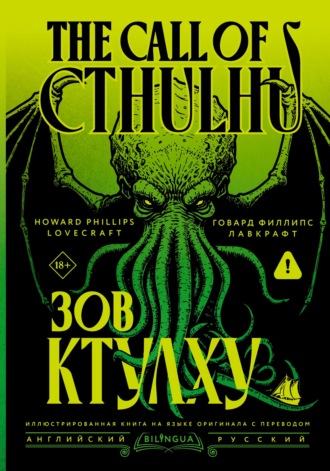
The Call of Cthulhu / Зов Ктулху



For several hours I sat thinking or brooding in the boat, which lay upon its side and afforded a slight shade as the sun moved across the heavens. As the day progressed, the ground lost some of its stickiness, and seemed likely to dry sufficiently for traveling purposes in a short time. That night I slept but little, and the next day I made for myself a pack containing food and water, preparatory to an overland journey in search of the vanished sea and possible rescue.
On the third morning I found the soil dry enough to walk upon with ease. The odor of the fish was maddening; but I was too much concerned with graver things to mind so slight an evil, and set out boldly for an unknown goal. All day I forged steadily westward, guided by a far-away hummock which rose higher than any other elevation on the rolling desert. That night I camped, and on the following day still traveled toward the hummock, though that object seemed scarcely nearer than when I had first spied it. By the fourth evening I attained the base of the mound which turned out to be much higher than it had appeared from a distance; an intervening valley setting it out in sharper relief from the general surface. Too weary to ascend, I slept in the shadow of the hill.
I know not why my dreams were so wild that night; but before the waning and fantastically gibbous moon had risen far above the eastern plain, I was awake in a cold perspiration, determined to sleep no more. Such visions as I had experienced were too much for me to endure again. And in the glow of the moon I saw how unwise I had been to travel by day. Without the glare of the parching sun, my journey would have cost me less energy; indeed, I now felt quite able to perform the ascent which had deterred me at sunset. Picking up my pack, I started for the crest of the eminence.
I have said that the unbroken monotony of the rolling plain was a source of vague horror to me; but I think my horror was greater when I gained the summit of the mound and looked down the other side into an immeasurable pit or canyon, whose black recesses the moon had not yet soared high enough to illumine. I felt myself on the edge of the world; peering over the rim into a fathomless chaos of eternal night. Through my terror ran curious reminiscences of Paradise Lost, and of Satan's hideous climb through the unfashioned realms of darkness.
As the moon climbed higher in the sky, I began to see that the slopes of the valley were not quite so perpendicular as I had imagined. Ledges and outcroppings of rock afforded fairly easy footholds for a descent, whilst after a drop of a few hundred feet, the declivity became very gradual. Urged on by an impulse which I cannot definitely analyse, I scrambled with difficulty down the rocks and stood on the gentler slope beneath, gazing into the Stygian deeps where no light had yet penetrated.
All at once my attention was captured by a vast and singular object on the opposite slope, which rose steeply about a hundred yards ahead of me; an object that gleamed whitely in the newly bestowed rays of the ascending moon. That it was merely a gigantic piece of stone, I soon assured myself; but I was conscious of a distinct impression that its contour and position were not altogether the work of Nature. A closer scrutiny filled me with sensations I cannot express; for despite its enormous magnitude, and its location in an abyss which had yawned at the bottom of the sea since the world was young, I perceived beyond a doubt that the strange object was a well-shaped monolith whose massive bulk had know the workmanship and perhaps the worship of living and thinking creatures.
Dazed and frightened, yet not without a certain thrill of the scientist's or archaeologist's delight, I examined my surroundings more closely. The moon, now near the zenith, shone weirdly and vividly above the towering steeps that hemmed in the chasm, and revealed the fact that a far-flung body of water flowed at the bottom, winding out of sight in both directions, and almost lapping my feet as I stood on the slope.
Across the chasm, the wavelets washed the base of the Cyclopean monolith; on whose surface I could now trace both inscriptions and crude sculptures. The writing was in a system of hieroglyphics unknown to me, and unlike anything I had ever seen in books; consisting for the most part of conventionalized aquatic symbols such as fishes, eels, octopi, crustaceans, molluscs, whales, and the like. Several characters obviously represented marine things which are unknown to the modern world, but whose decomposing forms I had observed on the ocean-risen plain.
It was the pictorial carving, however, that did most to hold me spellbound. Plainly visible across the intervening water on account of their enormous size, were an array of bas-reliefs whose subjects would have excited the envy of a Doré. I think that these things were supposed to depict men – at least, a certain sort of men; though the creatures were shewn disporting like fishes in waters of some marine grotto, or paying homage at some monolithic shrine which appeared to be under the waves as well. Of their faces and forms I dare not speak in detail; for the mere remembrance makes me grow faint. Grotesque beyond the imagination of a Poe or a Bulwer, they were damnably human in general outline despite webbed hands and feet, shockingly wide and flabby lips, glassy, bulging eyes, and other features less pleasant to recall. Curiously enough, they seemed to have been chiselled badly out of proportion with their scenic background; for one of the creatures was shown in the act of killing a whale represented as but little larger than himself.
I remarked, as I say, their grotesqueness and strange size; but in a moment decided that they were merely the imaginary gods of some primitive fishing or seafaring tribe; some tribe whose last descendant had perished eras before the first ancestor of the Piltdown or Neanderthal Man was born. Awestruck at this unexpected glimpse into a past beyond the conception of the most daring anthropologist, I stood musing whilst the moon cast queer reflections on the silent channel before me.
Then suddenly I saw it. With only a slight churning to mark its rise to the surface, the thing slid into view above the dark waters. Vast, Polyphemus-like, and loathsome, it darted like a stupendous monster of nightmares to the monolith, about which it flung its gigantic scaly arms, the while it bowed its hideous head and gave vent to certain measured sounds. I think I went mad then.
Of my frantic ascent of the slope and cliff, and of my delirious journey back to the stranded boat, I remember little. I believe I sang a great deal, and laughed oddly when I was unable to sing. I have indistinct recollections of a great storm some time after I reached the boat; at any rate, I know that I heard peals of thunder and other tones which Nature utters only in her wildest moods.
When I came out of the shadows I was in a San Francisco hospital; brought thither by the captain of the American ship which had picked up my boat in mid-ocean. In my delirium I had said much, but found that my words had been given scant attention. Of any land upheaval in the Pacific, my rescuers knew nothing; nor did I deem it necessary to insist upon a thing which I knew they could not believe. Once I sought out a celebrated ethnologist, and amused him with peculiar questions regarding the ancient Philistine legend of Dagon, the Fish-God; but soon perceiving that he was hopelessly conventional, I did not press my inquiries.
It is at night, especially when the moon is gibbous and waning, that I see the thing. I tried morphine; but the drug has given only transient surcease, and has drawn me into its clutches as a hopeless slave. So now I am going to end matters, having written a full account for the information or the contemptuous amusement of my fellow-men. Often I ask myself if it could not all have been a pure phantasm – a mere freak of fever as I lay sun-stricken and raving in the open boat after my escape from the German man-of-war.
This I ask myself, but ever does there come before me a hideously vivid vision in reply. I cannot think of the deep sea without shuddering at the nameless things that may at this very moment be crawling and floundering on its slimy bed, worshipping their ancient stone idols and carving their own detestable likenesses on submarine obelisks of water-soaked granite. I dream of a day when they may rise above the billows to drag down in their reeking talons the remnants of puny, war-exhausted mankind – of a day when the land shall sink, and the dark ocean floor shall ascend amidst universal pandemonium.

The end is near. I hear a noise at the door, as of some immense slippery body lumbering against it. It shall not find me. God, that hand! The window! The window!
The Nameless City

When I drew nigh the nameless city I knew it was accursed. I was traveling in a parched and terrible valley under the moon, and afar I saw it protruding uncannily above the sands as parts of a corpse might protrude from an ill-made grave. Fear spoke from the age-worn stones of this hoary survivor of the deluge, this great-grandmother of the eldest pyramid; and a viewless aura repelled me and bade retreat from antique and sinister secrets that no man should see, and no man else had ever dared to see.
Remote in the desert of Araby lies the nameless city, crumbling and inarticulate, its low walls nearly hidden by the sands of uncounted ages. It must have been thus before the first stones of Memphis were laid, and while the bricks of Babylon were yet unbaked. There is no legend so old as to give it a name, or to recall that it was ever alive; but it is told of in whispers around campfires and muttered about by grandams in the tents of sheiks so that all the tribes shun it without wholly knowing why. It was of this place that Abdul Alhazred the mad poet dreamed on the night before he sang his unexplainable couplet:
That is not dead which can eternal lie,And with strange eons, even death may die.I should have known that the Arabs had good reason for shunning the nameless city, the city told of in strange tales but seen by no living man; yet I defied them and went into the untrodden waste with my camel. I alone have seen it, and that is why no other face bears such hideous lines of fear as mine; why no other man shivers so horribly when the night wind rattles the windows. When I came upon it in the ghastly stillness of unending sleep it looked at me, chilly from the rays of a cold moon amidst the desert's heat. And as I returned its look I forgot my triumph at finding it, and stopped still with my camel to wait for the dawn.
For hours I waited, till the east grew gray and the stars faded, and the gray turned to roseate light edged with gold. I heard a moaning and saw a storm of sand stirring among the antique stones, though the sky was clear and the vast reaches of the desert still. Then suddenly above the desert's far rim came the blazing edge of the sun, seen through the tiny sandstorm which was passing away, and in my fevered state I fancied that from some remote depth there came a crash of musical metal to hail the fiery disk as Memnon hails it from the banks of the Nile. My ears rang and my imagination seethed as I led my camel slowly across the sand to that unvocal stone place; that place too old for Egypt and Meroё to remember; that place which I alone of living men had seen.
In and out amongst the shapeless foundations of houses and palaces I wandered, finding never a carving or inscription to tell of these men, if men they were, who built this city and dwelt therein so long ago. The antiquity of the spot was unwholesome, and I longed to encounter some sign or device to prove that the city was indeed fashioned by mankind. There were certain proportions and dimensions in the ruins which I did not like. I had with me many tools, and dug much within the walls of the obliterated edifices; but progress was slow, and nothing significant was revealed. When night and the moon returned I felt a chill wind which brought new fear, so that I did not dare to remain in the city. And as I went outside the antique walls to sleep, a small sighing sandstorm gathered behind me, blowing over the gray stones though the moon was bright and most of the desert still.
I awaked just at dawn from a pageant of horrible dreams, my ears ringing as from some metallic peal. I saw the sun peering redly through the last gusts of a little sandstorm that hovered over the nameless city, and marked the quietness of the rest of the landscape. Once more I ventured within those brooding ruins that swelled beneath the sand like an ogre under a coverlet, and again dug vainly for relics of the forgotten race. At noon I rested, and in the afternoon I spent much time tracing the walls and the bygone streets, and the outlines of the nearly vanished buildings. I saw that the city had been mighty indeed, and wondered at the sources of its greatness. To myself I pictured all the splendors of an age so distant that Chaldea could not recall it, and thought of Sarnath the Doomed, that stood in the land Mnar when mankind was young, and of Ib, that was carven of gray stone before mankind existed.

All at once I came upon a place where the bed-rock rose stark through the sand and formed a low cliff; and here I saw with joy what seemed to promise further traces of the antediluvian people. Hewn rudely on the face of the cliff were the unmistakable facades of several small, squat rock houses or temples, whose interiors might preserve many secrets of ages too remote for calculation, though sandstorms had long since effaced any carvings which may have been outside.
Very low and sand-choked were all of the dark apertures near me, but I cleared one with my spade and crawled through it, carrying a torch to reveal whatever mysteries it might hold. When I was inside I saw that the cavern was indeed a temple, and beheld plain signs of the race that had lived and worshipped before the desert was a desert. Primitive altars, pillars, and niches, all curiously low, were not absent; and though I saw no sculptures nor frescoes, there were many singular stones clearly shaped into symbols by artificial means. The lowness of the chiselled chamber was very strange, for I could hardly kneel upright; but the area was so great that my torch showed only part of it at a time. I shuddered oddly in some of the far corners; for certain altars and stones suggested forgotten rites of terrible, revolting, and inexplicable nature and made me wonder what manner of men could have made and frequented such a temple. When I had seen all that the place contained, I crawled out again, avid to find what the other temples might yield.
Night had now approached, yet the tangible things I had seen made curiosity stronger than fear, so that I did not flee from the long moon-cast shadows that had daunted me when first I saw the nameless city. In the twilight I cleared another aperture and with a new torch crawled into it, finding more vague stones and symbols, though nothing more definite than the other temple had contained. The room was just as low, but much less broad, ending in a very narrow passage crowded with obscure and cryptical shrines. About these shrines I was prying when the noise of a wind and of my camel outside broke through the stillness and drew me forth to see what could have frightened the beast.
The moon was gleaming vividly over the primitive ruins, lighting a dense cloud of sand that seemed blown by a strong but decreasing wind from some point along the cliff ahead of me. I knew it was this chilly, sandy wind which had disturbed the camel and was about to lead him to a place of better shelter when I chanced to glance up and saw that there was no wind atop the cliff. This astonished me and made me fearful again, but I immediately recalled the sudden local winds that I had seen and heard before at sunrise and sunset, and judged it was a normal thing. I decided it came from some rock fissure leading to a cave, and watched the troubled sand to trace it to its source; soon perceiving that it came from the black orifice of a temple a long distance south of me almost out of sight. Against the choking sand-cloud I plodded toward this temple, which, as I neared it, loomed larger than the rest, and showed a doorway far less clogged with caked sand. I would have entered had not the terrific force of the icy wind almost quenched my torch. It poured madly out of the dark door, sighing uncannily as it ruffled the sand and spread among the weird ruins. Soon it grew fainter and the sand grew more and more still, till finally all was at rest again; but a presence seemed stalking among the spectral stones of the city, and when I glanced at the moon it seemed to quiver as though mirrored in unquiet waters. I was more afraid than I could explain, but not enough to dull my thirst for wonder; so as soon as the wind was quite gone I crossed into the dark chamber from which it had come.
Конец ознакомительного фрагмента.
Текст предоставлен ООО «Литрес».
Прочитайте эту книгу целиком, купив полную легальную версию на Литрес.
Безопасно оплатить книгу можно банковской картой Visa, MasterCard, Maestro, со счета мобильного телефона, с платежного терминала, в салоне МТС или Связной, через PayPal, WebMoney, Яндекс.Деньги, QIWI Кошелек, бонусными картами или другим удобным Вам способом.