Полная версия
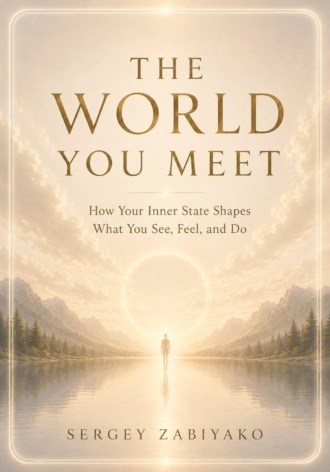
THE WORLD YOU MEET. How Your Inner State Shapes What You See, Feel, and Do
One client treats the work with respect, understands that a good result requires preparation, trusts the professional eye, and can discuss the task calmly. Beside such a person, you want to search more carefully for the light, work with the person in front of the camera, try another angle, and give slightly more than the agreement formally requires. Not because the photographer suddenly became better, but because the professional system received a space in which competence did not have to be defended every minute.
Another client devalues the process from the first message, negotiates not so much over price as over the specialist’s right to be paid, continually changes the conditions, and demands a result while refusing to recognize the cost of the work. Formally, it is the same shoot, the same cameras, light, and professional skill, but a significant part of the energy is now spent not on photography but on defending dignity and anticipating the next pressure.
Two hours of such work can be more exhausting than a long, intense day with people who are engaged in the shared process. The other person has not changed the photographer’s abilities. They have changed the state from which those abilities become available.
A person may be highly competent and still lose almost all pleasure in the work if the professional environment continually reflects them as a function required to produce results without boundaries, time, price, or human conditions of its own.
Something similar happens with a text. An author may trust the idea, yet after a conversation with someone who greets every idea with a skeptical smile, they begin devaluing the material in advance. They open the document not out of curiosity toward the thought, but out of the need to prove that they have the right to develop it.
The reverse is also true. One precise conversation can restore access to the text because the other person saw not only the imperfect wording, but the direction that had not yet taken shape. They did not write the chapter for the author and did not guarantee success. They helped the thought become real again.
A good professional mirror does not have to praise. Sometimes it speaks firmly, points to a weak place, and demands revision. But after such feedback, the person understands more and can act with greater precision. A poor mirror leaves only a sense of personal inadequacy without explaining what, specifically, needs to change.
This is especially important in education. One teacher may see a student’s lack of knowledge and reflect it as a temporary stage: “You do not understand this mechanism yet. Let us see where the logic was lost.” Another reflects not knowing as a characteristic of the whole person: “You are simply incapable of understanding something this basic.”
In both cases, the error is real. But one response preserves access to learning, while the other ties the question to shame and gradually teaches the person to remain silent where they most need to ask.
The professional mirror shapes more than an opinion about a particular piece of work. It participates in the version of the specialist a person becomes: exploratory, alive, and capable of correction, or chronically defensive, cautious, and afraid of visibility.
At this point, the Observer asks an important question: after contact with this person, do I understand the work better, or do I merely doubt more deeply that I have the right to do it?
The answer does not define the entire value of the relationship, but it reveals the state the relationship regularly assembles.
EMIGRATION AND THE LOSS OF THE FORMER REFLECTION
Moving to another country makes it especially clear how deeply self-image depends on social confirmation.
In a familiar environment, many people know your history. They remember where you studied, what work you did, which projects you created, what responsibility you carried, and who you were ten or twenty years ago. You do not have to retell your entire biography each time for the person you are today to have depth.
In Russia, I lived as a person with a long professional history behind me. There had been science, programming, management, the university, educational systems, marketing, projects, and people who knew not only the results but the path that led to them. A significant part of my identity was supported by the environment automatically. It was written into relationships, institutions, familiar places, and other people’s memory.
When I moved to Montenegro, much of that mirror disappeared.
The new environment did not see the whole biography. It saw a person in a current role: a foreigner, a neighbor, a client, a photographer, a specialist with an accent and an unknown history who still had to show what he could do.
A strange discrepancy appears inside. You know who you have been and what you are capable of, but the outer world does not yet reflect that depth. It is not interested in the internal folder containing your degrees, projects, responsibilities, losses, and experience. It looks at what you can create here and now.
There is pain in this, but also freedom.
Relocation deprives a person of part of their familiar confirmation, but it also loosens the hold of the old image. You can begin to see what in the former identity was genuinely your own and what was sustained only by position, social environment, status, and the inertia of other people’s gaze.
Freedom, however, does not cancel loneliness. When no one around you knows your history, it can feel as though part of your life has ceased to exist. Not because the past has disappeared, but because it no longer has living witnesses in the present environment.
This is why people who preserve the continuity of a biography become especially important in emigration. Beside them, you do not have to begin again from a new business card. They know that today’s difficult period is not the whole personality. They remember former strength, mistakes, projects, love, losses, and the ways the person has changed.
But new mirrors are gradually needed as well: people who come to know you in the new country through work, actions, relationships, participation in common life, and the contribution being made here. Otherwise, the person remains caught between two reflections. The old one is far away, the new one has not yet formed, and inside there is a persistent sense of temporariness.
My photographic path in Montenegro became one way of receiving a new social reflection. At first, you are simply a person with a camera. Then people begin recognizing your work, inviting you to events, trusting you with important shoots, recommending you, greeting you in the street, and associating your name with a particular quality and way of seeing.
There is a professional result in this, but also a deeper process. The new environment gradually says: you exist here not only as a person from the past. You participate in this life, help create its memory, and have already become part of the local story.
Emigration reveals that self-image does not live only inside the mind. It is assembled in a continuous exchange between inner memory and what the surrounding world is able to see, recognize, and return.
LONELINESS AMONG PEOPLE
Loneliness cannot be measured only by the number of contacts.
A person may live alone and not feel abandoned because there are several relationships in which they are genuinely known, awaited, and heard. Another person may spend every day among colleagues, relatives, followers, clients, and acquaintances and still remain inwardly lonely because nowhere can they show up as a sufficiently complete version of themselves.
They speak, but not about what matters. They joke, but do not reveal anxiety. They perform the role of the strong, useful, convenient, cheerful, or professional person and receive a response precisely to that role. Those around them may sincerely consider them sociable and stable, while they feel that no one knows the person living beneath the well-organized surface.
Конец ознакомительного фрагмента.
Текст предоставлен ООО «Литрес».
Прочитайте эту книгу целиком, купив полную легальную версию на Литрес.
Безопасно оплатить книгу можно банковской картой Visa, MasterCard, Maestro, со счета мобильного телефона, с платежного терминала, в салоне МТС или Связной, через PayPal, WebMoney, Яндекс.Деньги, QIWI Кошелек, бонусными картами или другим удобным Вам способом.