Полная версия
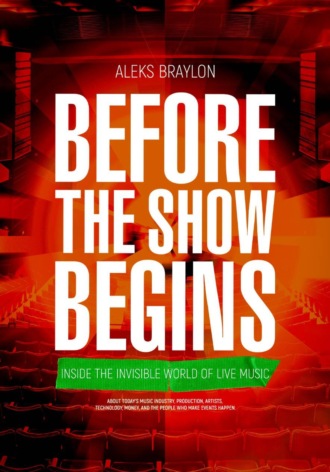
Before The Show Begins
Festival production is the art of standardization without making the event feel standardized. The better the common infrastructure, the more freedom different artists can have inside it. A good festival does not force everyone to look the same; it provides enough predictability for each act to become itself quickly. People who can speak briefly and precisely are especially valuable here. 'We need five more minutes' at a festival never means only five minutes for one team. It means five minutes of the next artist, security labor, broadcast timing, venue restrictions, and sometimes a municipal curfew. In a dense schedule, minutes have owners.
“Every year has to be better than the last.” — Lisca Stutterheim105
From Rave to Global Festival: How a Party Became an Industry
It is easy to think of the modern festival as a mature format that has always existed: multiple stages, branded zones, apps, camping, VIP, sponsors, streaming, dozens of vendors, and hundreds of pages of operational documentation. Electronic festivals did not grow out of a PowerPoint deck. They grew out of clubs, warehouses, local scenes, and people first trying to understand why one night could suddenly change the behavior of an entire city.
That is why I am interested not only in how enormous the stage became, but in the moment when a party was first forced to become a system. That is where the profession is born: when enthusiasm is no longer enough and the atmosphere has to survive scale.
Before the Festival, There Was a Night: Haçienda as a Laboratory
In Electrochoc, Laurent Garnier begins one of his key stories in Manchester in 1987, at the Haçienda. He describes a night when Mike Pickering played a house record and the room's reaction showed that more than musical taste was changing. The social code of the space was changing. People moved differently, listened differently, and understood the DJ differently.101 Stories like this matter because a large industry almost always appears after a small cultural shift, not before it. First there is a room, sound, a few hundred people, and the feeling that 'we found something that belongs to us.' Then come queues, press, money, competitors, licenses, and eventually someone with a spreadsheet asking where the emergency exit is.
In that sense, the club was a research laboratory. It formed not only the music, but the future logic of the festival: the DJ as central figure, the visual environment, collective identity in the audience, the long dramatic structure of a night, and the value of simply being present in one particular place.
When Rave Had to Learn to Function as Infrastructure
The next step is visible in British rave culture in the early 1990s. In Garnier's account, a Mind Body Soul party drew around seven thousand people; later, the promoter Universe obtained licenses for events of up to twenty-five thousand and Tribal Gathering emerged - already a hybrid between rave and full festival.101 That is a qualitative change. With hundreds of people, some problems can still be solved by relationships and improvisation. With tens of thousands, improvisation does not disappear, but it can no longer be the primary operating model. You need site permission, transport, medical provision, security, sanitation, food, power, redundancy, and a clear interface with authorities.
In France, the same era sometimes looked literally like a game of cat and mouse with police: organizers held backup locations, passed new addresses to attendees by mobile phone, and learned to move an event almost in real time. The romance of the underground sounds wonderful until you become responsible for thousands of people. The larger the scene became, the more strongly the culture needed legal and engineering infrastructure.101
Commercial success produced its own reverse effect. Garnier writes that as multi-thousand-person raves grew, people entered the market whose main interest was quick cash: rent a warehouse, print flyers, book a few names, collect the money. It is a cycle that repeats in every fast-growing industry. A subculture creates value. The market notices. Then the competition becomes who can scale that value without destroying trust.101
Sensation: One Color, One Arena, One Dramatic Language
Sensation began in Amsterdam in 2000 with a very specific idea from Duncan Stutterheim: looking at Ajax’s football stadium, he imagined turning it not into a venue with a DJ inside, but into a complete world for a single night. In a 2012 interview, he emphasized that from the beginning the team invested heavily in transforming the space itself — decor, staging, and the technical environment.105
After his brother's death, white became part of the memory and later the mandatory visual code. The decision became more powerful than ordinary branding because the audience physically wore the brand. A person did not simply buy a ticket to Sensation; they became part of the image. This is where one of event design's most important ideas appears: the strongest visual concept does not have to be located onstage. Sometimes the primary scenographic material is tens of thousands of people. A white audience turned any wide shot of the arena into a recognizable image long before vertical video and TikTok.
Sensation was later exported as a complete show format. According to Access All Areas, the project ultimately produced 177 editions in 37 countries. That is more than touring. For a system like that to repeat across markets, it must carry not only scenery and content but venue standards, logistics, staging, timing, brand rules, and a mechanism for local adaptation.105 Stutterheim once described the formula as roughly half and half: technology and show on one side, the people creating the party on the other. I like the incompleteness of that formula. You can copy the structure, lighting, and timecode perfectly; you cannot upload atmosphere to a server. Production can create the conditions. The audience always writes the last part of the product.105
Years later, working on Sensation Wicked Wonderland in Moscow, I saw the same idea from the other side - from inside a large touring machine. From the room, it feels as if the theme of the night was born there. Backstage, you understand how much engineering is required for the same world to arrive in a different city, inside a different building, and still remain itself.
Tomorrowland: The Festival as a World, Not a Poster
Tomorrowland's history begins almost comically small compared with what it became. Michiel Beers has recalled that in 1997 his brother Manu organized a party for roughly five hundred scouts. Later the brothers promoted a Wednesday club night that drew around fifteen hundred people. After that came the company.106
The first Tomorrowland in Belgium's De Schorre park took place in 2005 as a one-day festival of roughly ten thousand. By 2024, according to Access All Areas, the Belgian edition stretched across two weekends, more than eight hundred artists on sixteen stages, and around four hundred thousand attendees from two hundred countries. The comparison is useful not as a cult of scale, but as a reminder that legendary infrastructures also once had a first event.106
Tomorrowland's particular achievement was turning the festival into a world of its own. The annual theme establishes a visual language, the Mainstage becomes an architectural symbol, and the aftermovie extends the life of the event beyond the final set. Around that core grew radio, education, artist services, fashion, and other businesses. The festival stopped being only a date on a calendar and became a media and experience brand.106 For production, that changes the meaning of the main stage. It is no longer simply the place where the DJ booth stands. It carries the story of the brand. That is why the 2025 Mainstage fire was operationally devastating in two ways at once: the team lost not only a physical structure, but the central visual symbol of that edition. We will return to the incident in the chapter on safety.
DID YOU KNOW? Before Tomorrowland, the Beers brothers began with a scout party for about 500 people and a midweek club night that drew around 1,500. Sometimes a global festival company begins not with an investment memorandum, but with the question, 'What if we throw another party?'106
Soundstorm: A Festival as Infrastructure for a New Market
Soundstorm is interesting for a different reason. It did not emerge from the gradual expansion of a European club scene over several decades. It appeared as part of the rapid construction of a new entertainment infrastructure in Saudi Arabia. The first edition in 2019 already operated at enormous scale.
According to MDLBEAST, the first Soundstorm recorded more than 400,000 visits, 80 artists, and six stages; the company also reported 16,000 direct and indirect jobs and an economic contribution of about $118.5 million. Those are organizer figures, not an independent audit, so I do not use them to stage a contest over who is bigger. They support a more important point: from the beginning, the festival was conceived as economic and cultural infrastructure, not merely as a large concert.107
A large event generates demand around itself. It needs technicians, security, transport, catering, temporary structures, hotels, local artists, agencies, training, ticketing solutions, rights, media, and people capable of managing all of it at once. If the market can retain those capabilities between events, the festival stops being an imported spectacle and begins to grow its own ecosystem. For the Gulf, that is an especially important distinction. You can fly the world's biggest artist in for one night. It is much harder to make sure that ten years later the region has enough of its own production managers, engineers, writers, promoters, venues, and companies capable of creating an international product themselves.
What a Major Festival Really Sells
The lineup remains critical, but a mature festival sells more than the sum of its artists. It sells a temporary city with its own identity, rules, and memory. It has architecture, a human journey through space, rituals, visual language, belonging, and the promise that this world will appear again next year. The audience will remember the fire, the headliner, a favorite track, and the person they met at three in the morning. The organizer has to remember something else: toilets, roads, queues, water, crew shifts, radio frequencies, contracts, permits, medical posts, fuel reserve, transport after closing, and how many minutes it takes to move people safely off the site.
There is no contradiction. The less the audience notices the urban mechanics of a festival, the better those mechanics are probably working. And the more the festival wants to look like fantasy, the more realistic the person calculating its infrastructure must be. The history of major festivals is therefore not, for me, a history of stage size. It is the moment a cultural idea learns to survive its own success. That is when a party becomes an industry.
Stormzy and Lady Gaga: What 'We Don't Have Much Time' Means at a Professional Level
A short preparation period does not make a project small. It makes the cost of error and coordination higher. On one Stormzy project, TAIT described a stage created in roughly three weeks. One way to work inside a window like that is not to invent every component from zero, but to use existing equipment and configurable systems wherever doing so does not damage the creative idea. The opening, for example, used a suspended performance platform - a 'magic carpet.' For the audience it was a few spectacular seconds. For the crew it meant engineering, rigging, rehearsal, approvals, and safety that cannot be waived simply because the schedule is short.
Lady Gaga's team faced a different kind of time pressure before Coachella 2025. Choreographer and co-creative director Parris Goebel said full work on the show began late, preparation took less than two months, and before the first weekend the team had effectively completed only one full dress rehearsal. The show itself remained highly layered: choreography, complex costumes, lighting, video, scenery, and camera blocking.
The difference between professional acceleration and chaos is that the first compresses decision cycles while the second simply skips them. If there is no time for five iterations, authority has to be clearer. If three full rehearsals are impossible, checks must be broken into modules. If a creative decision changes late, the team has to understand the tail of consequences: new choreography can require a different lighting cue, a different camera angle, fresh stage marks, a changed RF route, and another safety review. Short preparation demands more standards, not fewer. Consistent filenames, clear versioning, an approval chain, disciplined meetings, and a change log become tools for preserving creative freedom inside limited time.
Конец ознакомительного фрагмента.
Текст предоставлен ООО «Литрес».
Прочитайте эту книгу целиком, купив полную легальную версию на Литрес.
Безопасно оплатить книгу можно банковской картой Visa, MasterCard, Maestro, со счета мобильного телефона, с платежного терминала, в салоне МТС или Связной, через PayPal, WebMoney, Яндекс.Деньги, QIWI Кошелек, бонусными картами или другим удобным Вам способом.