Полная версия
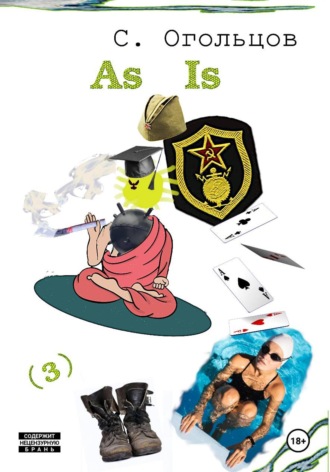
As Is

Сергей Огольцов
As Is
As Is
Annotation
Book 3 in the Rascally Romance series is a covert Halliluya to the hero’s priceless asset–muchly handy whether basking in the sunny side of the street or pulling through situations created with his active participation. I mean the happy trait in his mental make-up–taking anything for granted, that is – as is…
Were the protagonist a tree, the period encompassed here would add him 6 annual rings. However, our baobab is a lucky plant. And I’ll disclose you even more! Paying with 6 years of his personal time (which is also money, you know it as well as any other mother’s son do) for 6 additional rings in any unrelated tree, he begins gradually suspect, that it’s his life, after all.
~ ~ ~ the royal troops
'And the drill grounds will start shining,
Will get polished with our boots,
Will get crushed to fractions tiny
By the marching brave recruits…'
(to the air of 'C’mon, fellas, uncinch the horses…')
The buses rolled past the summer-green countryside beyond the window. The covered seats were soft enough, but it brought little consolation. Summer would begin without me, and how could I manage all the summer without Olga?
Two years of compulsory military service were less terrifying. The length itself turned them into an abstraction. The unimaginable can't frighten, but here, a concrete summer flies past the window. Sad view…
In five hours, the buses delivered and unloaded the recruits at the Assembly and Distribution Center (ADC) in the regional capital, the city of Sumy, named after the Sumka River, where Peter the Great lost his. It was probably leather, and it contained coins from the Tsar's treasury. Of course, he swore, the lanky gaper. He must have been carrying a bribe to fortune before the Battle of Poltava…
At the ADC, I made a desperate, last-ditch attempt to avoid the draft. At the final checkup, I told the ophthalmologist that I could barely make out the second line from the top of his chart on the wall, although I'd actually seen the third, in part.
Lying is wrong, unseemly, and shameful. However, the fear of the impending nightmare—two years without Olga!—shaken my moral compass, and I lied. Partially.
The doctor nodded with clear empathy. And I was deemed unfit for active duty, but perfectly suitable for a construction battalion…
Then I spent three days on bare planks of bunks in further ADCs and on the equally hard shelves of conscript train cars… But finally, here I am: standing in the pre-dawn gloom on the platform of the Stavropol railway station—after the heavy rain of the receding night—in only one shoe.
On my other, bare foot, there still stays a sock, soaked to the core of its cottony soul. This fact prevents me from being identified with Jason, or whatever the ancient Greek name was for that gaping idiot who couldn't lace his sandals properly.
Because there were no other options left. Nothing to choose from. When, in the dim light of the overhead bulbs, we, chechaco recruits were shouted out. I searched not only the compartment where I slept but also a couple of adjacent ones. My search was hampered by the sergeant's obscene yells from the vestibule at the end of the empty car, where only he and I remained.
My right shoe was still missing. And so, while the chill dampness of the rain-drenched asphalt seeped through the fabric of my black sock—so defenseless against the rest of the shod ranks—with the same slowed undercurrent, slowly but surely, the awareness of the cause of my discomfort surfaced within me. A nascent (even in the absence of direct evidence) indirect suspicion grew stronger that the disappearance of half my footwear was the vengeful handiwork of Valik Nazarenko from Krolevets.
. .. .
Of all the guys in our compartment, he was the only one carrying a thick wad of five-kopeck postcards congratulating with Soviet Army, Aviation, and Navy Day. At every station, through the narrow transom above the window, he would pester passersby with a whiny plea to drop half a dozen filled-out postcards into a mailbox.
Would anyone dare refuse a kid being transported, no, not in a prison car, but still locked?
And when the train left the station and settled into the steady clatter of throwing the miles behind, Valik would put on a smart face and ask himself the same question: 'Who else should I write to?' And to this, he invariably found the same answer: 'Ah! I know!' After which, he began filling out the next couple of postcards, declaring that he'd been drafted into the army and had already passed through the city of Rostov.
Having accomplished his literary feat, he read the creations (every single postcard) to his two-day-old companions, sharing the same compartment. Among those present, only one had been drafted from the same regional center as he. But even his fellow countryman couldn't immediately figure out which of the postcards' recipients were who in the glorious city of Krolevets. Although Valik had been communicating with him for three days, starting from the first.
The epistles were distinguished by an enviable consistency of theme and an unwavering set of words. Each composition concluded with the inevitable, timeless line: 'My best wishes, Valik.'
Towards the end of the second day of travel, I suggested that he change the word order, for sheer variety, and at least occasionally, say, every other postcard, write 'My Valik wishes best.' The compartment's audience, already driven to brain stupor by the author's monotony, burst into laughter…
But who laughs last laughs best, and now, in one sock amidst all these puddles, I was in no mood for laughter. An innocent play on words had caused the disappearance of a shoe, which had surely left the train before Stavropol, forcibly… hopelessly left behind… pairless, alien to the grass along an unfamiliar embankment… lashed by a nighttime downpour… This red-haired bastard responded to the elegant pun with a crude, practical joke. But if he wasn't caught, then he wasn't joking…
. .. .
We were ordered to climb into the waiting trucks’ backs. The convoy rolled through the streets of a strange, still-sleeping city, then exited along an empty two-lane highway, but soon turned left onto a potholed asphalt road.
A low forest stretched along the sides, and after another three kilometers, a long wall of white sand-lime brick, one and a half meters high, ran along the right shoulder.
The trucks turned into a wide-open gate made of a tall grating of vertical pipes (2-inch cross-section). A red and yellow sign under a glass frame, next to the outer door of the checkpoint, announced that this was Military Construction Detachment No. 11, Military Detachment No. 41769. Meanwhile, the deserted road beyond the gates flowed on—through a gap between a green forest and the white brick fence that ended about a hundred meters from the checkpoint, and the road, with no companions now, crossed the near horizon.
The sergeants led us to the bathhouse, where a lieutenant with a youthful, clean-shaven face came up to the porch and asked: would anyone like to send their rags back to where they were drafted from?
Predictably, no one made such plans, remaining true to the folk tradition of joining the army in clothes having one foot in the grave. Those were now dumped in the stunted grass under the brick wall of the bathhouse…
Only once, in the mess hall of the Rostov Assembly and Distribution Center, did I happen to see a conscript in a suit and tie. Besides that, his age was also striking—almost ten years older than the cropped-haired punks around him. But he was younger than twenty-seven, otherwise they wouldn’t nab him.
He hadn't his hair cut and wasn't eating anything, but simply sat motionless, staring into space, or rather, into himself.
(… because on the outside, we're smoothly homogeneous, but inside—wow!—there's something to laugh about, such epics unfolding there—no Odyssey neither the Iliad cant hold a candle to…)
So he sat there, his tie loose around his thick neck, oblivious to the sympathetic or malevolent glances, not knowing where they were taking him or what would happen there…
~ ~ ~
Military Construction Detachment No. 11, or MCU-11 for short, had the bare minimum necessary to house a large number of people compactly, in one place.
Behind a brick fence separating the detachment from the asphalt road, a group of five barracks huddled together, lined inside with painted plywood and faced outside with white brick laid in shiner position. The barracks were connected by a common system of steam heating pipes, laid overhead on tall (2.2 m) supports, each consisting of a pair of two-inch pipes.
For thermal insulation, the pipes were wrapped in a layer of brown glass wool, swaddled in white fiberglass, which occasionally stuck out from under the final layer of black roofing felt (aka tar paper). The said layer was kept in place with pieces of fine-gauge binding wire at three-meter intervals.
Three barracks to the right of the gate ran parallel to the wall between them and the road, each bordered by the badly packed asphalt of the internal paths.
In the second echelon, behind the first barrack from the checkpoint, stood a building of equal length but wider and also one story. It housed the canteen, with its own kitchen, and the unit club. The next building—in the third rank from the fence—comprised the bathhouse, the boiler house, the sewing and shoemaking shop, and the metalworking shop under one common roof.
The parade ground, clumsily paved with concrete, began at the checkpoint gates and continued to the mess hall. On opposite side of the ten-meter-wide parade ground, stood the last pair of barracks (of five). Separated by poorly compacted asphalt paths, they maintained a parallel alignment with each other and the silicate fence that protected MCU-11 from the potholes in the filthy asphalt of the outside world.
Behind the last pair of barracks, near the far left corner of the parade ground, stood a red brick latrine, with its entrance facing the mess hall exit (near the far right corner of the parade ground).
The latrine consisted of ten equally spaced holes of standard size, along the left wall. Each hole demonstrated the fairly solid thickness of the concrete floor screed. Along the entire opposite wall ran a cemented urinal channel, sloping toward the corner where it met the far end wall and bent along it to reach the left corner with a drain hole into the underground cesspool.
To the left of the latrine was a deep tin wash basin, about ten meters long, raised above the ground by meter-tall legs made of rebar. Another half meter higher, a half-inch pipe, emerged from under the ground, hanged loosely burdened with a dozen water taps mounted at one-meter intervals to discharge into the basin.
Directly beyond the parade ground, about twenty meters away, stood three box-sheds without front walls—to keep a pair of reclining trucks. To the left of the sheds stretched two rows of sturdy warehouses for food products and inedible ammunition. Behind them, in the very corner of the rectangular territory of military detachment 41769, the squat structure of a pigsty could be seen.
Oh, I almost forgot! Near the gate, opposite the checkpoint, stood the brick box of a small 'Militar-trade' store, with a gate wing hung from its corner toward the second wing hung from the corner of the checkpoint…
A white fence, with brick posts, ran only along the asphalt road, while the rest of the perimeter was bordered with the same barbed wire surrounding my childhood.
Behind the boxes and the sagging wire fence, a wide field tilted gently upward, concealing the following hollow with an abandoned sand quarry and a deep ravine with the village of Tatarka, the immediate destination for soldiers going AWOL—unauthorized absences from their unit.
And the road we were brought along, six kilometers later, entered the village of Demino, where soldiers also went AWOL, just like they did to Stavropol itself, of course. But I knew none of this as I emerged from the bathhouse, freshly dressed in a monochrome khaki cotton uniform, pungent with the smell of acetone, each foot clad in a separate black tarpaulin boot over clumsily swathed foot wraps.
I also didn't know that 'KhE/bE) means 'cotton', and that foot wraps—two strips (30 cm x 60 cm) of light calico or flannel (depending on the season) used to swathe your feet—are much more practical than socks.
In the summer, when you take off your socks, you notice uneven streaks of dust near your toes and on the instep where the dust has worked its way through the socks’ fabric. Foot wraps are a different matter—they get dirty themselves, but they keep your feet clean. You just have to swathe them properly—tight, evenly, without creases, otherwise you'll rub your feet to bleeding. And in winter, foot wraps without socks keep you warmer than foot wraps over socks, although neither method protects you from frostbite in your boots, frozen to the point of being as stiff as iron…
A couple of soldiers from previous conscriptions rummaged through civilian rags discarded on the grass in front of the bathhouse, picking out some civilian clothes for their AWOL…
. .. .
We were taken to the unit's club, with a bare stage, devoid of any curtains, and rows of plywood seats across the hall with the sloping floor of unpainted planks.
Our first mission in the army became clearing the hall of seats, washing the wide gray floorboards, hauling double-decker iron beds from a nearby barracks, and then installing for the personnel of the fourth company, since their barracks had been repurposed as a 'training' facility for us new recruits.
~ ~ ~
After completing our initial non-combat duty assignment, we formed up in front of the entrance to the fourth company to be divided into three platoons, each under the command of a separate sergeant. The sergeants compiled lists of their commandos, checked them against the master list with the senior lieutenant, and began drilling the recruits.
All three platoons practiced the same command.
‘Platoon! Form up!’
‘Platoon! Disperse!’
‘Platoon! Form up!’
‘Platoon! Disperse!’
‘Platoon! Form up!’
‘Platoon! Disperse!’
We followed the commands, warding our hunger off with anticipation, because a small group of recruits had already been dispatched to the mess hall to prepare the tables for the meal. And finally: 'Form up for lunch!'
‘Forward… ARCH!’
. .. .
Unlike the Club, where you have to climb three steps to reach the entrance, in the mess hall, after the door without a porch, the same number of steps descended to enter a spacious hall filled with tables in two tightly packed squares, separated by a central aisle from the back wall to the entrance/exit.
Beside each table stood benches of equal length, painted a smooth brown, strong enough to support the weight of ten diners stepping over them and sitting down, side by side.
The dark gray, smoothly polished concrete 'mosaic' floor filled the room with a reverberating, indistinct echo, like the gigantic waiting rooms at major railway stations.
Along the entire left wall (from the entrance), two wooden steps led up to three windows that provided access to rooms outside the mess hall. A sturdy window sill, lined with galvanized tin sheets, extended half a meter above the steps, running, like them, uninterrupted along the entire left side of the room.
First, in the row of windows above the sill was a small one for the bread-slicing shop, mostly closed by a tin-lined shutter.
The next—a meter high and four meters long, precluding the use of shutters—presented a panoramic view of the kitchen with its wide, cylinder-shaped nickel-plated cauldrons, from whose half-unscrewed lids steam gushes billowed. A pair of soldier-cooks strolled through the clouds. They wore army pants, flip-flops on bare feet, and tank tops under half-unbuttoned white jackets stained yellow with frying pan grease. One of the cooks wore a flat white beret, nesting there (even a novice ornithologist could tell) for months.
The final window—also free of shutters, but half as wide, merely two meters—looked into the dishwasher, where clouds floated, thicker and foggier than those in the fjords of Norway. The phenomen was fed with the relentless gush-and-splash of hot water from several taps into a long tin trough, piled high with enamel bowls, mugs, and heaps of aluminum spoons, washed almost separately.
The far wall, opposite the entrance—blank, painted, like everything within the MCD, a practical mourning marsh color—separated the mess hall from the Club.
In the right wall, high above the floor, there was a continuous strip of glass in the woodwork of the fixed transoms.
Bowls (once white, but long since chipped enamel) placed on the tables serve as markers for seating on the benches. Twenty aluminum spoons are piled in a compact heap in the center of the table, nestled in a pool of water dripped of them, so each eater can grab one.
A heavy ladle lay close to the spoons heap, and a tight cluster of enamel mugs (also 20) crowd by the heap’s opposite edge, not exactly in their first youth, they bear battle scars from scraps and battering in the dishwasher trough.
Nearby are two and a half crosswise-cut 'bricks' of gray bread, on a dented aluminum tray, also falling apart into exactly twenty pieces…
The cooks began to toss five-liter enamel pots onto the windowsill beneath the serving window and shout something vague.
The first army meal had started. Borscht was brought from the serving window to be poured into bowls with the heavy ladle. This dish turned out to be very red and scalding hot.
Since the soldier used the same bowl throughout the meal, he had to finish the borscht to get a second course, or refuse it outright and wait for the soldier on duty to bring a 'bucket' of second course, a thin pearl barley porridge known in military parlance as 'kirzukha.'
(… look closely at the shaft of a soldier's boot, made of kirza [from the shyz-garied English 'kersey'], this artificial leather was invented during the Russo-Japanese War, and although it did not prevent the defeat of the Russian Empire in the aforementioned conflict, it nevertheless faithfully served its purpose, both combat and non-combat, for over a hundred years.
Now, putting aside these side comments, focus on the fine pattern of the upper layer of the boots of the Russian-Red-Soviet-(and, yes, again) Russian armies. Well, how about it? Objectivity will not allow one to deny the impeccable accuracy of the unofficial nickname 'kirzukha' for the traditional barley feed in the aforementioned armies.
It is not surprising that this similarity prompted soldiers on the brink of starvation to boil the shafts of their boots. As it happened on a small barge carried by storms into the Pacific Ocean, where it became a plaything of currents and winds for 49 days before being spotted by a US Navy aircraft carrier off the coast of California.
Four emaciated Soviet sailors were offered political asylum in the United States. They did need some rest from the Cold War, declared by the British hereditary star on the political firmament, Winston Churchill, in his Fulton Oratorio, had not yet given way to the Greenhouse Effect and other global shifts.
However, Sergeant Ziganshin remembered the beauty of both sunsets and sunrises in the steppes of his native Tatarstan and refused. The other three sailors followed his example (even though they were not Tatars).
Later, they were all nominated for the highest orders and decorations of the Soviet Union, after appropriate verification to ensure they had not become CIA agents while in the process of regaining normal body weight in the notorious 'horn of planty', aka state of California.
[It wasn't until the mid-1990s that Askhat Ziganshin finally managed to recover from the alcohol addiction he'd developed through endless drinking during interrogations disguised as all sorts of celebratory patriotic events.]
All this happened in 1960 and inspired the then-popular folk-rock song:
Beware the boogie man!
Ziganshin's on the loot!
The night before
He chomped his buddy’s boot!
And this is the strangest fact in this whole story, since there wasn't a single vocal-instrumental ensemble in the USSR at the time…)
. .. .
The porridge also turned out thin and as hot as borscht. The compote, poured into mugs from a dented aluminum teapot, wasn't hot, but still thin. The deep hum of bustle at the train station served as a backdrop to the chomping and slurping.
Occasionally (though not daily), the peaceful symphony of animal feeding was pierced by the loud curse of someone hurling something and the whining clink of a mug as it bounced and splashed across the floor of the central aisle.
Nothing to startle at! The soldier simply noticed that he'd received a defective mug—it was worn beyond its capacity to hold a full cup—and he expressed his indignation at the current situation, since, according to time-honored prison tradition, using leaky utensils is both a prerogative and, at the same time, a mark of a buttboy, whose holes are used by other prisoners, even if he's not homosexual, but rather a degraded one, regardless of his straight sexual orientation outside the walls…
After eating, the implements of personal nourishment are to be carried to the dishwasher window and left in piles or heaps of similar items on the shelf. As they accumulated, the dishwashers themselves would dump these piles into the appropriate sections of the trough, under the scalding water from the taps.
Now we could leave the mess hall and stagger back to the training barracks, wary of missing the next command, 'Form up!'
~ ~ ~
Subsequent army experience showed that borscht is never served for breakfast or supper; those begin immediately with 'kirzukha'. Furthermore, in the mornings, a tray with twenty cubes (2.5 cm x 2.5 cm x 1.2 cm) of yellow butter appears on the table next to the bread, delivered from the bread-slicing shop. You spread it on the bread with the handle of an aluminum spoon snatched from the common heap.
If the butter is brought in a single piece, it is divided by the most respected soldier (of those at your table) using the handle of his spoon.
A piece of butter (or a number of its cubes) could noticeably dwindle thanks to the attentive care of a soldier passing by your table. The fellow began serving his duty to the Soviet Motherland a year or a year and a half earlier than you. A weighty reason to reward himself for his combat service early in the morning. The lump sugar brought for morning tea also didn't escape the attention of one or another distinguished veteran…
Overall, the rations were unpretentious, but sufficient for survival. In the fall, they reached a deeply unassuming simplicity—cabbage with water for the first course, cabbage without water for the second, water without cabbage for the third.
On a particularly good day, your bowl of 'kirzukha' might contain a piece of lard (the unit has a pigsty, by the by), but nothing but lard. And on Soviet holidays, morning tea was accompanied by a bun for everyone, one of those that cost 12 kopecks in the school canteen…
~ ~ ~
At first, I couldn't eat soldier's food. It wasn't that I was squeamish, but on the contrary, I tried my best, but despite all my efforts, I couldn't stomach the rations. They stubbornly stuck in my throat. During one of the feedings, a soldier from the previous draft, watching my diligent toil, laughed and explained, 'Don't worry! You'll get the hang of it and start gobbling everything in sight.'
He turned out to be right. The thing is, in a construction battalion, they don't eat, they gobble.
'The company's off to gobble. Catch up!'
'What's the gobble today?'
As soon as I stopped eating and started gobbling, everything went smoothly. Sometimes I could even gobble a second helping. But that came later, because if a soldier in the first six months of his service (called 'youngster' or 'greenhorn' or 'salabon' during that period) dares to approach the food service window with a bowl in hand, the cook will likely be too lazy to pour a ladle of chow into it and will simply bark, 'Get the fuck out, greenhorn!' And not because he's a genetic misanthrope, but simply because he was also scared off when he was still a greenhorn himself. However, he might not send you away, because exceptions are found anywhere.