



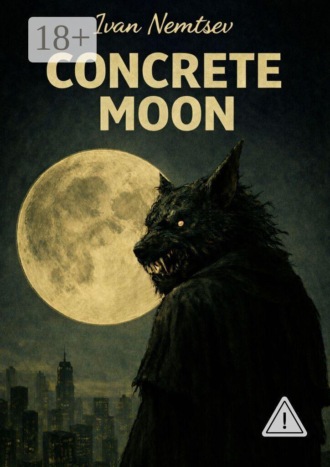
Полная версия

Concrete moon
vol. 1
Ivan Nemtsev
TRANSPARENT WALLS,
A COLD THAT CALLS,
A DROWSY HAZE, A KNOT OF FEAR—
BLOOD ON MY HANDS…
IT WON’T WASH CLEAR…
© Ivan Nemtsev, 2026
ISBN 978-5-0069-9731-8 (т. 1)
ISBN 978-5-0069-9732-5
Created with Ridero smart publishing system
FOREWORD
Welcome, dear reader.
Most books open with thank-yous and dedications. Some hit you with a disclaimer. Mine’s the second kind.
I’d rather save the gratitude until after we’ve walked the streets of Rosenberg together — a city that used to be great, but you won’t find it on any map. Yeah, we’re stepping into a European metropolis that exists only here. Germany and I go way back. With my last name, what did you expect? German names, street signs, scraps of foreign speech — none of it’s random. It’s my love for the whole country shoved through the meat grinder of serial-killer psychology and my obsession with thrillers and dystopias.
If European settings rub you the wrong way, if German names and places grate on your nerves — close the book now. You won’t like what’s coming.
Same goes if you can’t handle strong language. There’s plenty of it here. Without the profanity, you don’t get the full stink of Rosenberg. You don’t get the world it lives in.
And finally: this book is brutal. It’s not light reading. It’s a dark, psychologically heavy thriller with elements of a detective story and drama. I’m digging into loneliness, love, human cruelty, and society’s moral rot. I don’t endorse violence. I don’t justify murder. At its core, this series is about love — but the novel in your hands is about a killer. That means victims, blood, and more than a few ugly details.
Bottom line: this is for adults. If brutality and raw language make you flinch, this won’t be your ride. Concrete Moon is for fans of dystopian fiction and anyone who likes staring into the darker corners of human nature. If you’ve ever wondered whether violence can be justified in the name of “cleansing” society, or how the hell you find meaning in a world where morality has turned to sludge — then this one’s for you.
They say every story’s already been told. Mine’s no exception. I drew inspiration from Crime and Punishment, Saw, Dexter, The Dark Knight, Monster, The Silence of the Lambs, Squid Game, and Manhunt. If those titles mean something to you — if they didn’t scare you off or turn your stomach — welcome to the streets of Rosenberg.
The commissioner’s already been yanked awake by the call. He’s gearing up to head to the crime scene.
Come on, reader — let’s go. Before we miss everything.
See you on the last page.
PART I
FALL
I
Dilemma
Before us was a closed loop of twelve elements, like a long string of holiday lights. Eleven bulbs — dead and cold — and only one pulsed with a scarlet glow. There was nothing physical around us — only a cosmic emptiness filled with black as pitch1.
A moment passed, and then — suddenly, as if out of nowhere — a figure strode toward the chain: a thin man with a thick beard, seemingly elderly and impossibly tall (compared to the bulbs). A long robe the color of old parchment swayed, though there was no wind here — couldn’t be. His beard — ashen, almost white — spilled down his chest in heavy strands. And his face… slipped away. Blink, and all that remained in memory was a vague outline, as if someone were rubbing it out with an eraser right inside your mind.
You couldn’t say anything definite about how he reached the chain of bulbs, either — there was no surface in a place like this.
The glowing bulb trembled almost imperceptibly, giving off a thin whistle like the moan of a wounded creature.
“Again…” the man said at last. “Well, then…”
Bony fingers closed around the hot glass. The bulb shuddered, hissed, and letters surfaced on its skin. He read the inscription several times, then carefully returned the element to its place.
“Earth. Transatlantic Union of Nations. Saxony, German State. October, 2067.”
It was October — the month that turned one man’s mind inside out.
* * *
Saturday, October 1Night. Forest. A thick fog wraps itself around the trees along the roadside leading to a two-story mansion.
A white SUV idles at the wrought-iron gates. Only the headlights shine — and the lone moon overhead. The driver doesn’t move: hands on the wheel, eyes forward. Inside the cabin — silence, and the heavy smell of leather, coffee, and cigarettes.
With a faint metallic scrape, the gates slide open. One second — and the SUV launches forward, hugging the curves. The winding road drops from a high hill, through the forest, into the city of Rosenberg, glittering with lights.
Senior Commissioner Engel Becker’s weekend night began with an unsettling call from the police station dispatcher.
* * *
Rosenberg. A city on the Elbe. Four Horsemen rule here: corruption, drugs, murder, and robbery. It’s a zoo without cages, where packs of psychopaths, rapists, prostitutes, thieves, and traitors roam. Everything the darkness can breed is here.
Day after day, merciless Death hangs over Rosenberg, cutting down sinful souls with its scythe. Most of them get picked up by a taxi, hauling a person’s ghostly remains straight into the hottest pit of Hell.
A city where it feels like any moral boundary — any notion of decency — has been erased; where every commandment of every religion on earth is broken in plain sight. Where the handful of honest cops are forced to wear wolfskin, while their colleagues knock back drinks in seedy bars with the very people they’ll be “looking for” tomorrow.
This city is a sinkhole in the body of the Earth… a sinkhole that drops all the way into Hell. A typical twenty-first-century city, drowning in the worst crisis since World War II.
This city is Rosenberg. Welcome.
* * *
The commissioner reached the crime scene quickly. It was an abandoned three-story warehouse that had once been used to store fuel and other flammables. The docks sat nearby, and that was probably how the district had gotten its name: “Rock-Port.”
The grounds were ringed by a low fence topped with barbed wire. The first-floor windows were sealed shut with thick boards. The police had already cordoned off the perimeter. The strobing lights of patrol cars threw restless crimson-and-blue shadows across the building’s facade, turning it into something like a gigantic, pulsing organ.
Engel Becker — Senior Commissioner, Rosenberg’s chief of police — cut hard to the curb and killed the engine. The moment he stepped out, a cold, gusty wind off the river slapped him in the face, making him squint for a beat.
Engel was fifty-three, and he’d given almost his entire life to the job. Average height, a big belly, strong hands — gray had been creeping through his hair for years, and his face wore the same faint, gray stubble.
The commissioner’s gaze took in the scene at once. Static. Officers hunkered behind their cars, barrels trained on the dark third-floor windows. Someone was barking into a radio; someone else was silently biting his lip, trying to keep the tension under control.
The moment Becker came into view, one of the men under him sprinted over. A tall, wiry kid — his face carried that combustible mix of adrenaline and fear that rookies always had.
“Thomas. Report,” Engel said curtly.
“Herr Commissioner!” the rookie — Thomas — panted. “About an hour ago, on Graschtenstraße, an armed man was spotted — black athletic gear, around forty. He was walking along the shoulder with an assault rifle trained on a chain of eight bound hostages… He made them crawl on all fours, and then they disappeared into the abandoned building. We don’t have an ID yet.”
“Anyone tried to get inside?”
Thomas hesitated.
“Speak!” Engel snapped.
“My partner…” The officer swallowed. “Kuno tried. But when he got close to the window… well. He’s been hit.”
The commissioner spat at his own feet.
“Again with this goddamn hero sticking his nose where it doesn’t belong!”
“There are two entrances, and both are blocked from the inside. Kuno tried to go in through a window — nearly tore a board off with his bare hands… The shot came from the third floor. Shoulder. Through-and-through.”
“Why didn’t you report right away that we’ve got wounded?” the commissioner demanded.
“Sorry, Herr Becker. We managed to stop the bleeding. Herr Werner insisted he could keep going — ”
“That asshole’s going to get us all buried one day,” Engel cut him off. “All right. To hell with it. Here’s what you do: send that idiot to the medics. Tell him it’s my order. Move!”
“Yes, Herr Commissioner!”
Thomas ran back toward the cars, while Engel Becker — already feeling the full weight of the paperwork this would turn into — moved slowly toward the cordon, letting his eyes tick from one vehicle to the next: four in front, one more behind the warehouse.
“Goddamn it all,” he muttered, flicking his cigarette butt to the ground. Something splashed on his bald scalp. Then again. He looked up at the night sky, choked with clouds. A light rain had started.
What a night, the commissioner thought, irritated.
“Who are you, for fuck’s sake…” he added aloud, staring at the dark third-floor windows.
He pulled his cell phone from his coat pocket, selected a name from his contacts, and hit call. The line rang.
“Klos, drop everything and get your ass to Graschtenstraße 17. Hostage situation. Possible casualties. And bring Bauer — we need at least one sniper. The morons staring at porn in the duty room right now are more likely to shoot each other by accident than hit what they’re aiming at.”
A short answer came through the receiver.
“Then Maurice!”
A pause. An unhappy exhale.
“Goddamn them all… Fine. Come alone — you’ll get comp time. Just hurry. I want you to talk to him.”
Without waiting for the reply, the commissioner ended the call and immediately dialed the precinct.
“Do you have the floor plan for Graschtenstraße 17 ready? What do you mean ‘in progress’? ! Yes, of course it’s urgent. I need it now, not by Christmas!”
He shoved the phone back into his pocket and walked toward the group of officers.
“I hate negotiations.”
* * *
Time dragged like tar gone cold. The tension in the air kept climbing. Only the commissioner held on to that ice-cold calm. The other officers were visibly on edge — especially Thomas Meyer. The poor bastard was practically trembling. Maybe from the autumn rain that cut straight to the bone, maybe from the fear that shooting was about to start any second now. Either way, the kid was doing his best to hide the fact that his teeth were chattering.
His partner, Kuno Werner — a solidly built, average-height man — sat in a patrol car hazed up with bluish cigarette smoke and chain-smoked in silence. It was probably his fourth cigarette in the last half hour.
The scene came alive when headlights washed over the abandoned warehouse and the ground around it. Shadows broke into a frantic dance, leaping across the walls and the old, potholed asphalt. A black sedan rolled up, so meticulously washed it looked like it had just been driven off the lot.
The car stopped beside the commissioner’s vehicle. A young man stepped out — around five-eleven, light stubble, short-cropped black hair, blue eyes. He slammed the door and headed for the cordon without looking around. A long black coat streamed behind him in the wind as he walked with his eyes on the asphalt, as if the weight of the sky pressed down on the back of his neck.
At the cordon, his gaze caught on a reflection in a side mirror. In it — a tired face: Klos Heinemann, a homicide detective, with eyes long since accustomed to the night.
My eyes…
I spotted Commissioner Engel right away — his bulky figure stood out in the jittery chaos of the cops.
“Herr Becker.”
“Still alone?” he sighed, disappointed, instead of a greeting. “I’m gonna fire those clowns’ asses…”
“Easy. Diana said the guys have been tied up on a call in Karbon for an hour. The whole precinct’s empty — busy night.”
“Yeah, yeah,” the commissioner snorted and pulled a crumpled pack from his pocket. The lighter flicked three times before his hands finally obeyed. “Some asshole with hostages.” He jabbed with the cigarette toward the third floor. “Don’t know who yet. No demands. At least eight hostages in there, so we need to make contact ASAP. And since our only negotiator got cut in the layoffs, you’re going to have to handle this shit. You know what to do?”
“Yes,” I said, trying to sound more confident than I felt.
“I’m trusting you. Move.”
At the nearest patrol car, I pulled an old bullhorn from the trunk — heavy, cold as a slab of ice.
“Hey, Kuno!”
He didn’t answer, absorbed in scrolling through something on his phone.
From another car, Thomas Meyer watched what I was doing. Inside the cabin it looked quiet and calm — a stark contrast to what was happening outside, where the air was practically soaked in fear.
I switched the bullhorn on, brought it to my mouth, and, forcing my voice to stay steady, said: “Rosenberg Police! The building is completely surrounded. Drop your weapon and come out with your hands up before anyone gets hurt. An attorney will be provided!”
Just as expected, a tense pause settled in. The perp was clearly stalling — playing with us, savoring the power. He was like a spider, calmly watching stupid flies caught in its web.
Everyone froze, eyes locked on the dark windows. Silence. Only the wind chased dry leaves down the alley, and they spun in time with the flashing police lights, scattering anxious glints across the asphalt.
Then something loud tore through the static from the direction of the warehouse. Glass rained down, and after it — a woman’s scream: “Help!”
“Hold your fire!” the commissioner ordered.
A few seconds later, a silhouette appeared in the broken third-floor window. The woman stepped slowly out of the darkness with her hands raised above her head and climbed onto the sill. She looked about twenty-five — beautiful, long blonde hair. And pregnant, it seemed — her belly rounded beneath thin clothing.
“I… I’ll relay his words,” she blurted in a shaking voice. “His name is Reinhold. He demands… he demands that you count yourselves.”
The pause hung in the air. For a moment, all I could hear was blood buzzing in my temples.
“Reinhold…” the commissioner grabbed his head, his face twisting. “Don’t tell me…”
But the woman went on, not giving us time to guess: “All officers… must gather in front of the main entrance… on the road. Otherwise he’ll… start shooting.”
Engel snatched up his radio.
“No tight clusters! Four to a car — stay in cover! Everyone in vests — move!”
Then he turned to me and added quietly, almost in a whisper: “I’ve got Oliver behind the warehouse, in cover. He’ll make sure that freak doesn’t try anything. Go on — tell her we’re ready.”
“Commissioner, is this the same Rein — ”
“I don’t know. Pray it isn’t.”
Cold ran down my spine.
I lifted the bullhorn again and rasped out: “We’re ready.”
She reacted instantly. I could feel fear twisting her up from the inside.
“Nineteen officers… and there are only nine of us in the building. He… he demands balance. Ten…” She glanced back over her shoulder, said something quickly into the darkness, then continued: “Ten ‘stinking pigs’ must get the hell out of here immediately. But Werner and Meyer have to stay. For every minute you stall, he will… kill one hostage.”
She vanished so sharply it was like someone had yanked her by an invisible leash.
The commissioner quickly picked ten of the most useless cops on scene and ordered them to fall back to the intersections to the left and right of the warehouse. He spread the rest around the perimeter. My eyes stayed on the second hand as it raced across the dial. Exactly forty seconds passed.
“Why did he call for me?” Thomas asked in a nervous half-whisper. His voice — pure, animal panic — was more contagious than a scream.
At that moment the hostage appeared in the window again, but now a man’s figure surfaced behind her. He stepped out of the darkness into the circle of the spotlight, and it became clear to everyone who we were dealing with.
Reinhold Wulf.
One of Germany’s most infamous criminals — and the nightmare of every Rosenberg cop. The leader of The Golden Calf, a fanatic who’d declared war on the “rule of money.”
For four years he torched banks and pulled off brazen robberies, staged bombings in financial districts — calling it all “purification.” Once, on Unification Day, his people rounded up nearly a hundred ATMs and hauled them out beyond the city limits, where they simply… burned them, like pagan idols. But the worst part of his crimes wasn’t even that…
Reinhold almost always used hostages, and he played us like an instrument — taking pleasure in the sadistic mechanics of chaos, turning every “operation” into an elaborate game with death. A psychopath without empathy, rationalizing violence with mad slogans.
The last time the police faced Reinhold, it turned into a slaughter: dozens of hostages died during the takedown, several officers were seriously injured — one later died in the ICU. The price was monstrous, but that was when we finally caught him. We thought it was over, but the bastard avoided prison — the killer was involuntarily committed to a psychiatric hospital.
And then he escaped — two years ago. Since then, nothing. Not a word.
“We’re screwed,” the commissioner exhaled softly.
“Well, pigs…” came the voice you couldn’t forget — low, rasping, soaked in contempt. “Been a while.”
He took another step, and we got a better look at him. Average height, heavyset, with a thick, toad-like face — puffy, sagging cheeks, tiny deep-set eyes. Reinhold wore a sun-faded hooded jacket. He wore plastic safety goggles on an elastic strap, making him look like a giant fly. Using the pregnant woman as a human shield, he pressed the muzzle of a pistol tight to her temple.
Wulf let his gaze drift slowly over the street, savoring our helplessness.
“Listen carefully and don’t interrupt! I have eight hostages! Use your heads and don’t do anything stupid. First — put your weapons on the asphalt, or one of the hostages dies. Eight seconds. Seven. Six…”
“Do it,” Becker barked, and there was real alarm in his voice.
The officers exchanged looks and slowly laid their pistols on the asphalt. A few only pretended to comply, catching the commissioner’s barely noticeable gesture.
“Good piggies,” Wulf snorted, pleased. “Fair warning — this little shed is packed to the rafters with explosives. If it even crosses your mind that you can take the warehouse by storm…” He paused, as if checking whether it had sunk in.
“Diana — bomb squad. Now,” Engel muttered into his phone.
“Today you’ll learn that not even death can stop my cause. I’m eternal. For years they tried to turn me into a monster… and all I ever wanted was to rid your cursed society of the rule of money. It’s time to open your eyes — not only to what I am, but to what you really are. Don’t be naïve enough to think I’m the only bastard here. This entire warehouse is full of bastards. At least one more…” — his voice dipped, almost savoring it — “is standing right among you. My accomplice.”
Silence went absolute.
“I don’t care how you figure it out, but you have eight minutes — not one second more — to find out who he is. Give me his name — loud and clear. Get it wrong… or keep quiet — and one hostage dies. Time starts now.”
With that, Reinhold snapped back into the darkness, dragging the woman with him.
“Sick freak!” Engel slammed his fist down on the car roof so hard the metal buckled. “I knew this scum would pull some bullshit again!”
“We taking him alive?” I asked tensely, even though I already knew the answer from the commissioner’s face. “He’ll just escape again. Maybe we should — ”
“And what do you think?” Engel muttered, irritated. “If it weren’t for the hostages… Damn it!”
His phone started vibrating like crazy in his pocket, and the commissioner quickly stepped aside.
I turned away and slowly swept my eyes over everyone present, looking each of them in the face. In the depths of their pupils, the same fear was hiding.
The fear of death.
Closest to me, crouched behind a patrol car, was Thomas Meyer. His lips were clamped tight, like a kid at the blackboard after being caught doing something wrong. First year on the job, first real test… and it showed: he wasn’t ready. Not at all. There were rumors Tom had ended up in the police against his will — his parents had come from Old America, and the children of Americans were allowed to work in the System. So they’d slotted him in here, naturally, “for his own good.”
Beside him, leaning against the car, Kuno smoked. His face wore its usual mask of angry cynicism, but the traitorous tremor in his fingers gave him away: the cigarette smoke danced in uneven rings, betraying the shaking.
A little farther off, Hans from day shift, his phone clenched in sweaty hands, typed fast. His fair hair was plastered to his forehead like wet straw. He looked wrung out to the limit — probably already imagining himself turning in his weapon, getting in his car, opening his front door… and then this damn call, and here he was, and now he might not make it home. At last his bright blue eyes lifted from the phone. His pupils wandered, refusing to lock on anything. He was thinking — hard, feverishly.
Then my attention settled on Korbl, a young officer hunched under the weight of his vest. Long greasy hair, like raven feathers, hung down, half covering his face. Fingers with bitten nails traced circles on his belt buckle. Hypnotized, he stared at a crack in the asphalt — maybe he was searching for answers there. Or hiding his eyes.
I could feel their fear from a distance.
As for Engel… I wanted to believe the commissioner — who’d seen plenty in his life — wasn’t afraid. That he had everything under control, that he was already picturing how he’d soon get home, pour himself some whiskey, sink into a hot bath, and finally relax.
“Time to act!” someone called from behind a car.
“And do what, exactly? Anyone got ideas?” came back at once from another hiding spot.
“Shut up. We’re waiting for orders,” Hans cut in sharply.
“Meaning we wait until a hostage gets their throat slit,” Kuno spat.
“What’s there to think about?” Korbl muttered, licking cracked lips. “It’s obvious… Tom or Kuno. He ordered them to stay — so one of them…”
Everyone turned toward the car behind which the partners were positioned. Werner lit another cigarette in silence.