Полная версия
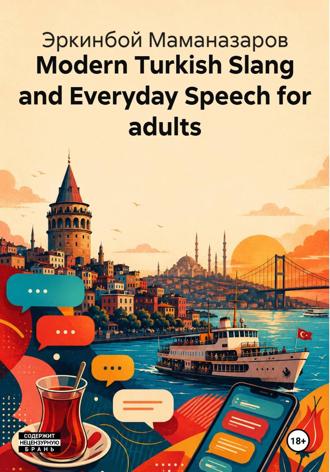
Modern Turkish Slang and Everyday Speech for adults

Эркинбой Маманазаров
Modern Turkish Slang and Everyday Speech for adults
Introduction
Why learn slang at allPicture this. You studied Turkish honestly for six months. You know that "how are you" is Nasılsınız, you can conjugate verbs, you do not even mix up the cases. You land in Istanbul, open your mouth, and someone fires back something like "Naaabeeer kanka, n'apıyosun ya?"
And just like that, your foundation falls apart.
The problem is not you. The problem is that textbook Turkish and living Turkish are almost two different languages. A textbook prepares you for a formal email and a job interview at a bank. Real life is a group chat with friends, flirting in the DMs, the seller at the market, the taxi driver, the neighbor, the waiter, and the person you have a crush on. They all speak fast, swallow their endings, mix Turkish with English, and pile on the slang.
The good news: slang is not chaos. It has logic, levels of "strength," and clear rules about when something is okay. This book is about those rules. After reading it you will:
understand what Turks aged 18 to 35 actually say (not what a phrasebook from 2009 prints);
sound natural instead of like a translation engine;
feel the line between "nice joke" and "accidentally rude";
catch the references from shows, memes, and stories.
How to adapt to real speech fastThree principles that save you months:
Listen to the rhythm, not the individual words. Turks love to shorten. Ne haber becomes Naber, then Naaber, then in a chat just nbr. If you wait for the full form, you will never hear it.
Learn in blocks, not single words. Nobody says "surprise." They say a ready-made phrase: Yok artık! Take the expression whole, with its intonation and its situation.
Do not be afraid to slip up in a friendly setting. Turks love it when a foreigner drops a kanka or a valla. It instantly closes the distance. In a formal situation, on the other hand, play it safe (more on that below).
Pronunciation and transliteration: the rules of this bookFor every expression I give the Turkish spelling in bold, a rough English-style pronunciation in parentheses, and the meaning. The respelling is always an approximation, so trust your ears and a native speaker over my hyphens.
How to read the vowelsa = "ah" as in father.
e = "eh" as in bed.
ı (dotless i) = a short, neutral sound, like the "a" in about or the "e" in roses. The single trickiest letter for English speakers.
i = "ee" as in see, but shorter.
o = "oh" as in more.
ö = like the German ö, or the vowel in bird said with rounded lips. No real English twin.
u = "oo" as in food.
ü = like the German ü or French u. Say "ee" with your lips rounded.
How to read the consonants and special lettersc = "j" as in jam.
ç = "ch" as in church.
ş = "sh" as in shoe.
j = "zh" as in measure.
ğ = mostly silent, it stretches the vowel before it (the "soft g," yumuşak g).
h = always pronounced, like the "h" in hat.
y = "y" as in yes.
v = "v," sometimes closer to English "w."
r = lightly tapped, and very soft, almost whispered, at the end of a word.
Main traps for English speakers:
ı is not "ee." It is a neutral, schwa-like sound. Nasılsın is roughly "nah-suhl-suhn," not "nah-sill-sin."
ö and ü are real, distinct sounds. Do not flatten them into plain "o" and "u."
ğ is not a hard "g." Değil is "deh-EEL," yağmur (rain) is "yah-MOOR," not "yag-moor."
Stress is usually on the last syllable, with plenty of exceptions in names, loanwords, and slang.
The "strength" scaleSo you do not put your foot in your mouth, every expression carries a color tag. This is the most important thing in the book, so read carefully:
Neutral conversational. Fine almost anywhere informal: coworkers, new acquaintances, shopkeepers.
Friendly / informal. With your people, peers, friends, in chats.
Familiar / a bit rough. Close company only, easily offends a stranger.
Strong / taboo. Very close friends only, or avoid entirely. There is a whole chapter with warnings.
How each entry is builtFor the important expressions, the layout is:
Turkish spelling (bold) and (rough pronunciation)
Meaning and shade of meaning, plus the strength tag
Example: a Turkish sentence with translation
When and with whom: context and level of closeness
Alternatives: milder or stronger versions
️ a warning, where needed
Similar expressions are gathered into short lists in the same spirit: the Turkish word, the pronunciation, the tag, the meaning, and a note on where it fits.
Let's go.
Chapter 1. Casual basics: greetings, goodbyes, and "how are you"
This is the foundation. About 90% of real conversations open and close with phrases from this chapter. Master it and you already sound far more natural than most people who "learned from an app."
GreetingsSelam (seh-LAHM) "Hi." The most universal informal greeting. Works for almost everyone. Example: Selam, naber? (Hi, how's it going?) When and with whom: peers, acquaintances, easygoing coworkers, shopkeepers. Alternatives: more neutral and polite Merhaba (MEHR-hah-bah); warmer in a chat Selamlar (seh-lahm-LAHR).
Merhaba (MEHR-hah-bah) "Hello." The neutral, all-purpose option. Not slang, but your safety net when you are unsure of the distance. Example: Merhaba, bir şey soracaktım. (Hello, I wanted to ask something.) When and with whom: literally anyone, formal situations included.
Naber / N'aber (NAH-bair) "What's up? / How's it going?" Short for Ne haber ("what news"). It is a greeting and a question at the same time. Sounds friendly. Example: Naber dostum, ne yapıyorsun? (What's up, buddy, what are you doing?) When and with whom: friends, peers, informal acquaintances. Alternatives: slightly fuller Ne haber (neh hah-BAIR); very casual Naber lan (see lan below).
Ne var ne yok? (neh VAHR neh YOHK) Literally "what is there, what isn't there," meaning "so how are you, what's new?" A very warm, human greeting that signals you actually care. Example: Kaç gün oldu görüşmeyeli, ne var ne yok? (It's been days, what's new?) When and with whom: friends, good acquaintances.
Naptın? / Ne yaptın? (NAHP-tuhn) "What've you been up to? / How've you been?" Often used as a greeting rather than a literal question. You do not have to answer in detail. Example: Naptın bütün gün? (What were you up to all day?) When and with whom: friends, close people, your partner.
A few more everyday neutral greetings:
Günaydın (gewn-ahy-DUHN) "good morning."
İyi günler (ee-YEE gewn-LAIR) "good day," also works when leaving.
İyi akşamlar (ee-YEE ahk-shahm-LAHR) "good evening."
Selamün aleyküm (seh-lah-MEWN ah-ley-KEWM) / traditional and religious in flavor; fits with religious people, elders, and the provinces.
️ Selamün aleyküm is not a "bad" word, but it is a marker. It fits with religious people, elders, and conservative settings. Among a secular group of young people at a bar it will sound out of place.
"How are you" (and how to answer)Asking is easy. Answering so it sounds alive is the harder part.
How to ask:
Nasılsın? (NAH-suhl-suhn) "how are you?" (the standard).
Nasıl gidiyor? (NAH-suhl gee-dee-YOR) "how's it going?"
Keyfler nasıl? (KEYF-lair NAH-suhl) "how's the mood?"
How to answer, from "great" to "I'm a corpse":
İyiyim (ee-YEE-yim) "I'm good, fine."
İyilik (ee-yee-LEEK) "all good" (the classic reply to naber).
İyidir (EE-yee-deer) "yeah, all good."
Bomba gibiyim (BOM-bah gee-BEE-yim) "I'm on fire, feeling great."
Fena değil (feh-NAH deh-EEL) "not bad."
İdare eder (ee-dah-REH eh-DAIR) "it'll do, getting by."
Patladım (paht-lah-DUHM) "I'm wiped, totally drained."
Ölüyorum (ur-lew-YOR-um) "I'm dying" (from tiredness, laughter, or heat).
İyilik, senden? (ee-yee-LEEK, sen-DEN) "Good, and you?" The classic answer specifically to Naber. Memorize the combo: Naber? – İyilik, senden? It sounds completely local. Example: Naber? İyilik, senden naber? (What's up? Good, what about you?)
Eh işte (eh EESH-teh) "Eh, getting by." The all-purpose honest answer when things are neither great nor a disaster. Often with a light sigh. Example: Nasılsın? Eh işte, idare ediyoruz. (How are you? Eh, we're managing.)
GoodbyesGörüşürüz (gur-ew-SHEW-rewz) "See you." The everyday goodbye. Neutral and warm at the same time. Example: Hadi görüşürüz, kendine iyi bak! (Alright, see you, take care!) When and with whom: almost everyone. Alternatives: more formal Görüşmek üzere (gur-ewsh-MEK ew-zeh-REH).
Kendine iyi bak (ken-dee-NEH ee-YEE bahk) "Take care of yourself." Warm, caring. Often paired with Görüşürüz. When and with whom: friends, close people, but it also sounds nice with people you barely know.
Hadi / Haydi (HAH-dee) "Alright / come on / let's go." A little engine of a word. It launches a goodbye or an action. On its own it already means "okay, I'm off." Example: Hadi bana müsaade. (Alright, I'll take my leave.) Polite but conversational. When and with whom: everyone, extremely common.
Bay bay / bb (bahy bahy) "Bye-bye." Light, a touch cute or childlike, but young people use it a lot, especially as bb in chats. Example: Tamam canım, bb (Okay dear, bye .) When and with whom: friends, your partner, light texting.
Eyvallah (ey-vahl-LAH) "Thanks / deal / take it easy." A very multi-purpose, friendly, slightly masculine word. It can mean "thanks," "okay, got it," or "alright, bye." Sounds matey. Example: Hallederim, eyvallah kanka. (I'll handle it, thanks bro.) When and with whom: more common in male company and among friends; not for a very formal setting.
A few more goodbyes for the collection:
Hoşça kal (HOSH-chah kahl) "take it easy, farewell."
İyi günler / akşamlar (ee-YEE gewn-LAIR / ahk-shahm-LAHR) polite and neutral, also when parting.
Görüşmek üzere (gur-ewsh-MEK ew-zeh-REH) "until we meet," a touch more formal.
Address terms: kanka, abi, abla and friendsThis is a secret weapon. Turks constantly address each other not by name but by "role." The right address instantly makes you one of the group.
kanka / kanki (KAHN-kah / KAHN-kee) "Bro / mate / dude (gender neutral)." The most popular friendly address, used for anyone. Literally from "kan kardeşi" (blood brother), but it lost the literal meaning long ago. Example: Kanka bu akşam müsait misin? (Bro, are you free tonight?) When and with whom: friends and peers. Not for an older stranger or the office. Alternatives: dostum (DOS-tum, "buddy"), kardeşim (kar-deh-SHIM, "my brother/sister").
abi / abicim (ah-BEE / ah-bee-JEEM) "Older brother," used for an older man or just for a guy in a friendly, respectful way. A magic word. This is how you address the waiter, the taxi driver, the shopkeeper, the older friend. The mood warms up instantly. Example: Abi bir çay alabilir miyim? (Brother, can I get a tea?) When and with whom: almost any man, especially in service.
abla / ablacım (ahb-LAH / ahb-lah-JEEM) "Older sister," the female counterpart to abi. For a woman a bit older, or in service. Polite and warm. Example: Abla, bu kaç para? (Sister, how much is this?)
Other common address terms:
kardeşim (kar-deh-SHIM) "my brother/sister," friendly.
dostum (DOS-tum) "buddy."
reis (reh-EES) "boss, chief," respectful and playful, usually to a guy.
koçum (KO-chum) "champ, buddy," warm and a touch patronizing.
hocam (HO-jahm) "teacher, master," respectful to an expert, a teacher, sometimes any professional.
moruk (mo-RUK) "old man, dude," a bit dated but still alive.
️ moruk is friendly but rough and slightly "2000s." Not for strangers. abi/abla is almost always safer.
The particle lan/la: the master amplifierlan / la (lahn / lah) This does not translate into a single word. It is an amplifier that adds familiarity, emotion, and sometimes rudeness. In meaning it sits somewhere between "damn," "hey you," and "no way." It changes the whole tone of a sentence. Example (friendly): Naber lan! (What's up, man!) Example (annoyed): Ne diyorsun lan? (What the heck are you saying?) When and with whom: very close friends. Tone and context decide everything. ️ With elders, at the office, with strangers, lan sounds rude or aggressive. Listen to how locals use it first, then add it in. Among close guy friends it is normal, but with a girl you barely know, or with someone's parents, it is off limits.
Test yourself (Chapter 1)A friend texts you: "Naberrr ". Give two different natural replies.
How do you address a male waiter so it sounds warm and local?
Translate into living Turkish: "Alright, see you, take care!"
Why is "Ne diyorsun lan?" risky to say to someone you barely know?
Your companion is older and fairly formal. Which greeting is safer: Selam, Naber lan, or Merhaba?
For example: "İyilik, senden?" or "İyidir, naber sende?"
Abi (for example, "Abi, bir çay alabilir miyim?").
"Hadi görüşürüz, kendine iyi bak!"
lan adds familiarity and easily reads as aggression or disrespect toward someone who is not a close friend.
Merhaba. It is neutral and safe in any situation.
Chapter 2. Emotions and reactions
Living speech runs on reactions. Turks are expressive, and in conversation it matters that you do not go silent but "play along": be surprised, be impressed, be annoyed. This chapter is about the small phrases that turn you into a real conversation partner instead of a translator.
Surprise and disbeliefYok artık! (yohk ahr-TUHK) "No way! / You're kidding! / Come on!" A reaction to something unexpected or unbelievable. One of the most frequent emotional phrases there is. Example: Ayrılmışlar mı? Yok artık! (They broke up? No way!) When and with whom: friends, peers, informal. Alternatives: milder Hadi canım (HAH-dee jah-NUHM); stronger Olamaz! (o-lah-MAHZ, "it can't be!").
Cidden mi? / Gerçekten mi? (jeed-DEN mee / gehr-CHEK-ten mee) "Seriously? / Really?" A neutral, very common reaction. Cidden is a touch more colloquial, gerçekten a touch more neutral. Example: Sınavı geçtim! Cidden mi, tebrikler! (I passed the exam! Seriously, congrats!) When and with whom: everyone.
Vay be! (vahy beh) "Wow! / Whoa!" Admiring and surprised. be is a light intensifier. Example: Yeni araba mı? Vay be! (A new car? Wow!) When and with whom: friends, informal.
Vallahi mi? (vahl-lah-HEE mee) "For real? / Honestly?" From vallahi ("I swear to God"), but in living speech it is just "no way, really?" In everyday context it is not taken as a religious oath. Example: Onu kovmuşlar. Vallahi mi ya? (They fired him. For real?) When and with whom: friends, peers.
More surprise reactions:
Hadi canım! (HAH-dee jah-NUHM) "come on, get out!"
Olamaz! (o-lah-MAHZ) "it can't be!"
Şok oldum (shohk ol-DUM) "I'm shocked."
Kafam gitti (kah-FAHM geet-TEE) "my mind is blown" (from surprise).
İnanmıyorum (ee-nahn-muh-YOR-um) "I can't believe it."
Admiration and approvalHelal! / Helal olsun! (heh-LAHL / heh-LAHL ol-SUN) "Well done! / Respect! / You earned it!" Praise with a note of respect for effort or a deed. Very warm. Example: Tek başına yapmış, helal olsun! (He did it on his own, respect!) When and with whom: friends, coworkers in a friendly way.
Eline sağlık (eh-lee-NEH sah-LUHK) "Thanks for your work / nicely done" (literally "health to your hands"). You say it to whoever cooked, made, or fixed something. If you do not know this phrase, you lose a lot of points at the table. Example: Yemek harikaydı, eline sağlık! (The food was great, thank you!) When and with whom: everyone, especially the host, cook, or craftsman.
Efsane (ef-sah-NEH) "Legendary / fire / awesome" (literally "legend"). A young person's rating word. The concert is efsane, the person is efsane, the night is efsane. Example: Dünkü parti efsaneydi! (Last night's party was fire!) When and with whom: friends, informal.
Bayıldım (bah-yuhl-DUHM) "I love it / I'm obsessed" (literally "I fainted"). Very emotional approval. Often about food, things, people. Example: Bu şarkıya bayıldım! (I'm obsessed with this song!) When and with whom: everyone, informal.
More words of praise:
Süper (SEW-pair) / Harika (hah-ree-KAH) "super / great."
Mükemmel (mew-kem-MEL) "perfect."
Tam benlik (tahm ben-LEEK) "totally my thing, right up my alley."
Bomba (BOM-bah) "a bomb, amazing."
Annoyance, fatigue, disappointmentYa / Yaa (yah / yaah) A sigh of a word. On its own it expresses frustration, pleading, or fatigue, depending on intonation. Often at the end of a sentence. Example: Yapma ya! (Come on, don't / stop it!) When and with whom: everyone, informal.
Off / Of ya (off / off yah) "Ugh / damn / I'm so done." An exhale of irritation or fatigue. Example: Off, yine geç kaldık. (Ugh, we're late again.) When and with whom: everyone.
Boş yapma (bohsh yahp-MAH) "Don't talk nonsense / don't kid around." Literally "don't make emptiness." You say it when someone is talking rubbish. Can be playful or sharp. Example: Boş yapma, öyle bir şey demedim. (Come on, I didn't say that.) When and with whom: friends. With strangers it sounds rude. Alternatives:
Конец ознакомительного фрагмента.
Текст предоставлен ООО «Литрес».
Прочитайте эту книгу целиком, купив полную легальную версию на Литрес.
Безопасно оплатить книгу можно банковской картой Visa, MasterCard, Maestro, со счета мобильного телефона, с платежного терминала, в салоне МТС или Связной, через PayPal, WebMoney, Яндекс.Деньги, QIWI Кошелек, бонусными картами или другим удобным Вам способом.