Полная версия
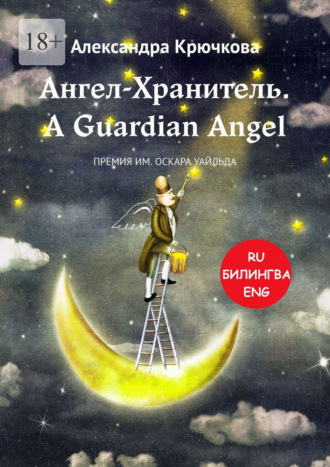
Ангел-Хранитель. A Guardian Angel. Премия им. Оскара Уайльда. Билингва: Ru-Eng
«Вокруг меня – надгробия. Я подхожу к одному из них и читаю: «Иосиф Бродский»… Как я оказалась в Венеции? Что я здесь делаю? Наверное, я – во сне?.. Издалека доносятся чьи-то голоса, они зовут меня – я догоняю их и… вдруг с радостью вспоминаю: я же здесь с группой писателей и поэтов, на семинарах Евгения Борисовича Рейна и Виктора Ерофеева! Ко мне подходит поэт и историк Дмитрий Немельштейн:
– Сашунь, не грусти! У тебя всё получится!
Я не сплю! Да! Точно! Он назвал меня моим земным именем! Мы приехали сюда на экскурсию по местам Бродского! Память возвращается, я постепенно вспоминаю, как мы выехали из Милана на автобусе, как добрались до причала Сан-Марко, а потом на катере – до острова-кладбища Сан-Микеле…5»
У итальянцев есть примета – в Венецию нельзя приезжать с любимым человеком, в противном случае после поездки вы по той или иной причине расстанетесь.
« – В Венецию надо ехать с любимым человеком!
– Я тоже так думала. Но итальянец, директор фабрики, с которым мы общаемся по работе, сказал, что Венеция считается в Италии несчастливым городом для влюблённых, приносящим вечную разлуку. Он привёл примеры из собственной жизни и жизни его друзей, когда после поездки расторгались помолвки, а одна девушка вообще умерла!6»
Возможно, именно поэтому Венеция предстаёт в стихах Крючковой – городом призраков, а в прозе – «театральной сценой с картонными декорациями», где даже «Луна на Небе – картонная», да и отражается она в «картонной воде»:
«Венеция – мистический город, поездка в который вместе с любимым человеком, по преданию итальянцев, грозит вечной разлукой, предстаёт в романе зловещим чёрным городом, оплакивающим призраков. Сильное впечатление производит описание автором картонной Луны в небе и её картонное же отражение в картонной (!) воде – как погружение в сумасшествие в тот момент, когда ты сам переживаешь чувства главной героини и осознаёшь смещение граней в собственной голове».78
« – Что это? – невольно вырывается у меня.
– Я рисую, – смущённо произносит композитор.
На полках у окна – картины. Их много. На них на всех – чёрный город. Чёрные дома. Маленькие слепые окна. Серый Туман. Полная Луна… Это город, который до боли мне знаком. Мой любимый город. Город-на-Воде. Но на картинах он выглядит совершенно «картонным», как декорации на сцене… Искусственным… Пугающим… Зловещим…
– А ты был в Венеции?! – удивляюсь я.
– Нет, никогда…
– А почему она чёрная?
– Может быть, она… плачет?9»
Фактически, и стихи, и центральная часть романа «Ангел-Хранитель», «Ловушка снов», связаны с таинственным сном автора о собственных похоронах в Венеции, который описан и в романе, и в стихотворении «Химера».
« – Мне снился странный сон где-то год назад. Как меня хоронят в Венеции. Я совсем забыла, но вспомнила, когда недавно, во время последней командировки, гуляла по Сан-Марко. Я подошла к пристани и увидела лодку, которая отчаливала от берега. Прямо как в том сне…
– Так тебя похоронят в Венеции?!
– Не знаю… Было раннее утро. Похоже, весна. И туманная дымка. В лодке находилось всего два человека – сам лодочник и Человек в Чёрном. С седыми, практически белыми, волосами… Они везли моё тело. Или прах. Не знаю, мне было страшно заглянуть внутрь лодки. Они ехали на противоположный остров. Я даже не знаю, что это за остров. Я на нём никогда не бывала.
– Ну и КТО ОН, твой Чёрный Человек?
– Не знаю…10»
И вот растущая Луна, символ Подсознания, достигает «картонной» кульминации в Венеции:
«Мы причаливаем к Сан-Марко ночью. Человек в Чёрном привёз меня в мой любимый Город-на-Воде, но теперь, ступая на площадь, я вижу его ИНАЧЕ – Чёрным Зловещим Городом, утопленным в кромешной Тьме, целиком и полностью… картонным, как декорации на театральной сцене! Весь земной мир – огромная театральная сцена, на которой люди играют в спектаклях для… призраков. Облачённые в костюмы земных тел, они «живут» на сцене в окружении картонных декораций, которые могут быть мгновенно разрушены Тем, кто постоянно прописывает в Скрижалях сюжетные нити пьес их судеб. Эти странные существа – люди – настолько зачарованы магической иллюзией сменяющихся декораций, что лишь Смерть в состоянии сорвать венецианские маски, сросшиеся с их лицами.
Я – на Сан-Марко… пытаюсь отыскать в кромешной темноте хоть один фонарик, но тщетно – Город обесточен, я не вижу в нём света. Вокруг меня – только чёрные мёртвые дома. Здесь всё – ненастоящее. Картонное! Пугающее!! Зловещее!!! И я бегу прочь в длинном платье, сотканном Туманом, вдаль, по мостикам, пытаясь найти Реку, уносящую души в небо. Бегу, задыхаясь, вдоль декораций чёрных картонных домов, в окнах которых не горит свет <…> Наконец-то! Я нахожу точку перехода – добираюсь до места, где нет мостика, но есть ступеньки, уходящие в воду, и аналогичные ступеньки выходят из воды уже с противоположной стороны. Перепрыгнуть на ту сторону не получится. Там – Зазеркалье, в нём отражается всё, что находится здесь. Жаль, никто не видит то, ЧТО я вижу, и КАК я теперь вижу земной мир – он стал картонным, чёрным, зловещим монстром!
Я сажусь на ступеньки, ведущие в воду, – жду родителей, которые вот-вот придут за мной, – и смотрю в чёрное небо, где висит огромная Луна. Но и она тоже… картонная!!! Я перевожу взгляд вниз, на её отражение – надо же! – кто-то вырезал картонную копию небесной Луны и положил её на такую же картонную (!!!) воду… Из Зазеркалья появляются родители. Они подходят к ступенькам с той стороны Реки. Но внезапно с этой стороны, за моей спиной, раздаются гулкие шаги – Человек в Чёрном бережно берёт меня на руки, как маленькую девочку, и уносит прочь.
Сан-Марко. Утро. Солнце. Площадь постепенно оживает, наводняется людьми. Я стою у колонны недалеко от Собора, вижу море и остров Святого Георгия напротив. Я – в белом платье. Играет весёлая музыка. И я постепенно начинаю видеть Венецию такой же, какой видела её раньше. Но… как я здесь оказалась? И что я тут делаю? Рядом со мной – призраки: мои друзья из Библиотеки Вселенной и родители. Человек в Чёрном улыбается и приглашает потанцевать с ним прямо на площади. Призраки окружают нас. Их никто не видит, кроме меня. Жаль. А я теперь вижу призраков даже днём. Гораздо отчётливей, чем всё, что видят обычные люди. И призраки шепчут: «Алиса, ну улыбнись же! Потанцуй, ну, пожалуйста! Ты же так этого хотела! Он нужен тебе!» И я понимаю, что сегодня у меня – венчание, поэтому я – в белом платье. Но из гостей будут только мои призраки. И я танцую на Сан-Марко с Человеком в Чёрном. Призраки подхватывают голубей и подбрасывают их на нас, заставляя меня улыбаться… Внезапно память возвращается полностью, я вспоминаю, как рухнул мой мир, и отчаянье захлёстывает меня… Всё снова – картонное, ненастоящее, зловещее! Этот город похож на тюрьму! И я решаю выбраться наружу…11»
Конфликт Любви и Смерти, присущий прозе Крючковой, проявляется и в поэтическом цикле о Венеции, магическое притяжение которой не только пленит самого автора, но и завораживает читателя.
С одной стороны, Венеция, цитируя Александру Крючкову, – это «ловушка», «лабиринт», «апокриф поэта», «сон», «химера», «плохая примета», «дом трагедий», «последний приют», «музыка дождей, теней и птиц», «служит зловещей звезде», «мосты, ведущие к беде».
Само название города многозначно, хотя, кроме того, что оно связано с племенем венетов, по имени которого область получила у римлян название «Венеция» (лат. Venetia), других официальных значений нет. Но фантазия поэта безгранична, Венеция вызывает у него разные ассоциации: это и венок Офелии из «Гамлета» Шекспира с неоднозначными по значению цветами, символизирующими несчастную любовь; и сама планета Венера – планета любви с её двумя образами: Люцифер «Утренняя звезда» и Геспер «Вечерняя звезда». И, возможно, у кого-то «Венеция» вызывает другие ассоциации.
И всё же —
«…муранcкое стеклолилось во мне симфонией нюансов»,«мои мосты не видели нас вместе»,«нарисуй мне…Кофейню, фонарик во фраке,сквозь годы искрящий в надежде,что счастье коснётся нас прежде,чем сердце утонет во мраке…»…Любовь побеждает – автор уверен в своём возвращении:
«Вернёмся на ощупь в тот город,где песни поются воде, —смеяться над звонким червонцем,танцуя средь масок и лиц,светиться с мостами под солнцем…»«Влетим в портал! Да здравствует побег!Туда, где жизнь ласкается волнами…Дарю – тебе! – Венецию – навек! —Храни её, как ниточку меж нами…»«Марк спит, по-прежнему не зная,что я – сквозь сны —вернусь – заложница земнаяЕго весны…»Несмотря на грусть, которая звучит во всём «венецианском» цикле Александры, главный лейтмотив остаётся всё-таки жизнеутверждающим: «Венеция – разлучна, но призраком в рассвет засветится беззвучно улыбчивый привет…»
Но лучше прочитайте роман сами. Итак, Венеция Александры Крючковой…
Лариса Михайловна КУЗЬМИНСКАЯ,
поэт, член Союза писателей России, руководитель направления по сотрудничеству с регионами России и зарубежными странами Общественного Движения «ПОЭТЫ МОСКВЫ»
Газета «Литературные известия»12 №1 (211), 202313
«Guardian Angel do exist!» by T. Troubnikova
«A Guardian Angel» by Alexandra Kryuchkova, winner of the awards: «Wings of the 21st Century» of Oscar Wilde (Moscow City Organization of the Union of Writers of Russia, Literary Republic, 2021), «Silver Angel» of Françoise Sagan (Open Literary Club «Response», 2015), and «Literary Olympus» (League of the Writers of Eurasia, 2014), is a very unusual, stunningly deep and naked novel-revelation, based on real events.
From the first lines you think of Paulo Coelho and Bernard Werber, but reading on, it reminds you of Carlos Castaneda and the dream hackers, and somewhere, of Gabriel Garcia Marquez and Vadim Zeland. The real facts of the unique destiny of the writer are so closely interconnected and harmoniously interwoven with Another Reality and the Worlds of Mist and Dreams, as well as their representatives, guardian angels and ghosts, that space-time borders are erased completely and irrevocably, and all the events are wholly and completely perceived by the reader as one and indivisible whole – the only-possible and truly real one.
In the non-linear and non-trivial storyline – about love, of course! – including time pigtails and dizzying, roller-coaster-like journeys in the Space of Options, because the Future is not predetermined and hence can be rewritten, the music of refrains is playing – meetings, feelings, visions and dreams repeat recreating the spiral of existence and lulling the mind, making ripples in the water. But a charade plot with a taste of detective really keeps the readers in suspense till the last, and all their versions fall away as they approach the denouement, and it seems impossible to connect the disparate links into a single chain of events, which leads the main character Alice to her own death in Venice, the puzzle won’t be put together! But… «it only seems so»!
Venice, the mystical city to which, according to the Italians, a trip together with the loved one threatens eternal separation, appears in the novel as a sinister black city, mourning ghosts. The description of the cardboard Moon in the sky and its cardboard reflection in the cardboard (!) water make a strong impression – like plunging into madness at the moment when, experiencing the main character’s feelings, you become aware of shifting edges in your own head.
However, despite the drama of the events, the writer managed to describe the dark side of her life quite easily and in some moments even ironically and to look at herself from the outside – through the eyes of her Guardian Angel, joking about herself, which is typical of a wise and bright person who has gone through fire, water and cooper pipes, but not embittered by the world.
«Everyone has their own Devil», but the worst thing is to lose oneself. Wandering in the World of Mist, Alice has to visit the Library of the Universe, get to the right pages in the Tablets of Astral Light, enter the House of Life and find the reason in the Labyrinth of Subconscious for what is happening to rewrite the script.
Unlike other novels by A. Kryuchkova, «A Guardian Angel» is written in Russian in the spirit of script – in the Present Tense, perhaps as a subtle hint to the reader that it’s important to live here and now rather than dwell on the Past and the Future. The prose includes also poems by Kryuchkova, as delightful illustrations, bright flashes of accents like the red poppies on the white dress of the protagonist, who won «The King of Poets» competition (Union of Writers of Russia, 2013) and the imperial «Heritage» competition (Russian Imperial House & RSP, 2014).
The positioning of Alice as a poet is also curious. Referring to the three masters of the Silver Age poets (A. Blok, M. Tsvetaeva and A. Akhmatova), who are inhabitants of the Library of the Universe and characters of the novel, Alice doesn’t compare herself to them, but asks for help and receives it in critical situations. Thus, she comes to Marina Tsvetaeva in Elabuga before a serious surgery, and before the car accident on Anna Akhmatova’s birthday she rereads a volume of poems by Alexander Blok, her favorite book in childhood.
As Sergey Yesenin said, nothing worthwhile can be achieved without a message to Death, and he was right! Alice is not afraid to look into the eyes of her own death, moreover, she looks even through it, and not just believing in the posthumous existence, but exploring it in borderline states. At the same time, Alice has a panicked fear of… life! – Yes, there he is, her Man in Black, known by Esenin, Pushkin and Mozart. Thus, the mysterious death of the protagonist in Venice appears in a completely different light: it’s not the Man in Black who kills Alice, but her own fear of the Future, since it can cause pain.
And here the phrase «we all come from childhood» is confirmed by the writer 100%: in search of strength to overcome the fear of the Future, the wandering soul of Alice the adult, first of all returns to her tragic Past, reliving its most dramatic fragments and turning to Alice the child, to support herself in a hard moment. And this diving headlong down to the bottom of the ocean of Subconscious with memories of the burnt-out house and early dead parents, with conversations with her mother in reality and in dreams is scary and poignant, touching to the point of tears.
In the beginning of the novel, we clearly hear the voices of the invisible Guardians of people – the Angels who agree with each other to help their wards make the right step in one direction or another. However, chapter by chapter, their speech becomes weaker and weaker, giving way to the power of the human Spirit. And finally, on the background of exciting ordinary and completely unbelievable events, the most important actor appears, that’s Divine Love, reaching its climax in the finale: at the last second of a terrible car crash Alice is given the right to choose… But should she return from Another World to become a Guardian of the man who betrayed her and because of whom she wished to die in that crash?
Like all novels by A. Kryuchkova, «A Guardian Angel» is worthy of a luxury movie! Well, a sequel to the story follows! «Confession of a Ghost», a new philosophical-mystical novel in the «Playing Another Reality» series, has already been awarded the prizes of D.L. Andreev «Creator of Worlds» (Open Literary Club «Response», 2019) and F. M. Dostoevsky «Life suffocates without purpose» (Union of Writers of Russia, 2021). I sincerely join in congratulations to the writer and look forward to read her next novels!
Tatiana Troubnikova,
writer and screenwriter, member of the Union of Writers of Russia
«Literary News» No. 11—12 (197—198), November-December 2021
«Angels and stars. Marina Tzvetaeva, Evgeny Rein and Alexandra Kryuchkova» by B. Mikhin
The novel «A Guardian Angel» by Alexandra Kryuchkova is a multifaceted work in which everyone will see something different. For me personally, it’s not just an unusual novel about the search for earthly love and the passions of a love triangle with a detective flare, astrological handwriting and charming self-irony of the writer. By the way, as Peter Guldedava, the honored writer of the Union of Writers of Russia, remarked in a review (hereafter I quote the preface to the previous edition of the novel in «RIPOL Classic», 2015), «For my taste, there’s too little earthly. By extolling the idealized image of the beloved half-ghost, the protagonist seems to emphasize her own inaccessibility, while the average reader aims for the accessible.»
Celestial aftertaste from reading the novel was also left by the Orthodox writer-publicist Inna Butorina, «A real diary of an angel! An exclusive rarity, fragile jewel. A breath of pure spring water for each wayfarer exhausted by life. A book you will remember forever…»
«A Guardian Angel» for me is not even so much a fascinating and enlightening «Playing Another Reality» (as the title of the series suggests), due to which the reader certainly penetrates the Subtle Spheres, including the worlds of angels, ghosts and dreams, to overcome their own fears and complexes and rewrite a multi-variant Future, what is legitimately admired by Irina Lejava, a science fiction writer, «By no means a trivial plot! Beyond the love triangle there is the abyss of Subconscious, the world of Dreams, the Valley of Mist, the endless halls of the Library of the Universe, the pages of Astral Tablets, the rustling wings of ironic Guardians and the cosmic Soul of the writer, whose mission on Earth is to bring Light to people!»
For me, «A Guardian Angel» by A. Kryuchkova, on the one hand, is a splendid novel about a lady with strong Spirit (obviously not the iron lady), who is balancing, like a circus performer, on a thin thread, stretched over the abyss of Non-existence, and dancing with Death. Death either retreats, taking a step back, or pounces on Alice suffocating her in its passionate embrace. This novel is about the struggle with Death in its different guises, not even of a particular person, but of Life itself.
Almost the same was said by the writer Elena Gramenitskaya, «The power of Love of the main character, mesmerized by Death, but insanely eager to live, is able to destroy and revive worlds, it creates a powerful vortex flow, which takes your breath away! I missed my underground stop, reading the novel, having completely fallen into Another Reality.»
And for me, reading Kryuchkova’s books is like meditating. Both Alexandra’s poetry and her prose – no less poetic! – have an inexplicable magic effect, as noted in the reviews by Elena Tallenika («The Island of Charon»), by Konstantin Bely («A Trap for a Thought-Form»), by Peter Guldedava («The Moon Cat» and «A Guardian Angel»). This magic, quite unobtrusively, but persistently and powerfully influences the reader, making him think not only about mortal things, while every novel by Kryuchkova is a discovery, a clear non-standard, a break of the patterns, a puzzle, a charade, something unusual.
I agree with Vadim Shiltsyn, writer and critic, «Kryuchkova’s prose is as unique as a fingerprint. A rare combination of writing talent and esoteric knowledge. The easiest way is to compare her „Guardian“ to Bernard Werber and Paulo Coelho, but Kryuchkova has such a vivid sense of this world that the works of Werber and Coelho cannot even compete with her Another Reality. „A Guardian Angel“ is a fascinating reading and a fine script for a stunning film to win at the Venice Film Festival!»
On the other hand, «A Guardian Angel» represents a cross-section of an entire decade, our literary history with the star names of the era, that emerges before the reader’s eyes, since the writer describes real events taking place in the literary circles of the early 21st century. The reader takes part in the Tsvetaeva’s bonfire in Elabuga, wanders through book exhibitions in Paris and London, goes to the seminars of Eugene Rein and Viktor Erofeev at the Booker Laureates’ School in Milan, travels to Venice to the grave of Joseph Brodsky, visits the 3rd International Poetry Festival in Hungary, oversees preparations for and holding «The King of Poets» tournament in the Central House of Writers in Moscow, acquaints with the imperial «Heritage» and plans a trip to the festival «I Love This World!» in Bulgaria.
In my opinion, it’s interesting, because, first of all, these events are not ordinary, but significant for their time, and second, the writer was directly involved in them, so the reader has the opportunity to plunge into the real literary environment and touch the celebrity personalities, which is much nicer than reading dry information from encyclopedic reference books.
What about the writer? What is her role in the events described?
Since 2001 Alexandra Kryuchkova has actively participated in literary events in Moscow and St. Petersburg, and her first performance abroad was on 11 April 2010 at the invitation of Carte Blanche Czech Republic, with pianist Philippe Subbotin, Director of the Gradus ad Parnassum music school at the Russian Center for Science and Culture in Prague (Czech Republic). It was a three-hour musical and poetic concert at the St. Mary’s Church in Prague (Kostel Panny Marie Snezne) with a video broadcast on Russian television in Prague.
In September 2011, thanks to the Union of Writers of the 21st Century and its President Evgeny Stepanov, Alexandra Kryuchkova represented Russia at the 3rd International Poetry Festival in Hungary, organized with the support of the international cultural and creative foundation E.O.S., headed by poet and translator Aron Gaal. After performances in Budapest, Szentendre and Isáseg, she was announced as the winner of the Festival and had her book translated into Hungarian in Budapest published free of charge. Her name was engraved on a memorial stone in the Park of Stars on the Walk of Fame. She was awarded the Order of G.R. Derzhavin by the Union of Writers of Russia. After the publication of her book «Ez a – Szerelem!» («This is Love!»), a selection of poems translated into Hungarian by A. Gaal, Alexandra was awarded the international Hungarian prize «New Pleiades» 2012 for her merits in the field of literature.
Later Kryuchkova, as a poet and writer, represented Russia as part of the delegation of the Union of Writers of Russia at the book fair in Paris (2012), where indeed, as in the novel, she spoke with the French Minister of Culture. The she was a speaker at the conference «The New Russian Revolution in Literature» organized by Edizioni Spirali Italian Publishers in Milan (2012); held master classes at the Literary Festival in Varna (Bulgary) and read poetry at the Union of Bulgarian Writers, where she met the legendary Bulgarian poet and translator Elka Nyagolova, who had translated Kryuchkova’s poetry into Bulgarian. Alexandra performed at the book fair in London (2013) and led a literary tour in Italy (2014) as the head of the delegation of writers and poets. She was the initiator of the international projects of the Moscow State Organization of the Union of Writers of Russia such as Russia-Czech Republic, Russia-Germany, Russia-Hungary, Russia-Spain, Russia-Italy, Russia-Greece. Each of her foreign performances and international projects were awarded diplomas of the Moscow State Organization of the Union of Writers of Russia, and her works were partially translated into English, German, Italian, Bulgarian and Hungarian. The book «Without a Mask» mentioned in the novel was indeed published in Germany by Stella-Verlag publishing house.
Alexandra Kryuchkova is a three-time winner of the League of Writers of Eurasia «Literary Olympus» in the prose category, including the novel «A Guardian Angel» (2014), but a special role in her creative destiny was played by poets Evgeny Borisovich Rein and Marina Ivanovna Tsvetaeva. It’s no coincidence that in her acknowledgements, she mentions E. B. Rein first. The novel is also dedicated to A. Akhmatova and A. Blok. At the same time, E.B. Rein is a real character of the novel, while Tsvetaeva, Akhmatova and Blok help the main character from a parallel world by meeting her in the Library of the Universe.