Полная версия
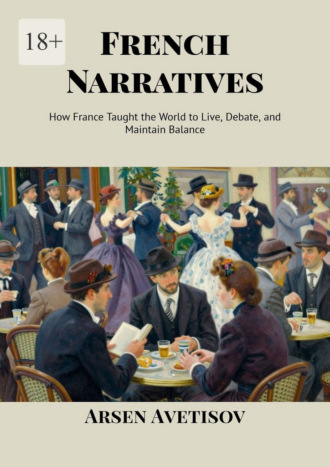
French Narratives. How France Taught the World to Live, Debate, and Maintain Balance
France doesn’t hush up mistakes; it revises them. Revolutionary terror is recognised as tragedy. The colonial past as trauma. Collaborationism as shame, openly recognised.
There is particular dignity in this. A person capable of naming his mistake ceases to be its prisoner. A country acknowledging its own wounds becomes more stable. Historical flexibility isn’t forgetting traumas but refusing to turn them into poison.
Lesson 2: Crisis Is Not Failure, but Reboot
In French history, crisis is a mechanism of renewal. After the defeat of 1870, the Third Republic emerged. After 1940 – a more mature political culture. After 1968 – a renewed understanding of freedom and rights.
Crisis here isn’t proof of inadequacy but a signal: the former form has exhausted itself.
Lesson 3: Form Is Secondary, Content Is Primary
Political forms changed, but the idea of human dignity remained central. In the French narrative, this resonated unchangingly: a person cannot be a thing.
France seems to remind us: when form ceases to work, it needn’t be defended to the end. It needs to be let go. This is remarkably similar to personal crises that tell a person, ‘You’ve outgrown the former form; it’s time to move on.’
Facts and Contexts
– French state archives become publicly accessible after 50 years, which contributed to forming a strong culture of transparency and historical responsibility.
– The French Constitution originally builds on the possibility of changes: the idea of révision (revision) is considered normal, not a threat.
– After the Second World War, France officially recognised collaborationism as part of its history – a rare example of national honesty.
– The culture of memory is built not on heroicising form but on comprehending ruptures. Hence the cult of discussion, archives, and museums.
Notes in the Margins
– You can change form without betraying yourself.
– Mistakes aren’t a sentence, but material for the next version.
– Crisis isn’t destruction but an invitation to reassembly.
– Meaning survives forms if you allow it to remain alive.
Chapter 9: Why French Narratives Work as a Model of Balance
Wholeness is not the absence of contradictions, but the ability to live in them.*
Albert CamusA mature society doesn’t erase tensions – it learns to hold them.*
Marcel GauchetDespite its complex history, multilayered nature, and series of internal conflicts, France remains remarkably whole. But this isn’t wholeness that can be fixed or preserved. It’s alive and mobile, like a person who has passed through many roles and crises but hasn’t lost his own voice.
It is precisely this living wholeness that makes France an accurate model of human balance. It shows: one can be contradictory and stable; one can experience crises and not lose meaning; one can change form and preserve content.
France doesn’t hide its weaknesses and doesn’t mask its fractures. It exists in a mode of constant self-analytical questioning: ‘Who are we? What is important to us? How do we preserve ourselves in a changing world?’ In this process, humans easily recognise themselves.
France isn’t an ideal, and therein lies its strength. In an ideal world, it’s impossible to see one’s own complexity. In France one can.
France Doesn’t Hide Its Inner Stories
In many cultures, common meanings are implied but not articulated. The opposite is true in France. Values, conflicts, historical traumas, moral disputes, and questions of freedom are brought to the surface.
The country lives in a mode of public internal monologue. Sometimes loud, sometimes painful, sometimes contradictory. But it is precisely this that makes narratives transparent: one can see how meanings are born, collide, transform, and reassemble.
A person’s inner life is arranged the same way. Unspoken stories control from the shadows. Spoken ones become material for growth. France chose the second path – the path of conscious complexity.
France as a Model of Multilayered Personality
France has its central meaning: respect for dignity and freedom. It has identity: the voice of a subject, not of an object of history. It has values, conflicts, lines of development, and crises.
This structure remarkably resembles the inner architecture of a person. Everyone has meaning, roles, contradictions, and a path. France allows one to see this system on a historical scale and thereby more clearly recognise it within oneself. Looking at France, we look not at a country but at an enlarged reflection of human psychology.
Holding Complexity as a Form of Stability
It’s customary to think that wholeness is born from simplicity. France shows the opposite: wholeness arises from the ability to withstand tension between opposites without destroying any of them.
Freedom and order, rationality and emotions, individuality and community, style and practicality don’t compete but coexist in French experience. This isn’t compromise but maturity.
In exactly the same way, people aren’t obliged to choose between strength and gentleness, logic and feelings, or autonomy and closeness. They can be multifaceted, and it’s precisely in this that they find stability.
Presence as Philosophy of Life
French culture values presence above busyness. Life here isn’t a project but a space of living. Not only to do, but to be.
This manifests in everything: in conversation, in food, in a walk, in debate. A Parisian café isn’t a place of consumption but a laboratory of presence. People sit there not from idleness, but because it’s part of the rhythm – to observe, think, and feel.
The French aren’t afraid to spend time. They’re afraid not to notice life.
Meaning as Rhythm, Not Summit
In many cultures, meaning is conceived as a height that must be reached. In France it’s built into the rhythm of life. Here there’s no rigid boundary between the elevated and the everyday.
Philosophical conversations coexist with the joy of taste, and great ideas with simple gestures. Meaning doesn’t require distance. It’s present in the movement of life itself.
One who absorbs this approach ceases to chase meaning as a rare reward. He or she begins to find it where they live now.
France as a Mirror of Human Inner Dynamics
France is chosen as a model of balance because it shows what people look like when they think, feel, argue, make mistakes, restructure themselves, and remain themselves in the process.
Its history is an enlarged projection of inner life. Here one can see how meaning survives crisis, how identity confronts pressure, how values require confirmation, and how form collapses whilst content survives.
France isn’t a complete story but a constant attempt to live with dignity. And it is precisely this incompleteness that makes it such an accurate model of human balance.
Facts and Contexts
– In France the logic of art de vivre is used, not the managerial ‘work-life balance’.
– The school dissertation teaches holding thesis and antithesis simultaneously.
– Cafés historically were spaces of philosophy, not ‘unproductive leisure’.
– Protest in France is a form of participation, not destruction of the system.
Notes in the Margins
– Wholeness doesn’t equal simplicity.
– Presence is a form of respect for life.
– Balance is born not from choosing ‘one’, but from the ability to hold ‘several’.
– The history of a person and the history of a country follow the same logic: form changes; meaning either survives or doesn’t.
Chapter 10: French Sketches
How Balance Lives
Le vrai luxe, c’est le temps vécu. (To live is not to breathe, it is to act.)
Georges PerecLa liberté commence là où l’on cesse de se sentir coupable d’exister. (Freedom begins where one ceases to feel guilty for existing.)
Pascal BrucknerParisian cafés are officially recognised as cultural heritage, not as gastronomy, but as social space.
France is one of the few countries where solitude in a public place isn’t stigmatised: a person alone at a table is normal, not a signal of misfortune.
The French tradition of dispute (debates) formed from the time of 18th-century salons, where argument was considered a sign of intellect.
Bricolage is officially supported as a form of cognitive activity for the elderly (research by Inserm).
Café
To understand how French narratives live, one needn’t go into archives and read treatises. It’s enough to enter an ordinary Parisian café and sit a little. A French café is a miniature of the country. Not a place where people grab a quick bite, but a space where everyone lives out his role.
By the window sits a young writer. Before him, coffee, a notebook, and a procession of faces. He catches gestures, intonations, and pauses, as if trying to understand what story governs each passer-by. This is the France of observers and thinkers.
At the neighbouring table, two people are arguing about politics. Loudly, passionately, interrupting each other. But in this argument there’s no desire to win, only the desire to test thought for strength. Argument here doesn’t destroy connection but creates it.
A little further on, a woman of about fifty orders a plate of cheese. She examines it as if there were a painting before her. No haste, no fuss. Each piece is a small ceremony. The French ability to make even the mundane beautiful.
In the corner, a man in a suit reads a newspaper. He’s alone, and there’s no drama in this. The French know how to be alone with themselves without turning solitude into a problem.
Nearby there’s a company of friends. Noisy, lively, emotional. Everyone speaks simultaneously, and yet everyone hears each other. This is a French community: freedom within connection.
In the street, a small demonstration passes. Someone from amongst the patrons goes out to look; someone waves a hand and returns to coffee. Resistance here isn’t a system failure but part of the rhythm.
And finally – the café owner. He moves slowly, attentively. He doesn’t bustle, doesn’t fawn, and doesn’t hurry. He maintains his rhythm and sets it for the space. This is one of the most mature roles: the role of a person living in his own story and not playing someone else’s.
Morning in Lyon
Early morning in Lyon. A man emerges from the bakery with a still-warm baguette. He walks unhurriedly, as if he’s acquired along the way not bread, but the right to exist for today.
He doesn’t rush and doesn’t make excuses for enjoying himself. His movement is both action and sensation. He doesn’t separate the useful and the pleasant. This small morning explains the French approach better than any theories: life begins not with a plan, but with presence.
Late Evening, Nice
An elderly woman sits on a bench by the sea. In her hands she has ice cream. She enjoys it as if the whole world has narrowed to this taste. She smiles at passers-by, nods to children, and watches the waves.
Конец ознакомительного фрагмента.
Текст предоставлен ООО «Литрес».
Прочитайте эту книгу целиком, купив полную легальную версию на Литрес.
Безопасно оплатить книгу можно банковской картой Visa, MasterCard, Maestro, со счета мобильного телефона, с платежного терминала, в салоне МТС или Связной, через PayPal, WebMoney, Яндекс.Деньги, QIWI Кошелек, бонусными картами или другим удобным Вам способом.