


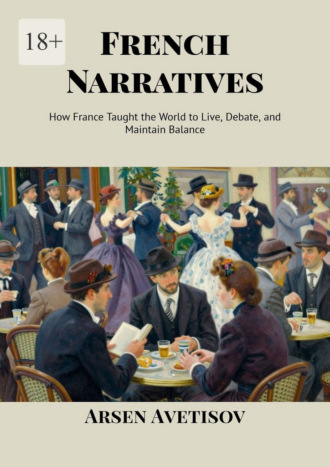
French Narratives. How France Taught the World to Live, Debate, and Maintain Balance
Полная версия

French Narratives. How France Taught the World to Live, Debate, and Maintain Balance

Язык: Английский
Год издания: 2026
Добавлена:
Настройки чтения
Размер шрифта
Высота строк
Поля
На страницу:
1 из 3

French Narratives

How France Taught the World to Live, Debate, and Maintain Balance


Arsen Avetisov

Translator Gregory Attaryan


© Arsen Avetisov, 2026

© Gregory Attaryan, translation, 2026


ISBN 978-5-0069-5824-1

Created with Ridero smart publishing system

To my mother and her innate talent as a narrator.

Why France?

What you see depends on how you look.

To truly see and feel what surrounds us, we must slow down a little, perhaps even stop. Look around and finally allow ourselves to pay attention to this world. Sense its taste, colour, and smell.

Sometimes a taste for life is a matter of conviction. But the absence of taste is always a matter of life habits. How can we return to life’s subtle flavours? How can we once again savour the rich adventure of our existence? How can we attune our perception of life? For this, we must tell a story.

And if you want to know how you truly live and what will become of you, think about what you were taught and what you have learnt. A person learns from lessons and stories. What stories do you learn from?

There is a place in the world whose history is itself this incredible sensory textbook. A textbook of the art of living. The experiment with globalisation has shown that true competitive advantage comes from what only we know. Perhaps our particular knowledge isn’t explicitly defined, but it’s always felt as our exclusive competence, as personal life experience. It’s what shapes our character, our distinctiveness, our purpose. It’s what exists in our thoughts, feelings, in our understanding and sense of happiness.

Each nation, country, or people does this in its own way, oscillating from total control and adherence to its historical mission to fatalism-laden sailing under a bright flag in an ocean of opinions, ideas, and directions. But there are nations that have found – not always stable, but nevertheless – a balance between these two extremes. And their knowledge is a priceless revelation.

However strange it may seem, form and depth are created not by the object itself, but by its shadow. And this sometimes applies to us, to entire countries, nations, and their histories. Today, when thousands of people lose their lives daily, we, in conditional safety and perceiving life as an endless battle, may never actually begin to live. We are constantly and insistently offered survival. The question is, how to do this? And it’s not a method or technology. It’s a genuine art. It’s an entire story.

For example, the story of France. A story in which, immersing oneself despite all the differences between us, one might wish to be born or become French to share their unbearable thirst for life.


In the 1st century BC, in honour of the Roman victory over the tribes inhabiting the Alps, a colossal statue of Emperor Augustus was erected at the highest point of the modern town of La Turbie in the Alpes-Maritimes region. The enormous monument served both as a lighthouse and a vivid reminder to all rebellious peoples of the power and might of the Roman Empire and its emperor.

Distance lends perspective. But to understand the essence of this great thing, one must always pay attention to details. This is what numerous tourists do when visiting the restored remains of the monument to the vanished empire’s grandeur. Great things are indeed worth examining up close. Especially if this great thing is life itself.

Where does this life-affirming and rebellious spirit come from in the descendants of peoples conquered by the Romans, who through the centuries became one of the brightest and most creative nations? Where does such refinement and sensuality come from, such concentration on living rather than merely existing? And how did the country and nation carry through millennia their main enchantment, this secret guidance and the very concept of the ‘Art of Living’ – Art de vivre?

Say to yourself the names of several countries, and at the end say, ‘France…’ France. Listen as you pronounce it. France… Doesn’t it seem that the word ‘France’ generates special sensations, different from other words? Something light, sensual, lace-like, with accents of love, romance, and impression? And along with this, something incredibly bold, epic, and sacrificial. Something to which we are so receptive from birth and to which we aspire and dream of all our lives.

France has no impressive reserves of minerals, no oil rigs, no large-scale mines. But it has always managed to preserve more valuable resources, constantly renewed by it: the intelligence and talent of its citizens. This is precisely the stratum, the source that has given and continues to give the world inventive scientists, skilled craftsmen, brave travellers, romantic entrepreneurs, engineers, diplomats, and world leaders.

The land of France, together with the fruits of peasants and artisans, skilfully protected traditions and the taste of centuries-old cultural heritage. Despite constant wars and destruction, it preserved the character of its cities and landscapes, recreating this atmosphere of beauty each time. The formation of statehood and the development of its society raised worldwide attention to and attractiveness of the country’s social life.

Undoubtedly, France owes such a role in the world to the dramatic character of its history, to the constant, sometimes desperate struggle for freedom, to its miraculous rebirths, to its 40 kings, two emperors, 23 presidents, and also to politicians, revolutionaries, ministers, and heroes. And on the other hand, to its enlighteners, writers, artists, architects, and thinkers. And to its people.

There is no doubt that all nations are unique in their own way. But how many of them arose from such an incredible mixture of different peoples as France? How many of them became the birthplace of progressive ideas, the foremost of which is the Declaration of the idea of being human? How does the thirst for beauty, order, and balance coexist with regular street outbursts of emotion from categorical impatience with injustice? How, on the threshold of perceived chaos, does an incredible striving for wholeness arise? In a single instant, how is everything mobilised and committed to maintaining a balanced yet vibrant life? Where does this incredible patriotism come from, this national idea of protecting beauty, freedom, and life? Such a life that can only be lived in this history, in this architecture, and in this nature? To live in awareness and acceptance of all this as a deliberate choice, to allow oneself to say the eternal words ‘Life is art…’ at least once?

Foreword

One cannot begin life anew, but one can continue it differently

Le gain de notre vie, ce n’est pas qu’elle soit longue, c’est qu’elle soit bien employée. (The advantage of living is not measured by length, but by use.)

Michel de Montaigne

The French don’t rush through life – that’s why they succeed.

The French art of life is rarely reduced to pleasure. Its essence is measure. Not renunciation and not excess, but precise calibration of effort and presence, action and pause, aspiration and attention.

Happiness here is neither a goal nor a result. It’s a way of moving through life without losing contact with what is happening now. The French early on made the sense organs an entry to thinking: to see, to hear, to feel means to understand. But what remains decisive isn’t the sensation itself but how it’s interpreted and how it’s integrated into the picture of the world.

Intellect without bodily experience is incomplete. Pleasure isn’t opposed to reason; it passes through it. Therefore, work, food, conversation, and rest aren’t divided into ‘important’ and ‘secondary’ but are gathered into a single rhythm. A pause doesn’t hinder effectiveness; it sustains it.

French directness, the inclination to argue and grumble, is a form of critical presence. Discontent is directed not inward at life, but outward, at circumstances, authority, and the world’s imperfection. It’s a way of releasing tension without losing oneself.

Joie de vivre – this is lightness as the ability to let go without devaluing. Not resignation, but acceptance of changeability. Not escape from complexity, but refusal to live in constant haste that deprives life of rich density.

The art of life here isn’t about knowing how to enjoy but knowing how to stop in time. To notice, choose, value. To see life not as a race, but as a space in which one can already be.

It’s precisely with this, with the search for a measure between aspiration and presence, that we begin our conversation about the French balance.

Part One: The French Model

Chapter 1: The Secret of the Golden Ratio

You are not paid to work hard. In fact, you are not paid for effort at all. You are paid for results. It’s not what you do; it’s what you get done.

Larry Winget

La force d’un homme ne se doit pas juger par ses efforts extraordinaires, mais par sa conduite ordinaire. (The power of a man’s virtue should not be measured by his special efforts, but by his ordinary doing.)

Blaise Pascal

Measure as a Form of Life


The golden ratio is a proportion in which the parts and the whole are in harmony. It’s found in nature, architecture, art, and, far more rarely, in human life. Meanwhile, the golden ratio isn’t only a formula for beauty but also a rare ability to calibrate desires, efforts, goals, and life itself.

When measure is lost, even the most brilliant achievements cease to be felt as happiness. A person can possess much whilst losing the sense of wholeness. The reason lies in the loss of proportion between what they want and what is sufficient for them.

Over time, desires became more complex; ideals, ambitions, and goals appeared. These words gave life direction, but along with this came intensified tension. The quality of existence came increasingly to be measured by the quantity of what was achieved rather than the depth of what was lived. Thus arose the idea of an endless race, and together with it, the chronic sense that happiness is always somewhere ahead.

In attempting to ensure confidence in the future, a person increasingly loses contact with the present. They begin to live in a mode of postponement: ‘Just a little more, and then.’ But it’s precisely this ‘then’ that deprives them of the ability to feel now.


On the Quality of Time


We can measure time by the clock, but its quality is determined not by minutes but by attention. The simplest pleasures – a walk, a meal, a conversation – often turn out to be more satisfying than complex and expensive constructions promising a ‘high standard of living’.

Possession doesn’t equal presence; a car doesn’t replace the sensation of one’s own body in motion, and luxury doesn’t guarantee inner comfort. Things create an illusion of future security but often steal the ability to be in the present.

Modern culture has imperceptibly substituted meanings: vanity has become ambition, greed – success, exhaustion – productivity, and haste – the norm.

With the blurring of concepts, the sensation of life becomes blurred too. It becomes ever harder for a person to distinguish the necessary from the excessive, and need from imposed desire. The more things are ‘needed’, the less time remains. And a deficit of time quickly turns into a deficit of life itself.


Where True Quality of Life Resides


True quality of life lies in perception, in sensations, and in the clarity of one’s own meanings. In the ability to feel, think, be engaged in culture, space, and history. This is precisely what constitutes the human form of existence.

Balance is the inner equivalent of the golden ratio. Balance between desire and sufficiency, effort and enjoyment, goal and presence, action and awareness.

Different cultures have different models of this equilibrium. None of them is universal. The best is the one that helps a person maintain a living sense of their own life.


Why the French Model Works


The French have developed a special, remarkably whole model of relating to life. It manifests in the rhythm of the day, in food, in clothing, in the manner of arguing, in the ability to stop. This isn’t style, and it isn’t a pose; it’s a skill. Its basic principle is simple and difficult at the same time: happiness is what you can do every day.

The French consciously develop habits of measure. They don’t strive for the maximum; they strive for precision. In this sense their ‘unhurriedness’ is deceptive: in matters of quality of life they are surprisingly disciplined.

The Latin word disciplina means ‘order’, and its root discere means ‘to learn’. To be disciplined means to construct form. French culture strives to establish form in the most important thing – in the ability to live without losing one’s taste for life.

This model doesn’t promise happiness as a result. It offers something else: to learn to maintain the equilibrium in which life feels alive. This is precisely what we shall discuss further.


Facts and Contexts


– The term qualité de vie in France was originally used not in economics but in philosophy and the sociology of everyday life.

– French culture long opposed mesure (measure) to Anglo-Saxon success.

– The French school of aesthetics has always considered proportion an ethical category, not only a visual one.

– In 18th-century France, it was considered bad form to want too much: excessive aspiration was perceived as a sign of inner instability.


Notes in the Margins


– Quality of life is the proportionality between ‘I want’ and ‘enough’.

– Possession doesn’t equal presence.

– Balance isn’t renunciation of desires, but the ability not to lose life between them.

– Happiness is a skill of daily adjustment, not the result of a sprint.

Chapter 2: Life Balance

How we understand quality of life and what form and content have to do with it

In reading the lives of great men, I found that the first victory they won was over themselves… self-discipline with all of them came first.

Harry S. Truman

I want man to act and live, not to freeze.*

Michel de Montaigne

Balance is not a standstill, but coordinated movement.*

Pierre Sansot

Why Numbers Don’t Measure Life


We’re accustomed to measuring quality of life by numbers: income, square metres, the amount of free time, journeys, productivity indicators. Numbers create a sense of control. It seems that if everything is properly distributed, life will become stable and comprehensible.

But numbers don’t measure the main thing: inner state, the taste of the moment, the ability to be alive rather than just productive. Quality of life isn’t composed of items; it’s composed of rhythm. Of how people feel about themselves within the stories they live.

Balance isn’t the equalising of scales. Balance is the moment when inner narratives cease to pull a person in different directions.


False Choice and Its Consequences


We’re accustomed to choosing one of two: to be strong or gentle, to think or feel, to work or live, to maintain form or allow ourselves spontaneity. The world seems to demand unambiguousness, as if complexity were a mistake. Contradiction within is perceived as weakness, not as the natural state of a living person.

French culture leads a person out of this false choice. It reminds us: it’s possible to be rational and emotional, serious and alive, disciplined and sensitive simultaneously. This doesn’t destroy personality; it makes it rich and stable.

Balance is about coordinating inner lines into one story that moves forward.


Form and Content: Not Conflict, but Dialogue


Within us live pairs that we’re accustomed to clashing with each other: form and content, useful and pleasant, sensation and consciousness, meaning and action. We’re taught: ‘choose one.’ However, these pairs weren’t created for struggle but for dialogue.

Form is a way of presence. Content is the meaning of what’s happening. The useful sustains structure. The pleasant sustains life. Sensation is the body. Consciousness is thought.

We set the useful against the pleasant. The French unite them.

We say, ‘First work, then the meaning.’ The French ask, ‘If there’s no meaning now, what kind of work is this?’

We oppose beauty and functionality. French logic is different: if it’s beautiful, it means it’s functional for the soul.


When Balance Is Broken


When form and content diverge, a person loses stability.

If there is meaning but no action, it is dreaminess. If there are actions but no meaning, it is burnout. Style without depth is emptiness. If there is depth but no form, the person disappears from their own story.

When consciousness is active, the body is silent, and life turns into a project. When sensations are turbulent, consciousness can’t keep up; it’s chaos.

France serves as a mirror of how these levels can unite. A walk, food, conversation, debate, a pause – all this is simultaneously form and content, action and meaning. As if life itself is saying, ‘I’m already here.’


Balance as Rhythm, Not Instruction


We live in the logic of ‘first the obligatory, then the permitted’. First the result, then the taste; first the difficult period, then life.

French culture is arranged differently. It has no rigid boundary between the serious and the beautiful, between everyday life and aesthetics, or between the moment and meaning. This isn’t frivolity. It’s the ability to live by rhythm, not by checklist.

Balance isn’t stability. It’s a movement where an individual stops labelling themselves as ‘correct’ or ‘alive’.


Return to Oneself


We live in a culture of reflections. Quality of life is increasingly substituted by its image. A person checks not against sensations but against standards: effectiveness, success, development. They compare themselves with an ideal that doesn’t exist.

Such a race destroys the ability to hear oneself. But it’s precisely spontaneity, silence, small joys, and moments of presence that create a taste for life.

France returns to a person the right to check against themselves. The meaning of the day can lie not in productivity, but in the precision of form, in the sensation that you lived in accord with yourself.


Balance as a Form of Maturity


The French live not in the logic of ‘happiness must be earned’ but in the logic of ‘happiness must be able to be noticed’. For them, happiness isn’t an event but a skill. A competence requiring practice: the ability to stop, refuse, enjoy, and be honest with oneself.

A taste for life isn’t weakness and isn’t luxury. It’s a form of reason. Because if a person doesn’t know how to feel, they don’t know how to choose. And if they don’t know how to choose, they lose the authorship of their life.

The French balance isn’t ideal and isn’t perfect. It’s an honest model of life amongst contradictions, without loss of self.


Facts and Contexts


– In 18th-century French philosophy, forme and contenu were considered ethical categories, not aesthetic ones.

– The French labour system long considered plaisir (pleasure) an element of stability, not a threat to discipline.

– The very word ‘équilibre’ in French is more often used in a dynamic sense, not as a static state.

– French culture permits contradiction as the norm, hence the love of debates, argument, nuances.


Notes in the Margins


– Balance is the accord of inner narratives, not a perfect schedule.

– Form and content strengthen each other; they don’t compete.

– Pleasure is part of human functionality.

Chapter 3: Quality of Life

Quality of life depends on the narratives we believe in: the role of power, society, and the French ability to hold contradictions

Le bonheur n’est ni hors de nous ni en nous. Il est en Dieu, et hors et en nous. (Happiness is neither without us nor within us. It is in God, both without us and within us.)

Blaise Pascal

Quality of life is, above all, quality of presence.*

Yves Bonnefoy

Narratives are not stories we tell. They are structures within which we choose, breathe, and define what is permissible. Quality of life depends not only on what a person does but also on the narrative within which he or she lives whilst doing it. It is precisely the narrative that forms the inner configuration: what is normal for you and what is worthy, what you have the right to and what you perceive as a threat, what you are ready to fight for and what you accept as inevitable.

The French model is valuable because it shows that a quality life is not the absence of contradictions but the ability to hold them. France teaches resilience not through unambiguity, but through the ability to withstand the simultaneously incompatible: fear and desire, duty and pleasure, calculation and intuition, strict logic and the pull towards the beauty of disorder.

A country that has passed through so many falls and rebirths knows a simple thing: a person improves and grows not where everything is perfectly arranged, but where the structures sometimes shake but neither collapse nor break the one living within them.


Historical Flexibility


France has survived changes of regime, revolutions, dictatorships, humiliations, and uprisings. And each time it not only survived, it reassembled its identity anew.

Forms changed: monarchy, empire, republic. But the idea of human dignity sprouted again and again. It can be crushed, burnt out, or distorted, but it returns like grass through asphalt.

This quality – flexibility without loss of essence – is one of the key skills of personal balance.

A person also passes through epochs: dependence, rebellion, achievement, burnout, restructuring, maturity. Roles and circumstances change. But what matters is not what changes, but what remains.

Essence is not form. It is the inner meaning that survives any form.


Freedom, Style, Community, and Resistance


These four elements are the foundation of the French balance. They exist only in interaction:

Freedom – the right to be oneself, to speak aloud, to make mistakes. Style – the way to live beautifully even in the mundane. Community – the ability to be part of something greater. Resistance – the refusal to reconcile oneself with what destroys meaning.

When they are balanced, the system is alive. When one force suppresses the others, a crisis begins. It is the same within a person: freedom without community is loneliness, community without freedom is dissolution, style without meaning is emptiness, and resistance without values is destruction.

The French combination is important precisely because of this: it shows how inner forces can coexist without destroying one another.


Why French Narratives Work as a Model


France is neither an ideal nor a standard. It is an honest mirror. It is sufficiently complex to be meaningful, sufficiently comprehensible to be relatable, sufficiently dramatic to speak of destiny, and sufficiently plastic to demonstrate evolution.

France demonstrates that one can make mistakes, argue, suffer, begin anew – and not lose oneself.


Facts and Contexts


– France is one of the few countries where revolution became part of national identity rather than a trauma they try to forget.

На страницу:
1 из 3