


Полная версия
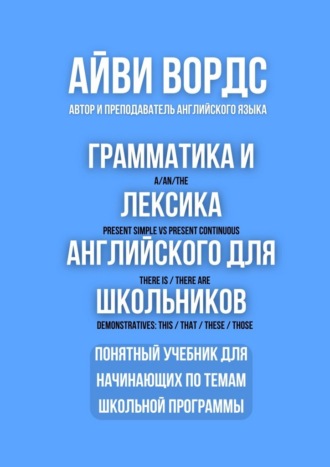
Грамматика и лексика английского для школьников. Понятный учебник для начинающих по темам школьной программы
Добавляйте please, чтобы сделать команду вежливой.
Повторение команд в классе помогает быстро запомнить конструкцию и слова.
Present Simple: Daily Routines and Facts
Grammar Focus
Настоящее простое время (Present Simple)
Present Simple используется для описания:
Регулярных действий и привычек (daily routines)
Общеизвестных фактов (facts)
Формы глагола
Для I / you / we / they: основная форма глагола
I get up at 7 a.m.
They play football after school.
Для he / she / it: добавляется окончание -s или -es
He goes to school by bus.
She watches TV in the evening.
Отрицательная форма
Для I / you / we / they: do not (don’t) + глагол
I don’t like spinach.
Для he / she / it: does not (doesn’t) + глагол
He doesn’t eat meat.
Вопросительная форма
Для I / you / we / they: Do + подлежащее + глагол?
Do you play football?
Для he / she / it: Does + подлежащее + глагол?
Does she like apples?
Совет
Всегда проверяй подлежащее: если это he / she / it, добавляй -s к глаголу в утвердительных предложениях. Для отрицаний и вопросов используем вспомогательный глагол do/does.
Story
Tom is a student. Every morning, he wakes up at 7 a.m. He brushes his teeth and eats breakfast. At 8 a.m., he goes to school by bus. He likes learning new things. At school, he studies English, mathematics, and science.
After school, Tom plays football with his friends. Sometimes, he watches TV or reads a book. In the evening, he helps his mother with dinner. He usually goes to bed at 10 p.m.
Tom’s sister, Anna, has different routines. She wakes up at 6:30 a.m., and she practices gymnastics. She goes to school by bike. Anna likes animals and often feeds the birds in the park. Tom and Anna both enjoy their daily routines and try to stay healthy and active.
Useful Words and Expressions
daily routine – ежедневная рутина
fact – факт
wake up – просыпаться
brush your teeth – чистить зубы
eat breakfast – завтракать
go to school – идти в школу
play football – играть в футбол
watch TV – смотреть телевизор
read a book – читать книгу
help – помогать
dinner – ужин
go to bed – ложиться спать
study – учиться
mathematics – математика
science – наука
practice gymnastics – заниматься гимнастикой
ride a bike – кататься на велосипеде
feed the birds – кормить птиц
healthy – здоровый
active – активный
Exercises
Exercise 1. Complete the sentences with the correct form of the verb
Tom usually ___ (wake up) at 7 a.m.
He ___ (brush) his teeth in the morning.
Anna ___ (practice) gymnastics before school.
Tom ___ (play) football after school.
She ___ (feed) the birds in the park.
Exercise 2. Make questions
___ Tom go to school by bus?
___ Anna like animals?
___ he watch TV in the evening?
___ they study English at school?
___ Tom help his mother with dinner?
Exercise 3. Answer the questions
What does Tom do every morning?
How does Tom go to school?
What subjects does Tom study at school?
What does Anna do before school?
How do Tom and Anna spend their free time?
Answer Key
Exercise 1
wakes up
brushes
practices
plays
feeds
Exercise 2
Does Tom go to school by bus?
Does Anna like animals?
Does he watch TV in the evening?
Do they study English at school?
Does Tom help his mother with dinner?
Exercise 3
Every morning, Tom wakes up, brushes his teeth, and eats breakfast.
Tom goes to school by bus.
He studies English, mathematics, and science at school.
Before school, Anna practices gymnastics.
Tom plays football, watches TV, or reads a book; Anna feeds birds and rides her bike.
Mini Tips
Для he / she / it добавляйте -s к глаголу в утвердительных предложениях.
Для отрицаний и вопросов используйте вспомогательный глагол do/does.
Present Simple легко запомнить через ежедневные привычки и факты, повторяя их вслух.
Adverbs of Frequency
Grammar Focus
Наречия частоты
Adverbs of Frequency показывают, как часто происходит действие. Они помогают уточнить привычки или регулярные действия.
Основные наречия частоты
always – всегда
usually – обычно
often – часто
sometimes – иногда
rarely – редко
never – никогда
Позиция наречий в предложении
Перед основным глаголом (кроме глагола to be):
Конец ознакомительного фрагмента.
Текст предоставлен ООО «Литрес».
Прочитайте эту книгу целиком, купив полную легальную версию на Литрес.
Безопасно оплатить книгу можно банковской картой Visa, MasterCard, Maestro, со счета мобильного телефона, с платежного терминала, в салоне МТС или Связной, через PayPal, WebMoney, Яндекс.Деньги, QIWI Кошелек, бонусными картами или другим удобным Вам способом.