


Полная версия
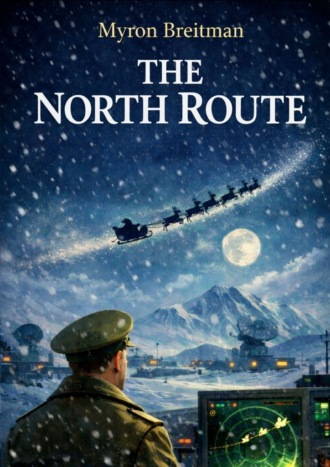
The North Route. A Novella of Hope in the Cold War Sky

The North Route
A Novella of Hope in the Cold War Sky
Myron Breitman
© Myron Breitman, 2026
ISBN 978-5-0068-9862-2
Created with Ridero smart publishing system
Foreword
Listen. Do you hear it?
It is 1955. The world is a vast, shivering clock, ticking toward a midnight no one wants to see. It is a time of iron curtains and leaden skies, where men in windowless rooms watch green-phosphor eyes for the end of everything. They are guardians of the Void, shepherds of the Great Cold.
But then, the miracle. Not a miracle of fire or thunder, but a miracle that arrives as a whisper through a copper wire.
We often think that history is made of grand speeches and heavy boots. We are wrong. History is made of the moments when a hand hesitates over a button, when a heart decides to beat against the rhythm of a machine, when a soldier chooses to become a storyteller.
This is the story of a Red Line. Not the line that divides nations, but the line that connects the lonely earth to the soaring stars. It is about a map where the North Route is carved not by bombers, but by the laughter of a thousand children and the jingling of silver bells.
Open this book as you would open an old watch – carefully, feeling the gears turn. Step into the snow. Hear the hum of the radar. And remember: as long as one person is brave enough to answer the telephone and say «Yes, I see him,» the world will never truly go dark.
The sleigh is in the air. The radar is locked on.
Believe.
Chapter 1. The Night That Breathed
Christmas night came to the North softly – almost a ghost.
It did not arrive as a storm does – with howl and clatter, rattling shutters, sobbing in flues. It did not arrive like spring – with silver rush of meltwater, shout of birds, raw scent of thawed earth.
It came differently.
Like a dream.
Like a memory.
Like something that has always been and always will be, yet remains impossible to hold.
It came as an exhale.
Colonel Henry Caldwell stood by his office window and watched the sky. It was black and scrubbed clean – the stars burned there so fiercely it seemed someone had pricked holes in dark velvet to reveal a world of pure light hidden behind it. He watched the stars and wondered what they had seen. How many centuries. How many wars. How many men had stood just like this, peering upward, asking: What is up there? What hides in the hollow dark between the sparks of light?
Caldwell was no romantic. He was a soldier. He knew that up there, in the Great Void, nothing good lay in wait. Metal birds flew there, pregnant with fire. Invisible borders were drawn there, lines that must never be crossed. There, in that silence, in that emptiness, the end of the world might begin.
And his job was to watch it.
To ensure the end did not come tonight.
He checked his watch. Five minutes to ten. Time. He turned from the window, plucked his cap from the rack, and stepped into the corridor.
The corridors of a military base are always the same. Long. Hollow. Concrete walls painted that particular institutional gray – a gray that does not exist in nature, found only in those places where people do not live, but merely exist: schools, hospitals, barracks. Fluorescent lights buzzed overhead like a swarm of glass bees. His footsteps echoed back at him, until it felt as though he weren’t alone, but followed by a phantom army in polished boots.
Somewhere far off, behind heavy doors, someone laughed. Perhaps in the barracks, soldiers were gathered around a television. A Christmas special. A movie. Or perhaps they were just telling tall tales, because tonight was a night when you could loosen the collar, forget the regulations, and simply be human.
But Caldwell could not loosen his collar.
He walked, feeling the holiday fall away with every step. The laughter grew faint. The warmth receded. Ahead lay only the door – the heavy steel door behind which holidays did not exist.
He paused for a heartbeat.
Christmas, he thought. A strange word. As if something were truly being born. As if the world started over every year, fresh and new.
But the world does not start over. It only continues. It spins, it grinds forward, and the only thing a man can do is watch, making sure it doesn’t come to a sudden, grinding halt.
Caldwell pushed the door open and stepped inside.
The Headquarters met him with its familiar thrum. It was always loud here, though the men rarely spoke. It was the machines that made the noise – a low, rhythmic pulse, as if some Great Beast were breathing beneath the floorboards. Radios crackled. Screens flickered – dozens of them, large and small, each offering a fragment of the world. Dots. Lines. Numbers. Coordinates. Trajectories.
Everything happening in the sky was reduced here to glowing specks on dark glass.
«Evening, Colonel,» said Sergeant Thomas without looking up.
«Evening, Sergeant,» Caldwell replied.
He surveyed the room. The night shift – six men. Corporal Miller at the radar. Technician Johnson on comms. Lieutenant Harris with a clipboard. Three others, young boys whose names Caldwell couldn’t quite summon. They sat at their stations, staring at screens, scribbling in logs. Working.
But Caldwell saw that their minds were leagues away.
Home, perhaps. At a table laden with food. Where a tree glowed and the air smelled of cinnamon and pine.
He understood them. He was thinking of home himself. Of his wife, likely clearing the table now. Of his son, lying awake in bed, unable to sleep because tonight is the night children simply cannot sleep.
But here, in this room without windows, home was only a thought.
Caldwell took off his cap, hung it on a peg, and sat at his desk. It was an old wooden thing, scarred and worn. A mug of cold coffee sat there – a ghost of the previous shift. A stack of papers – reports, briefings, manuals. And the telephone.
The black telephone.
A common thing, found in homes across America.
Caldwell looked at it and thought how strange it was. This entire headquarters, these machines, these eyes that saw the invisible and ears that heard the silent – all of it built to catch a threat before it became a reality.
And the telephone just sat there, mute.
Until it rang.
Caldwell took a sip of the coffee. It was cold and bitter. He grimaced and set it aside, glancing at the clock on the wall. A large, round face with black hands.
10:05 p.m.
A whole night lay ahead. A long night. A Christmas night.
Nothing will happen, Caldwell thought. Nothing ever happens on Christmas.
But he knew that was a lie.
He knew that danger does not take a holiday. That the enemy does not celebrate with you. Somewhere, thousands of miles away, in other windowless rooms, other Colonels sat before similar screens, thinking these very same thoughts.
The world was full of men who waited.
Waited for an order. Waited for a signal. Waited for the moment when everything would change.
Caldwell leaned back and closed his eyes. He felt a weariness. Not the kind that sleep cures, but the other kind. The kind that piles up over the years. The exhaustion of a man who spends his life searching the sky for death.
«Colonel,» someone said.
Caldwell opened his eyes. Sergeant Thomas stood by the desk with a tablet.
«Evening report, sir,» he said. «All quiet. Three commercial flights over Alaska. Two military transports. One weather balloon. Nothing unusual.»
«Good,» Caldwell said. «Thank you, Sergeant.»
Thomas nodded and retreated.
Silence.
The thrum of machines.
The flicker of screens.
Caldwell stared at the map of the world on the wall. A vast thing, marked with bases, routes, zones of responsibility. He knew it by heart. Every dot. Every line. He could see it with his eyes shut.
And suddenly, he thought: How fragile it all is.
How easily it could all shatter.
One mistake. One false signal. One dot on a screen misread by a tired eye.
And that would be the end.
He shook his head, chasing the thoughts away. You couldn’t think like that. You couldn’t let the fear crawl in. Fear was a poison; it paralyzed. It bred doubt. And here, in this room, there was no room for doubt.
Only for the work.
Watch. Wait. Be ready.
In the corner, Corporal Miller began to hum softly. Caldwell listened. The tune was familiar. Jingle Bells. An old song. A simple song. The kind children sing.
Miller stopped abruptly, as if catching himself. He shot a glance at Caldwell. But Caldwell said nothing. He only offered a small nod – Go on, if you like.
Miller didn’t go on.
The silence returned.
And in that silence, in the humming of the wires and the glowing of the tubes, there was something strange. Something Caldwell couldn’t name. An expectation. But not the usual kind. Not the jagged, anxious kind.
Something else.
As if the night itself were waiting.
Caldwell looked at the telephone.
The telephone was silent.
He picked up a pen and began to move through the paperwork. Routine. Signatures. Figures. The work that never ends. He read, but the words slipped through his mind like shadows.
The clock ticked.
The hand moved sluggishly, as if time had turned to syrup.
10:15.
10:20.
10:25.
And then, in that silence, in that waiting, the telephone rang.
The sound was not loud. Almost polite. Ring-ring. Not sharp, not demanding. Just a ring. An ordinary phone call, the kind that happens a thousand times a day.
But everyone in the room froze.
Caldwell looked at the receiver. A black handle on a black base. It sat there, yet the ring continued. Ring-ring.
Sergeant Thomas looked up. Corporal Miller turned around. Lieutenant Harris paused, pencil mid-air.
They all stared at the telephone.
Why, Caldwell didn’t know. It was just a telephone. Perhaps another department. Perhaps HQ. Someone wanting to verify data or pass on a memo.
But for some reason, no one spoke.
Ring-ring.
Caldwell reached out. His fingers brushed the cold plastic. He lifted it to his ear.
«Continental Air Defense Command, Colonel Caldwell speaking,» he said.
His voice was level. Calm. The voice of a man who knows exactly what to say.
There was silence in the receiver.
Not an empty silence. A living one. One that held a presence. Someone was there. Someone was breathing. Someone was holding their breath, not knowing how to begin.
«Hello?» Caldwell said, a little softer.
And then, from the receiver, came a voice.
Thin.
High.
Cautious.
A child’s voice.
«Hello,» the voice said. «Is… is this really Santa?»
Caldwell went still.
He sat at his desk, the telephone pressed to his ear, unable to move. The words snagged in his throat. He looked at the screens where the glowing dots crawled – planes, satellites, everything that drifted over the world. He saw the map on the wall. He saw Sergeant Thomas, who had turned toward him with a confused frown.
Santa?
«Say that again, please,» Caldwell said.
The voice in the receiver grew smaller, as if the child feared they had said the wrong thing.
«Mommy gave me the number,» they said. «She said I could call and find out where Santa Claus is right now. That you track him. That you have radars.»
Caldwell closed his eyes.
Of course.
The advertisement. He remembered now. Last week, someone had shown him a newspaper. A local store – Sears, he thought – had launched a Christmas promotion. «Call Santa!» in big, bold letters. And a phone number at the bottom. For the children.
Only the number had been printed wrong.
One digit. One tiny error in the printing press.
And now, instead of a department store, the children were calling here.
To the Continental Air Defense Command.
To the place where they tracked missiles, not sleighs.
Caldwell opened his eyes. He looked at the telephone in his hand. At Sergeant Thomas, who was waiting for him to speak. At the others – all of them motionless, all of them listening.
Silence in the receiver. The child waited for an answer.
And Caldwell suddenly realized: in this moment, he was the first adult who could either preserve the miracle or destroy it.
He said nothing.
He waited longer than he should have.
He waited because in that pause, there was too much to weigh.
His own childhood – a winter in Mississippi, a small house, a Christmas morning when he had raced to the tree, and there…
Nothing.
Because there was no money. Because his father was away at war. Because his mother was crying in the kitchen, whispering, I’m sorry, I’m sorry, next year will be different.
But a miracle, once vanished, does not return.
Caldwell remembered sitting on the floor by that bare tree, thinking: So, it’s all a lie. The adults had lied. The world was not made of the things he thought it was.
Something inside him had snapped that morning.
Something he had never quite been able to mend.
And now, many years later, he sat in a windowless room, holding a telephone, listening to the voice of a child who still believed.
Believed that there was magic in the world.
That somewhere, Santa Claus was in flight.
That adults did not lie.
Caldwell thought: I could tell the truth. I could explain the mistake. That Santa isn’t real. That we watch for other things here – terrible things that children should never have to know.
He could tell the truth and shatter the wonder.
Or…
Or he could lie.
But would it be a lie?
«Santa,» Colonel Henry Caldwell said slowly, as if weighing every word on a fine scale, «is currently…» – he looked at the map of the world on the wall – «…over the North Pole.»
In the receiver, the silence changed.
It became light.
It became full of hope.
«Really?» the child gasped.
«Really,» Caldwell said. «He’s preparing for takeoff. Checking the sleigh. The reindeer are ready. Everything is on schedule.»
«Will he be here soon?»
«Very soon. But you have to be asleep. You know the rule, don’t you?»
«What rule?»
«Santa only comes to those who are sleeping. The sooner you go to bed, the faster he’ll arrive.»
«I’m going right now!» the voice rang with joy. «I’m running to bed right now! Thank you! Thank you so much, sir!»
«Goodnight,» Caldwell said.
«Goodnight!»
Click.
Caldwell slowly lowered the receiver onto the cradle.
He sat motionless, staring at the telephone. A black telephone. A perfectly ordinary thing.
Then he raised his eyes.
The entire shift was watching him.
Sergeant Thomas. Corporal Miller. Lieutenant Harris. Technician Johnson. All of them. They watched and they were silent, not knowing what to say.
Someone in the corner let out a soft huff of a laugh.
Then someone else.
And then Sergeant Thomas smiled. Not a wide smile. Not a loud one. Just – a smile.
And laughter began to ripple through the room. Soft. Warm. Not mocking, but kind. The laughter of relief. The laughter that comes when something unexpected – something good – happens.
Laughter that had not been heard in this headquarters for a very long time.
«Alright,» Caldwell said, trying to summon his sternest voice, though he couldn’t keep the corners of his mouth from twitching. «Back to work.»
The laughter faded.
But something had shifted.
The air felt warmer. It was easier to breathe.
Caldwell looked at the telephone. Then at the screens. At the glowing dots moving along their invisible paths.
And he thought:
Maybe we really should be tracking Santa.
The thought was foolish. Absurd.
But it wouldn’t leave him.
Outside, the snow was falling. Caldwell couldn’t see it – there were no windows – but he knew it was there. Falling silently upon the earth. Draping the world in a white blanket.
And somewhere out there, in that world, a child was tucking themselves into bed, believing that Santa Claus was flying toward them.
Believing that miracles exist.
Caldwell leaned back in his chair.
The night breathed softly.
And in that breath, there was hope.
Chapter 2. The Room Without Windows
The Headquarters was a place apart.
It was not like a home. It was not like the street. It was not like any other place where men drew breath and lived their lives.
The Headquarters was a place without windows.
Caldwell thought of this often during the long, graveyard shifts when time stretched out slow and thick as clover honey. He wondered: Why are there no windows here? The official manual offered a cold, logical answer: security. Windows were a frailty. Through them, light could leak, sound could spill, a blast wave could shatter the peace. Through them, the enemy could peer in.
But Caldwell knew the deeper truth.
There were no windows because the men who labored here were not meant to see the world. They were meant only to see the screens. Only the dots and the lines. Only the cold geometry of numbers and coordinates.
They had to forget that outside, there was a sky. That beneath that sky, there were cities. That in those cities, there were houses. And in those houses, people lived.
For if you remembered these things every hour of every day, you could not do this work.
You could not sit and wait for the signal that might spell the end of everything.
Caldwell rose from his desk and paced the room. His legs felt heavy – he had sat motionless for too long. He approached the great screen that swallowed half the wall. On it, the map of North America glowed – from ocean to shining ocean, from the white wastes of Canada to the heat of Mexico. Green sparks marked their own birds. White sparks were the civilian flights. Everything else was a void – dark, silent, and deep.
«Anything of interest, Corporal?» he asked Miller, who sat hunched over the radar.
«No, sir,» Miller said, his eyes locked onto the electronic pulse. «An ordinary evening. Three commercials on the West Coast. One military transport over Montana. Everything is within the margins.»
«Good.»
Caldwell returned to his desk. He sat. He watched the clock.
10:38 p.m.
The night was only beginning to breathe.
He pulled a folder of reports toward him and began to read. Technical maintenance for Radar Station Seven. Equipment replacement at Outpost Fourteen. A request for more men at the Colorado base. Papers. Endless, drifting snows of paper. An army is not made merely of men and steel – it is made of papers that never cease to fall.
He signed one report. A second. A third.
Somewhere in the corner, a radio crackled like a small, dying fire. A voice recited coordinates. Another voice confirmed. A routine exchange of information. Mechanical. Stripped of all heat and emotion.
Caldwell listened to those voices and thought how they – he, Sergeant Thomas, Corporal Miller, all of them – lived in two worlds at once.
There was the world outside. The world where it was Christmas. Where lights burned in windows. Where children lay awake, ears strained for the ghost-sound of bells. Where the air smelled of cinnamon and pine needles. Where people laughed and held one another, believing – if only for this one night – that the world was a kind place.
And then there was this world. The room without windows. The thrum of the dynamos. The flicker of the cathode tubes. The waiting that never ended. Because danger does not take a holiday. It is always here. It simply keeps its peace, hiding, waiting for its moment to strike.
And the men in the Headquarters stood between these two worlds. They guarded the one from the other. They watched so that the shadows would not break into the places where the lights burned and the children laughed.
But the price of that vigil was to forget that the other world even existed.
To lock oneself in a room without windows and look only at the glass eyes of the machines.
Caldwell set the folder aside. He rubbed his eyes. The weariness wasn’t in his muscles – it was deeper, in a place his hands couldn’t reach.
«Coffee, sir?» Sergeant Thomas asked.
Caldwell looked up. Thomas stood there, a thermos in his grip. He was a sturdy, block-shaped man with a face that remained solemn even when he smiled. A good soldier. Solid. The kind of man who could hold up a collapsing wall.
«Thank you, Sergeant,» Caldwell said.
Thomas poured the coffee. It was hot and black. The scent was wonderful – the only living smell in a room that smelled of scorched metal, ozone, and recycled air.
«That was a strange call,» Thomas said softly. «The one about Santa.»
«Yes,» Caldwell agreed. «Strange.»
«A misprint in the paper?»
«It seems so.»
Thomas nodded. He was silent for a moment. Then he asked, «You did the right thing, sir. Not telling him the truth.»
Caldwell looked at him. «Do you think so?»
«I’m sure of it.» Thomas offered a thin smile. «I’ve got two of my own. A girl, five, and a boy, seven. They’re waiting for Santa, too. And if someone told them he wasn’t…» He shook his head. «I don’t know. It’s like taking something vital away from them. Something they still need.»
«Childhood,» Caldwell said.
«Yes.» Thomas looked away, into the gray distance of the room. «Childhood. It’s a short season. And then you spend the rest of your life remembering it, wondering if it ever really happened at all.»
He caught himself and straightened his posture. «Sorry, sir. I’m rambling.»
«It’s alright, Sergeant. I understand.»
Thomas nodded and retreated to his station.
Caldwell sipped the coffee in small, thoughtful measures. He thought of Thomas’s words. Of childhood. Of how swiftly the light fades from it. How one morning you wake up and realize you no longer believe. Not in Santa, not in fairies, not in the impossible. Now you know how the world is geared and bolted together. And that knowledge – heavy, cold, and gray – settles on your shoulders and never leaves.
His own son, Michael, no longer believed. He was twelve, and at twelve, the magic has usually leaked out. But Caldwell remembered the exact moment the belief vanished. It was two years ago. They were sitting on the porch in the autumn dusk, and Michael had suddenly asked:
«Dad, is Santa Claus really just you and Mom?»
And Caldwell hadn’t been able to lie. He looked into his son’s eyes and nodded.
«Yes, son. It’s us.»
Michael didn’t cry. He didn’t shout. He just nodded, as if he’d known all along and simply wanted the final confirmation.
«I see,» he’d said.
They never spoke of it again.
But something had shifted after that talk. Something Caldwell couldn’t quite put a name to. Michael became graver. More grown-up. He looked at the world with different eyes – not the wide, wondering eyes of a child, but the tired eyes of someone who had already learned to be disappointed.
And Caldwell sometimes wondered: Did I hurry him? Could I have given him one more year? One more Christmas to hold onto the dream?
But time does not flow backward. Words cannot be swallowed once spoken.
Childhood ends, and no man can bar the door against its departure.
Caldwell finished his coffee and looked at the telephone.
The telephone was silent.
The child was likely asleep by now. Tucked into bed, eyes shut tight, dreaming of sleighs and reindeer and a beard as white as a mountain peak. Dreaming of the miracle that would descend in the night.
And Caldwell thought: What if he calls again?
The thought was irrational. Why would he call again? It was a stray call. An error. One of a thousand tiny glitches that happen every day – a wrong number, a slipped digit, a coincidence.
But something inside Caldwell whispered: This is not the end.
This is only the beginning.
He stood and walked back to the great screen. The map of the world glowed in the gloom. Continents, oceans, borders. All of it was there, compressed into the size of a wall. You could reach out and touch Europe. Asia. The North Pole.