Полная версия
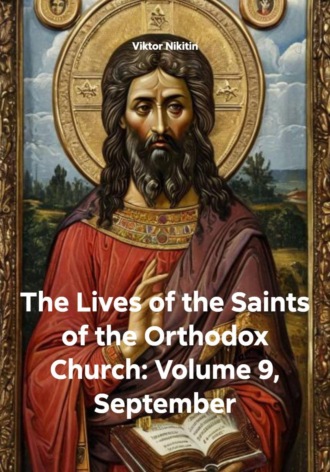
The Lives of the Saints of the Orthodox Church: Volume 9, September
3628 Martyrs of Nicomedia:
The 3628 martyrs of Nicomedia suffered during one of the most ferocious persecutions of the early Church, under Emperor Diocletian. The city had a flourishing Christian community, organized, devout, and unashamed of its identity. When Diocletian launched his assault against the Christian faith, the believers in Nicomedia refused to abandon Christ, even as imperial soldiers surrounded their gatherings, burned their churches, and hunted them through the streets. The persecution reached a horrifying climax when thousands of Christians assembled for worship were trapped inside their church and burned alive. Those who escaped the flames were captured and executed in waves—stabbed, drowned, tortured, or thrown to wild beasts. Their response was not panic or despair but remarkable spiritual unity. Families encouraged one another to stand firm; clergy exhorted their flocks as they were led to execution; young and old alike accepted suffering with the quiet dignity of those who know their loyalty belongs to a higher King. Their collective martyrdom became a monument of steadfastness, showing that no earthly power can extinguish a community built on faith, prayer, and the hope of eternal life. Their memory stands as both a tragedy and a triumph: a tragedy for the cruelty they endured, and a triumph for the courage of thousands who died singing the praise of God.
Venerable Anthony and Theodosius, Founders of Monasticism in Rus’ of the Kiev Caves:
Saints Anthony and Theodosius of the Kiev Caves are the fathers of monasticism in the lands of Rus’, shaping the spiritual identity of a nation. Saint Anthony, trained on Mount Athos, brought to Kiev the Athonite spirit of silent prayer, hesychia, and humble struggle. He established a small cave for solitary asceticism, but God soon drew others to him, forming the beginnings of the Kiev-Pechersk Lavra. His presence radiated a spiritual authority rooted not in command but in example—the authority of a man who had given every breath to God. Saint Theodosius, joining Anthony as a young monk, added a complementary gift: the spiritual fatherhood needed for communal monastic life. Where Anthony embodied solitude, Theodosius embodied brotherhood. He organized the monastery according to the Studite rule, taught gentleness in speech, obedience in action, and charity toward the poor. Under his leadership, the Lavra became the heart of spiritual life for Rus’, forming monks whose lives shaped bishops, writers, missionaries, and saints for centuries. Together, Anthony and Theodosius laid foundations deeper than stone—foundations built from repentance, humility, and ceaseless prayer. Their legacy forged not merely a monastery but an entire culture rooted in the pursuit of holiness.
Martyrs Diomedes, Julian, Philip, Eutykhian, Hesychios, Leonides, Eutychios, Philadelphos, Melanippos, Parthagapa, and Theodore:
These eleven martyrs stood firm during the fierce persecution unleashed under various Roman emperors when confessing Christ meant immediate danger. They came from different backgrounds—soldiers, craftsmen, ordinary townsmen—but shared a single conviction: loyalty to Christ outweighed loyalty to the empire when the two collided. Arrested and interrogated, they were ordered to renounce Christ and participate in pagan rites. Their refusal was calm, united, and unbreakable. One by one they endured tortures designed to terrify them into submission: scourging, burning, dismemberment, and starvation. Yet their courage fed one another; the steadfastness of one strengthened the others. They comforted each other in prison, prayed together as brothers, and encouraged one another to face suffering with dignity. Their common witness turned what could have been isolated deaths into a single, powerful act of unity in faith. They died not as eleven individuals but as one body, bound together by their love for Christ, proving that the strength of faith is multiplied when borne together.
Righteous Eleazar, son of Aaron:
Righteous Eleazar, the son of the high priest Aaron and nephew of Moses, occupies a central place in the sacred history of Israel. He inherited the high priesthood at a moment of transition, guiding the people through the wilderness as they moved from the shadow of rebellion toward the promise of settlement in the land given by God. Eleazar’s life was marked by obedience—obedience not only to the Law but to the will of God revealed through Moses. He played a crucial role in maintaining the purity of worship, teaching the people discernment, and ensuring that the sacred rites were performed according to God’s commandments. It was Eleazar who, by God’s command, received Aaron’s priestly garments at the moment of his father’s death, continuing the priesthood with solemn dignity. His leadership was steady, unflamboyant, and faithful—rooted in reverence rather than personal ambition. His righteousness helped stabilize the nation during its formative years, and he is remembered as a guardian of the covenant and a man who served God with unbroken fidelity.
Righteous Phineas, grandson of Aaron:
Phineas, the zealous grandson of Aaron, is remembered for his bold, decisive action during a period of grave moral crisis among the Israelites. When the people fell into idolatry and immorality with the pagan nations surrounding them, bringing divine judgment upon the camp, Phineas confronted the sin not with hesitation but with a fierce devotion to the holiness of God. His courage halted a plague that had already claimed thousands, and God rewarded him with a “covenant of peace,” promising that the priesthood would remain in his descendants forever. Yet Phineas is not remembered only for his dramatic act of zeal. He also embodied long-term faithfulness, serving as a priest and judge who guided Israel with integrity and steady leadership. His zeal was not reckless passion but disciplined devotion—a love for God that refused to compromise. His life stands as a reminder that genuine righteousness requires both purity of heart and the strength to defend the truth when it is endangered.
Martyrs Aeithalas and Ammon of Thrace:
Aeithalas and Ammon were soldiers in Thrace who were confronted with the choice between imperial command and divine command. When ordered to participate in pagan rituals, they refused, stating plainly that their allegiance was to Christ alone. Their bold confession enraged their commanders, who subjected them to tortures meant to break both body and will. Yet these two brothers-in-arms stood as brothers in faith. Their torturers alternated cruelty with false promises, but neither man faltered. They prayed aloud during their sufferings, strengthening one another with psalms and reminding each other of the eternal kingdom promised to those who endure. Their martyrdom was a testimony not only of personal courage but of fraternity—a witness to the power of friendship rooted in Christ. Their memory stands among the many soldier-martyrs who proved that true loyalty belongs first to God.
Saints Antonii and Feodosii of Pechersk, founders of the Kiev Caves:
These two great ascetics stand as pillars of early Rus’ monasticism, shaping the spiritual character of generations. Antonii brought the Athonite spirit of solitude and repentance; Feodosii shaped that spirit into communal order, charity, and spiritual fatherhood. Together they formed the Pechersk Lavra as a beacon of prayer, humility, and unceasing ascetic struggle. Their lives, marked by gentleness, courage, and unwavering devotion to God, laid the foundations of holiness for an entire nation.
* * *
Lives of the Saints Celebrated on September 3
Hieromartyr Anthimus, Bishop of Nicomedia, and those with him:
Hieromartyr Anthimus shepherded one of the largest and most embattled Christian communities of the early Empire. Nicomedia stood near the heart of imperial authority, and thus its Christians suffered some of the fiercest waves of persecution. Anthimus guided them not through force or political maneuvering but through a fatherly gentleness that revived hope in the persecuted and inspired repentance among the wayward. His preaching carried a serenity born of deep prayer; his presence became a refuge amid the wreckage of burned churches and scattered families. When the Great Persecution erupted, Anthimus worked tirelessly to comfort the suffering, distribute alms, and hide fugitives. Those who suffered with him—Theophilus the Deacon, Dorotheus, Mardonius, Migdonius, Peter, Indes, Gorgonius, Zeno, the Virgin Domna, and Euthymius—formed a radiant company united by faith rather than rank: clergy, palace servants, ascetics, soldiers, and converts from paganism. Each bore unique gifts. Domna, once a pagan priestess, had embraced the faith with such fervor that she lived in hidden asceticism even inside the imperial palace. Others used their influence to minister to imprisoned believers, rescue children, and shelter orphans. Their martyrdoms came in waves, each arrest a blow to a Church already staggering under oppression. Tortures were devised to break their resolve: scourging, fire, iron claws, and suffocating confinement. Yet each remained immovable, strengthened by the prayers of the others. Many guards were converted simply by witnessing their peace. When Anthimus was taken, it was in secret so the people could not gather around him. He converted the soldier sent to kill him and received beheading with holy dignity. The soldier, too, was martyred shortly thereafter, sealed with the blood of the shepherd he had come to love. Their collective witness became a living flame in Nicomedia, burning away fear and setting countless hearts ablaze with courage.
Venerable Theoctistus, fellow ascetic with Venerable Euthymius the Great:
Venerable Theoctistus was among the first architects of desert monasticism, a man whose quiet humility shaped generations of ascetics. Drawn from youth to solitude and prayer, he journeyed into the Judean wilderness seeking a master of the spiritual life. There he encountered Euthymius the Great, whose insight and holiness became the compass of his soul. Theoctistus learned from him the arduous art of inner watchfulness, the discipline of guarding one’s thoughts, and the consolation of constant prayer. The two lived together in a cave for years, sustaining themselves by manual labor and the sparse vegetation of the desert. Their brotherhood was marked by perfect harmony: Theoctistus’ gentleness complemented Euthymius’ prophetic clarity. Eventually, Theoctistus founded a cenobitic monastery under Euthymius’ guidance. There he nurtured monks with a father’s compassion, emphasizing discernment, humility, and obedience as the cure for the passions. Miracles accompanied his prayers—healings, exorcisms, and prophetic counsel—yet he kept them hidden as much as possible to avoid admiration. At his repose, Euthymius grieved as though he had lost a limb of his own soul. A mysterious stillness settled over the monastery, and the brethren sensed the fragrance of grace. The memory of Theoctistus endured as a model of monastic gentleness: strict with himself, tender toward others, and always pointing his disciples toward the quiet kingdom within the heart.
Saint Phoebe, Deaconess of Cenchreae near Corinth:
Saint Phoebe shines brightly in the early Church as a woman entrusted with sacred responsibilities and apostolic confidence. As deaconess of Cenchreae, she ministered to the poor, the sick, widows, travelers, and catechumens. She acted as a trusted collaborator of the Apostle Paul, who commended her to the entire Church at Rome and urged them to receive her “in the Lord.” This remarkable endorsement reveals her stature and reliability among the earliest Christians.
Phoebe used her home as both a refuge and a mission center, aiding evangelists and offering hospitality to those fleeing persecution. She provided material support to struggling believers and funded the spread of the Gospel throughout the region. Her most historically significant task was carrying Paul’s Epistle to the Romans to its recipients—a journey fraught with danger. Tradition holds that she also interpreted Paul’s teaching and clarified his theological points for the Roman Christians, serving as the apostle’s emissary in both message and spirit. Her life exemplified the seamless integration of prayer, charity, leadership, and service. She became a model of responsible spiritual authority exercised through compassion and fidelity to the apostolic mission. Her legacy endures as a reminder that holiness and service are inseparably intertwined.
Martyr Basilissa of Nicomedia:
Martyr Basilissa was born into nobility yet embraced a radically different path from the wealth and privilege that surrounded her. Drawn to the humility and purity of the Christian faith, she used her resources to alleviate suffering, shelter fugitives, and ransom prisoners during waves of persecution. Her conversion scandalized her peers, who accused her of dishonoring her social station by mixing with the poor and enslaved. Basilissa, unmoved by their scorn, chose Christ over comfort with a joyful determination. Her arrest came after she was discovered harboring Christians and distributing money to imprisoned believers. When confronted by the authorities, she demonstrated both courage and serenity. Threats of torture failed to intimidate her; promises of wealth and favor failed to seduce her. The tortures she endured were prolonged and brutal—scourging, branding, deprivation—but she prayed throughout, comforting fellow prisoners and astonishing guards with her peace. Her execution became a silent liturgy of faith. Believers watched from hidden places, unable to intervene, yet strengthened by her unwavering witness. After her death, numerous miracles occurred at her tomb, especially aiding women in childbirth and healing afflictions of the mind. Basilissa remains a symbol of noble humility—one who gave up earthly honor to receive the unfading crown of martyrdom.
Saint Ioannicius, Patriarch of Serbia, Wonder-worker:
Saint Ioannicius rose from simple monastic beginnings to become a shepherd of his nation’s soul. As a monk, he was known for intense asceticism, sleepless vigils, and profound humility. His fellow monks often found him weeping in prayer, interceding for the world. Even before his elevation, miracles occurred through his petitions: storms ceased, children were healed, and prophetic warnings preserved villages from disaster. As Patriarch of Serbia, Ioannicius guided his flock through political turbulence with remarkable wisdom and gentleness. He championed the translation of spiritual texts into the Slavic tongue, strengthened monasteries, and encouraged the people to cling to the faith amid external pressures. He mediated political disputes with such fairness that even secular leaders sought his counsel. Beneath the grandeur of his office was a heart still shaped by monastic quiet. Sensing his approaching repose, he withdrew into prayer and prepared himself in silence. After his passing, his relics became a fountain of miracles, and the Serbian faithful honored him as a father, protector, and wonder-worker whose sanctity had woven itself into the fabric of their nation’s life.
Blessed John “the Hairy,” Fool-for-Christ of Rostov:
Blessed John embraced the radical vocation of foolishness for Christ, choosing a path that concealed his virtues beneath the appearance of madness. His wild hair, ragged clothing, and unpredictable behavior confused onlookers, yet these were not signs of disorder but tools for spiritual healing. By disarming social expectations, he exposed hidden hypocrisy, confronted sin without provoking defensiveness, and protected himself from praise. He gave away every gift he received, lived among the poorest, and dwelt frequently in abandoned places where the rejected sought shelter. He rebuked the drunkards of taverns with riddles that struck the heart. Children mocked him, and adults dismissed him, but John bore insults with joy, offering them as a sacrifice for their salvation. Many stories reveal his prophetic insight: predicting fires, averting disasters through prayer, and offering mysterious yet healing counsel to the despairing. Only at his repose did the city of Rostov recognize the depth of his holiness, for miracles began at his tomb, and the people realized that the “madman” had been one of God’s hidden pillars sustaining the entire city.
Hieromartyr Bishop Aristion of Alexandria in Syria:
Bishop Aristion served the Church with apostolic fervor during a time of intense suffering. He traveled tirelessly across his diocese, preaching Christ with clarity and compassion, strengthening wavering believers, and restoring those who had fallen. He sold his possessions to feed the starving during famines and became a father to widows and orphans. When he was arrested for refusing to sacrifice to idols, the faithful gathered outside the prison in grief. Aristion endured torture with unwavering calm—scourging, fire, and the rack—using even these moments to preach repentance and forgiveness. In prison he comforted criminals, instructed catechumens, and baptized converts at the risk of further torment. At his execution he lifted his hands in blessing over the crowd and prayed for God to enlighten those who persecuted the Church. After his death, his tomb became a source of miracles, drawing pilgrims from near and far who sought healing of body and soul.
Martyrs Zinon, Chariton, Achrontionus, and Vitalian:
These four martyrs were ordinary believers whose steadfastness in a moment of trial became a luminous testimony. Zinon was admired for his honesty in trade; Chariton for his open-handed charity; Achrontionus for his love of Scripture; and Vitalian for his kindness to strangers. When pressures arose to join pagan rites, the four refused with unanimous resolve. Their unity astonished the authorities, who attempted to break them through humiliation and torture. They endured public beatings, the tearing of flesh, and roasting over fire. Yet even in torment they prayed aloud, quoting psalms and encouraging one another. Their unshakeable brotherhood in suffering inspired even witnesses who feared to show sympathy. After their execution, the place of their martyrdom became sacred to Christians, who felt a divine peace lingering there. Generations later, their names were invoked as examples of the strength found in faithful friendship rooted in Christ.
Martyr Dasa:
Martyr Dasa lived a humble life marked by prayer, work, and charity. His faith was steady and unpretentious, and he was known for helping neighbors without seeking recognition. When ordered to perform pagan sacrifices, he responded with simple clarity: “I cannot deny the One who gave me life.” Enraged, the authorities subjected him to lashings, hunger, and cold confinement. Despite these torments, Dasa prayed continually, asking not for deliverance but for the conversion of his persecutors. Fellow prisoners were moved by his gentleness, and some secretly asked for instruction in the faith. He finally surrendered his soul to God while under torture, his final breath a prayer of thanksgiving. Drops of his blood, gathered by believers, were later used as instruments of healing.
New-Martyr Polydorus of Cyprus:
Polydorus was raised in a devout family and learned early the beauty of prayer, fasting, and charity. As a young man working among non-Christians, he became known for honesty and gentleness. When falsely accused of blaspheming Islam, he was arrested and pressured to renounce Christ. Promises of wealth and power could not sway him; neither could threats of execution. He replied, “My Christ is my life.” His imprisonment was harsh. Confined in darkness, deprived of food, and tormented by guards, he spent his nights repeating the Jesus Prayer, his face radiant despite his suffering. His execution was intended to instill fear, but instead it emboldened the Christians of the region. After his death, miracles occurred at the site of his martyrdom, and his memory became a wellspring of courage for the faithful of Cyprus.
Martyr Edward of England:
King Edward was a young ruler whose short reign was marked by justice, mercy, and a purity of heart rare among kings. He protected monasteries, aided the poor, and resisted corruption at court. His stepmother, fearing the loss of power, conspired to have him murdered. Edward arrived at her house in kindness, seeking peace, when he was treacherously struck down. The betrayal echoed the murder of righteous Abel by his envious brother. Edward’s death was politically motivated, yet spiritually it was a martyrdom, for he was killed for righteousness’ sake. Miracles soon occurred at the site of his death, and his relics brought healing to many. The English people came to venerate him as a saint whose innocence bore witness to the eternal kingdom of God.
Saint Constantine the New, Emperor:
Saint Constantine the New ruled with a heart steeped in Christian humility. Rejecting the lavish excesses of imperial life, he channeled resources into churches, hospitals, and shelters for the poor. He enacted just laws that protected the vulnerable and restrained the wealthy from exploiting the weak. Seeking reconciliation in times of political unrest, he counseled forgiveness and unity rather than vengeance. He approached his reign as a sacred stewardship, beginning each day in prayer and seeking wisdom from monks and ascetics. His personal modesty—rare among emperors—won the love of his subjects. After his peaceful repose, the faithful remembered him as a ruler who had mirrored Christ’s kingship through mercy, humility, and justice.
Martyr Archontinus:
Martyr Archontinus was a man of deep faith and pastoral compassion. A gifted teacher and spiritual guide, he nurtured his community with wisdom and tenderness. When commanded to sacrifice to idols, he refused with quiet firmness, professing Christ as the true God. The authorities, frustrated by his calm resolve, subjected him to cruel tortures—scourging, burning, and prolonged confinement. Throughout his suffering, Archontinus prayed for his persecutors, asking God to enlighten them. His endurance moved even his tormentors to awe. At last he was executed, and his martyrdom became a beacon of faith for those who witnessed it. His name remains honored among those who held fast to Christ with unwavering integrity.
Repose of Priest Peter of Uglich, Fool-for-Christ of Uglich:
Priest Peter served faithfully at the altar for many years before embracing the path of foolishness for Christ. He relinquished worldly dignity to adopt a life of extreme humility, hiding his virtues beneath unpredictable behavior and poverty. Wandering barefoot even in winter, he blessed children, visited the imprisoned, and offered veiled rebukes to the proud. Though ridiculed by many, he bore insults with compassion, interceding nightly for the salvation of his city. At his death, the people suddenly understood his holiness, for miracles began at his grave and healings multiplied. He remains a reminder that God often hides His greatest servants under garments of humility and apparent madness.
Translation of the relics of Saint Nektarios of Pentapolis:
The translation of Saint Nektarios’ relics revealed the full splendor of a saint who had embraced humiliation on earth with patience and love. During his lifetime he suffered slander, unjust exile, and mistreatment, yet he never defended himself; instead, he blessed those who wronged him and continued to serve with serenity. After his repose, his body became a vessel of miracles: paralytics walked, the sick were cured, and countless souls found peace. At the translation of his relics, a fragrance filled the air, and the faithful experienced profound consolation. His relics, radiant with grace, continue to be a source of healing and hope. Through them God glorifies a saint who lived in meekness and now intercedes powerfully for the world.
* * *
Lives of the Saints Celebrated on September 4
Hieromartyr Babylas, Bishop of Antioch, and with him Martyrs Urban, Prilidian, and Epolonius, and their mother Christodula (3rd century, ca. 250):
Hieromartyr Babylas of Antioch stands as one of the earliest and most radiant examples of episcopal courage in the face of imperial tyranny. Renowned for both his gentleness and his uncompromising orthodoxy, he shepherded the Christians of Antioch during a time when pagan rulers sought to coerce the Church into silence. When Emperor Numerian attempted to enter the church during a corrupt and violent reign—seeking the blessing and honor due only to the righteous—Babylas boldly barred him at the doors, declaring that one stained with blood and injustice could not stand before the Holy God. For this act alone he drew the emperor’s wrath, yet he refused to apologize or compromise. Arrested alongside three devout youths—Urban, Prilidian, and Epolonius—and their noble mother Christodula, Babylas continued to strengthen the faithful even in chains. Tortures followed: scourging, imprisonment, deprivation, and threats designed to break their spirits. But Babylas and the young martyrs remained steadfast, Christodula herself encouraging her sons to be courageous unto the end. They accepted death with dignity, their witness leaving an indelible mark upon Antioch and the entire Church. To this day, the relics of St. Babylas are known to have driven out demons and purified places defiled by idolatry, a testimony to his enduring spiritual authority.