Полная версия
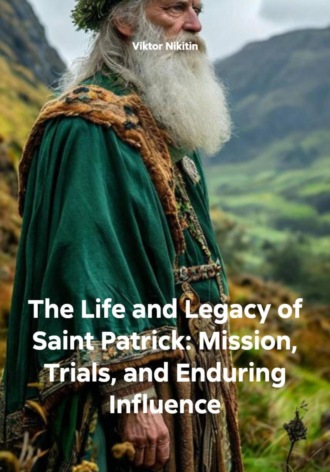
The Life and Legacy of Saint Patrick: Mission, Trials, and Enduring Influence

Viktor Nikitin
The Life and Legacy of Saint Patrick: Mission, Trials, and Enduring Influence
How Christianity Spread Beyond the Roman Empire
The sweeping series of migrations, conquests, and settlements that reshaped Europe over nearly a millennium began around the second century A.D. These movements, largely driven by the Germanic and Slavic peoples, redrew the political map of the continent and transformed its ethnic and cultural makeup. Known broadly as the “Wandering of the Peoples,” this vast migration movement saw entire tribes and nations uprooted, moving across vast territories and settling in new lands. It was a dynamic, sometimes chaotic, but ultimately defining chapter in European history. The last major wave of this migration took place in the ninth century with the northern Germanic peoples from Scandinavia and Denmark—the Vikings and Danes—who extended their influence westward through raiding and settlement in the British Isles and the coasts of Western Europe, while also pushing eastward to lay the foundations of the early Russian state. These Viking expansions are often remembered for their violence and suddenness, but they represent the final phase of a much longer, complex process of ethnic and political transformation that began centuries earlier.
Ireland, throughout much of this turbulent period, remained a remarkable exception. Shielded from large-scale invasions and major political upheavals, it stood apart from the storm of conquest and migration that swept much of Europe. Unlike its neighbors, it was never incorporated into the Roman Empire, which left its political structures untouched by Rome’s direct authority. It was not until the ninth century, during the height of Viking expansion, that Ireland experienced significant foreign settlement and the establishment of a foreign kingdom within its borders. Yet, long before this dramatic moment, Ireland had already been drawn into the wider world, not by armies or political domination, but by a quieter, more profound force: Christianity.
Christianity, which had its beginnings as a persecuted minority faith within the Roman Empire, grew steadily in influence and numbers until it became the Empire’s official religion under Emperor Constantine in the early fourth century. This shift in the Empire’s religious orientation marked a turning point not only for the Roman world but also for all the peoples and lands connected to it, directly or indirectly. Though Ireland remained politically aloof and socially distinct, it was gradually woven into the spiritual and cultural fabric of Christian Europe. Christianity linked Ireland to the rest of the continent and became a powerful agent of change, shaping its culture, law, and identity for centuries to come.
To fully grasp how Christianity took root in Ireland, we need to understand the broader context of its spread within and beyond the Roman Empire. The Empire’s vast expanse, sophisticated road networks, bustling cities, and relatively safe travel routes provided an ideal environment for ideas to move quickly across great distances. This infrastructure made it possible for early Christian missionaries and converts to communicate and organize more effectively than would have been imaginable elsewhere. Though early Christians endured periods of harsh persecution, the eventual legalization and endorsement of Christianity under Constantine changed everything. The Edict of Milan in 313 A.D. granted Christians the freedom to worship openly and laid the groundwork for the faith’s institutional growth. Churches were built, bishops gained political influence, and missionary efforts expanded.
By the second century, Christian communities had been established in parts of Gaul (modern-day France) and in Roman Britain by the late third century. However, the spread of Christianity was uneven and faced many obstacles. Large areas, particularly in northern Gaul and parts of Britain, remained staunchly pagan well into the fourth century. Spain, on the other hand, experienced a rapid and thorough Christianization even before Constantine’s official conversion. The Spaniards skillfully adapted Christian beliefs to local traditions, making the faith more acceptable and deeply rooted in the region. This uneven progress highlights the complex, regionally diverse nature of Christianity’s expansion.
Beyond the Empire’s formal boundaries, the spread of Christianity was less a matter of planned missionary activity and more the result of chance encounters and circumstances. One significant example involves the West Goths, who lived in the region known as Dacia (approximately modern Romania). Their conversion to Christianity did not come about through organized missions but rather through the presence of Christian captives brought into their lands during mid-third-century conflicts. These captives maintained their Christian beliefs and, over time, influenced their captors. Wulfilas, an influential figure known as the “Apostle of the Goths,” descended from such captives. Raised among the Goths and fully embracing their language and culture, he devoted himself to spreading Christianity among his people, translating the Bible into Gothic and fostering Christian communities. This story exemplifies how Christianity spread beyond the Empire’s formal reach, often carried by the movements of displaced people and war captives.
A similar case occurred in the kingdom of Iberia, near the Caucasus Mountains, where Christianity is said to have been introduced by a Christian slave woman named Nino. Although her story carries legendary elements, the reverence she still receives as the “Enlightener and Apostle of Georgia” points to a historical foundation. This narrative highlights once again the important, if indirect, role that captives played in spreading Christianity to new peoples.
The role of captives in the spread of Christianity is a theme often overlooked in traditional histories. These individuals, though forcibly removed from their homes, carried their faith with them and sometimes succeeded in influencing their captors. Likewise, soldiers from outside the Empire who served in Roman armies could encounter Christianity while stationed in Roman territories. Upon returning home, these soldiers sometimes brought Christian beliefs back with them, creating new pockets of faith beyond the Empire’s borders. Commerce also played a vital but less visible role. Although ancient and medieval writers rarely detail trade routes and economic exchanges, merchant activity helped facilitate the exchange of ideas, including religious beliefs. The founding of the Christian church in Abyssinia (modern Ethiopia) is a striking example. Greek explorers shipwrecked and enslaved on the Abyssinian coast included a young man named Frumentius, who gained favor with the local king and used his influence to support Christianity’s establishment. Later consecrated as bishop, Frumentius returned to Abyssinia to nurture the fledgling Christian community. His story demonstrates how captivity and trade, intersecting with political circumstances, enabled Christianity’s spread beyond the Empire.
Until the sixth century, the Church’s outreach beyond Roman borders was largely incidental rather than intentional. The mission to convert “barbarian” peoples was, in practice, limited to the Roman world. Still, Church leaders welcomed and supported Christian groups that arose beyond the Empire, even if their origins were accidental.
The elevation of Christianity to the Empire’s official religion by Constantine had profound implications beyond the Empire’s borders. Christianity’s newfound prestige made it a powerful force in shaping the beliefs of neighboring tribes. Despite frequent conflicts, these “barbarian” peoples held Rome in awe, seeing it as an eternal, unassailable power. Rome symbolized civilization, order, and legitimacy. When Christianity became Rome’s religion, it inherited this prestige, transforming from a persecuted sect into the faith of the greatest power on earth. For neighboring tribes, the Christian God became a protector worth respecting and fearing. Many converted not only for spiritual reasons but because political calculation dictated that allegiance to Rome’s God could bring advantage. The Burgundians famously embraced Christianity because they believed “the God of the Romans is a strong helper to those who fear Him.” The symbolic and political weight of Christianity’s association with Rome helped it spread rapidly among Germanic tribes. Had Constantine’s conversion been delayed by even a century, the fate of Christianity in Europe might have been very different.
Ireland holds a unique position in this narrative. As the only Celtic land never incorporated into the Roman Empire, it has often been mistakenly thought of as isolated or disconnected from the wider world. But recent research shows this was not the case. Long before written history, maritime routes connected the Mediterranean and northern seas, facilitating trade and cultural exchange. The Celtic peoples who settled Britain and Ireland likely maintained frequent contact with the continent. Roman geographers placed Ireland midway between Spain and Britain, suggesting active sea routes and trade connections. Although Ireland lay beyond Rome’s political reach, it was not unknown or ignored. Roman writers, though sparse on details, acknowledged Ireland’s existence and recorded trade relations. Ireland’s lack of Roman conquest was not due to isolation but political calculation—Rome expanded its borders only when necessary. Britain’s conquest, for example, was driven by the need to secure Gaul’s borders. Ireland’s Celtic Goidelic tribes posed no similar threat.
Still, Rome exercised indirect influence over Ireland. In the third century, an Irish tribe called the Dessi was displaced from their homeland in Meath and settled in southwestern Britain. Archaeological evidence, such as inscribed stones, confirms Goidelic settlements in Devon, Cornwall, and Wales. These movements may have been encouraged by Rome as a way of stabilizing border regions with loyal groups.
Considering these connections, it is unsurprising that by the late fourth century Christianity had reached Ireland’s shores. Trade and cultural exchange with Christian Britain, Gaul, and Spain provided avenues for the faith to travel. The settlement of Irish groups in Britain created further links. Captives taken during raids likely introduced Christianity as well. By the fifth century, Irish men traveled abroad to study Christian theology. Christian communities in Ireland were sufficiently developed to be organized and supported. The adoption of the Latin alphabet signaled wider cultural influence and connection. Though politically independent, Ireland was spiritually linked to the Christian world of Europe. Its gradual acceptance of Christianity was part of the continent’s larger transformation—a step that would shape Irish history and identity for centuries.
Ireland’s conversion to Christianity was not a sudden rupture or isolated event. Instead, it was the culmination of centuries of contact, exchange, and gradual spiritual change, bringing the island into a new era of cultural and religious unity with Europe. The foundation laid in this period would give rise to Ireland’s famous Christian heritage and its role as a beacon of learning and faith in the medieval world.
* * *
The Captivity and Spiritual Awakening of Patrick
Patrick’s captivity began under the ownership of a man named Miliucc, whose lands lay in the remote and rugged region of northern Dalaradia. This territory was far from the centers of Roman civilization, a wild borderland of Ireland, where the natural landscape ruled with a harsh and untamed authority. During his imprisonment, Patrick was assigned the humble and taxing duty of tending to his master’s herds of pigs on the slopes of Mount Miss. Though Mount Miss is not especially high or commanding from a distance, its distinctive and unusual shape—a broad, rounded peak resembling an inverted bowl—imposes itself dramatically on the landscape when approached closely. Over time, this mountain’s name merged with the Gaelic word *sliabh*, meaning “mountain,” transforming into “Slemish,” a name that has persisted into the present day. Much like how the triangular and sharply defined form of Mount Pentelicus looms over Athens and lingers in the memory of those walking its plains, Mount Miss, though lesser known, captivates the eye of the traveler in the valley of the Braid, dominating the surrounding scenery with its quietly commanding presence.
Tradition firmly holds that Patrick spent six grueling years bound in servitude within this valley and on the rugged slopes of Mount Miss, performing the relentless daily tasks imposed by his lord. Yet Patrick’s own writings place his captivity near the forest of Fochlad, a location which seems to conflict with the popular story. Some historians have attempted to reconcile this discrepancy by suggesting that Patrick may have been sold from one master to another, moving from a western region to the northern lands of Dalaradia during his imprisonment. However, Patrick’s vivid and detailed descriptions of his experience suggest a singular captivity, making such a theory less convincing. The simplest and most logical conclusion is to question the accuracy of the traditional story linking Patrick’s imprisonment specifically with Mount Miss. For Patrick, the geographic details were secondary to the spiritual and personal transformation his captivity triggered.
Despite the harshness and isolation of captivity in a foreign and hostile land, it was during these years that a profound and lasting transformation overtook Patrick’s inner life. Before his capture, religion had been a peripheral concern, something distant and largely ignored in his youth. But now, stripped of freedom and surrounded by strangers who did not share his beliefs, Patrick found that “the Lord opened the eyes of my unbelief.” A powerful religious awakening seized him—a passionate and consuming love, fear, and reverence for God that filled his spirit wholly. He remembers how he would offer prayers by the hundreds in a single day or night, rising before dawn to pray in the chill of early morning, whether beneath the open sky in forests or on exposed hillsides, undeterred by hail, rain, or snow. His thoughts ceased to dwell on the earthly hardships around him and instead were fixed on spiritual realities beyond the material world. These years of servitude were not merely a time of suffering, but the crucible in which his soul was refined and his faith forged. Patrick himself looked back on this period as the most critical and defining stage of his spiritual development.
Yet amid his growing devotion and faith, Patrick’s longing for home and freedom never dimmed. He was still a young man, filled with hope and determination not to accept permanent exile in this harsh and distant land. His prayers were fervent for release and reunion with his family, for a safe return to his homeland within the borders of the Roman Empire. Even during sleep, his hopes were revived through vivid and comforting dreams where he heard a voice say, “You are wise to fast; soon you shall return to your native land,” and another voice promised, “Behold, your ship is ready.” Patrick accepted these dream-visions as divine messages—signs from God encouraging him and strengthening his resolve to escape. The journey to freedom, however, was fraught with danger and difficulty. The port from which he hoped to flee lay nearly 180 miles away from his master’s homestead—a daunting trek through wild, unfamiliar territory filled with potential threats.
Though Patrick does not explicitly name this port, scholars generally identify it as Inver-dea, situated at the mouth of a river now known as the Vartry, near the modern town of Wicklow. The sheer determination it took for Patrick to undertake such a journey speaks to the power of his faith and the force of these divine dreams. Against overwhelming odds, he successfully avoided detection and capture, navigating the landscape with care until he reached the port, a place where he knew no one and had no guarantee of aid. There, to his relief, he found the very ship his dreams had foretold waiting to set sail. The ship was a merchant vessel, laden with cargo that included dogs—likely Irish wolfhounds, valued throughout Europe as fierce and loyal hunting companions.
Patrick approached the crew and offered to work his passage, willing to toil in exchange for his chance at freedom. At first, the shipmaster seemed to consider his offer, but soon bluntly refused, saying, “You shall not come with us.” The bitter disappointment of having freedom within reach only to be denied must have weighed heavily on Patrick’s spirit. Turning away quietly, he prayed as he retraced his steps toward the shelter he had found. Yet before he could finish his prayer, a voice from the ship called out to him, urging him to hurry. The shipmaster had been persuaded by his crew to relent, and Patrick boarded the ship, setting sail from the shores of Ireland with a crew of heathen traders.
The origins of these sailors remain a mystery. Patrick notes only that they were pagans, worshippers of foreign gods. Though they sought to initiate him into their fellowship through a ritual akin to adoption, he refused, saying, “I would not suck their breasts for the fear of God.” Still, Patrick hoped these men might one day come to embrace Christianity, and so he remained among them, enduring their company and journey. After three days at sea, the ship made landfall on an unnamed coast. The voyage itself was calm and uneventful—no storms had driven them off course. However, their subsequent overland journey was grueling. For twenty-eight days, they trekked through barren and desolate wilderness, far from any villages or signs of human habitation. Food grew scarce; starvation loomed. Many of their dogs, exhausted and unable to continue, were left behind to die.
At their bleakest moment, the shipmaster challenged Patrick’s faith, saying, “You claim your God is great; why do you not pray for us? We face starvation with no hope of rescue.” Ever the missionary, Patrick answered with unwavering conviction, “Nothing is impossible to the Lord my God. Turn to Him with true hearts, and He will send you food this day.” Soon after, as if in answer to his prayer, a herd of pigs appeared along their path. The starving travelers slaughtered many and rested for two nights, regaining strength and health. The crew regarded this timely provision as a miraculous sign, a divine response to Patrick’s prayer, and from that moment, their respect for him deepened.
That night, after the feast, Patrick dreamed vividly of a heavy stone falling upon him, pinning his limbs and preventing movement. Calling out to the prophet Elijah, he was awakened by the dawn’s first light, feeling the oppressive weight lift from his body. Patrick interpreted this nightmare as a spiritual attack by Satan, met and overcome by Christ’s protection. While the story might strike modern readers as almost comical, it reveals the extraordinary religious fervor and sensitivity of Patrick’s mind at this time—how even the smallest events were suffused with spiritual meaning. In the culture of that era, dreams were widely regarded as messages from the divine or warnings from evil forces, imbued with mystery and portent.
The journey continued for nine more days through deserted lands, but food and shelter were no longer lacking. On the tenth day, they finally reached inhabited regions. Patrick had no intention of staying longer than necessary. He had been told in a dream that he must remain with these people for two months—a period he accepted as divinely ordained. After this time, he successfully escaped his captors and regained his freedom.
Patrick’s account deliberately avoids naming specific places or people, as if these events took place in a land beyond human knowledge and memory. Yet the details allow us to infer that the ship’s destination was the coast of Gaul, modern France. Gaul was the only land reachable in about three days by sea from Ireland, besides Britain, which the story excludes. The traders, with their Irish dogs, likely aimed for southern Europe, possibly disembarking at Nantes or Bordeaux. The grueling march through wilderness reflects the reality of the time: Gaul had been devastated by barbarian invasions—by Vandals, Sueves, and other tribes—leaving towns, villages, and countryside ravaged and deserted. Contemporary Gallic poets lamented the destruction and desolation brought by these marauders in heartrending verses.
It remains surprising that a group traveling from the western coast toward the Mediterranean would endure such a prolonged stretch without encountering human settlements. Their cautious avoidance of main roads and inhabited areas suggests a deliberate effort to evade hostile barbarian bands roaming the land.
Though Patrick does not recount the details of this journey in his writings, he later told his disciples that “the fear of God was my guide through Gaul and Italy,” confirming Gaul as their first destination and implying that the group journeyed onward to Italy. It was likely in Italy that Patrick finally succeeded in escaping his captors altogether.
The narrative of captivity and escape was written by Patrick himself in his old age. He carefully excluded extraneous details, focusing solely on the spiritual meaning of these experiences. While the fact of his captivity in Ireland was deeply significant, other names and places were of little consequence to him, and thus were left unmentioned. Instead, Patrick presented these events as part of a divine story—how his trials and sufferings had shaped his faith, and how Heaven had guided and protected him throughout his journey from bondage to freedom.
* * *
In Gaul and Britain
Patrick’s account, while rich in spiritual insight, leaves us without many details about the precise moment or circumstances under which he parted from his companions following his escape from captivity. He offers no explicit narrative about the immediate days or weeks after he found himself free. Nevertheless, it is natural to conjecture that the first and most urgent desire of a young man freed from slavery would have been to return home—to Britain, the land of his birth and youth. Although the route remains unclear, it is probable that Patrick managed to slip away from his fellow travelers somewhere in Italy. If that were the case, then the most direct way back to his native land would have been to follow the well-established coastal road through Liguria and Provence, leading eventually to the bustling port city of Marseilles.
However, the story is far from straightforward. Historical clues are sparse and fragmented, leaving much to speculation. Yet, it is here on the southern coast of Gaul—modern Provence—that we finally find a concrete point where Patrick’s life intersects with known geography. Among the scattered hints of his wanderings, the island monastery of Lérins emerges as a fixed and enduring place where he is likely to have spent a significant time. This small island monastery, situated on the Mediterranean near the present-day city of Cannes, thus becomes a pivotal landmark in tracing Patrick’s path.
The monastery of Lérins itself is deeply rooted in the spiritual and cultural movements that shaped late antiquity. By the late fourth century, the Christian world was undergoing profound transformation. The influence of Eastern monasticism—initially centered around the desert ascetics of Egypt and Syria—was now spreading westward, infusing the Roman Church with new ideals of holiness, solitude, and self-denial. The writings and example of eminent figures like Ambrose of Milan, Martin of Tours, and Jerome of Bethlehem had inspired many in the West to seek lives apart from the city’s distractions and moral complexities. This yearning for retreat found a natural home in the isolated islands that dotted the western Mediterranean.
Before the end of the fourth century, the coastline of Italy was dotted with such island monasteries, forming a spiritual “necklace” of solitary retreats and monastic settlements. The little islands off the coast of Provence were soon to follow this pattern. It was in this environment that Honoratus, a weary pilgrim returning from the East, found the island of Lérins. Though once deserted and feared for its serpentine infestations, Honoratus transformed this “uncouth” isle into a haven for monks seeking the rigorous spiritual life. According to tradition, he drove out the snakes, dug wells to provide fresh water amid the bitterness of the salt sea, and planted vineyards. Slowly, a small monastic community grew up around him, embracing a life of prayer, work, and contemplation that would come to influence the whole of southern Gaul.