



 полная версия
Narrative of the surveying voyages of His Majesty's ships Adventure and Beagle, between the years 1826 and 1836
Table I.
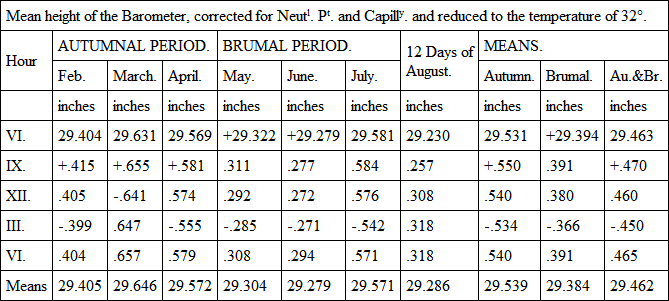
Table II.
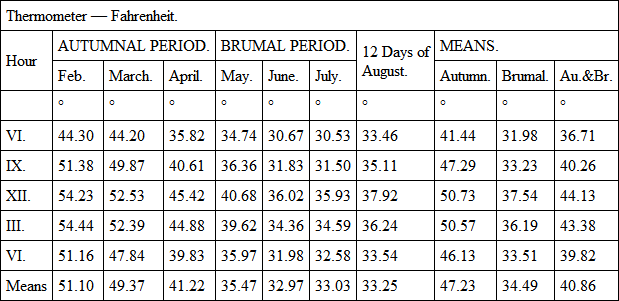
Table III.
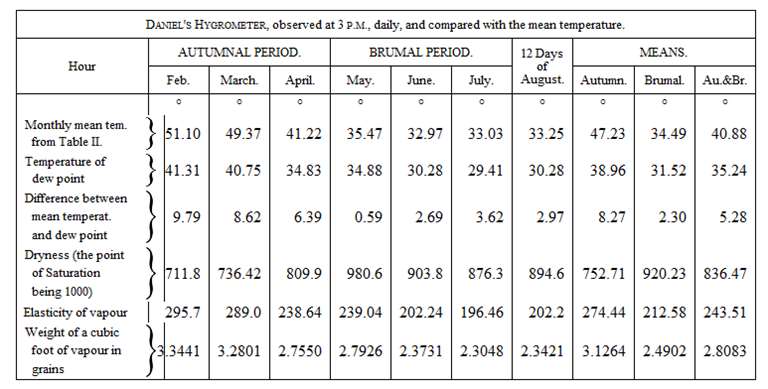
Table IV.
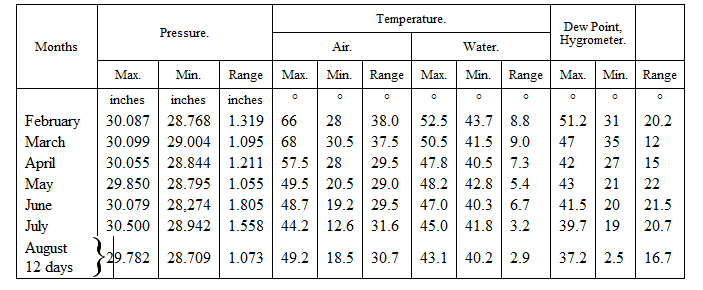
From the preceding tables it will be seen that the mean temperature for the autumnal period (the months of February, March, and April) was 47°.2; the maximum and minimum were respectively 68° and 28°. For the brumal period, the three following months, the mean temperature was 34°.5, and the maximum and minimum 49°.5 and 12°.6. During the former, or autumnal period, the barometer ranged between 30.099 and 28.768 inches, and for the latter it was between 30.5 and 28.274 inches. The range for the first being 1.331 inches, and for the last 2.226 inches.
EXTRACT
FROM THE
BEAGLE'S 'GAME' BOOK, 1830.
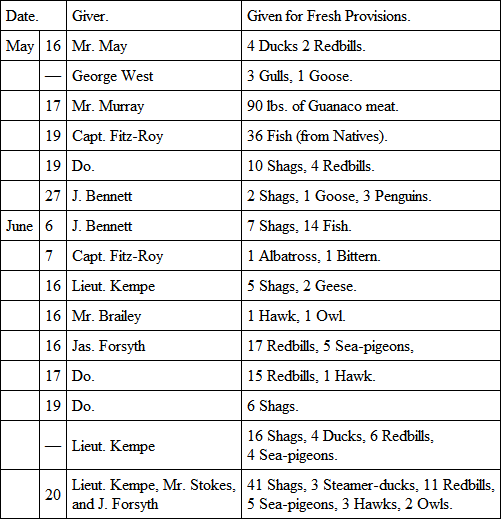
Note.– Otters, foxes, and seal, were tried more than once, but discarded. Very young seal, however, were liked, as well as young penguins.
EXTRACT
FROM THE
BEAGLE'S 'GAME' BOOK, 1830.
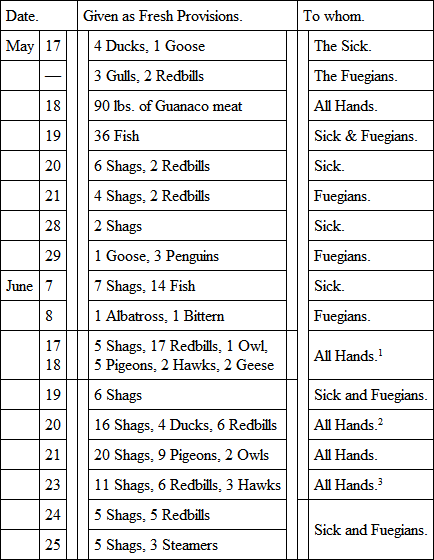
1Except gun-room, second and third messes.
2Except cabin, fourth and fifth messes.
3Except cabin, sixth and seventh messes.
END OF VOL. I
1
Excepting one for signals.
2
Twelve additional seamen having been ordered, by the Admiralty, for the Adelaide schooner.
3
On the north side of the river Plata.
4
Commonly called Magellan. See p. 11.
5
Dasyprocta patachonica: it is the Patagonian cavy of Dr. Shaw, and Pennant's Quadr., tab. 39, and the liévre pampa of D'Azara. M. Desmarest thinks that if the teeth were examined it would form a new genus, for which he proposes the name of Dolichotis (Ency. Meth. Mamm. p. 359). At present he has, from its external character, placed it amongst the genus Dasyprocta (agouti). The only one that was taken was not preserved, which prevented me from ascertaining the fact.
6
Dasypus minutus, Desm. Tatou pichiy, or tatou septième of D'Azara, &c. &c. It has seven bands.
7
A similar error was made by one of the ships of the fleet under Loyasa in the year 1525. The Nodales also, in their description of the coast, mention the similarity of appearance in the two capes, Virgins and Fairweather. "Y venido de mar en fuera à buscar la tierra facilmente podian hacer de Rio de Gallegos el Cabo de Virgenes," (and in making the land Cape Virgins may easily be mistaken for the river Gallegos). – Viage de los Nodales, p. 53.
8
Some of the specimens of the clay strata consist, according to Dr. Fitton, who has kindly examined my collection, of a white marl not unlike certain varieties of the lower chalk; and of a clay having many of the properties of fuller's earth. The pebbles on the beach consist of quartz, red jasper, hornstone, and flinty slate, but do not contain any stone resembling chalk flint.
9
Dr. Fitton considers these masses of clay to bear a resemblance to the upper green sand of England.
10
Ultimo Viage al Estrecho de Magallanes, part ii. p. 298.
11
A hill on the north shore of Possession Bay, having near it, to the westward, four rocky summits, which, from a particular point of view, bear a strong resemblance to the cropped ears of a horse or ass. These are described less briefly in the Sailing Directions.
12
Flowing into the strait from the east towards the west.
13
Fucus giganteus.
14
Usually called by seamen 'kelp.'
15
Columns of smoke rising from large fires.
16
Berberis.
17
Previous to the expedition quitting England, I had provided myself with medals, to give away to the Indians with whom we might communicate, bearing on one side the figure of Britannia, and on the reverse George IV. "Adventure and Beagle," and "1826."
18
Narborough, p. 67.
19
Ultimo Viage, p. 120.
20
From an attentive perusal of the voyage of Magalhaens, I have lately been led to think that this is the mountain which Magalhaens called Roldan's Bell. Sarmiento has, however, assigned that name to a mountain at the back of his Bay of Campana, which will be noticed in it's proper place. The name of Mount Sarmiento was too long, and too well established with us, or I should have restored the name bestowed upon it by Magalhaens. Herrera, in his Descripcion de las Indias Occidentales, cap. xxiii, notices the "Campana de Roldan" as a great mountain in the midst of the entrance of a channel; they gave it this name (Campana de Roldan) because one of Magalhaens's companions, named Roldan, an artillery officer, went to examine it. "Y la Campana de Roldan una Peña grande en medio al principio de un canal: dieron le este nombre porque la fué a reconocer uno de los compañeros de Magallanes llamado Roldan que era artillero."
21
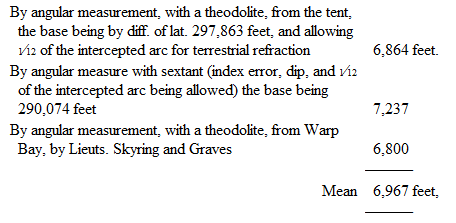
but as the last observation, from the angle of elevation being greater, was more likely to be correct, 6,800 feet is considered to be its elevation.
22
At a subsequent visit, embracing a period of 190 days, it was only seen on twenty-five, and during seven days only was it constantly visible. On the remaining eighteen, portions only were seen, and those but for a few hours at a time.
23
Sarmiento's Voyage, p. 25.
24
Id. l.c.
25
See Burney, ii. p. 45, for a fuller account; also id. 71.
26
Who made a remark on the occasion, which became proverbial, "that if a ship carried out only anchors and cables, sufficient for her security against the storms in that part of the world, she would go well laden." Burney Coll. vol. ii. 45.
27
Burney, ii. 51.
28
The situation of "Jesus" must have been about half-way between the First and Second Narrow, near the point named in the chart N.S. de Valle, where some peaked elevations, dividing vallies near the coast line, are conspicuous. The Beagle anchored there, and found plenty of fresh water.
29
Close to Port Famine.
30
From Sarmiento's description of the coast, Point Santa Brigida is the outward point of Nassau Island.(258) See Sarmiento's Voyage, p. 220.
31
Formerly spelled 'Candish.'
32
"Near to Port Famine they took on board a Spaniard, who was the only one then remaining alive of the garrison left in the Strait by Sarmiento. The account given by this man, as reported by Magoths, is, that he had lived in those parts six years, and was one of the four hundred men sent thither by the King of Spain in the year 1582, to fortify and inhabit there, to hinder the passage of all strangers that way into the South Sea. But that town (San Felipe) and the other Spanish colony being destroyed by famine, he said he had lived in a house, by himself, a long time, and relieved himself with his caliver(259) until our coming thither." Burney, ii. p. 96. This man died on the voyage to Europe. Id. p. 97.
33
So named by Bougainville.
34
It belongs to the group which M. Temminck has lately named Hylobates, without attending to the name long since conferred upon it by Dr. Fleming. I designated it Oidemia Patachonica, from its large dimensions, in my communication upon the Ornithology of the Straits. Zoological Journal, vol. iv. p. 100. On my return to England, I found that M. de Freycinet had figured this bird, in the account of his last voyage in l'Uranie, where it is described by Messrs. Quoy and Gaimard under the name of Micropterus brachypterus.
35
Cook's Second Voyage, 4to. p. 570.
36
On the shores of Eagle Bay we procured a large collection of shells, among which were Margarita violacea (Nob. in Zool. Journ. v. 346, No. 53), a beautiful Modiola (M. trapesina, Lam.k), a new Pecten (P. vitreus Nob. in Zool. Jour. v. 337, No. 17), and a delicate transparent-shelled Patella, answering the description of P. cymbularia. These four species were found attached to floating leaves of the kelp (Fucus giganteus), and afford food to the steamer-duck. We also collected good specimens of Murex Magellanicus, Lam.k, of Fissurella picta, Lam.k, and a great number of the common patella of the Strait, which forms a considerable article of food for the Natives.
37
Byron's Voyage round the World, 4to. p. 38.
38
l. c.
39
Psittacus smaragdinus, Gmel. I have no doubt that the bird we saw is the same as Bougainville procured, and from which a description has been given in the Ency. Méth., art. Ornith. 139; although a material error is made, for they are not splendidé viridis, nor is the uropygium red, in other points, however, the description is correct. See Buffon's Hist. Nat. des Oiseaux, vi. 262. Pl. enl. n. 85, Perruche des Terres Magellaniques.
40
Bougainville says, "we have likewise perceived some perrokeets: the latter are not afraid of the cold." To which the English translator, T. R. Forster, who is incredulous of the correctness of Bougainville's assertion, appends the following note: "Perruches, probably sea-parrots, or auks." Buffon also doubted the fact, and the author of Histoire Naturelle, art. Oiseaux, tom. ii. p. 322, suggests the possibility of a specimen having been obtained in some other part of the world, and put, by mistake, amongst those collected in the Strait.
41
So named because Mr. Tarn, the surgeon of the Adventure, was the first person who reached its summit.
42
The height of this place, as shown by the barometer, on the ascent, was 941 feet, and, on the descent, 973 feet.
43
On this table-land the barometer stood at 27,767. Temperature of the air 46°,5, and of the mercury 47°,5, which gave the elevation 1,327 feet.
44
The result of the barometric observation for the height of Mount Tarn is as follows:
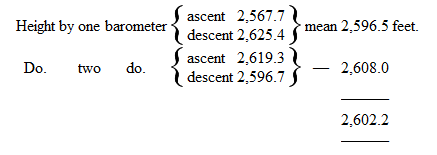
By angular measurement from Observation Cove, Port Famine, with theodolite, allowing 1⁄12 of the intercepted arc for terrestrial refraction, the height is 2,850 feet.
Another observation, with the sextant, made it 2,855 feet. The mean 2,852 I consider more correct, from the difficulty of obtaining a correct reading of the barometer on the summit.
45
By Daniell's hygrometer, used in this sheltered spot, I found the temperature of the air to be 48°; dew point 41°: but upon exposing the instrument to the wind, the air was 39½°, and the dew point 36°: the difference in the former being 7°; and the latter 3½°; from which the following results are obtained:
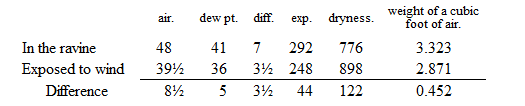
The above being the difference in the short space of three feet apart; the instrument, in the first case, being just under the lee of the rocky summit of the mountain, and in the last, above it, exposed to the wind.
46
The air was so dry this afternoon that I failed to procure a deposit of dew upon Daniell's hygrometer, although the internal temperature was lowered from 61° to 37°. One of Jones's portable hygrometers was also tried, and the temperature was lowered to 31°½ without a deposit; so that, the difference being more than thirty degrees, the expansive force of the air must have been less than 212, the dryness, on the thermometric scale, less than 367, and the weight of vapour, in a cubic foot of air, less than 2,355 grains.
47
Fires made to attract attention, and invite strangers to land.
48
This fern we found at the island of Juan Fernandez also.
49
After the lieutenant of the Adventure.
50
At Mr. Tarn's request.
51
King's 'Australia,' vol. i. p. 70; also vol. ii. pp. 573, 582, and 613.
52
At high tide the sea-water undermines, by thawing, large masses of ice, which, when the tide falls, want support, and, consequently, break off, bringing after them huge fragments of the glacier, and falling into the still basin with a noise like thunder.
53
"En los dias 24, y 25, oimos un ruido sordo, y de corta duracion, que, por el pronto, nos pareció trueno; pero habiendo reflexîonado, nos inclinamos à creer que fué efecto de alguna explosion subterranea, formado en el seno de alguna de las montañas inmediatas, en que parece haber algunos minerales, y aun volcanes, que están del todo ó casi apagados, movièndonos a hacer este juicio, el haberse encontrado, en la cima de una de ellas, porcion de materia compuesta de tierra y metal, que en su peso, color, y demas caracteres, tenia impreso el sello del fuego activo en que habia tomado aquel estado, pues era una perfecta imagèn de las escorias del hierro que se ven en nuestras ferrerías. —Apendice al Viage de Cordova al Magallanes, p. 65.
54
No canvas could withstand some of these squalls, which carry spray, leaves, and dirt before them, in a dense cloud, reaching from the water to the height of a ship's lower yards, or even lower mast-heads. Happily their duration is so short, that the cable of a vessel, at anchor, is scarcely strained to the utmost, before the furious blast is over. Persons who have been some time in Tierra del Fuego, but fortunate enough not to have experienced the extreme violence of such squalls, may incline to think their force exaggerated in this description: but it ought to be considered, that their utmost fury is only felt during unusually heavy gales, and in particular situations; so that a ship might pass through the Strait of Magalhaens many times, without encountering one such blast as has occasionally been witnessed there. – R. F.
55
"sub rupe cavatâ
Arboribus clausam circum atque horrentibus umbria."
56
Mount Boqueron.
57
Including the master, there were on board, when cast away, twenty-two persons.
58
Bougainville Harbour, better known to Sealers by the name of 'Jack's Harbour.'
59
While the 'current' runs eastward for many days in mid-channel, or along one shore, it often happens that the 'stream of tide' either sets in a contrary direction, along each side of the Strait, or that it follows only the shore opposite to that washed by the 'current.' – R. F.
60
"Voyage autour du Monde." 1767.
61
One of the feathered tribe, which a naturalist would not expect to find here, a 'humming bird,' was shot near the beach by a young midshipman. – Stokes MS.
62
Hawkesworth's Coll. of Voyages, vol. i. p. 76.
63
It was here that Commodore Wallis and Captain Carteret separated, the Dolphin going round the world; the Swallow returning to England. Sarmiento's name of Puerto de la Misericordia, or 'Harbour of Mercy,' being of prior date, ought doubtless to be retained.
64
Called the Scilly Isles.
65
'Anas Rafflesii,' Zool. Journ., vol. iv., and Tab. Supp., xxix.
66
Of these a species of mactra (M. edulis Nob.) was most abundant.
67
Burney, i. 35 and 37.
68
Falkner's Patagonia, pp. 110, 111.
69
It is good to be drunk, it is pleasant to be drunk.
70
Two Portuguese seamen, however, who had resided some months with them, having been left behind by a sealing vessel, and taken off by us at a subsequent period of the voyage at their own request, informed us that Maria is not the leader of religious ceremonies. Each family possesses its own household god, a small wooden image, about three inches in length, the rough imitation of a man's head and shoulders, which they consider as the representative of a superior being, attributing to it all the good or evil that happens to them.
71
Burney, i. p. 33.
72
Ibid. p. 135.
73
Burney, i. 318.
74
Ibid, i. 324.
75
Sarmiento, p. 244.
76
Sarmiento's Appendix, xxix.
77
Purchas, iv. ch. 6 and 7.
78
Burney, ii. p. 106.
79
The tribes described by this boy are the

80
Burney, ii, 215.
81
Ibid. ii. 334.
82
Hawksworth's Coll. i 28.
83
Ibid.
84
See a letter from Mr. Charles Clarke, an officer on board the Dolphin, to Mr. Maly, M.D., secretary of the Royal Society, dated Nov. 3, 1766, read before the Royal Society on 12th April 1767, and published in the fifty-seventh volume of the Phil. Trans., part i. p. 75, in which an exaggerated account is given of this meeting. The men are described to be eight feet high, and the women seven and a half to eight feet. "They are prodigious stout, and as well and proportionably made as ever I saw people in my life." This communication was probably intended to corroborate the commodore's account.
85
Ultimo Viage, p. 21.
86
Falkner, according to Dean Funes, was originally engaged in the slave trade at Buenos Ayres; but afterwards became a Jesuit, and studied in the college at Cordova, where, to an eminent knowledge of medicine, he added that of theology. He is the author of a description of Patagonia, published in London after the expulsion of the Jesuits. – (Ensayo de la Historia Civil del Paraguay, Buenos Ayres, y Tucuman, por el Doctor Don Gregorio Funes, iii. p. 23, note. Published at Buenos Ayres. 8vo. 1817.)
87
See Dean Funes's account of Buenos Ayres, and of the Indian tribes, vol. ii. 394.
88
We left Gregory Bay in the morning, and passed Cape Virgins in the evening of the same day.
89
On our passage from Santos to St. Catherine's, in latitude 28° south, we caught a 'dolphin' (Coryphena), the maw of which I found filled with shells, of Argonauta tuberculosa, and all containing the 'Octopus Ocythöe' that has been always found as its inhabitant. Most of the specimens were crushed by the narrow passage into the stomach, but the smaller ones were quite perfect, and had been so recently swallowed that I was enabled to preserve several of various sizes containing the animal. To some of them was attached a nidus of eggs, which was deposited between the animal and the spire. The shells varied in size from two-thirds of an inch to two and a half inches in length; each contained an octopus, the bulk and shape of which was so completely adapted to that of the shell, that it seemed as if the shell increased with the animal's growth. When so many learned naturalists have differed so materially as to the character of the inhabitants of the argonauta, it would be presumption in me to express even an opinion; I therefore merely mention the fact, and state that in no one specimen did there appear to be any connexion between the animal and the shell.
90
Nodales, p. 48.
91
Falkner says, in his account of the burial ceremonies of the southern Patagonians – that, after a certain interval, the bodies are taken out of the tomb, and skeletons are made of them by the women – the flesh and entrails having been burnt. It is possible that in this case the body had been so treated, and that the fire near it was for the purpose of burning the flesh, and perhaps with it all the flags and ornaments of the tomb.
92
He was a great favourite with them.
93
The medicinal property of this intestinal concretion is well known wherever the animal is found. Marcgrave, in his "Tractatus topographicus et meteorologicus Brasiliæ," folio, p. 36, says: – "Hæc animalia (guanacoes) generant lapides Bezoares in sinu quodam ventriculi, qui maximi æstimantur contra venena et febres malignos ad roborandum et refocillandum cor, aliosque affectus. Materia è qua generantur sunt herbæ insignis virtutis, quibus vescuntur naturæ instinctu ad sanitatem tuendum, aut morbos et venena superandum. Hi lapides inveniuntur in adultioribus hisce animalibus atque interdum tam grandes, ut unum in Italiam attulerim qui pendet uncias duas supra triginta." – Mr. Thompson, on Intestinal Concretions. See his Syn. of Chemistry, iv. 576.
94
Anser nigrocollis. Encyc. Méthod., art. Ornithol. 108.
95
Weddell's Voyage.
96
I cannot avoid noticing here the considerate conduct of the Commander-in-chief (Sir George Eyre) with respect to this appointment. By the tenor of my instructions the Adventure and Beagle were placed under the Admiral's orders; and the vacancy, had he wished to exercise his prerogative, might have been filled by one of his own followers. It was, however, given, at my request, to Mr. Sholl, as being more conversant with the duties of this peculiar service than any of the midshipmen of the flag-ship. The Admiral's conduct, on this occasion, calls for my warmest thanks.
97
Relacion del Viage, &c. que hicieron los Capitanes B. G. de Nodales y Gonzalo de Nodales, p. 59.