Полная версия
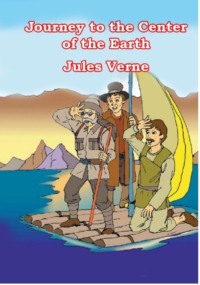
A Journey to the Centre of the Earth
"Follow my finger along the west coast of Iceland. Do you see Rejkiavik, the capital? You do. Well; ascend the innumerable fiords that indent those sea-beaten shores, and stop at the sixty-fifth degree of latitude. What do you see there?"
"I see a peninsula looking like a thigh bone with the knee bone at the end of it."
"A very fair comparison, my lad. Now do you see anything upon that knee bone?"
"Yes; a mountain rising out of the sea."
"Right. That is Snæfell."
"That Snæfell?"
"It is. It is a mountain five thousand feet high, one of the most remarkable in the world, if its crater leads down to the centre of the earth."
"But that is impossible," I said shrugging my shoulders, and disgusted at such a ridiculous supposition.
"Impossible?" said the Professor severely; "and why, pray?"
"Because this crater is evidently filled with lava and burning rocks, and therefore—"
"But suppose it is an extinct volcano?"
"Extinct?"
"Yes; the number of active volcanoes on the surface of the globe is at the present time only about three hundred. But there is a very much larger number of extinct ones. Now, Snæfell is one of these. Since historic times there has been but one eruption of this mountain, that of 1219; from that time it has quieted down more and more, and now it is no longer reckoned among active volcanoes."
To such positive statements I could make no reply. I therefore took refuge in other dark passages of the document.
"What is the meaning of this word Scartaris, and what have the kalends of July to do with it?"
My uncle took a few minutes to consider. For one short moment I felt a ray of hope, speedily to be extinguished. For he soon answered thus:
"What is darkness to you is light to me. This proves the ingenious care with which Saknussemm guarded and defined his discovery. Sneffels, or Snæfell, has several craters. It was therefore necessary to point out which of these leads to the centre of the globe. What did the Icelandic sage do? He observed that at the approach of the kalends of July, that is to say in the last days of June, one of the peaks, called Scartaris, flung its shadow down the mouth of that particular crater, and he committed that fact to his document. Could there possibly have been a more exact guide? As soon as we have arrived at the summit of Snæfell we shall have no hesitation as to the proper road to take."
Decidedly, my uncle had answered every one of my objections. I saw that his position on the old parchment was impregnable. I therefore ceased to press him upon that part of the subject, and as above all things he must be convinced, I passed on to scientific objections, which in my opinion were far more serious.
"Well, then," I said, "I am forced to admit that Saknussemm's sentence is clear, and leaves no room for doubt. I will even allow that the document bears every mark and evidence of authenticity. That learned philosopher did get to the bottom of Sneffels, he has seen the shadow of Scartaris touch the edge of the crater before the kalends of July; he may even have heard the legendary stories told in his day about that crater reaching to the centre of the world; but as for reaching it himself, as for performing the journey, and returning, if he ever went, I say no—he never, never did that."
"Now for your reason?" said my uncle ironically.
"All the theories of science demonstrate such a feat to be impracticable."
"The theories say that, do they?" replied the Professor in the tone of a meek disciple. "Oh! unpleasant theories! How the theories will hinder us, won't they?"
I saw that he was only laughing at me; but I went on all the same.
"Yes; it is perfectly well known that the internal temperature rises one degree for every 70 feet in depth; now, admitting this proportion to be constant, and the radius of the earth being fifteen hundred leagues, there must be a temperature of 360,032 degrees at the centre of the earth. Therefore, all the substances that compose the body of this earth must exist there in a state of incandescent gas; for the metals that most resist the action of heat, gold, and platinum, and the hardest rocks, can never be either solid or liquid under such a temperature. I have therefore good reason for asking if it is possible to penetrate through such a medium."
"So, Axel, it is the heat that troubles you?"
"Of course it is. Were we to reach a depth of thirty miles we should have arrived at the limit of the terrestrial crust, for there the temperature will be more than 2372 degrees."
"Are you afraid of being put into a state of fusion?"
"I will leave you to decide that question," I answered rather sullenly. "This is my decision," replied Professor Liedenbrock, putting on one of his grandest airs. "Neither you nor anybody else knows with any certainty what is going on in the interior of this globe, since not the twelve thousandth part of its radius is known; science is eminently perfectible; and every new theory is soon routed by a newer. Was it not always believed until Fourier that the temperature of the interplanetary spaces decreased perpetually? and is it not known at the present time that the greatest cold of the ethereal regions is never lower than 40 degrees below zero Fahr.? Why should it not be the same with the internal heat? Why should it not, at a certain depth, attain an impassable limit, instead of rising to such a point as to fuse the most infusible metals?"
As my uncle was now taking his stand upon hypotheses, of course, there was nothing to be said.
"Well, I will tell you that true savants, amongst them Poisson, have demonstrated that if a heat of 360,000 degrees[4] existed in the interior of the globe, the fiery gases arising from the fused matter would acquire an elastic force which the crust of the earth would be unable to resist, and that it would explode like the plates of a bursting boiler."
"That is Poisson's opinion, my uncle, nothing more."
"Granted. But it is likewise the creed adopted by other distinguished geologists, that the interior of the globe is neither gas nor water, nor any of the heaviest minerals known, for in none of these cases would the earth weigh what it does."
"Oh, with figures you may prove anything!"
"But is it the same with facts! Is it not known that the number of volcanoes has diminished since the first days of creation? and if there is central heat may we not thence conclude that it is in process of diminution?"
"My good uncle, if you will enter into the legion of speculation, I can discuss the matter no longer."
"But I have to tell you that the highest names have come to the support of my views. Do you remember a visit paid to me by the celebrated chemist, Humphry Davy, in 1825?"
"Not at all, for I was not born until nineteen years afterwards."
"Well, Humphry Davy did call upon me on his way through Hamburg. We were long engaged in discussing, amongst other problems, the hypothesis of the liquid structure of the terrestrial nucleus. We were agreed that it could not be in a liquid state, for a reason which science has never been able to confute."
"What is that reason?" I said, rather astonished.
"Because this liquid mass would be subject, like the ocean, to the lunar attraction, and therefore twice every day there would be internal tides, which, upheaving the terrestrial crust, would cause periodical earthquakes!"
"Yet it is evident that the surface of the globe has been subject to the action of fire," I replied, "and it is quite reasonable to suppose that the external crust cooled down first, whilst the heat took refuge down to the centre."
"Quite a mistake," my uncle answered. "The earth has been heated by combustion on its surface, that is all. Its surface was composed of a great number of metals, such as potassium and sodium, which have the peculiar property of igniting at the mere contact with air and water; these metals kindled when the atmospheric vapours fell in rain upon the soil; and by and by, when the waters penetrated into the fissures of the crust of the earth, they broke out into fresh combustion with explosions and eruptions. Such was the cause of the numerous volcanoes at the origin of the earth."
"Upon my word, this is a very clever hypothesis," I exclaimed, in spite rather of myself.
"And which Humphry Davy demonstrated to me by a simple experiment. He formed a small ball of the metals which I have named, and which was a very fair representation of our globe; whenever he caused a fine dew of rain to fall upon its surface, it heaved up into little monticules, it became oxydized and formed miniature mountains; a crater broke open at one of its summits; the eruption took place, and communicated to the whole of the ball such a heat that it could not be held in the hand."
In truth, I was beginning to be shaken by the Professor's arguments, besides which he gave additional weight to them by his usual ardour and fervent enthusiasm.
"You see, Axel," he added, "the condition of the terrestrial nucleus has given rise to various hypotheses among geologists; there is no proof at all for this internal heat; my opinion is that there is no such thing, it cannot be; besides we shall see for ourselves, and, like Arne Saknussemm, we shall know exactly what to hold as truth concerning this grand question."
"Very well, we shall see," I replied, feeling myself carried off by his contagious enthusiasm. "Yes, we shall see; that is, if it is possible to see anything there."
"And why not? May we not depend upon electric phenomena to give us light? May we not even expect light from the atmosphere, the pressure of which may render it luminous as we approach the centre?"
"Yes, yes," said I; "that is possible, too."
"It is certain," exclaimed my uncle in a tone of triumph. "But silence, do you hear me? silence upon the whole subject; and let no one get before us in this design of discovering the centre of the earth."
Chapter VII.
A woman's courage
Thus ended this memorable seance. That conversation threw me into a fever. I came out of my uncle's study as if I had been stunned, and as if there was not air enough in all the streets of Hamburg to put me right again. I therefore made for the banks of the Elbe, where the steamer lands her passengers, which forms the communication between the city and the Hamburg railway.
Was I convinced of the truth of what I had heard? Had I not bent under the iron rule of the Professor Liedenbrock? Was I to believe him in earnest in his intention to penetrate to the centre of this massive globe? Had I been listening to the mad speculations of a lunatic, or to the scientific conclusions of a lofty genius? Where did truth stop? Where did error begin?
I was all adrift amongst a thousand contradictory hypotheses, but I could not lay hold of one.
Yet I remembered that I had been convinced, although now my enthusiasm was beginning to cool down; but I felt a desire to start at once, and not to lose time and courage by calm reflection. I had at that moment quite courage enough to strap my knapsack to my shoulders and start.
But I must confess that in another hour this unnatural excitement abated, my nerves became unstrung, and from the depths of the abysses of this earth I ascended to its surface again.
"It is quite absurd!" I cried, "there is no sense about it. No sensible young man should for a moment entertain such a proposal. The whole thing is non-existent. I have had a bad night, I have been dreaming of horrors."
But I had followed the banks of the Elbe and passed the town. After passing the port too, I had reached the Altona road. I was led by a presentiment, soon to be realised; for shortly I espied my little Gräuben bravely returning with her light step to Hamburg.
"Gräuben!" I cried from afar off.
The young girl stopped, rather frightened perhaps to hear her name called after her on the high road. Ten yards more, and I had joined her.
"Axel!" she cried surprised. "What! have you come to meet me? Is this why you are here, sir?"
But when she had looked upon me, Gräuben could not fail to see the uneasiness and distress of my mind.
"What is the matter?" she said, holding out her hand.
"What is the matter, Gräuben?" I cried.
In a couple of minutes my pretty Virlandaise was fully informed of the position of affairs. For a time she was silent. Did her heart palpitate as mine did? I don't know about that, but I know that her hand did not tremble in mine. We went on a hundred yards without speaking.
At last she said, "Axel!"
"My dear Gräuben."
"That will be a splendid journey!"
I gave a bound at these words.
"Yes, Axel, a journey worthy of the nephew of a savant; it is a good thing for a man to be distinguished by some great enterprise."
"What, Gräuben, won't you dissuade me from such an undertaking?"
"No, my dear Axel, and I would willingly go with you, but that a poor girl would only be in your way."
"Is that quite true?"
"It is true."
Ah! women and young girls, how incomprehensible are your feminine hearts! When you are not the timidest, you are the bravest of creatures. Reason has nothing to do with your actions. What! did this child encourage me in such an expedition! Would she not be afraid to join it herself? And she was driving me to it, one whom she loved!
I was disconcerted, and, if I must tell the whole truth, I was ashamed.
"Gräuben, we will see whether you will say the same thing to-morrow."
"To-morrow, dear Axel, I will say what I say to-day."
Gräuben and I, hand in hand, but in silence, pursued our way. The emotions of that day were breaking my heart.
After all, I thought, the kalends of July are a long way off, and between this and then many things may take place which will cure my uncle of his desire to travel underground.
It was night when we arrived at the house in Königstrasse. I expected to find all quiet there, my uncle in bed as was his custom, and Martha giving her last touches with the feather brush.
But I had not taken into account the Professor's impatience. I found him shouting—and working himself up amidst a crowd of porters and messengers who were all depositing various loads in the passage. Our old servant was at her wits' end.
"Come, Axel, come, you miserable wretch," my uncle cried from as far off as he could see me. "Your boxes are not packed, and my papers are not arranged; where's the key of my carpet bag? and what have you done with my gaiters?"
I stood thunderstruck. My voice failed. Scarcely could my lips utter the words:
"Are we really going?"
"Of course, you unhappy boy! Could I have dreamed that you would have gone out for a walk instead of hurrying your preparations forward?"
"Are we to go?" I asked again, with sinking hopes.
"Yes; the day after to-morrow, early."
I could hear no more. I fled for refuge into my own little room.
All hope was now at an end. My uncle had been all the morning making purchases of a part of the tools and apparatus required for this desperate undertaking. The passage was encumbered with rope ladders, knotted cords, torches, flasks, grappling irons, alpenstocks, pickaxes, iron shod sticks, enough to load ten men.
I spent an awful night. Next morning I was called early. I had quite decided I would not open the door. But how was I to resist the sweet voice which was always music to my ears, saying, "My dear Axel?"
I came out of my room. I thought my pale countenance and my red and sleepless eyes would work upon Gräuben's sympathies and change her mind.
"Ah! my dear Axel," she said. "I see you are better. A night's rest has done you good."
"Done me good!" I exclaimed.
I rushed to the glass. Well, in fact I did look better than I had expected. I could hardly believe my own eyes.
"Axel," she said, "I have had a long talk with my guardian. He is a bold philosopher, a man of immense courage, and you must remember that his blood flows in your veins. He has confided to me his plans, his hopes, and why and how he hopes to attain his object. He will no doubt succeed. My dear Axel, it is a grand thing to devote yourself to science! What honour will fall upon Herr Liedenbrock, and so be reflected upon his companion! When you return, Axel, you will be a man, his equal, free to speak and to act independently, and free to —"
The dear girl only finished this sentence by blushing. Her words revived me. Yet I refused to believe we should start. I drew Gräuben into the Professor's study.
"Uncle, is it true that we are to go?"
"Why do you doubt?"
"Well, I don't doubt," I said, not to vex him; "but, I ask, what need is there to hurry?"
"Time, time, flying with irreparable rapidity."
"But it is only the 16th May, and until the end of June—"
"What, you monument of ignorance! do you think you can get to Iceland in a couple of days? If you had not deserted me like a fool I should have taken you to the Copenhagen office, to Liffender & Co., and you would have learned then that there is only one trip every month from Copenhagen to Rejkiavik, on the 22nd."
"Well?"
"Well, if we waited for the 22nd June we should be too late to see the shadow of Scartaris touch the crater of Sneffels. Therefore we must get to Copenhagen as fast as we can to secure our passage. Go and pack up."
There was no reply to this. I went up to my room. Gräuben followed me. She undertook to pack up all things necessary for my voyage. She was no more moved than if I had been starting for a little trip to Lübeck or Heligoland. Her little hands moved without haste. She talked quietly. She supplied me with sensible reasons for our expedition. She delighted me, and yet I was angry with her. Now and then I felt I ought to break out into a passion, but she took no notice and went on her way as methodically as ever.
Finally the last strap was buckled; I came downstairs. All that day the philosophical instrument makers and the electricians kept coming and going. Martha was distracted.
"Is master mad?" she asked.
I nodded my head.
"And is he going to take you with him?"
I nodded again.
"Where to?"
I pointed with my finger downward.
"Down into the cellar?" cried the old servant.
"No," I said. "Lower down than that."
Night came. But I knew nothing about the lapse of time.
"To-morrow morning at six precisely," my uncle decreed "we start."
At ten o'clock I fell upon my bed, a dead lump of inert matter. All through the night terror had hold of me. I spent it dreaming of abysses. I was a prey to delirium. I felt myself grasped by the Professor's sinewy hand, dragged along, hurled down, shattered into little bits. I dropped down unfathomable precipices with the accelerating velocity of bodies falling through space. My life had become an endless fall. I awoke at five with shattered nerves, trembling and weary. I came downstairs. My uncle was at table, devouring his breakfast. I stared at him with horror and disgust. But dear Gräuben was there; so I said nothing, and could eat nothing.
At half-past five there was a rattle of wheels outside. A large carriage was there to take us to the Altona railway station. It was soon piled up with my uncle's multifarious preparations.
"Where's your box?" he cried.
"It is ready," I replied, with faltering voice.
"Then make haste down, or we shall lose the train."
It was now manifestly impossible to maintain the struggle against destiny. I went up again to my room, and rolling my portmanteaus downstairs I darted after him.
At that moment my uncle was solemnly investing Gräuben with the reins of government. My pretty Virlandaise was as calm and collected as was her wont. She kissed her guardian; but could not restrain a tear in touching my cheek with her gentle lips.
"Gräuben!" I murmured.
"Go, my dear Axel, go! I am now your betrothed; and when you come back I will be your wife."
I pressed her in my arms and took my place in the carriage. Martha and the young girl, standing at the door, waved their last farewell. Then the horses, roused by the driver's whistling, darted off at a gallop on the road to Altona.
Chapter VIII.
Serious preparations for vertical descent
Altona, which is but a suburb of Hamburg, is the terminus of the Kiel railway, which was to carry us to the Belts. In twenty minutes we were in Holstein.
At half-past six the carriage stopped at the station; my uncle's numerous packages, his voluminous impedimenta, were unloaded, removed, labelled, weighed, put into the luggage vans, and at seven we were seated face to face in our compartment. The whistle sounded, the engine started, we were off.
Was I resigned? No, not yet. Yet the cool morning air and the scenes on the road, rapidly changed by the swiftness of the train, drew me away somewhat from my sad reflections.
As for the Professor's reflections, they went far in advance of the swiftest express. We were alone in the carriage, but we sat in silence. My uncle examined all his pockets and his travelling bag with the minutest care. I saw that he had not forgotten the smallest matter of detail.
Amongst other documents, a sheet of paper, carefully folded, bore the heading of the Danish consulate with the signature of W. Christiensen, consul at Hamburg and the Professor's friend. With this we possessed the proper introductions to the Governor of Iceland.
I also observed the famous document most carefully laid up in a secret pocket in his portfolio. I bestowed a malediction upon it, and then proceeded to examine the country.
It was a very long succession of uninteresting loamy and fertile flats, a very easy country for the construction of railways, and propitious for the laying-down of these direct level lines so dear to railway companies.
I had no time to get tired of the monotony; for in three hours we stopped at Kiel, close to the sea.
The luggage being labelled for Copenhagen, we had no occasion to look after it. Yet the Professor watched every article with jealous vigilance, until all were safe on board. There they disappeared in the hold.
My uncle, notwithstanding his hurry, had so well calculated the relations between the train and the steamer that we had a whole day to spare. The steamer Ellenora, did not start until night. Thence sprang a feverish state of excitement in which the impatient irascible traveller devoted to perdition the railway directors and the steamboat companies and the governments which allowed such intolerable slowness. I was obliged to act chorus to him when he attacked the captain of the Ellenora upon this subject. The captain disposed of us summarily.
At Kiel, as elsewhere, we must do something to while away the time. What with walking on the verdant shores of the bay within which nestles the little town, exploring the thick woods which make it look like a nest embowered amongst thick foliage, admiring the villas, each provided with a little bathing house, and moving about and grumbling, at last ten o'clock came.
The heavy coils of smoke from the Ellenora's funnel unrolled in the sky, the bridge shook with the quivering of the struggling steam; we were on board, and owners for the time of two berths, one over the other, in the only saloon cabin on board.
At a quarter past the moorings were loosed and the throbbing steamer pursued her way over the dark waters of the Great Belt.
The night was dark; there was a sharp breeze and a rough sea, a few lights appeared on shore through the thick darkness; later on, I cannot tell when, a dazzling light from some lighthouse threw a bright stream of fire along the waves; and this is all I can remember of this first portion of our sail.
At seven in the morning we landed at Korsor, a small town on the west coast of Zealand. There we were transferred from the boat to another line of railway, which took us by just as flat a country as the plain of Holstein.
Three hours' travelling brought us to the capital of Denmark. My uncle had not shut his eyes all night. In his impatience I believe he was trying to accelerate the train with his feet.
At last he discerned a stretch of sea.
"The Sound!" he cried.
At our left was a huge building that looked like a hospital.
"That's a lunatic asylum," said one of or travelling companions.