


Полная версия
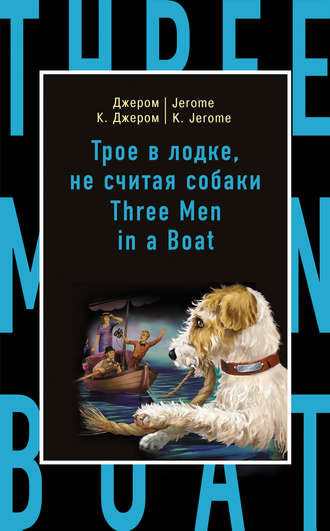
Трое в лодке, не считая собаки / Three Men in a Boat (to Say Nothing of the Dog)


“I know what it is, old man; you’ve got a chill. Now, you come along with me. I know a place round the corner here, where you can get a drop of the finest Scotch whisky you ever tasted – put you right in less than no time.”
Harris always does know a place round the corner where you can get something brilliant in the drinking line. I believe that if you met Harris up in Paradise (supposing such a thing likely), he would immediately greet you with:
“So glad you’ve come, old fellow; I’ve found a nice place round the corner here, where you can get some really first-class nectar.”
In the present instance, however, as regarded the camping out, his practical view of the matter came as a very timely hint. Camping out in rainy weather is not pleasant.
It is evening. You are wet through, and there is a good two inches of water in the boat, and all the things are damp. You find a place on the banks that is not quite so puddly as other places you have seen, and you land and lug out the tent, and two of you proceed to fix it.
It is soaked and heavy, and it flops about, and tumbles down on you, and clings round your head and makes you mad. The rain is pouring steadily down all the time. It is difficult enough to fix a tent in dry weather: in wet, the task becomes herculean. Instead of helping you, it seems to you that the other man is simply playing the fool. Just as you get your side beautifully fixed, he gives it a hoist from his end, and spoils it all.
“Here! what are you up to?” you call out.
“What are YOU up to?” he retorts; “leggo, can’t you?”
“Don’t pull it; you’ve got it all wrong, you stupid ass!” you shout.
“No, I haven’t,” he yells back; “let go your side!”
“I tell you you’ve got it all wrong!” you roar, wishing that you could get at him; and you give your ropes a lug that pulls all his pegs out.
“Ah, the bally idiot!” you hear him mutter to himself; and then comes a savage haul, and away goes your side. You lay down the mallet and start to go round and tell him what you think about the whole business, and, at the same time, he starts round in the same direction to come and explain his views to you. And you follow each other round and round, swearing at one another, until the tent tumbles down in a heap, and leaves you looking at each other across its ruins, when you both indignantly exclaim, in the same breath:
“There you are! what did I tell you?”
Meanwhile the third man, who has been baling out the boat, and who has spilled the water down his sleeve, and has been cursing away to himself steadily for the last ten minutes, wants to know what the thundering blazes you’re playing at, and why the blarmed tent isn’t up yet.
At last, somehow or other, it does get up, and you land the things. It is hopeless attempting to make a wood fire, so you light the methylated spirit stove, and crowd round that.
Rainwater is the chief article of diet at supper. The bread is two-thirds rainwater, the beefsteak-pie is exceedingly rich in it, and the jam, and the butter, and the salt, and the coffee have all combined with it to make soup.
After supper, you find your tobacco is damp, and you cannot smoke. Luckily you have a bottle of the stuff that cheers and inebriates, if taken in proper quantity, and this restores to you sufficient interest in life to induce you to go to bed.
There you dream that an elephant has suddenly sat down on your chest, and that the volcano has exploded and thrown you down to the bottom of the sea – the elephant still sleeping peacefully on your bosom. You wake up and grasp the idea that something terrible really has happened. Your first impression is that the end of the world has come; and then you think that this cannot be, and that it is thieves and murderers, or else fire, and this opinion you express in the usual method. No help comes, however, and all you know is that thousands of people are kicking you, and you are being smothered.
Somebody else seems in trouble, too. You can hear his faint cries coming from underneath your bed. Determining, at all events, to sell your life dearly, you struggle frantically, hitting out right and left with arms and legs, and yelling lustily the while, and at last something gives way, and you find your head in the fresh air. Two feet off, you dimly observe a half-dressed ruffian, waiting to kill you, and you are preparing for a life-and-death struggle with him, when it begins to dawn upon you that it’s Jim.
“Oh, it’s you, is it?” he says, recognising you at the same moment.
“Yes,” you answer, rubbing your eyes; “what’s happened?”
“Bally tent’s blown down, I think,” he says.
“Where’s Bill?”
Then you both raise up your voices and shout for “Bill!” and the ground beneath you heaves and rocks, and the muffled voice that you heard before replies from out the ruin:
“Get off my head, can’t you?”
And Bill struggles out, a muddy, trampled wreck, and in an unnecessarily aggressive mood – he being under the evident belief that the whole thing has been done on purpose.
In the morning you are all three speechless, owing to having caught severe colds in the night; you also feel very quarrelsome, and you swear at each other in hoarse whispers during the whole of breakfast time.
We therefore decided that we would sleep out on fine nights; and hotel it, and inn it, and pub. it, like respectable folks, when it was wet, or when we felt inclined for a change.
Montmorency hailed this compromise with much approval. He does not revel in romantic solitude. Give him something noisy; and if a trifle low, so much the jollier. To look at Montmorency you would imagine that he was an angel sent upon the earth, for some reason withheld from mankind, in the shape of a small fox-terrier. There is a sort of Oh-what-a-wicked-world-this-is-and-how-I-wish-I-could-do-
something-to-make-it-better-and-nobler expression about Montmorency that has been known to bring the tears into the eyes of pious old ladies and gentlemen.
When first he came to live at my expense, I never thought I should be able to get him to stop long. I used to sit down and look at him, as he sat on the rug and looked up at me, and think: “Oh, that dog will never live. He will be snatched up to the bright skies in a chariot, that is what will happen to him.”
But, when I had paid for about a dozen chickens that he had killed; and had dragged him, growling and kicking, by the scruff of his neck, out of a hundred and fourteen street fights; and had had a dead cat brought round for my inspection by an irate female, who called me a murderer; and had been summoned by the man next door but one for having a ferocious dog at large, that had kept him pinned up in his own tool-shed, afraid to venture his nose outside the door for over two hours on a cold night; and had learned that the gardener, unknown to myself, had won thirty shillings by backing him to kill rats against time, then I began to think that maybe they’d let him remain on earth for a bit longer, after all.
To hang about a stable, and collect a gang of the most disreputable dogs to be found in the town, and lead them out to march round the slums to fight other disreputable dogs, is Montmorency’s idea of “life;” and so, as I before observed, he gave to the suggestion of inns, and pubs., and hotels his most emphatic approbation.
Having thus settled the sleeping arrangements to the satisfaction of all four of us, the only thing left to discuss was what we should take with us; and this we had begun to argue, when Harris said he’d had enough oratory for one night, and proposed that we should go out and have a smile, saying that he had found a place, round by the square, where you could really get a drop of Irish worth drinking.
George said he felt thirsty (I never knew George when he didn’t); and, as I had a presentiment that a little whisky, warm, with a slice of lemon, would do my complaint good, the debate was, by common assent, adjourned to the following night; and the assembly put on its hats and went out.
Chapter III
Arrangements settled. – Harris’s method of doing work. – How the elderly, family-man puts up a picture. – George makes a sensible, remark. – Delights of early morning bathing. – Provisions for getting upset.
So, on the following evening, we again assembled, to discuss and arrange our plans. Harris said:
“Now, the first thing to settle is what to take with us. Now, you get a bit of paper and write down, J., and you get the grocery catalogue, George, and somebody give me a bit of pencil, and then I’ll make out a list.”
That’s Harris all over – so ready to take the burden of everything himself, and put it on the backs of other people.
He always reminds me of my poor Uncle Podger. You never saw such a commotion up and down a house, in all your life, as when my Uncle Podger undertook to do a job. A picture would have come home from the frame- maker’s, and be standing in the dining-room, waiting to be put up; and Aunt Podger would ask what was to be done with it, and Uncle Podger would say:
“Oh, you leave that to ME. Don’t you, any of you, worry yourselves about that. I’LL do all that.”
And then he would take off his coat, and begin. He would send the girl out for sixpen’orth of nails, and then one of the boys after her to tell her what size to get; and, from that, he would gradually work down, and start the whole house.
“Now you go and get me my hammer, Will,” he would shout; “and you bring me the rule, Tom; and I shall want the step-ladder, and I had better have a kitchen-chair, too; and, Jim! you run round to Mr. Goggles, and tell him, 'Pa’s kind regards, and hopes his leg’s better; and will he lend him his spirit-level?’ And don’t you go, Maria, because I shall want somebody to hold me the light; and when the girl comes back, she must go out again for a bit of picture-cord; and Tom! – where’s Tom? – Tom, you come here; I shall want you to hand me up the picture.”
And then he would lift up the picture, and drop it, and it would come out of the frame, and he would try to save the glass, and cut himself; and then he would spring round the room, looking for his handkerchief. He could not find his handkerchief, because it was in the pocket of the coat he had taken off, and he did not know where he had put the coat, and all the house had to leave off looking for his tools, and start looking for his coat; while he would dance round and hinder them.
“Doesn’t anybody in the whole house know where my coat is? I never came across such a set in all my life – upon my word I didn’t. Six of you! – and you can’t find a coat that I put down not five minutes ago! Well, of all the – ”
Then he’d get up, and find that he had been sitting on it, and would call out:
“Oh, you can give it up! I’ve found it myself now. Might just as well ask the cat to find anything as expect you people to find it.”
And, when half an hour had been spent in tying up his finger, and a new glass had been got, and the tools, and the ladder, and the chair, and the candle had been brought, he would have another go, the whole family, including the girl and the charwoman, standing round in a semi-circle, ready to help. Two people would have to hold the chair, and a third would help him up on it, and hold him there, and a fourth would hand him a nail, and a fifth would pass him up the hammer, and he would take hold of the nail, and drop it.
“There!” he would say, in an injured tone, “now the nail’s gone.”
And we would all have to go down on our knees and grovel for it, while he would stand on the chair, and grunt, and want to know if he was to be kept there all the evening.
The nail would be found at last, but by that time he would have lost the hammer.
“Where’s the hammer? What did I do with the hammer? Great heavens! Seven of you, gaping round there, and you don’t know what I did with the hammer!”
We would find the hammer for him, and then he would have lost sight of the mark he had made on the wall, where the nail was to go in, and each of us had to get up on the chair, beside him, and see if we could find it; and we would each discover it in a different place, and he would call us all fools, one after another, and tell us to get down. And he would take the rule, and re-measure, and find that he wanted half thirty-one and three-eighths inches from the corner, and would try to do it in his head, and go mad.
And we would all try to do it in our heads, and all arrive at different results, and sneer at one another. And in the general row, the original number would be forgotten, and Uncle Podger would have to measure it again.
He would use a bit of string this time, and at the critical moment, when the old fool was leaning over the chair at an angle of forty-five, and trying to reach a point three inches beyond what was possible for him to reach, the string would slip, and down he would slide on to the piano, a really fine musical effect being produced by the suddenness with which his head and body struck all the notes at the same time.
And Aunt Maria would say that she would not allow the children to stand round and hear such language.
Конец ознакомительного фрагмента.
Текст предоставлен ООО «Литрес».
Прочитайте эту книгу целиком, купив полную легальную версию на Литрес.
Безопасно оплатить книгу можно банковской картой Visa, MasterCard, Maestro, со счета мобильного телефона, с платежного терминала, в салоне МТС или Связной, через PayPal, WebMoney, Яндекс.Деньги, QIWI Кошелек, бонусными картами или другим удобным Вам способом.
Примечания
1
stone – примерно 6,35 кг
2
St. Vitus’s Dance – нервное расстройство, выраженное характерными неконтролируемыми движениями, «тряской» (пляска Святого Витта)
3
Bright’s disease – болезнь почек (острый или хронический нефрит)
4
housemaid’s knee – бурсит, распухание и воспаление коленного сустава. В основном наблюдается у тех, кто долгое время проводит, стоя на коленях (служанки-уборщицы).
5
the charge-sheet – документ, в котором офицер полиции излагает детали обвинения
6
Referee– спортивный еженедельник
7
queer –зд. чувствующий головокружение, обморочный
8
ad. lib. – от латинскогоad libitum, т.е. свободно, по желанию
9
Dditto – с итальянского – такой же, или похоже
10
Worcester – очень острый соус из соевых бобов