


Полная версия
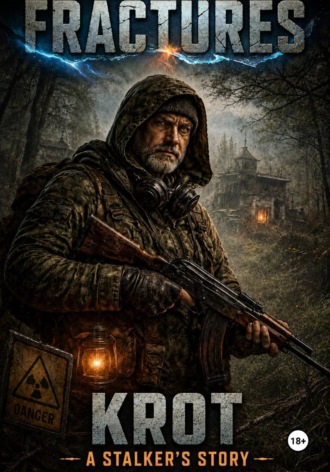
Krot. A Stalker's Story


Borland Clause
Krot. A Stalker's Story
Prologue. The Point of No Return
He understood it on the day he came back to base empty-handed for the third time running.
Three trips. Three weeks. Feet rubbed raw, two containers of samples that Kolyan the fence took with a sour face and paid half of what they'd agreed — because "market's like that, brother, nobody wants this crap right now." He got it. Nodded. Took the money. Sat down on the bench by the barracks and stared at the mud under his feet for a long time.
In his pocket was a letter from Irina. Paper — she wrote on paper as a matter of principle, said "so you can hold something in your hands, since you're not holding me." He didn't open it for two days. He knew what was in it. Didn't want to know more precisely.
"Masha hasn't slept in three nights. Her temperature was thirty-eight. The doctor came, said the same thing he always says. I don't understand what you're looking for out there, Misha. We're waiting for you. Masha is waiting. Do you hear me — waiting."
He heard her.
He heard every word of every letter. Read them, reread them, folded them into a plastic bag inside his rucksack — carefully, without a single crease. That was his anchor.
Only the artifact never turned up.
Not "eternal flame" — supposedly a cure for genetic mutations, and worth enough money to buy half their hometown. Not "night star" — a legend people whispered about around campfires, and no one could confirm they'd seen it with their own eyes. Other things turned up: "fireball" — good, but not it. "medusa" — rare, but not it. "crystal bubble" — beautiful, useless. Not it. Never it.
Stalkers around the fire told stories about a veteran named Begemot, who'd found something "genuinely medicinal" and sold it to some professor for a six-figure sum. He listened. Asked questions. Begemot had died three years back — walked into a carousel in the northern sector, going solo.
The stories ended differently, every time. The Zone never ended at all.
He opened the letter.
Read it to the end. Sat quietly — a minute, maybe two. Then stood, shouldered his rucksack, and went to get clearance for the next run. In the morning.
That was when he understood it.
Not in words. It never came out right in words — whenever he tried to put it into a sentence, it came out either too frightening or too trite. Something just clicked — the way a safety clicks when it's taken off. Quiet. No going back.
He wasn't leaving. Not anymore.
Not because there was nothing left to lose. Just the opposite — there was still plenty to lose. A wife. A daughter. An apartment overlooking a park where they used to walk every Sunday, back when Masha was healthy. Coworkers who still invited him to the odd office party. A life waiting for him on the other side of the perimeter — a decent, comprehensible, warm life.
He wasn't leaving. Because there was something in there, inside the Zone. He felt it — not with his mind, not with instruments. With something that had no name but worked all the same. Something was waiting for him. Lying somewhere deep, beneath layers of anomalous filth and animal trails and other people's routes, waiting for him to finally come and take it.
That's how it felt to him.
It felt that way because the Zone knew how to draw people in, wrap around them, and never let go again.
* * *
He sat on the bench until it got dark. At first — just sat. Then he started thinking. Methodically, the way he always thought when a problem needed breaking down.
Three years. He'd been walking the Zone for three years. Counting the first run — twenty-eight routes, twelve of them longer than three days. He knew the northern sector better than he knew his own rented apartment back in the city. Knew where the water pooled after rain, where the detector started lying because of interference, which grid square had more carousels than the old notes on his handheld showed. That knowledge had piled up on its own — no intention, no plan. It just accumulated, because he walked and watched and listened.
Outside, he no longer had that. Nothing like it.
Out there he had a rented room with a window overlooking a parking lot. A job he hadn't formally quit — took vacation days, sick leave, whatever he could — but which was already starting to look at him like a man about to quit on his own. Irina — with her paper letters and a patience that had a limit. Masha — with her serious look and her question, "Dad, when will I get better?"
He'd answer: soon.
Soon never came.
But the Zone was there. Every time he crossed the perimeter, something inside him stopped hurting. Not because it was safe here — just the opposite. Because here things were clear. Here every decision had direct consequences. Here there was nothing to wait for — not "soon," not anything else. You just had to walk, watch, listen.
He understood something else too, sitting on that bench.
He was searching for an artifact for Masha. That much was true. But somewhere — deep, below that truth — he was searching for something else too. Something with no name. The very thing that made him walk not toward the perimeter, once the route was finished, but further. One more grid square. One more hour. More.
The Zone held him — not by force. By a promise.
Not a specific one: not "you'll find the artifact," not "you'll understand something important." Just — the promise that there was something more out there.
That was the point of no return. Not the moment leaving became impossible. The moment he stopped wanting to — before he'd even fully realized it.
He got up from the bench. Went inside. Lay down.
The Zone stayed silent beyond the barrack walls — dark, nocturnal, patient. It knew how to wait.
Chapter 1. The Scientist's Son
His father explained the Zone through equations.
Mikhail remembered sitting in the study as a child — a narrow window, heavy dark cabinets, the smell of paper and old tobacco that had soaked into the wallpaper so deeply it had become part of the air itself. His father stood at the blackboard he'd hung right there in the apartment — his wife grumbled but gave up fighting it — and wrote. The chalk squeaked. Formulas branched from the upper corner downward and to the right, filling the whole space.
— Right here, Misha, — his father would say, — a quantum field. See? It doesn't just exist — it interacts. Every interaction changes the state. A change in state gives rise to a new interaction. Understand?
— Not really, — Misha would say honestly.
— Fine. Then the time will come and you will.
His father laughed — his own particular laugh, quiet and inward, one he only allowed himself at home. At work he was different: reserved, precise, with the kind of professional calm Misha later learned to tell apart from the real thing.
Sergei Alekseyevich Zemtsov had worked in quantum physics for thirty years. Wrote papers published in journals with long, unpronounceable names. Traveled to conferences in Moscow, and once to Berlin, where he brought Misha back a small folding knife and a book in German that Misha could never read but kept for years. Worked at an institute where everyone knew him by his name and patronymic and stepped aside for him at the coffee machine.
And then the Zone expanded.
Not in an explosion — that would have been understandable. An explosion has a specific point, a specific cause, a specific radius. The Zone expanded differently: slowly, unevenly, with anomalies that obeyed none of the known models of spread. One day the perimeter had to be pushed back three kilometers to the west. A week later — another kilometer and a half to the north. And that's when people started asking questions that had no answers.
His father left for the research center when Misha was twelve.
Not for good — not at first. A posting, three months. Then three months became six, six became a year. Then he came home on weekends, then on holidays, then — less and less. His mother explained it as the importance of the work. Misha didn't argue. He understood it himself — by the gleam in his father's eyes, which his father no longer bothered to hide: out there, by the Zone, he'd found what ordinary physics never gave him. A mystery with no solution. A phenomenon that fit none of the equations on his blackboard.
It was stronger than family. Misha understood that later. Much later.
On his last visit home — Misha was fifteen, it was summer, hot — his father took several sheets covered in small handwriting out of a worn briefcase and spread them on the kitchen table.
— Look, — he said. — These aren't just anomalies. They're fields. Quasi-fields — we haven't come up with a better word yet. They behave like classical fields only as a first approximation. In reality — they're adaptive. Every interaction with a person changes the field's behavior. Understand?
Misha looked at the pages. He understood — not all of it, but a lot. His father taught well.
— And artifacts? — he asked.
— Artifacts are interaction nodes. Points where the quasi-field fixed a change and crystallized it. — His father paused briefly. — Some of them contain information. Not in the digital sense — in the physical one. They change the state of the objects they come into contact with. Tissue, cells, molecules. We're only starting to understand the mechanism.
— Do they heal?
His father looked at him — a long look, with the expression Misha later learned to read as "good question, complicated answer."
— Some of them — yes. In a certain sense. But the Zone isn't a pharmacy, Misha. Remember that. It wasn't made to help people. It simply is. What we take from it — that's our interpretation. Our need.
Misha nodded.
He remembered it.
Two years later, his father died. A heart attack — right there in the lab, at night, working alone. They found him in the morning. On the desk lay calculations he hadn't finished.
Misha was seventeen. He enrolled at the polytechnic in "Engineering Physics" — not out of romance, not in memory of his father. He simply knew how to calculate and understood complex mathematical models — his father's doing. Back then, that seemed useful.
* * *
Twenty-two years old — his first job. The design department of a closed research institute on the edge of the city. Shielding, electromagnetic protection, field calculations. Dull and ordinary. Salary a bit above average, an older staff, a boss with a habit of showing up late to meetings while demanding punctuality from everyone under him.
Misha fit in fast. Worked carefully, didn't argue, did what was needed.
He got married at twenty-four. Irina taught at a school — mathematics, which Misha liked right away: a person who explains formulas to children can always make herself understood in plain language, without the feminine mystery Misha never understood. She was direct, no wasted words, with a light irony that never turned into anger. Misha liked that. He was the same way himself — or tried to be.
Masha was born when he was twenty-seven.
Small, with dark hair that later lightened, with a serious look that only grew more serious with age. She watched the world with that astonished attention children have when something is already inside them — something that just needs time to grow into.
Ten years flew by like a single moment. Daughter, wife, work, Saturdays at the dacha, Sundays in the park. The normal life of a normal man. As for how normal it really was, in a time when the Zone kept quietly expanding and rumors about artifacts moved through the markets like exchange rates — he didn't think about that. He caught snatches of news about the Zone. At work, colleagues sometimes discussed projects studying artifact properties. That was somewhere far away. Not his.
* * *
Masha was ten when she got sick.
Not a cold, not the flu — something else, something the doctors couldn't name for a long time. Her fever ran for weeks, then dropped, then climbed again. Her tests came back with anomalies that didn't fit any standard diagnosis. The child grew weaker. Ate poorly. Slept poorly. She'd look at Misha with serious eyes and ask:
— Dad, when will I get better?
He'd say: soon.
The doctors had no answers.
The third specialist — paid, at a good clinic — gave a preliminary diagnosis. A rare syndrome, autoimmune, with a neurological component. Treatment — symptomatic. Prognosis — cautious and vague.
— What does that mean? — Irina asked.
— It means we can manage the symptoms. But cure it — no. Not now. Maybe in the future.
In the future...
Misha rode home on the metro, staring into the dark glass. Across from him — an ad: "Take the Next Step." A picture — mountains, a man gazing into the distance. He almost smiled.
That evening he went to a stalker forum. Not for the first time — he'd read them occasionally, with a professional's interest in descriptions of anomalies. Now he was looking for something else.
"Artifacts with healing properties — real, or just campfire stories?"
The thread turned out to be an old one, with hundreds of replies. Misha read until three in the morning.
Chapter 2. The First Time
Preparation took six months.
He didn't rush it. Not because he wanted to drag it out — he simply understood: an unprepared man in the Zone lives exactly as long as it takes to make his first mistake. He'd read that on the same forum, and it matched what his father used to say.
He found an instructor — a former walker who taught "safety techniques in anomalously contaminated territories" for money. Officially. Over three months he went through six lessons: basic topography, working with a detector, recognizing anomalies by indirect signs, first aid for radiation exposure. The instructor's name was Palych. He was past sixty, wore his coveralls even indoors, and smelled of something Misha didn't place right away — later he realized it was the smell of anomalous dust, the kind that works into fabric and never washes out.
— You an engineer? — Palych asked at the first lesson.
— Physicist. Engineer-physicist.
— That's good. Means you won't go poking a finger at an "electra" and then wonder where your finger went. What's bad is you think you'll be able to understand how it works. You won't. Nobody does. Remember that and don't fool yourself.
Misha remembered.
He assembled his gear methodically. Not the most expensive — he didn't have money for that — but reliable. A coveralls suit with second-tier radiation protection. An "Echo" detector — a Chinese copy of the German "Analyzer," worked worse than the original but cost half as much. A knife. A medkit. A flashlight with two spare batteries. A compass — mechanical, no electronics. A military-surplus rucksack he bought at the market from a man with an unremarkable face.
For a weapon — an old Makarov. Not because he couldn't afford better. Because he thought: I'm going a short distance, not deep, not for long. I won't need more.
That was a mistake. The first of many.
* * *
He crossed the perimeter in the third grid square, northern sector.
March. The ground still frozen, the air sharp, with a chemical edge Palych called "anomalous exhaust." The detector chirped quietly — background, just background. Misha walked the beaten path he'd been shown during his training: "safe," in quotes, because nothing in the Zone is safe, but a path walked often enough all the same.
The first forty minutes — nothing.
A forest like any forest. A little quieter than usual — fewer birds, the wind behaving strangely, as if it didn't dare go past a certain mark. The ground a shade darker. The smell — that same chemical one, more distinct now.
Then — the first anomaly.
He saw it by the way the air trembled — exactly as Palych had taught: not head-on, at the edge of his sight, a turn, a stop, an assessment. About seven meters off, a little left of the path — a carousel, small, young. The grass around it clipped in a circle, as if traced with a compass. At the center — a faint glow, almost invisible in daylight.
His heart pounded. Not from fear — from recognition.
He'd seen this in photographs, in descriptions, in the training materials his father used to bring home. But a photograph wasn't the same. This was alive. Real. The Zone was real — not an abstraction on a forum, not a calculated model on a blackboard.
Misha went around the anomaly in a wide arc — five meters, as he'd been taught. Scanned the area — no artifacts. Moved on.
The detector chirped at two "fireballs" an hour later — one dull, worthless, the other decent, but not what he needed. He took the second. Went back to the perimeter.
His head didn't ache. His hands didn't shake. His coveralls were clean, apart from the mud on his boots.
Misha stood at the edge of the perimeter and looked back.
The Zone stayed silent.
* * *
He went out on his second run two weeks later.
Same route — northern sector, third grid square, the same path. He already knew it by heart: where the ground went soft, where the detector started lying because of a nearby "electra," where it was better not to cut through the brush. He walked with more confidence.
On the third hour, just as he was about to turn back, he heard it.
At first — just a rustle. Not wind, not a branch. Something heavy, alive, moving with the wrong rhythm. The detector stayed silent — mutants gave off no anomalous signal, he knew that from theory. In practice, theory ran into reality just like that, without warning.
Pseudoflesh came out of the bushes fifteen meters off.
An ugly thing — he'd seen photographs, they never conveyed the smell. Sour, heavy, alive. Three hundred kilos of deformed flesh on four legs with joints bent wrong. Small eyes stared with no expression — not vicious, not hunting. Just staring.
Then it moved.
Not running — walking. Heavy, swaying, with that characteristic squelch of hooves on frozen ground that would haunt his dreams for months afterward. Misha yanked out the Makarov. Fired twice — hit both times, he could shoot. The pseudoflesh didn't even slow down. A nine-millimeter round against a carcass like that — like throwing peas at a wall.
He understood that a second before it halved the distance between them.
Running — the path was too narrow, it would catch him. Shooting — useless. There was one option left: sideways.
Misha jumped into the bushes to the right of the path, fell, rolled, stood. The pseudoflesh went past him — carried by its own momentum, it hadn't managed to turn in time. But it was already turning back.
Then — a different kind of squelch. Sharp. Like something breaking in the air.
The pseudoflesh had caught the jelly — an anomaly Misha hadn't seen, because he didn't know what it looked like from the outside, because he hadn't spotted it in time, because this was only his second time here and he still didn't really know anything yet. The jelly held the creature for about five seconds while it struggled — long enough for Misha to get away.
He didn't look back. Just walked.
Past the perimeter, he stopped. Leaned his back against a tree. Breathed.
The Makarov was still in his hand. His knuckles white from gripping it.
If not for the jelly. If the anomaly had sat a meter to the right. If the pseudoflesh hadn't clipped its edge. The Makarov isn't a weapon. It's the illusion of a weapon. I need something serious.
That same evening he posted on the forum: "Recommend an AKS for the Zone, budget up to eight thousand."
Twenty-three replies came in.
* * *
He drove home. On the way he called Irina — "everything's fine, I'll be back for dinner." Sold the fireball to the dealer, got pennies for it. Stopped at the pharmacy, bought Masha some vitamins. Had dinner. Watched his daughter sleep.
That night he lay with his eyes open, thinking about the Zone. About the jelly. About how he'd been five steps from death and never noticed the anomaly that saved him.
Chapter 3. Krot
The second run came two weeks later. The third — one week after that.
By summer he was going once a month, by autumn — once every three weeks, by the following spring — a steady twice a month. Masha kept getting sick — sometimes she'd feel a little better, but more often she felt bad, as if the illness stood still in one place while the doctors still had no clear answers about treatment.
Misha searched.
On forums, in talks with dealers, in bars by the perimeter — everywhere he was let in. The stalker community accepted outsiders cautiously: watching, sizing up, keeping their distance. But Misha didn't pester people with questions, didn't brag, didn't whine. He listened. Helped out now and then — could plan a route, fix electronics, explain anomalies to research-center assistants from a physicist's angle none of the stalkers knew at that level. That bought him access.
Gradually, people started to recognize him.
Not by a callsign — he didn't have one yet. Just "the physicist," sometimes "four-eyes" — he wore glasses, though he switched to contacts in the Zone. Neither nickname stuck. He wasn't colorful enough for one.
At one of the rest stops — late autumn, a frozen November, a fire of three logs, six walkers none of whom had known each other more than a week — he first heard about "Stardust."
It was Gorbaty talking — a veteran, about fifty, with a nose that had healed crooked after a break, which was where his callsign came from.
— I saw it once, — Gorbaty said, staring into the fire. — Didn't take it, didn't find it — saw it, is what I mean. Lying in a crevice, three kilometers from Dead City. Glowing blue, even, no pulse to it. Doesn't look like an artifact at all — more like a crystal with flecks in it, like you're looking at a night sky, perfect shape, edges almost exact.
— And? — someone at the fire asked.
— Didn't take it. Wasn't alone, had a client. Client got held up at a springboard, I went back. When I came back — empty. Somebody got there first, or the anomaly swallowed it back up, detector showed nothing.
— What's it do, does it heal?
— So they say. — Gorbaty shrugged. — Say if you keep it on your body all the time, something changes at the cellular level. Regeneration speeds up, immunity spikes. The scientists pay well for it. Very well. Though who'd hand a thing like that over to scientists, and it's rare besides.
Misha drank his tea and said nothing. Just remembered.
"Stardust." The Dead City area.
* * *
Dead City sat in the western sector, seven kilometers from the nearest entry point. Closed to loners — not because it was forbidden, but because only a handful of first-timers ever came out alive. A dense anomalous field, mutants seen nowhere else. Old military presence, abandoned in a hurry, with gear and equipment rusting exactly where it had been dropped.
Misha didn't go there that year. Or the next.
He knew his level. That was one of the lessons Palych had given him, and one Misha accepted without argument: overestimate yourself in the Zone, and you don't come back. He walked, gained experience, sold artifacts, saved money. In small pieces.
By the third year — things got better. Not with Masha. With him.
He learned to read the Zone.
Not the way you read a book — not through the eyes. Through the feet, through the skin, through something his father used to call "a stalker's intuition" — a feeling that comes from living long enough in a space governed by nonlinear laws. The detector started to feel unnecessary. Not because it wasn't needed — it was, as insurance. But Misha started to predict anomalies before the signal ever beeped.
That scared him at first.
Then he got used to it.
* * *
The callsign Krot came in his fourth year.
He was crossing a sector with two other walkers — Rvany and Kleshch, both familiar, both experienced. The job was simple: collecting in an area where, according to the scientists' recon, dummies had gathered after the last emission. Small money, but safe.
They found the dummies. Rvany filled his container and stopped — enough. Kleshch too. Misha asked for one more hour.