Полная версия
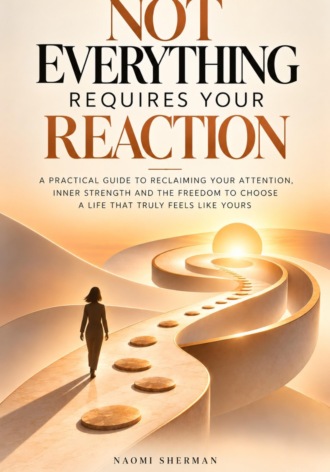
Not Everything Requires Your Reaction. A practical guide to reclaiming your attention.

Naomi Sherman
Not Everything Requires Your Reaction. A practical guide to reclaiming your attention.
Глава
NOT EVERYTHING REQUIRES YOUR REACTION
A practical guide to reclaiming your attention,
inner stability, and the freedom to choose your own life
NAOMI SHERMAN
Contents
Introduction. What if you do not need to try even harder?
1. When Life Becomes an Endless Cycle of Reacting
2. Other People’s Expectations Mistaken for Our Own Desires
3. Why Rest Can Come with Guilt
4. Unfinished Tasks and Mental Noise
5. Being Busy Does Not Always Mean Moving Forward
6. Your Thoughts Are Not Always Facts
7. How to Stop Replaying the Same Conversation
8. An Information Diet Without Extremes
9. How to Recognize Your Real Needs
10. Letting Questions Remain Unanswered for a While
11. How to Say No Without Lengthy Explanations
12. Closeness Without Constantly Earning Attention
13. Desires, Money, and Decisions Driven by Anxiety
14. How to Stop Waiting for the Perfect Moment
15. When Old Goals No Longer Inspire You
16. What Truly Matters to You
17. Fewer Promises to Yourself, More Achievable Actions
18. Personal Rules That Protect Your Energy
19. How to Recover from Setbacks Without Self-Punishment
20. A Daily System for Personal Decisions
The PAUSE Practice
A 30-Day Plan
Conclusion. You Do Not Have to Respond to Everything
About the Author
Introduction. What if you do not need to try even harder?
Imagine an ordinary morning. You open your eyes, and tasks are already filling your mind: reply, check, remember, solve, plan. You have not done anything yet, but you already feel as though you are falling behind in your own life.
During the day, you may be busy, attentive to others, and responsible. You solve problems, keep promises, maintain relationships, and look for opportunities. Yet in the evening, you may feel that the day has ended without you ever truly being present in your own life.
We tend to believe that the way out of overwhelm is to make more effort. Sometimes that helps. But sometimes the problem is not that we do too little. It is that we automatically treat too many things as obligations.
We reply because we are afraid of seeming indifferent. We agree because we do not want to disappoint anyone. We keep pursuing a goal because we once chose it ourselves. We replay conversations that have already ended and worry about decisions that do not need to be made yet.
This book does not ask you to abandon responsibility or ignore difficulties. It invites you to pause before giving something your time, attention, and energy, and ask whether it truly requires your involvement right now.
You do not have to respond to every thought. Not every feeling requires immediate action. Not every expectation becomes your responsibility. This is an invitation to stop living entirely on autopilot.
You do not need to become a completely different person. You need to notice the moment when you stop choosing and simply start reacting. That is where change can begin.
First Exercise. Where Does My Life Go?
Take ten minutes and write your answers. Do not search for the “right” wording. Try to see what is actually happening.
What three things occupy my thoughts most often during the day?
Where do I spend a lot of attention even though it rarely helps me?
What do I keep doing mainly out of duty, fear, or habit?
When did I last do something simply because I genuinely wanted to?
If I did not have to prove anything to anyone, what decision would I consider first?
You do not need to change your life immediately after answering. Do not turn this exercise into another test of personal efficiency. Simply look at your answers. Sometimes the first useful decision is not to add something new, but to notice what has stopped helping you.
Your first task is not to fix yourself. Your first task is to see yourself more clearly.
1. When Life Becomes an Endless Cycle of Reacting
Reacting is necessary: we respond to important events, help people close to us, and solve problems. The difficulty begins when reacting becomes our only way of living. A message arrives and we abandon what we are doing; someone is unhappy and we rush to fix everything. Other people’s signals begin to take priority over our own intentions.
Learn to distinguish what is genuinely urgent, what is important but can wait, and what is simply demanding attention loudly. Loudness is not the same as importance. Choose a short period of time and decide in advance what you will focus on. This is not about ignoring important messages; it is about refusing to give every signal the same priority.
Practice. Protect Twenty Minutes
Choose one important task. Remove distractions you can control and work on it for twenty minutes. Each time you feel the urge to switch tasks, make a small mark. At the end, notice what most often pulled your attention away.
What signal interrupted my work most often today?
Which interruptions truly required an immediate response?
What one change will help me protect time for important work tomorrow?
2. Other People’s Expectations Mistaken for Our Own Desires
Sometimes we spend years pursuing something we never truly chose: being agreeable, achieving more, looking a certain way, or proving our worth. These expectations may come from outside us, but over time they can sound like our own inner voice.
You do not have to reject a goal simply because other people influenced it. Ask yourself: if nobody knew about my choice, would it still appeal to me? What do I value about the process itself? Independence does not mean ignoring everyone else’s opinions. It means not allowing a decision to happen automatically.
Конец ознакомительного фрагмента.
Текст предоставлен ООО «Литрес».
Прочитайте эту книгу целиком, купив полную легальную версию на Литрес.
Безопасно оплатить книгу можно банковской картой Visa, MasterCard, Maestro, со счета мобильного телефона, с платежного терминала, в салоне МТС или Связной, через PayPal, WebMoney, Яндекс.Деньги, QIWI Кошелек, бонусными картами или другим удобным Вам способом.