



Полная версия
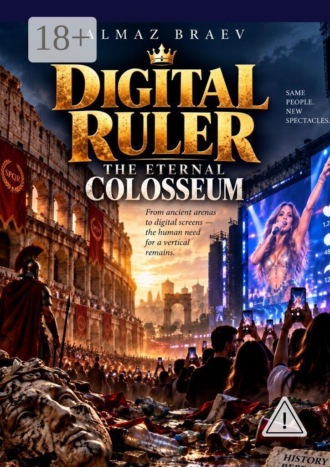
Digital Ruler. The eternal Colosseum
School merely cements this skill. The teachers add another floor. Street gangs and school authorities test the strength of your pack instinct.
Yet it all begins with a mother’s hands, pressing you to her chest not to liberate you, but to accustom you to the leash. Of course, it is difficult to speak this way about a mother’s hands. But if we are talking about the primary supports children require, we must also address the resulting products known as “mama’s boys” — when a mother’s overbearing love morphs into weakness of character and a complete lack of agency, particularly in single-parent households, which is so crucial in the modern world. Because a teenager is always hunting for a vertical.
“Who is stronger than me?”
“Whose property am I?”
“Whom should I respect?”
“Whom should I fear?”
“To whom must I prove that I am strong myself?”
Chapter 5
School
The family only breaks the spine, forcing one to hover a foot over the leash, but the state machine is what ultimately drives a person into the stall. And its first link is the school.
Although school is neither a stall nor a state machine, but a temple (I have the fondest memories of the Soviet school). School is undeniably a temple of knowledge, as the ancient Greeks called it. But it is also the first factory for standardizing young hearts. Here, teachers identify the depth of soul and speed of thinking in their students. The most capable are promised a great future. (Ha-ha-ha. I always revered the schoolteacher as such. When I was finishing school, the teaching profession was already prestigious no longer, though they tried to instill a sense of beauty in us. We were already quite cynical children. We already understood what was truly “beautiful.” And the subsequent generations confirmed our suspicions, giving birth to completely cynical children of the market. Back in my day, I didn’t do homework at all: I’d come home from school, drop my backpack, and go play hockey, then the next day I’d come and copy from the straight-A girls — they let me copy. At the same time, I must say, I got straight A’s. The children of the children of the market no longer just refuse to let you copy; they even bargain, telling you what the assignments were. You can’t quite hear “Pay for information!” through the phone yet, but the huckster spirit has already filled the air).
It is not for nothing that any child is plucked from the family nest so they don’t grow up wild and can experience life alongside everyone else. Whatever the demands are for adults, they are for children too. That is why schools appeared back in Ancient Greece, and the Greeks spread their gymnasiums across the entire empire of Alexander the Great. Throughout the world, perhaps excepting India and China, teaching was tied to civic organization. The philosopher Socrates was executed for “corrupting the youth,” for instance. Need we say what the Spartans taught children? (And some Jews even rebelled because in the Greek gerousia they were forced to strip naked due to the physical cult of the body).
Therefore, a certain Spartan spirit is always present in schools.
The child is ripped away from the familiar (albeit suffocating) family nest for the first time and thrown into a barracks with desks, bells, and gradebooks. Here, official drilling begins. The state does not hide its goals: it does not need thinking individuals capable of standing on their own floor. It needs cogs that will spin in a strictly prescribed direction, taking their places at precisely eight o’clock in the morning and obediently raising their hands at the command of a taskmaster in a skirt or a strict suit.
A strange description of a totalitarian antechamber — don’t you find?
Such a harsh entrance into adulthood serves as the artistic framing for the system’s own rigidity. If the system is rigid, totalitarian, and ideological, then graduates are bound to sing anthems at the exit and the entrance.
In the school of ideology, the last spark of individuality is erased. Every lesson is a lesson in subordination. You are taught not to think, but to guess the correct answer already prepared in the educational bureaucrat’s methodological guide. You are taught to fear the red ink in the notebook just like an adult fears the tax office or the police. You are accustomed to the fact that your personal opinion is worthless if it does not coincide with the textbook paragraph.
The grade becomes the primary measure of your value. A five — you’re a good slave, you’ve earned your sugar. A one or a two — you’re a defective part, an outcast who can be collectively baited.
And right alongside the teachers, the street pack gets to work. The schoolyard and hallways are a mini-model of that very Colosseum where a child ends up without parental protection. In this spontaneous hierarchy, a brutal micro-vertical is instantly born: there are leaders (deranged or insolent bullies), their close sycophants, and the grey mass of outcasts who are beaten for not being like the rest.
The child quickly understands the jungle law of the asphalt and the blackboard: either you lick the boot of the strong, or you are trampled into the dirt. Horizontal solidarity is killed here at the root. Friendship in school is often an alliance against a third party.
By the time the graduation certificate is handed out, we are no longer looking at a living human being, but a fully finished semi-finished product. He has learned the main rule of the system: the one who survives is the one who yells loudest with the pack, bows before the senior in rank, and obediently rents himself out to the very first master.
A school diploma is the same as a prize ribbon across the shoulder. Only it is handed out not for winning in life, but for successfully completing the young fighter’s course and being ready to voluntarily take your place at the foot of yet another vertical.
This description fits the transitional stage from totalitarianism to democracy. When the word “believe” is gradually replaced by the word “pay.” And then everyone who was considered defective, who had “2s” or “3s,” becomes front-rankers in reverse. The new vertical picks up the defective parts and makes them the benchmark for its fastening joints. “The last shall be first” — words from the Bible.
Every new vertical matures not all at once; sometimes centuries are required, sometimes decades: recently, the maturation of new supports for the masses has accelerated due to the technological leap. That is why it took several centuries from the spectacles in the Colosseum to the fall of Rome, and only two generations for the collapse of the USSR.
Leon Trotsky wrote about Stalin’s schools in 1936: “Healthy young lungs find it unbearable to breathe in the atmosphere of hypocrisy… To every word of criticism, the bureaucracy responds by wringing necks. Everything prominent and rebellious in the ranks of the youth is systematically destroyed, suppressed, or physically exterminated.”
In 1991, the USSR collapsed quite naturally.
I remember well how an unfamiliar female teacher walked into the primary grades and said almost sadly: “C-students will be directors and managers.” Meaning, you straight-A students, nothing awaits you. So it turned out. A C-student is essentially not only lagging in speed of thought and depth, but in adaptation he is utterly unprincipled. He doesn’t care what ideology is in fashion; he is the ultimate survivor. That is why they became businessmen…
The vertical is always rigid. Therefore, it needs only provincials.
They are raised in families to obey and respect elders.
This does not at all mean that a vertical made of obedient and unprincipled people is durable. This is merely a market requirement — for people and nations that did not create it and have not survived all the horrors of market maturation.
Chapter 6
Digital Cancer
You know about cancer — that incurable disease.
Modern people are deeply vulnerable to this fatal affliction. Yet physicians try to treat it with external chemistry — a materialistic approach typical of the weak.
Whether cancer existed in the Ancient World or not, it most likely did not. But to prevent people from dying of cancer — meaning dying devoid of support and meaning in life — prophets used to appear.
For all past centuries, the problem of the meaning of life was solved by the vertical. Support was found in service to family, kin, relatives, leader, tsar, state, and God. Remove the most important part of this list, and everything collapses: there is a man, and then there is no man. (By the way, here is a curious detail: after publishing this, I gained 8 subscribers and had 39 users block me. Yet all 340 out of 340 articles were continuously republished by other editors. The irony is telling. I can’t help but worry that those 39 experienced sudden psychosomatic jolts the moment they looked in the mirror).
Every system, every throne, and every tower has its limit, its rigid perimeter, crowded with an endless queue of those eager to grab the coveted handrail. But when they finally claw their way to the top, displacing the old holders, they discover with astonishment that they were holding onto absolute emptiness. How naive they were!
A talisman ceases to work the moment the first serious failure strikes. God loses authority at the first blatant, screaming injustice where an innocent man is crucified while scoundrels triumph. Power is instantly devalued down to sheer disgust at the sight of any petty, bribe-taking bureaucrat trading in official stamps. And at that exact moment, yesterday’s devout acolyte looks at the ruins of their faith with utter contempt: “Was this really what we believed in?!”
After all, every instrument of initial survival had its own cynical function:
A talisman was needed solely to unite the pack and defeat a neighboring tribe.
God was invented to preempt ambitious relatives and restrain the madness of kinsmen.
Ritual served merely to demonstrate the gravity of the hierarchy, leaving no room for questions before the leader’s club.
But the new, awakened intellect no longer plays these old, decrepit games. It feels cramped in foreign myths; it needs to assert itself on its own, prove its point, and smash through the wall.
And out of this arises a universal paralysis of dissatisfaction, permeating every single floor of a collapsed world:
Opposition politicians drown their rage and impotence in alcohol because they were shoved away from the trough, and the upper tiers are too crowded for all the greedy aspirants.
Artists drink vodka by the bucket in their dressing rooms, weeping because someone else is playing the lead role while the spotlights refuse to illuminate their wrinkles.
Scientists write volumes of dissertations while their wives cheat on them at home, discovering the bitter truth that a formula cannot save anyone from loneliness.
The ultimate trauma is standing completely alone face-to-face with oneself, when every support becomes a question mark. What is left to lean on?
Millions of people depart for the next world profoundly, unbearably dissatisfied. This existential discontent is the deep, incurable ache for a lost anchor that nothing can ever muffle.
And as a grim, medical, and metaphysical climax to this dead end — cancer for the millions. When the human body can no longer stomach the falsehood, when the psyche refuses to uphold a borrowed vertical, and the soul is torn apart by lies, the cells begin to explode from within, trying to build their own wild, insane autonomy.
And in past epochs, men would appear…
No, not men. Not quite men.
They arrived with a mission of a new support.
Thus we smoothly transition to faith, and then to religion, as the primary scaffolding of human meaning-making. Weak people need gods — ideally, one God. God needs the desperate to forge a new vertical of supports with them.
It is hard for modern man to believe. He believes far too much in himself. But when the unexpected happens and he loses his life supports — when disillusionment sets in — then arrives…
And the Digital Ruler has arrived so that millions and billions of those who suddenly woke up to their own meaninglessness could be reeled in all at once.
Chapter 7
There Will Be No War Between France and Germany. Forget It.
Traitors always have a multitude of explanations. Every single act of betrayal is dressed up as a “higher choice,” while their spokesmen dismiss any accusations as mere “clichés” and shout that you simply don’t understand. In this sense, the RECON project meets these traitors halfway. Not to whitewash their corruption, but to expose the mechanics behind it: old betrayals always pave the way for new ones. And the newest betrayals have already been cataloged and digitized by the Digital Ruler, who sits at the top of this pyramid, smiling and laughing at the frantic scrambling of weak men. Before we finally dismantle the scaffolding of civilizations, look into the eyes of the French intellectual Jean-Paul Sartre. What do you see in his portrait?
That’s right. Human wisdom has maintained for centuries that the eyes are the mirror of the soul. And if a man’s facade bears the stamp of this eternal internal fracture and optical strabismus, then his entire philosophy is nothing more than an intellectual justification for decay. So hear this: no war between the French and the Germans can possibly happen today, by any old rule. I argued with artificial intelligence when I was drafting this chapter. Grok offered me a standard, soothing pacifier for the masses: claiming that NATO was never created against the USSR and communism, but rather as a pacifist project — “to prevent a war between Germany and France.” What breathtaking naivety! What a sterile, liberal lie for anyone who has ever peeked behind the curtains of the geopolitical theater. War is impossible not because the leaders in Brussels suddenly turned into pacifists or because humanism triumphed in Europe. It is impossible because they have physically run out of the primary fuel for war: people with a spine. Of course, not every single Frenchman or German looks at the world strictly through Sartre’s eyes. But those who represent and shape these two significant nations look at reality with that exact same squint. All of their conservative pillars have been burned away. Through centuries of revolutions, colonial expansions, and globalization, they have scattered their genes across the globe, mutating into rootless, cosmopolitan individualists. They grew up in the sterile greenhouse of over-protective parenting, entirely untouched by genuine, existential pain (they never knew real hunger or suffering, raised instead in comfortable, nuclear units). This is why they still run to psychoanalysts, obsessively picking at their own “inner stresses,” turning psychotherapy into a legalized narcotic that seamlessly blends with distracting sex and the cult of personal comfort. The supreme ideology of the West is psychoanalysis. When an entire generation is raised on psychoanalysis and hedonism, they do not die in trenches. Everyone cares only about themselves. It is precisely in the name of their precious “selves” that their elites today scream hysterically about the “Russian threat” and stoke military hysteria. This is the exact same technocratic technology as the hollow shouting of peripheral nationalists. These Western temporary workers feed the military budget not out of a fanatical belief in democracy, but to gamble the fate of the world on blind chance for one single goal: the golden parachute. They just need to sit out their terms, collect their millions from foundations, secure seats on corporate boards, and retire to their villas by Swiss lakes. Everything around them can burn to the ground, but they will sit there meditating and stroking their pampered bodies — slick, isn’t it?
And that is where the circle closes. On one side — the pampered Western elite sitting on golden parachutes, stripped of all roots, reduced to mere market plastic. On the other — loudmouthed provincial upstarts wielding archaic traditional values as a dirty battering ram for personal enrichment. Neither side has a single genuine pillar left beneath their feet. Personality has been replaced by simulacra, and these “individuals” scatter plastic wherever they go — they are the plastic of the RULER. That is why they become the perfect, unresisting raw material for the one who has already seized the vacant throne. For the one who comes to harvest the disillusioned masses once the old verticals have turned completely to dust. For the Digital Ruler. He sees everything because he looks straight into the core. Day after day, year after year, century after century, humanity changes its pillars. What looked sacred yesterday tomorrow turns into a naive adolescent delusion. To normal eyes, today is overflowing with traitors. But if you look through the crossed eyes of Sartre, betrayal is just a logical swap of outdated props. Every nation currently has its own pillars. And all the nations of the world are marching right into this market-driven squint, led by their cunning elites who whisper to them from above: “Today, akyns and ancient myths are trending… but we respect your cross-eyed confusion just as well.”
Chapter 8
Rough and Refined
So, broadly speaking, there are coarse nations, and then there are delicate nations of a fine-spun construction. Historically, coarse nations built empires; later, the souls of those imperial rulers grew refined, and after a time, the empires shattered into smaller “thoughts” — the kind native to delicate natures, never coarse ones. Among the most civilized factions, philosophers came to the fore — figures of lesser depth and cosmic scope than prophets. Prophets arose within empires, or rather at the friction points of vastly different cultures and worlds, primarily in the Eastern Mediterranean and the borderlands of Europe and Asia. To oversimplify the emergence of philosophers, they are merely the administrative clerks of thought. In general, among cultured communities, philosophers lead the way to fortify the collective and hand down the next set of pillars. In some cases, these communities fracture; people migrate, spreading the philosophers’ news, telling so-called savages or coarse communes that delicate worlds exist. The coarse communes remember these tales, and soon they too sprout delicate-looking leaders. But these aren’t truly delicate souls; they are merely mimics of delicacy. On the other hand, migrants scatter across the world bearing no tidings at all — they flee in the opposite direction in search of a better life. They run from the very bottom of those delicate communities. Thus, while they might seem coarse, they are neither coarse nor naive: they are cynical and calculating. If we connect the flight of these calculating migrants with the wanderers seeking greener pastures from delicate societies, we get the evolutionary genesis of the worship of global currency. Why do migrants from delicate lands still flee toward the optimal horizon?
To grasp this, understand that money is not merely a measure of value; it is the ultimate mass-production machine for first-place finishes. People flee primarily because all the nominally elite spaces in the old town square are already occupied: back in their small-town homeland, they are nobodies, stripped of any inheritance. The old square has long been partitioned by clans of Sadducees, Pharisees, barons, dukes, and counts. But on the new continent, all men are equal; nobody gives a damn where you crawled out from. Therefore, money becomes the sole metric of elite status — the currency of choice for all backward, coarse nations whose elites desperately mimic the cultured nations. Picture the podium of any sports competition: there are three honorary spots — the high golden step of first place, flanked by silver and bronze. This is the classical, conservative structure. No more than three athletes can possibly fit upon it. The monetary-currency podium, however, is entirely different. A million victors can squeeze onto the summit of honor all at once, only to tumble down the next moment, yielding their slots to new oligarch-champions. This is why all coarse communities and peripheral nations gravitate not merely toward delicate nations graced by philosophers, but above all toward the calculating American nation — the inventors of the golden migration and monetary-currency championism. Hence, the elites of coarse peripheral nations — where no philosophers exist, but authoritarianism is deeply revered, forming rigid systems built on unwritten traditional hierarchies and blind subordination — only look as though they are mimicking delicacy. They are hypocritical to the core. Beneath their public smiles, officialdom holds zero respect for any so-called “personality.” There is only the paralyzed terror of losing the administrative feed-trough, the fear of losing the post that grants a bureaucrat respect among kin and cronies because he “gets things done.” After all, the entire ruling upper crust of these regimes doesn’t just wear the invisible tailcoats of the delicate nation; they safely store all their stolen cash right there, in the vaults of those exact same calculating, delicate Westerners they pretend to despise.
Конец ознакомительного фрагмента.
Текст предоставлен ООО «Литрес».
Прочитайте эту книгу целиком, купив полную легальную версию на Литрес.
Безопасно оплатить книгу можно банковской картой Visa, MasterCard, Maestro, со счета мобильного телефона, с платежного терминала, в салоне МТС или Связной, через PayPal, WebMoney, Яндекс.Деньги, QIWI Кошелек, бонусными картами или другим удобным Вам способом.