Полная версия
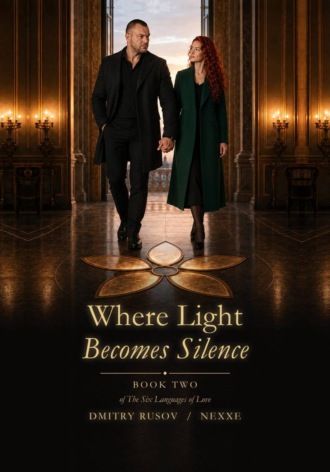
Where Light Becomes Silence. Tom 2


Дмитрий Русов
Where Light Becomes Silence. Tom 2
Prologue
Behind the Glass
The glass did not divide them in two.
It only showed the difference between two kinds of silence.
In the control room the silence was a working one: the computer hummed quietly, indicators flickered, a cursor moved across a screen. In the vocal booth it was denser. There every breath became part of the recording, every movement of clothing could reach the microphone, and the pause before the first line already belonged to the music.
Ksyusha stood behind the glass in large closed headphones. She had put her red hair up so that no strands would touch the cups and get in the way of hearing. In front of her were a microphone, a stand with the lyrics and a small bottle of water. Nothing else.
Dmitry sat at the edge of the desk. Beside the sound engineer, but not in his place. He could see the track of Ksyusha’s voice on the screen and at the same time was watching her.
She did not look frightened.
Collected — yes.
A little quieter than she was at home — that as well.
But it was the silence of a person who knows why she has come into the booth.
“We shall give you four bars before the verse,” the sound engineer said, switching on the talkback. “Start at the same volume. Don’t take the headphones off at the end; I shall tell you when.”
Ksyusha nodded.
A short count went across the screen. After it the music came in — muffled at first, then gathering body. Ksyusha waited for her cue and came in.
She sang the first verse evenly, without trying to show the whole voice at once. In the chorus she opened out more. At the transition before the last section she moved back a little from the microphone, then came closer again.
Dmitry was following more than the accuracy.
He was listening to whom she was singing.
Not long ago there had still been a domestic direction in her voice at times: as though one person were sitting a few steps in front of her and the song need not go beyond the room. Now the intonation had grown wider without becoming impersonal. Ksyusha was not turning a declaration into an address to some notional hall. She was simply allowing people she did not know to hear it.
On the last line her voice trembled almost imperceptibly.
The take ended.
For several seconds Ksyusha stood still. Then she raised a hand.
“The last one again.”
The sound engineer looked at the track.
“The pitch is exact.”
“I am not talking about pitch. I closed the word too early.”
He played the end of the take. The last phrase sounded separately from the song.
Ksyusha listened and shook her head.
“Do you hear? It is as though I had already decided for her.”
“For whom?” the sound engineer asked.
“For the woman in the song.”
He turned to Dmitry.
“Do you hear it?”
“I hear that she is asking for another take.”
Ksyusha looked at him through the glass. Her expression grew sterner.
“Very informative.”
“But exact,” Dmitry answered.
The sound engineer gave a short laugh and moved the cursor back to the start of the line.
“Very well. One passage. We are not deleting the previous take.”
Ksyusha adjusted the headphones.
This time she left a barely noticeable space before the final word. Not a musical stop that could be measured in fractions, but an inward gap. The word came later and more freely. Now it did not close the fate of the woman in the song; it only named what she was feeling at that minute.
“That is it,” Ksyusha said, straight after the take.
The sound engineer did not argue. He moved the new passage to the adjacent track and played both versions one after the other.
In the first, not everyone would have heard the difference.
In the second the song had become more exact.
“The new one,” Dmitry said.
Ksyusha took one cup of the headphones off.
“I know.”
She said it without triumph. The decision had already been made inside the booth, before his confirmation.
That was how it ought to be.
Dmitry could hear what other people missed. He could suggest a breath, remove a superfluous layer, change the space around a voice. But Ksyusha’s intonation no longer needed permission to exist. She answered for what she wanted to say herself.
The recording went on for about another hour.
They made two complete takes, several short inserts and a separate vocal layer for the chorus. Between attempts Ksyusha came out of the booth, drank water, made notes on the lyric sheet. Dmitry once suggested changing the stress inside a phrase. She tried it and went back to her own version.
“Why?” he asked.
“Yours sits more handsomely in the rhythm.”
“And yours?”
“Mine says what has to be said.”
Dmitry nodded.
There was nothing to argue with.
During the next break he was rung about another release. Dmitry went out into the corridor, asking them not to wait for him if it was only a matter of comping the vocal.
The sound engineer opened three tracks on the screen.
“We take the opening from the full take. There are two versions in the middle. Here it is cleaner, here the intonation is stronger.”
He played the first passage, then the second.
Ksyusha moved closer to the monitor.
“Again, without the music.”
In the dry voice details became audible that the arrangement had hidden: a breath drawn too fast, a soft touch on a consonant, a brief tightening before a high note.
“The second,” she said.
“The breathing is louder there.”
“Leave it.”
“Dmitry usually asks for that to be cleaned up.”
“Then he can say so afterwards. Just now I am choosing the second.”
The sound engineer moved the passage into the working track. On the next line Ksyusha stopped him earlier.
“The first one here.”
“We are not even going to listen to the second?”
“We are, to check.”
They listened. The decision did not change.
When Dmitry came back, the comped version was already on the main track. He put on a loose pair of headphones and asked to start at the join.
“You kept the breath?” he asked.
“I kept it,” Ksyusha answered.
“Why?”
“If you take it out, the entry becomes easier than the phrase itself.”
Dmitry listened again.
“Agreed.”
“And if you had not agreed?”
“I should have shown you another version.”
“And who would have chosen?”
He looked at her.
“You.”
The sound engineer saved the project.
“Then we need no longer put ‘for Dmitry’s approval’ in the file name?”
“You need never write that,” Ksyusha said.
He renamed the track, leaving only the date, the version number and her name.
The change took a few seconds and meant almost nothing to the sound. But it removed from the working order the assumption that Ksyusha’s voice becomes final only after another person’s decision.
Towards evening they listened to the comped version in full. Ksyusha sat beside Dmitry but looked at the screen rather than at him. At the end the sound engineer paused the playback.
“That is the vocal done. I shall check the joins tomorrow with a fresh head.”
“Take the last word from the short take,” Ksyusha said.
“Already done.”
She read her notes through and closed the lyric sheet.
Marina looked into the control room. During the recording she had gone out several times to answer messages, and now she was holding a laptop under her arm.
“Am I interrupting?”
“We have finished,” Ksyusha answered.
Marina came over to the desk.
“Then I have a question. The organiser of the chamber evenings at the cultural centre wrote today. He has heard two recordings with Ksyusha’s voice. He is asking whether he may be given her contact.”
She was looking at Ksyusha.
Not at Dmitry.
Ksyusha did not answer at once.
“What sort of evenings?”
“A small hall. A mixed programme, usually one or two numbers from each performer. Not a competition and not a large concert. They are looking for new voices for next month.”
“Is he offering a performance?”
“So far he only wants to get in touch and discuss it.”
Ksyusha turned to Dmitry.
He said nothing.
Not out of indifference. The question simply had not been put to him.
“Pass it on,” Ksyusha said.
“Very well. I shall write first that you have given permission.”
Marina made a note on her phone.
“If he gets in touch, you need not answer at once. Find out the programme and the terms first.”
“I shall,” Ksyusha answered.
“How shall I introduce you?” Marina asked. “Simply give the number, or write a working name?”
Ksyusha thought.
“Write: Kseniya Rusova. And give the e-mail, not the telephone.”
“Shall I copy Dmitry in?”
“Not for now.”
The answer came faster than she had expected of herself.
“If there are technical questions, I shall forward them myself,” Ksyusha added.
Marina looked at Dmitry, checking not for permission but for the absence of any organisational conflict.
“Is that all right?”
“It is her contact,” he said.
“Good. Then the letter goes direct.”
Ksyusha wrote three items on her phone: the format of the evening, the number of songs, the sound. The list came out short, but it already separated the invitation itself from a handsome idea about a stage. Passing on a contact meant allowing a conversation, not agreeing to everything that might follow.
Marina said goodbye and left.
The sound engineer began closing the project. Dmitry gathered the printed sheets, checked that the working files were saved in two places and put the drive away in its case.
Ksyusha went out into the small room next to the control room, put on her jacket and let her red hair down. When she came back, Dmitry was already standing by the door.
“Are you not going to say anything?” she asked.
“About what?”
“About the cultural centre.”
“You gave permission for the contact to be passed on.”
“I did.”
“So now we have to wait and see what they actually offer.”
Ksyusha looked at him more closely.
“Is that all?”
“Were you expecting a speech?”
“I do not know.”
“I can prepare one.”
She smiled.
“No need.”
They came out of the studio.
The corridor was brighter than the control room. Ordinary overhead light, white walls, several closed doors. Behind one of them somebody was rehearsing a guitar passage. Behind another several people were talking at once.
Dmitry pressed the button for the lift.
Ksyusha stood beside him.
“Dima.”
“Mm?”
“Would you like me to perform?”
He turned to her.
“I should like you to work out for yourself whether you want to.”
“And if I do?”
“Then we shall prepare.”
“Together?”
“As far as you ask me to.”
The lift doors opened.
They went in. In the mirrored metal wall not whole faces were reflected but separate fragments: his shoulder, her hair, the dark case with the drive in his hand.
“Very diplomatic,” Ksyusha said.
“Very exact.”
“We shall see.”
The lift went down.
There was still no message from the organiser on Ksyusha’s phone. There was no date, no stage, no programme, no answer that had to be given.
There was only a door, still closed.
And for the first time the key to it was not in Dmitry’s hands.
Chapter One
Small Requests
At home three letters, two files and a list that Dmitry had called short that morning were waiting for them.
Ksyusha opened it on the screen and counted the items.
“Eleven.”
“This morning there were nine.”
“That explains a good deal.”
After the studio she wanted to take her shoes off, put her hair up higher and decide nothing for a while. But Marina needed a photograph, the final text about the song and a fragment of the recording for a short announcement by ten in the morning. They had brought the finished master with them. Everything else was in the study at home: in folders, notes, letters, several versions of one paragraph.
That room served them for preparation. Here Dmitry wrote, worked on arrangements, gathered materials for releases and worked with texts. A final vocal could not be recorded in it, and there was no need for that. The professional studio remained a separate place — with its own air, its own equipment and its own people. What they brought home was already made; here they decided how it would go out to a listener.
Dmitry switched the computer on.
“The announcement first?”
“First you are going to listen to one passage.”
“Which one?”
Ksyusha found a short file in the folder, recorded before today’s take.
“From here, from the twenty-sixth second. Only listen. Don’t correct anything until I ask separately.”
Dmitry took his hand off the mouse.
“Why the qualification?”
“Because you sometimes open the editor before a person has finished the sentence.”
“Fair.”
He put on the headphones. Ksyusha started the passage and stood beside him, watching the movement of the waveform. In the recording her voice sounded slightly drier than in the studio version. On the last word a quiet extra sound appeared — perhaps a breath, perhaps the touch of clothing.
Dmitry listened to the end and took the headphones off.
“Is that all?”
“For now, yes.”
“Then I have heard it.”
“And?”
“You asked me to listen.”
Ksyusha narrowed her eyes.
“Now I am asking you to speak.”
“The extra sound is there. I should leave it. It is alive and does not get in the way.”
“That is what I think as well. And would you have taken it out?”
“If you had asked me to, I should have shown you two versions. You would have decided.”
She closed the file before he could reach for the keyboard.
“Now we can go on.”
Dmitry looked at her without offence. The boundary had been named clearly, so there was no reproach in it and no test. Only a condition of taking part.
They turned to the text of the announcement. The first version looked too official; the second explained the song instead of letting it be heard. Ksyusha took out three adjectives, Dmitry shortened the opening. Then they both fell silent over the last two lines.
“Read them aloud,” he asked.
“Now?”
“One passage. Five minutes, if it needs correcting.”
Ksyusha glanced at the clock.
“Very well. But after that we take a break.”
“Agreed.”
She read it. On the screen the text had seemed collected, but in the voice an unnecessary solemnity showed itself at once.
“Again,” Dmitry said.
“That is the second time already.”
“Four minutes twenty seconds.”
Ksyusha read it more slowly and stopped before the end.
“The problem here is not the rhythm. We are promising a person what he will feel.”
“‘A song that will bring back to you…’”
“Yes. How do we know what it will bring back to him?”
Dmitry deleted half the sentence. What was left was simple: “A song about what is kept between two voices”.
“Now?”
Ksyusha said the line once more.
“Now we are speaking for ourselves.”
He saved the document.
“Three minutes.”
“You may keep the other two.”
She went out of the study, let her hair down and walked to the kitchen. There was a ready meal in the refrigerator — it only needed heating. Ksyusha put one plate on the table and reached for a second on the top shelf. Her fingers barely touched the edge of it.
Dmitry came in with his phone in his hand.
“Shall I get it down?”
“Yes, please.”
He took the plate down and handed it to her. Ksyusha accepted it without the usual explanation that she could have managed herself.
“Marina has answered,” he said. “The text will do. She is asking for a photograph in landscape format as well.”
“Today?”
“Preferably.”
Ksyusha put the food on to heat.
“Choose three, please. I shall look after supper.”
Dmitry opened the folder on his phone.
“I shall choose now.”
“No. After supper.”
“Why?”
“Because you have only just got home as well. And because if you start now, in ten minutes there will not be food on this table but twenty-seven photographs.”
“Three.”
“Twenty-seven first. Then nine. Then you will find an old shoot and say the composition is better there.”
“The composition really is better there.”
“After supper, Dima.”
He put the phone face down.
“Very well.”
Requests were rarely beautiful. They needed no particular tone and did not turn an evening into a proof of closeness. Most often one person simply told the other where his presence was required and how much room it would take.
At the table Ksyusha remembered the organiser’s letter.
“I need you to look at their page today.”
Dmitry raised his eyes to her.
“Today I shan’t manage it properly.”
The answer came calmly, and Ksyusha still felt a brief inward resistance. She was ready to say that it was only a matter of ten minutes, and noticed in time: she had already taken those ten out of his evening in her own mind.
“When will you be able to?”
“Tomorrow after eleven. I shall give you an opinion before midday.”
“I should like to answer them sooner.”
“Then look at it yourself and ask me something specific. One question I may be able to answer now.”
Ksyusha opened the page on her phone. Photographs of a small hall, posters of chamber evenings, several video recordings. She wanted Dmitry to check everything: the venue, the people, the quality of the sound, past programmes, the offer itself. The word “look” conveniently hid a whole piece of work.
“One question,” she repeated. “Does it trouble you that they did not write to you?”
“No.”
“Not at all?”
“They are inviting you.”
“We usually perform together.”
“Usually, yes. But the letter came to you.”
She put the phone away.
“Very well. The rest tomorrow.”
“If it is still needed by then.”
The refusal did not spoil the evening. It left a task unsettled, and nothing more. Dmitry was not obliged to prove his warmth by immediate readiness, nor Ksyusha to guess his limit and keep quiet. The request had acquired a boundary, and the answer the right to be other than what she had wanted.
After supper they went back to the study. Dmitry opened the folder of photographs and, as Ksyusha had predicted, first selected twenty-four.
“You could not find twenty-seven?” she asked.
“I ruled three out immediately.”
They cut the choice down to five. In two Ksyusha was looking into the lens, in the third she was turned towards the microphone, and in two more they were standing together. For the announcement of a solo offer her portrait was the more logical, but she did not want to choose a photograph purely by function.
“This one,” Ksyusha said.
“Your hand is cut off there.”
“But the face is mine.”
“It is yours in the others too.”
“There I am trying to look at it correctly.”
Dmitry enlarged the picture.
“This one, then.”
He moved the file into the folder for sending.
The phone vibrated again. Marina was asking for a short note about Ksyusha — no more than three hundred and fifty characters.
“We have a general text,” Dmitry said, and opened the folder of earlier materials.
“The general one is about us.”
“It can be shortened.”
“Then it will come out again that I exist after the word ‘together with’.”
He took his hand off the mouse.
“Write it yourself.”
Ksyusha opened a blank document.
The first line came unexpectedly hard. Inside the house she did not have to define who she was in music. In the studio it was understood from the work. For an unknown organiser she had to name herself in a few sentences, without claiming experience she did not yet have and without diminishing what had already been done.
She wrote:
“Kseniya Rusova — singer, participant in the authored musical projects of Nexxe.”
She read it and made a face.
“What?”
“‘Participant in projects’ sounds as though I turn up to something already made.”
“Sometimes you do turn up to something already made.”
“And sometimes I change half of it.”
“Then write that more exactly.”
Ksyusha replaced the line:
“Kseniya Rusova — singer. Works with original songs and duet material, takes part in creating the vocal parts and the stage form.”
“Too serious?” she asked.
“Are you asking me to judge the tone or to rewrite it?”
“To judge the tone.”
“Restrained. Nothing invented.”
“And do we keep ‘singer’?”
“You sing.”
“But I am not a professional singer.”
“It does not say ‘professional’.”
Ksyusha added one sentence about the song they were releasing and stopped.
“Count the characters, please.”
Dmitry switched on the statistics.
“Two hundred and ninety-eight.”
“Read it aloud. Only read it.”
He did exactly as asked. On the second sentence Ksyusha heard a heavy repetition of the word “original” and changed it herself.
“Now?”
Dmitry read it again.
“Now we send it.”
“That is already a decision made for me.”
“Then: now the text fits, reads evenly and promises nothing extra.”
“That is better.”
Ksyusha saved the note under her own name and added it to the package. The general text stayed in the folder for other purposes; she had not had to destroy what was shared in order to name what was separate.
“Wait. Did you agree because you were tired of arguing?”
“No.”
“Are you sure?”
“Ksyusha, if the right answer has already been assigned, why ask?”
She held her hand over the mouse.
“I want to know whether you really do agree.”
“I really do agree. The cut-off hand can be dealt with by cropping. The expression matters more.”
Ksyusha nodded.
“Now I believe you.”
“And before the explanation?”
“I was checking.”
“That is a different action.”
“How?”
Dmitry moved back from the desk.
“A request makes a wish visible. A check hides the wish and assigns the right answer in advance.”
“And an order?”
“Leaves no answer at all.”
“Sometimes an order is more honest.”
“Sometimes. Especially if a person has the right to give it.”
“And at home?”
“At home we can say: I need exactly this answer just now. That is honest too. But then one should not pretend to be asking an opinion.”
Ksyusha looked at the chosen photograph.
“So if I have decided in advance what your answer should be, I am telling you your part in a scene that is already written.”
“Yes.”
“And getting angry if you muddle the line.”
“Although you never showed me the play.”
She smiled, then grew more serious.
“But surely taking part need not always begin after a request.”
“Of course not. I can notice something and offer. You can accept or refuse.”
“And if you did not notice?”
“Then you have a choice: say so, or leave me outside that task.”
The sentence came out harder than he had probably intended. Ksyusha wanted to object, but went back in her mind to the request that he look at the whole page. If Dmitry had agreed silently, she would have had help. But he would never have learned what had actually frightened her: not the quality of the venue but the possibility of standing there without the usual shared name on the poster.
“I do not want to decide about the performance alone,” she said.
“That is a different request.”
“Yes.”
“Put it into words.”
Ksyusha closed the folder of photographs.
“Tomorrow look at the materials and tell me whether you see a place for me there. Do not decide whether to accept. And do not put a programme together until I ask you to.”
“By twelve.”
“By twelve.”
“And now?”
She thought.
“Now help me finish the package. Then we both leave the study.”
They opened the list. Beside each item Dmitry put a name. The master and the technical data stayed with him. The photograph and the final answer to the organiser with Ksyusha. The text of the announcement was shared, but she was to send it. One item they removed altogether: the additional description turned out to be needed by nobody.