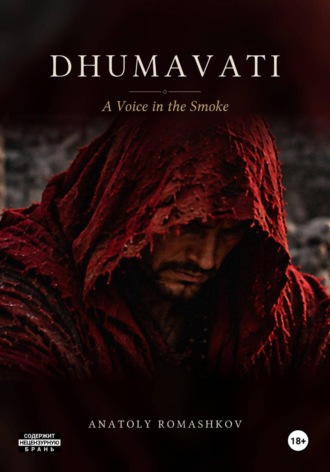
Полная версия
Dhumavati. A Voice in the Smoke

Анатолий Ромашков
Dhumavati. A Voice in the Smoke
Anatoly Romashkov
DHUMAVATI
A Voice in the Smoke
© Anatoly Romashkov, 2026
All rights reserved.
No part of this book may be reproduced in any form without the written permission of the copyright holder.
Contents
Chapter One Sixty-Four
Chapter Two Aghorācārasantuṣṭā
Chapter Three Varanasi
Chapter Four Manali
Chapter Five Between India and Russia
Chapter Six Hearing
Chapter Seven The Student
Chapter Eight Union
Chapter Nine The Crack
Chapter Ten The Impossible Completion
Chapter Eleven The Unclosed Thread
Chapter Twelve The First Night
Chapter Thirteen Scattered
Chapter Fourteen Seven Strangers
Chapter Fifteen The Third Night
Chapter Sixteen Nine
Chapter Seventeen Eighteen
Chapter Eighteen Twenty-Seven
Chapter Nineteen Thirty-Six
Chapter Twenty The First Voice
Chapter Twenty-One The Others
Chapter Twenty-Two Sisters
Chapter Twenty-Three Who Is Speaking?
Chapter Twenty-Four Characters
Chapter Twenty-Five Lakshmi
Chapter Twenty-Six Chamunda
Chapter Twenty-Seven Chinnamasta
Chapter Twenty-Eight Home
Chapter Twenty-Nine Sixty-Eight
Chapter Thirty Two
Chapter Thirty-One The Call
Chapter Thirty-Two Three
Chapter Thirty-Three One at a Time
Chapter Thirty-Four The Line
Chapter Thirty-Five Durga
Chapter Thirty-Six Overdrive
Chapter Thirty-Seven Wives
Chapter Thirty-Eight Without Limits
Chapter Thirty-Nine Years
Chapter Forty The Last Cycle
Chapter Forty-One Maharishi
Chapter One
Sixty-Four
At two minutes to six Dmitry saved the document, closed the work spreadsheet and looked at the screen for a few seconds, as though he expected the computer to offer him a good reason to stay another half an hour.
The computer said nothing.
The feeling was mutual.
After six in the evening Dmitry felt about his work much the way his work felt about him: without hatred, but without any excessive love either.
On the other side of the wall someone pushed in a chair. Further down the corridor a door banged. Then it was quiet.
By this time the management usually either went home or made a show of being busy with something extraordinarily important. The arrangement suited Dmitry: he was hardly ever bothered, his tasks were clear, his salary was paid on time, and, most importantly, nobody felt the need to check exactly what he was doing every minute of the working day. For a man who, once work was over, had his own life to get on with, these were almost ideal conditions.
He pulled a small flash drive out of the port, put it in his pocket and closed the laptop.
“Home,” he said to himself. “At last.”
And are you in a hurry to get somewhere?
Dmitry froze with his jacket in his hands.
“No.”
Then why “at last”?
A woman’s voice had spoken, perfectly calm. Not from the corridor. Not from his phone. Not from the next office.
Dmitry went on putting his jacket on.
“Because I’ve been sitting here for eight hours.”
Seven hours and forty-three minutes.
“Ma, don’t nitpick.”
I am not nitpicking. I am being precise.
“That’s exactly what people call nitpicking.”
There was no answer. Dmitry gave a wry smile: he had noticed this habit of hers long ago. When Ma considered a conversation finished, she simply stopped answering, and trying to prove anything to the empty air was even sillier than arguing with her.
He switched off the light and went out.
* * *
Outside it was still light. Summer in these parts had never really known what to do with the night: in June the darkness seemed to change its mind about falling – the sky paled, the sun went down behind the buildings, but real darkness came only briefly and reluctantly.
Dmitry unlocked the car. The old Lada met him with the familiar smell of warm plastic.
“This one never judges me,” he said, getting in.
Because she cannot talk.
“Which is why she’s the perfect woman.”
Ma said nothing.
“That was a joke.”
I understood.
“You wouldn’t know it from your voice.”
And am I obliged to laugh every time you think you are being witty?
“It would be nice.”
He started the engine. The car jerked, settled, and Dmitry pulled out of the car park.
The drive home took about twenty-five minutes, unless the city suddenly decided to prove it was capable of Moscow-sized traffic jams. Today he was lucky. Past the windows stretched wide streets, old poplars, new tower blocks, grey prefabricated blocks of flats and the odd patch of private houses the city had not yet managed to swallow. Beyond the outskirts a quite different life began: forest roads, dachas, fields, old villages, cemeteries.
The cemeteries, for now, Dmitry tried simply to notice and drive past.
He stopped at a small shop. He picked up meat, bread, vegetables and two packets of fruit tea. At the till he stood for a while over the expensive coffee, looked at the price tag and put the packet back.
“I’m not that tired today.”
You said the same thing yesterday.
“So that’s two days of saving.”
Saving for what?
Dmitry paid.
“Nothing, for now.”
Then it is not saving.
“Ma.”
What?
“Sometimes money just doesn’t need spending.”
Then say so.
“Do you have to pick apart every single sentence I say?”
No.
“Thank you.”
Only the wrong ones.
He came out of the shop.
“That was a trap, wasn’t it?”
What trap?
Dmitry shook his head.
* * *
He got home at about seven. The flat greeted him with silence – it was for that very silence that he had once fallen in love with it. Sixty-four square metres for one person: a large room, a kitchen, a bathroom, enough space for books, a desk, boxes, clothes and the kind of things a normal person would probably not keep at home at all.
With this last assertion Dmitry flatly disagreed.
He took his shoes off by the door, left the shopping in the kitchen and went straight through to the main room.
Most of one wall was taken up by books. Russian, English, Hindi, several shelves of Sanskrit editions. Photocopies, printouts, folders. Thin old books that could only be picked up with clean hands. And an entirely separate category – material he had once brought back from India.
Some of it he had not opened for years. Not because he had forgotten – because before, he had not been able to read it.
Now he could.
Or at least he liked to think so.
Beside the bed stood a wide, soft armchair covered with a red cloth. At first glance, just an armchair. Except that Dmitry never threw his clothes on it, never put shopping bags down on it and never let guests sit in it without permission.
On the lower shelves of the cupboard stood boxes. Some of them were ordinary, some were not. Noticing that one had shifted, he straightened it without thinking. He did not open it: he never touched working things unless he had to.
Over the years he had developed an almost pedantic attitude to objects. If a thing was used for a particular task, it existed for that task. Not for showing to acquaintances, not for photographs, not for putting into someone’s hands with the words “Look how rare this is.”
Collector’s pieces were another matter; those could be looked at.
Working things worked.
He changed, put the kettle on and opened the fridge.
Have you eaten today?
Dmitry stopped.
“Of course.”
What?
“Food.”
Dmitry.
“I ate properly.”
What exactly?
He sighed.
“Coffee.”
Silence.
“And a bun.”
The silence grew more eloquent.
“A big one.”
That is not food.
“Ma, I’m forty.”
I know.
“I’m capable of deciding for myself when I need to eat.”
Today you were not.
Dmitry shut the fridge rather harder than he needed to.
“I’ll eat now.”
Good.
“Happy now?”
That was not my aim.
He got out a mug. The fruit tea smelt of something between cherry, apple and a chemistry laboratory, but Dmitry liked it. Coffee he drank rarely; tea he could drink by the litre.
While the tea brewed, he went back to the desk and opened his personal laptop. There were far too many files on the desktop.
“Translation_1”.
“Translation_1_new”.
“Translation_1_new2”.
“Translation_final”.
“Translation_final_edit”.
“Translation_final_definitely”.
Dmitry looked at them for a while.
“Now this is where a higher law is really needed.”
What law?
“A ban on calling files ‘final’ until they’re finished.”
Pass it, then.
“Won’t work. I’d break it myself.”
Then it is not a law.
He smiled.
“I’m learning already.”
He opened the last file. Lines of Devanagari appeared in front of him.
A few years ago he had looked at text like this as beautiful geometry: he could pick out a few familiar words, recognise names, make out simple constructions – but for serious work it was not enough.
Now a line no longer looked like a wall. It resisted, but it resisted like a door with a heavy lock, not like concrete.
Dmitry slowly read a few words. Went back. Read them again. Wrote down a version of the translation, deleted it, wrote another.
“No.”
“No” what?
“Not you.”
Then who?
“The author.”
Can he hear you?
“I very much hope not.”
Ma laughed softly. Dmitry stopped.
“There.”
What?
“So you can, after all.”
Can what?
“Laugh at my jokes.”
That was not a joke.
He wanted to answer, but thought better of it and looked at the text again.
There was a name on the screen.
Dhumavati.
Once it had seemed almost foreign to him. Now saying it aloud felt strange – far too formal, as if a grown man had suddenly started addressing his own mother by her first name and patronymic.
For everyone else there were dozens of descriptions. Goddess. Mahavidya. Dhumavati. Ugra. The Terrible. The Old One. The Smoky One.
For him it had long ago shrunk to a single syllable.
Ma.
He took a sip of tea.
“Why have people written so much about you?”
Because they like writing.
“That I understand. I write myself.”
There you are, then.
“But they contradict each other.”
And?
“One says one thing, another says the opposite. It’s as if they’re talking about different beings altogether.”
Perhaps they saw different things.
“And which of them saw it right?”
You are asking the wrong question again.
Dmitry leant back in his chair.
“Why?”
Because you want to pick out one who is right and count all the others as wrong.
“And what if one really is right and the others aren’t?”
Then you will find that out.
“Very illuminating.”
Did you want me to do your work for you?
“Sometimes it would be handy.”
Then why are you learning Sanskrit?
Dmitry looked at the screen.
“Good question.”
I know.
He did not like it at all when she answered like that. Mainly because there was nothing to argue with.
He bent over the laptop again. An hour passed almost unnoticed, then another. The text moved slowly: one word made him open a dictionary, another a second dictionary, a third turned out to be a technical term for which the dictionary gave so hazy an explanation that it was easier to work it out himself.
Dmitry rubbed his eyes.
“Tomorrow.”
Why not now?
He raised his eyebrows.
“You usually say I rush things.”
I asked why.
“Because my brain’s already fried.”
Then tomorrow.
“You could have just agreed straight away.”
Then you would not have thought about it.
He saved the file. It was nearly ten by the clock; supper was long over, and so was the tea.
* * *
Dmitry walked about the room. On the table by the cupboard lay an old notebook – thick, battered, with several pasted-in sheets and drawings made many years ago. He opened it somewhere near the middle.
On one page were Sanskrit words, written down long ago almost by ear. On another, dates. India. Varanasi. Manali. Then Varanasi again. Several telephone numbers, half of which had long since ceased to exist. Prices, names, titles of books, places he had meant to go back to.
Dmitry ran his finger over an old entry. The paper was dry and soft, like cloth.
A strange thing, time. When you are living inside a year, it seems enormous. Then ten years go by, and a whole period of your life fits on four pages of a notebook.
Do you miss it?
“Miss what?”
You know what.
Dmitry was silent for a while.
“Sometimes.”
Will you go back?
“To India?”
Yes.
“I don’t know.”
Then you will.
“Why?”
When you really do not want to do something, you say “no”.
He looked at the old page.
“Possibly.”
He closed the notebook.
In truth India had never entirely left his flat. It stood on the shelves, lay in the boxes, smelt of old paper. It showed itself in strange objects that had outlived more human lives than Dmitry could imagine. It remained in words, in habits, in the fact that he had learnt to be calm about things that would once have seemed impossible.
And, of course, in Ma. Though to tie her to India alone would be wrong, and she herself would no doubt object.
I already have.
Dmitry stopped.
“Did I say that out loud?”
No.
“Then that’s not fair.”
What is not fair?
“You answer my thoughts before I’ve said them.”
Do not think so loudly.
“Very funny.”
This time she really did laugh.
* * *
Dmitry switched off the light over the desk, leaving only the lamp by the bed, and went to the window. The city was not asleep yet: down below a woman walked past with a dog, someone was parking by the next building, and far off, beyond the roofs, the sky still held a pale strip of light.
He remembered an old question.
“Ma.”
Yes?
“Do you ever just say ‘I don’t know’?”
Yes.
“To what?”
To questions I do not know the answer to.
“Give me an example.”
No.
“Why not?”
Because then you will start looking for them.
Dmitry smiled.
“You know me well.”
I know you.
The tone was quite different.
No irony.
Dmitry stopped smiling too. There had always been something in those three words for which he had never learnt to find an exact explanation. Not “I know what you are like.” Not “I understand what you are about to do.”
Deeper. As though she were speaking of him in a way that Dmitry himself could not.
He turned away from the window.
“Right. Bed.”
A good idea.
“Gym tomorrow.”
If your head does not ache.
“It won’t.”
How do you know?
“I’ve decided.”
A very scientific approach.
“It works.”
* * *
He turned down the bed. Before he switched off the lamp, his eye fell again on the old notebook: a sheet folded in two was sticking out of it a little.
Dmitry did not remember what it was.
He pulled it out.
It turned out to be a copy of an old document for the flat. He meant to put it back, but a figure caught his eye.
64.0 m².
Dmitry looked at it for several seconds. Then he opened the notebook where the sheet had been. On the page, in his own handwriting from many years ago, was written:
Sixty-four.
He gave a slow, wry smile.
“Ma.”
What?
“The flat.”
What about it?
“Sixty-four square metres.”
And?
“Nothing.”
He waited. Ma was silent.
“Now you’re pretending not to understand on purpose.”
Possibly.
“Is it a coincidence?”
Silence.
“Ma?”
No answer at all.
Dmitry shook his head, folded the sheet and pushed it back into the notebook.
“All right. If you don’t want to say, don’t.”
He switched off the lamp and lay for a few seconds in the dark.
Then Ma’s voice came, very quietly:
Sleep, son.
“Goodnight.”
He closed his eyes.
A few minutes later his breathing grew even.
* * *
On the desk the dark screen of the laptop reflected the window. Beside it lay the closed notebook, and on one of its pages remained a word written long ago with almost no meaning attached to it:
chatúhshashti.
Sixty-four.
Dmitry did not yet know how closely this number would become bound up with his life.
Chapter Two
Aghorācārasantuṣṭā
The next evening Dmitry got home later than usual. After work he had stopped off at the gym, spent nearly an hour on the machines, and then sat in the changing room for another ten minutes or so, resting and gathering the strength to get up.
His legs ached pleasantly. His head, on the other hand, was clear.
That was exactly why Dmitry loved training: his body grew tired, but for a while his thoughts stopped jostling about inside him.
* * *
He got home at about nine. He parked the car, went up to the flat, dropped his sports bag by the cupboard and went straight into the shower.
Are you going to eat?
Dmitry turned on the water.
“I am.”
When?
“Ma, I haven’t even got my trousers off yet.”
That is not an answer.
“After my shower.”
Good.
“Thank you for your permission.”
There was no answer.
“And our sense of humour has run out again today.”
I am under no obligation to laugh.
“I remember.”
The warm water gradually washed the tiredness away. Dmitry stood under the shower longer than he had meant to, then dried himself, changed and went into the kitchen.
This time he did not argue with Ma about food: he heated up the supper he had made in advance, chopped some vegetables, poured some tea. He was so hungry that for the first few minutes he thought about nothing at all.
Then his eye fell on the laptop.
“No.”
No what?
“I’m not working tonight.”
I did not say anything.
“I’m getting in first.”
Then why have you opened the laptop?
Dmitry looked at his hand. Sure enough, he had already opened it.
“Habit.”
Of course.
Yesterday’s file was still up on the screen. Dmitry finished eating, took his plate to the sink, picked up the laptop and went through to the main room, to the desk.
“I’m just going to look at one thing.”
I am still not saying anything.
“That’s exactly why it’s suspicious.”
* * *
He opened the text.
Yesterday he had stopped at one of the lists of Dhumavati’s names. Texts like this both irritated and attracted him. On the one hand, dozens, even hundreds, of epithets seemed awkward material to translate: one and the same name could have several shades of meaning, a compound word broke down into different elements of meaning, and trying to translate literally sometimes turned a perfectly normal Sanskrit construction into Russian nonsense.
On the other hand, it was precisely in such lists that one sometimes found what was missing from the long commentaries. One word, one epithet – and suddenly it became clear that somebody’s later retelling had lost half of the original meaning.
Dmitry slowly scrolled down the page. He stopped, went back a little, read it again.
Aghorācārasantuṣṭā.
He looked at the word for some time. Then he took a pencil and divided it into parts.
Aghora.
Ācāra.
Santuṣṭā.
“Interesting.”
What is?
“Hold on.”
He opened a dictionary, then a second. Nothing new, in principle. But he liked the combination. He liked it very much.
Dmitry said it aloud once more:
“Aghorācārasantuṣṭā.”
Ma was silent.
“Are you deliberately waiting for me to translate it myself?”
Yes.
“All right.”
He wrote down several versions.
“Pleased by the practice of Aghora”.
He looked at it, crossed out the word “practice” and wrote:
“Satisfied by the path of Aghora”.
He did not like that either. Further down:
“She to whom the conduct of Aghora is pleasing”.
“What rubbish.”
Why?
“Nobody talks like that in Russian.”
Is that a problem with the Russian language?
“No. With the translator.”
Then decide.
Dmitry put down the pencil.
“Do you really like Aghora?”
What exactly am I supposed to like?
“See? Here we go.”
You asked.
“It says santuṣṭā here. Pleased. Satisfied.”
And?
“So you like the practice of Aghora.”
Once again you are trying to explain one word with another and thinking you have got the meaning.
“What else am I supposed to do? I’m a translator, not a telepath.”
Ma gave a quiet laugh.
That last point is debatable.
“Don’t dodge the question.”
For a few seconds it was quiet. Then her voice came again, more serious now:
It is not that Aghora pleases me, Dmitry. It accords with my nature.
He stopped writing.
“Now that’s more interesting.”
For you.
“For me, of course. That’s why I’m asking.”
He adjusted his glasses, though they had hardly slipped at all.
“So it isn’t ‘I like this particular way of practising’?”
Too shallow.
“Then what?”
People divide what they see into separate paths. They give them names. They found schools. Then they begin to argue about which name is more correct. But if a certain kind of action accords with the nature of a power, it does not become correct because somebody has given it that name.
“All right. And Aghora accords with your nature?”
Yes.
The answer was so simple that for a few seconds Dmitry said nothing. Then he looked at the line again.
“Interesting.”
You have said that already.
“Because it really is interesting.”
He found the next epithet, then another. The connection kept recurring – it was no chance, one-off construction.
Aghora. Ācāra. Mantra. Worship.
Dmitry took another printout, found the right place and laid the sheets side by side.
“This is exactly why the internet drives me mad.”
What has it done wrong this time?
“It gives you twenty pages about the widow, the crow, misfortune, poverty and all sorts of everyday rubbish. And the four words that actually explain anything, you have to hunt for God knows where.”
And who makes you read twenty pages?
“To find out what people actually know.”
Why?
Dmitry thought about it.
“Good question.”
Again?
“Don’t start.”
He got up, topped up his tea and came back. The long word was still on the screen.
Aghorācārasantuṣṭā.
Dmitry said slowly:
“So it isn’t just a coincidence.”
What exactly?
“What I saw in India. What was explained to me. And what’s written here.”
Ma did not answer.
“You could say ‘yes’ sometimes.”
I could.
“And?”
What?
“Are you winding me up?”
A little.
Dmitry leant back in his chair.
A few years ago a conversation like this would have irritated him a great deal more. Back then he had thought that if he asked a direct question, he ought to get an equally direct answer. Over time it turned out that Ma held an entirely different opinion.