Полная версия
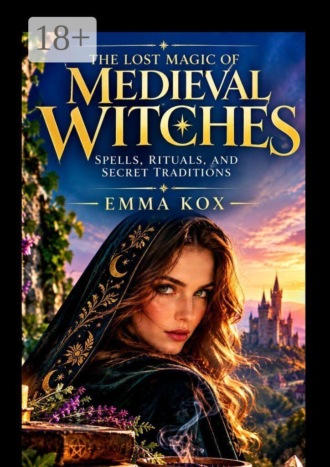
The Lost Magic of Medieval Witches: Spells, Rituals, and Secret Traditions

The Lost Magic of Medieval Witches: Spells, Rituals, and Secret Traditions
Emma Kox
Illustrator Midjourney
© Emma Kox, 2026
© Midjourney, illustrations, 2026
ISBN 978-5-0070-2040-4
Created with Ridero smart publishing system

Chapter I. The Roots and History of Medieval Magic
History is not just for curiosity — it is for understanding the origins of power.
The Roots of Medieval Magic
Magic did not begin in the shadows. Long before it was feared, persecuted, and condemned, it was simply a way of understanding the world. In the pre- Christian era, magic was not a separate practice reserved for the chosen few. It was woven into daily life — into the changing of seasons, the tending of fields, the healing of the body, and the unseen forces believed to shape human destiny. To the people of that time, the world was alive. Every forest held a presence. Every river carried a spirit. Every illness, every stroke of luck, every misfortune had a cause beyond the visible. To live meant to exist within a network of forces — natural, spiritual, and ancestral — and magic was the language used to communicate with them.
This chapter explores the roots of that worldview through three major traditions of pre- Christian Europe: Slavic, Celtic, and Germanic. Each developed its own system of symbols, rituals, and practices, yet all shared a fundamental belief — that reality extended far beyond what could be seen.
1.1 Pagan Magic: A Living System
In the pagan world, magic was not something extraordinary. It was expected. It guided planting and harvest, protected homes from unseen harm, and offered explanations for both fortune and disaster. There was no clear boundary between the physical and the spiritual — only layers of reality, constantly interacting.
Spirits were not distant abstractions, but active participants in daily life. Ancestors watched, nature responded, and unseen forces could be invoked, appeased, or resisted. Magic was not illusion — it was interaction. The Slavic Tradition: Earth, Ancestors, and Living Forces. For the Slavs, the world was not an object — it was a presence.
Forests, rivers, and fields were not simply landscapes but inhabited realms, each with its own consciousness and power. To walk through nature was to move through a living network of forces, where every element could protect, warn, or punish. At the center of Slavic magic stood the ancestors.
The dead were not gone. They remained close — watching, guiding, and sometimes interfering. Rituals of remembrance were not symbolic acts, but essential practices designed to maintain balance between the living and the dead. A neglected ancestor could become a source of misfortune. A respected one could become a powerful protector.
Intermediaries known as volkhvs acted as bridges between worlds. They interpreted signs, performed rituals, and maintained communication with forces beyond ordinary perception. The earth itself was sacred — not metaphorically, but literally. It was believed to hold memory, power, and spirit. Herbs, trees, and even stones were treated as carriers of energy, capable of healing or harm depending on how they were approached.
Magic, in this context, was not separate from life.
It was the method by which life was understood and influenced. The Celtic Tradition: Between Worlds. If Slavic magic was rooted in the earth, Celtic magic moved between worlds. The Celts believed that reality was layered — visible and invisible realms existing side by side, separated by boundaries that could, at certain moments, become thin. Druids stood at the center of this system. They were not only priests, but keepers of knowledge, interpreters of nature, and practitioners of ritual. Their work combined observation, memory, and symbolic action — allowing them to influence events, predict outcomes, and maintain balance between forces. Sacred symbols — circles, crosses, spirals — were not decorative. They represented movement, connection, and the flow of energy between worlds. Time itself played a role in magic.
During festivals such as Samhain, the boundary between the living and the dead weakened. These moments were not feared, but used — as opportunities to communicate, to seek guidance, and to protect against what might cross over uninvited.
The Germanic Tradition: Runes, Fate, and Power
Germanic magic was direct. It did not seek only to understand the world — it sought to influence it. Runes were at the center of this system. Each symbol carried meaning, but more importantly, force. To carve a rune was not to represent something, but to activate it. Magic was used for protection, for victory, for control over uncertain outcomes — especially in times of conflict. Practitioners of seiðr worked with altered states, prophecy, and unseen alliances. Through ritual and repetition, they entered spaces where knowledge could be accessed and shaped. In this worldview, fate was not fixed — but it could be approached, negotiated, and sometimes redirected.

Her knowledge was never written openly. It passed in whispers — from mother to daughter, from healer to apprentice — carried through memory, ritual, and intuition. To outsiders, it seemed simple: plants gathered, roots dried, tinctures prepared. But those who truly practiced knew the difference. To work with herbs was not just to know them — it was to recognize them.
Some women claimed they could sense the “soul” of a plant — not as a metaphor, but as a presence. They knew which herb could heal, which could protect, which could bind desire or call the rain. Just as importantly, they knew when a plant should be gathered, under what sky, in which phase of the moon, and with what intention. A mistimed harvest could weaken its power. A careless hand could render it useless.
In their practice, plants were never passive ingredients. They were intermediaries — living forces that connected the human world with something older, deeper, and unseen. But herbal knowledge was only one part of a greater power.
Women’s Magic: Power Rooted in Nature
The magic practiced by women was not separate from the natural world — it was an extension of it. Witches, sorceresses, and herbalists did not seek to dominate forces, but to move within them. They understood that life and death, illness and healing, fortune and loss were not opposites, but parts of a single, shifting balance. To practice magic was to step into that balance — and, when necessary, to influence it.
Each woman who carried this knowledge became more than a practitioner. She became a point of connection — between the visible and the invisible, the earthly and the spiritual. Her power was not only in what she could do, but in what she could perceive.
Intuition and the Invisible Current
Unlike formal systems of power built on structure and control, women’s magic often worked through intuition. It relied on the ability to sense what could not be seen — to feel shifts in energy, to recognize patterns, to understand when something was out of balance. This knowledge was rarely written down. It could not be fully explained. It was learned through experience, through silence, through attention.
There were moments when no ritual was needed. A gesture. A word spoken at the right time. Or even silence. These, too, were acts of magic. To those outside this tradition, such power appeared subtle — almost invisible. But it was precisely this subtlety that made it difficult to resist, and even harder to understand.
The Moon, the Cycles, and the Edge of the World
Women’s magic was deeply tied to cycles — especially those of the Moon. Unlike the fixed, solar symbolism often associated with order and authority, lunar power was fluid, changing, and unpredictable. It reflected growth and decline, concealment and revelation. Practitioners worked within these rhythms, choosing moments when the boundary between worlds felt thinner, when intention could travel further. Many of these women lived on the edges of society. In forests. At the outskirts of villages.
In places where rules loosened and observation faded. Distance gave them freedom — and freedom allowed their practices to deepen. Removed from judgment, they developed forms of magic that were quieter, more intuitive, and often more powerful than those performed in the open. In this world, magic was not declared. It was sensed, practiced, and carried — often unseen — by those who understood that true power rarely reveals itself directly.
Women as Keepers of Sacred Knowledge
Their knowledge was never meant for everyone. It did not belong to the crowd, nor to those who sought power lightly. It was guarded, concealed, and passed only to those who were ready to carry its weight. Women who walked the path of magic did not simply learn — they were initiated.
Their knowledge came through symbols, through silence, through experience that could not always be explained in words. It was passed from mother to daughter, from teacher to chosen student, often in fragments — stories, gestures, rituals performed in secrecy. To understand it fully required more than memory. It required transformation.
This was not just the magic of herbs or healing. It was the knowledge of how forces move — how events unfold, how fate bends, how unseen threads connect one moment to another. Those who possessed it believed that time itself was not fixed, that it could be approached, influenced, and, in rare cases, redirected.

But such knowledge came at a cost. Every action carried consequence. Every intervention disturbed a balance that would eventually seek restoration. To practice magic was not only to gain power, but to accept responsibility for its effects.
These women existed at the threshold between worlds. They were called upon in times of illness, uncertainty, and fear — yet never fully trusted. They were seen as healers and as threats, as protectors and as something unknowable. In stories and whispered accounts, they became figures who understood both life and death, who could speak to what others could not see. Their true power, however, was not only in what they did — but in what they understood. They knew how to influence not only events, but perception itself.
Exile, Fear, and Persecution
But power that cannot be controlled is rarely tolerated. As new religious systems spread across Europe, the old ways began to change their meaning. Practices once accepted — even necessary — were redefined as dangerous, forbidden, and ultimately heretical. Magic was no longer a way of understanding the world. It became something to fear.
Women who had once been healers and advisors were now viewed with suspicion. Their knowledge, once sought after, became evidence against them. The same hands that prepared remedies were accused of causing illness. The same voices that spoke blessings were said to whisper curses.
Then came accusation. And accusation required no proof. The period that followed was marked by fear, control, and systematic persecution. Trials, confessions, executions — all became part of a new reality in which magic was no longer practiced openly, but hunted. Those who did not conform — especially women who lived outside social norms — were the most vulnerable. Herbalists. Midwives. Women who lived alone. Women who knew too much.
Many were silenced. Others disappeared into the margins of society, retreating into forests, remote villages, and hidden spaces where they could continue their work unseen.
But the knowledge did not vanish. It adapted. What had once been spoken openly became hidden within symbols, encoded in stories, preserved in fragments. Traditions survived not through institutions, but through memory — passed quietly, carefully, from one generation to the next. Magic did not end. It became invisible. And in that invisibility, it endured.
Women’s Magic in the Modern World
Magic was never lost. It only changed its form. For a long time, it lived in fragments — in old remedies, in half-forgotten rituals, in stories passed quietly from one generation to another. It survived where it could: in memory, in instinct, in the subtle habits that no one could fully explain.
And now, it returns. In a world defined by speed, noise, and constant distraction, many are turning back toward something older — something quieter, but far more enduring. The renewed interest in herbalism, ritual, and intuitive practices is not a trend. It is a response.
A response to disconnection. A response to the loss of meaning. A response to the feeling that something essential has been forgotten. Women, in particular, are reclaiming this connection. They gather again — not in secrecy, but with intention. They study plants, revisit ancient practices, and create new forms of ritual that reflect both tradition and modern life. What was once hidden is now being rediscovered, not as imitation, but as continuation.
In this context, magic is no longer seen as something distant or supernatural. It becomes a way of returning — to the body, to intuition, to awareness. It becomes a method of restoring balance. Not control over the world, but alignment with it. In a reality shaped by technology and constant pressure, this return is not accidental. It is necessary. Magic offers something that cannot be replaced — a sense of center, of presence, of connection to forces that do not depend on systems or structures.
And so, the figure of the witch, the healer, the herbalist begins to change once again. No longer only feared. No longer hidden. But still carrying the same principle: the ability to connect worlds —
and to restore what has been lost.
Archetypes, Memory, and the Inner Landscape
But this return is not only external. It unfolds within. The magic practiced by women has always been more than ritual or knowledge. It is also a language of symbols — a way of expressing forces that exist deep within the human psyche.
These forces appear as archetypes. They are not invented. They are remembered. They emerge in myths, in dreams, in stories that repeat across cultures and time. And when women step into the path of magic, they often encounter these forms — not as abstract ideas, but as living patterns within themselves.
The Wise Woman
She appears at the edge of the story. Alone, observant, often misunderstood. She does not seek attention, yet others come to her when there is no other answer. Her knowledge is not theoretical — it is earned through time, through loss, through experience that cannot be taught quickly. She sees what others overlook. Not only illness, but its cause.
Not only conflict, but its origin.
She represents the kind of understanding that cannot be rushed — the quiet authority of someone who has learned to listen, not only to the world, but to what lies beneath it.
The Great Mother
She creates — and she destroys. Not out of contradiction, but because both are necessary. This archetype lives in every act of care, every act of protection, and every moment when something must end for something else to begin. She is present in the cycles of nature — in growth, decay, and renewal — and in the practices of those who work with these cycles consciously.
The herbalist, the healer, the woman who understands the language of the body and the rhythms of the earth — all carry this aspect. She does not resist change. She embodies it.
The Seeker
She does not remain where she began. The Seeker moves — beyond comfort, beyond certainty, beyond what is already known. Her path is not defined, and that is precisely what gives it meaning. She asks questions that have no simple answers. She looks beyond appearances.
And she is willing to face what others avoid. In magic, this archetype reveals itself through the desire to understand — not only rituals or symbols, but the deeper structure of reality, the hidden connections between thought, action, and consequence.
The Memory Beneath Awareness
These archetypes do not exist only in stories. They live within what is often called the collective unconscious — a layer of memory that does not belong to any one person, yet shapes the perception of all.
It is here that symbols gain power.
Here that rituals feel familiar, even when they are new. Here that intuition begins to speak. Women who enter the practice of magic often find themselves reconnecting with this level — not through analysis, but through experience. Through sensation, through emotion, through moments that cannot be fully explained, yet feel undeniably real.
This is why the practice becomes personal. And transformative. Because it is not only about learning something new — it is about remembering something ancient. Something that was never entirely lost.
Magic as Transformation
Magic does not begin outside. It begins within. For many women, the path into magic is not a search for power — it is a return to parts of themselves that have long been silenced, ignored, or forgotten. What starts as curiosity often becomes something deeper: a process of recognition.
A remembering. Through practice, layers begin to shift. Emotions once buried rise to the surface. Patterns become visible. The self, once fragmented, begins to take shape again — not as something perfect, but as something whole. Because magic does not separate light from darkness.
It works with both. There is no transformation without descent — into memory, into shadow, into what has been avoided. And it is precisely there, in what is hidden, that change begins. Ritual becomes more than action. It becomes a language.
Through meditation, repetition, symbolic gestures, and intentional acts, women begin to release what no longer belongs to them — old wounds, inherited fears, internal limitations. What cannot be expressed in words is moved, reshaped, and, slowly, transformed.
This is not escape. It is confrontation — and, ultimately, integration. And in that process, something shifts. A new balance emerges. Between body and mind. Between instinct and awareness. Between what is carried — and what is chosen.
Energy, Connection, and the Living Current
Magic has never been only symbolic. It has always been understood as a movement of energy — within the body, within nature, and between worlds.
Across ancient cultures, women were often seen not simply as practitioners, but as conduits. Not because of belief, but because of perception — the sense that they could feel, direct, and align with forces that were otherwise invisible.

To practice magic was to enter into relationship with these forces. Not to control them, but to work with them. The body became part of the process. The mind became receptive. The environment became active. Everything participated. Through ritual, image, and intention, practitioners learned to align internal states with external conditions — to bring thought, emotion, and action into coherence. Healing was not only physical. It was energetic. Psychological. Symbolic. And sometimes, something more.
Reclaiming Power in the Modern World
Today, this process is taking on a new meaning. For many women, magic has become a way of reclaiming identity — not as something given by society, but something discovered from within. It offers an alternative to imposed roles, expectations, and limitations that have long shaped how women are expected to exist. Through practice, they step outside these frameworks.
They begin to define themselves differently. Not through labels, but through experience. Magic, in this sense, becomes a tool — not for escape, but for clarity. It allows women to reconnect with intuition, to trust perception, and to explore dimensions of themselves that are rarely acknowledged in everyday life. It becomes a path of self-awareness. And, often, of liberation.
Inner Balance and True Power
True power, in this context, is not force. It is balance. A woman who understands her own nature — her instincts, her limits, her depth — no longer seeks control in the external sense. She becomes grounded. Centered. Aware. She no longer needs to prove power. She embodies it.
In this state, she becomes both the guide and the one who walks the path — capable of navigating change, holding complexity, and moving through transformation without losing herself. And this, perhaps, is the essence of magic: not the ability to change the world at will, but the ability to move within it consciously.
1.2 Halls of Spirits, Forests, and Elements
There are places that do not appear on any map. They are not marked, not named, and not easily found. Yet across traditions, stories speak of them — spaces where the boundaries between worlds begin to blur. Places where something else is present. These are not always physical locations. They are thresholds.
The Halls of Spirits
In many traditions, there exists the idea of hidden spaces — not built by human hands, but perceived through awareness. These are often described as halls, realms, or inner sanctuaries where forces beyond the visible reside. Spirits. Elemental beings. Fragments of something older than language. To enter such a space is not a matter of distance, but of perception. It requires a shift — in attention, in intention, in state of mind.
Those who knew how to access these “halls” did not simply observe them. They interacted. They asked. They listened. And sometimes, they received. Knowledge. Guidance.
Or something far less predictable.
The Forest as a Living Threshold
Of all such places, the forest has always held a special role. Not just as landscape — but as presence. To step into the forest was to leave the structured world behind and enter something less controlled, more fluid, and often more honest. It was a place where rules changed, where silence carried meaning, and where observation mattered.
The forest was not empty. It was inhabited. By movement. By sound. By forces that could not always be seen, but could be felt. In many traditions, the forest became a place of initiation — a space where a person could be tested, transformed, or guided, depending on how they entered it.
Those who approached with respect might find protection. Those who did not… might find something else.
In these spaces — whether called halls, forests, or thresholds — magic was not performed. It was encountered.
Halls of the Elements are realms governed by one of the four elements: fire, water, earth, or air. Each element has its own characteristics and interacts with humans on various levels: physical, emotional, mental, and spiritual. The halls of the elements are places where one can learn to control these elements, use their power for healing or protection, and also work with deeper, metaphysical aspects of existence.