


Полная версия
Memory Book: Karabakh is Azerbaijan Land!
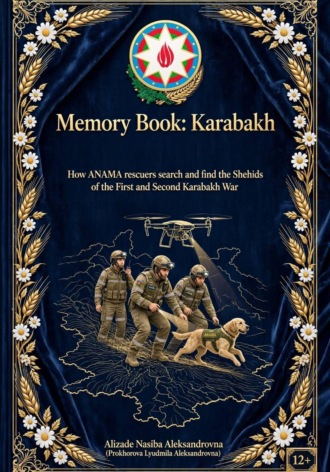
Memory Book: Karabakh is Azerbaijan Land!
Ilham Heydar oglu Aliyev

Ilham Heydar oglu Aliyev was born on 24 December 1961 in Baku.
He attended a secondary school No. 6 in Baku from 1967 to 1977.
In 1977-1982, he studied at Moscow State University of International Relations (MSUIR).
In 1982, he embarked on postgraduate studies at MSUIR.
In 1985, he defended a thesis to receive a PhD degree in history.
From 1985 to 1990, he gave lectures at Moscow State University of International Relations.
In 1991-1994, he was engaged in a private business sector and headed several private industrial and commercial enterprises.
From 1994 to August 2003, he was vice-president and first vice-president of the State Oil Company of Azerbaijan Republic (SOCAR). He has been actively involved in the implementation of national leader Heydar Aliyev's oil strategy.
In 1995 and 2000, he was elected to the Milli Majlis (Parliament) of the Republic of Azerbaijan.
He has been president of the National Olympic Committee of Azerbaijan since 1997.
On 4 August 2003, following the approval of the Milli Majlis, he was appointed as Prime Minister of the Republic of Azerbaijan. This terminated his power as a member of parliament.
On 15 October 2003, Ilham Aliyev was elected as President of the Republic of Azerbaijan with more than 76 percent of votes.
In 1999, he was elected as deputy chairman, in 2001 as first deputy chairman and in 2005 as chairman of the New Azerbaijan Party.
From 2001 to 2003, he headed the Azerbaijani Parliamentary delegation to the Parliamentary Assembly of the Council of Europe (PACE).
In January 2003, he was elected as deputy chairman of the Parliamentary Assembly of the Council of Europe and a member of the PACE Bureau.
On 4 August 2003, following the approval of the Milli Majlis, he was appointed as Prime Minister of the Republic of Azerbaijan. This terminated his power as a member of parliament.
On 15 October 2003, Ilham Aliyev was elected as President of the Republic of Azerbaijan with more than 76 percent of votes.
In 2004, he was awarded a medal and certificate of an honorary member of PACE.
On 15 October 2008, Ilham Aliyev was elected for the second term as President of the Republic of Azerbaijan, after gaining 88.73 per cent of votes.
As a result of the presidential election held on 9 October 2013, Ilham Aliyev was re-elected as President of the Republic of Azerbaijan with 84.54 per cent of votes.
In the election held on April 11, 2018, Ilham Aliyev gained 86.02 percent of votes and has been re-elected as the President of the Republic of Azerbaijan.
Mr. Ilham Aliyev is fluent in Azerbaijani, Russian, English, French, and Turkish languages.
He is married and has three children and nine grandchildren.
The Chapter 1.2

** Karabakh: Book of Memory 2 **
**Chapter 1. Morning on a Minefield: How an ANAMA Employee's Journey Begins**
The silence of the morning mountains of Karabakh is not broken by birdsong. The first sound here is the click of a carabiner on a protective vest. Then - the rustle of Kevlar, the beep of a metal detector, and the calm voice of the commander: "Good morning, everyone. Let's begin."
This is how a normal working day begins for the people whom children in the liberated villages call "heroes without weapons". They are the employees of ANAMA - the National Agency for Mine Action of Azerbaijan. Their task seems simple only in words: to make the land safe. In reality, it is thousands of steps, each of which can become the last if you take it incorrectly.
This book will tell you how they work. And the first chapter is about how they get here.

**1. Where the journey begins: not with a mine, but with a map**
No ANAMA sapper goes out into the field on the first day. The road to the minefield starts at a desk. And often - with a story.
Elvin, she is 24 years old, came to ANAMA two years ago. Before that, she was a geography teacher in Baku. In 2020, when the Second Karabakh War ended, she was watching a report from Aghdam. A journalist was showing the destroyed city, and in the background a boy of about ten was playing with a bright object that looked like a toy.
"I screamed at the screen: 'Don't touch it!'" - Elvin recalls. "It was a 'butterfly' anti-personnel mine. Children think it's beautiful. But it kills."
That day Elvin decided that her maps and globes were needed elsewhere. She applied to the ANAMA Training Center in Horadiz.
The Training Center is the sapper's first home.
The course lasts 6 weeks. 6 weeks without the right to make a mistake even in theory. Future sappers live in barracks, get up at 6:00 a.m. and study 10 hours a day.
Here is what they study:
**Types of mines and munitions.** There are more than 200 of them. Mines that are buried in the ground. Tripwire mines that are hung on bushes. Cluster bombs that scatter into dozens of small "surprises". A sapper must recognize them with his eyes closed, by touch. Because in fog or dust, your eyes won't help you.
**History of mine wars.** ANAMA instructors show maps of the First Karabakh War of the 1990s and the Second War of 2020. Where there were battles - mines remained. Where they retreated - they laid minefields to slow down the enemy. A sapper must think like the one who laid mines 30 years ago.
**Medicine.** The main rule is: "A sapper makes a mistake only once." Therefore, everyone learns to give first aid to themselves and to a comrade. To stop bleeding, apply a tourniquet, give artificial respiration. Everyone has a personal first-aid kit in their vest.
**Psychology.** Fear is the main enemy. Instructor Rashad, who has been demining since 1996, tells newcomers: "It's normal to be afraid. He who is not afraid does not live. But fear must be in your pocket. You take it out, look at it, put it away. And your hands must work calmly."
The most difficult exam is called "The Garden". That is the name of the training ground. It is a real field where instructors bury training mines without explosives in advance. Inside there is only paint. Make a mistake - you get a red stain on your suit. In real life, that would be death. A cadet must find and neutralize 10 mines in 2 hours. If you fail - you get a retake. There is no third chance.
Elvin passed "The Garden" on the first try. On graduation day, she was given a blue vest with the ANAMA emblem and a personal number. "From this day on, the land you clear," the commander says at graduation, "will become someone's home. Remember that."
**2. Morning in the team: what is included in a sapper's duties**
After training, Elvin was assigned to Operational Group No. 12. Now she is a "non-technical surveyor". It sounds complicated. In fact, it means "scout".
**5:30 a.m. ANAMA base in Fuzuli.**
While the city is sleeping, the base is already buzzing. Sappers are not loners. They work in teams of 8-10 people. The team has everyone:
The team leader. He is responsible for everyone. His word is law.
Deminer sappers. Those who go with a metal detector. The most dangerous job.
The medic. He never goes out into the field without a huge orange backpack.
The non-technical surveyor - like Elvin. She goes first. Without a metal detector.
A dog handler with a dog. Dogs smell explosives better than any device.
A driver-mechanic of a special vehicle. An armored excavator or a demining machine.
**6:00 a.m. Briefing.**
The commander spreads a map on the table. Today Elvin's group is working near a village that was under occupation for 30 years. People will return here soon. But first - ANAMA.
"The task," says the commander. "Square B-4. According to data from 1993, there was a stronghold here. So the mining is circular. We look for tripwires in the bushes, anti-personnel mines on the paths. Is everyone clear?"
Everyone nods. There are no "stupid questions" at a briefing. If you didn't understand - ask again. It's better to look stupid here than to be dead in the field.
**6:30 a.m. Equipment check.**
This is a ritual. Everyone checks themselves and their comrade.
The vest weighs 8 kg. It will not save you from a mine explosion under your feet. But it will save you from shrapnel if a mine goes off near your neighbor 20 meters away. The helmet is another 1.5 kg. The visor is made of thick plastic - so that your face is not cut by fragments.
The main tools are the probe and the metal detector. The ground is probed with the probe at an angle of 30 degrees. Gently, as if stroking it. If you hit something hard - stop. It could be a stone. Or it could be a mine.
Elvin checks her tablet. Her work begins before the sapper turns on his metal detector.
**3. "Non-technical survey": how to find a mine without a mine detector**
"Non-technical" means "without technical means". Elvin is the eyes and ears of the group. Her duty is to interview everyone and understand where it might be dangerous, even before work begins.
**8:00 a.m. The team arrived at the edge of the village.**
The vehicles go no further. This is where the "red zone" begins.
The first thing Elvin does is talk to the locals. Today it is Uncle Ilgar. He is 65. He was the first to return to the village to look at his house.
"Uncle Ilgar, did you live here before the war?" Elvin asks. She speaks calmly, like at home. People who have survived the war are afraid of people in uniform.
"I lived here, daughter. My house was there. Over there..." - he waves his hand towards the ruins.
"And where did the military stand? Where did they get water? Where did they graze cattle? Where did the children play?"
These are not idle questions. This is a map of the minefield.
The military mines the approaches to positions. Paths to a spring - they put tripwires there. Pastures - there may be anti-personnel mines so that reconnaissance cannot pass. And in abandoned houses they like to make "surprises" - a mine that explodes when you open the door.
Uncle Ilgar remembers: "Here, by the walnut tree, soldiers always sat. Smoked." Elvin puts a dot on the map in her tablet. "Thank you, Uncle Ilgar. You helped us a lot. Don't go there for now, okay?"
The second source is old maps and satellite images. ANAMA stores all data from the 1990s. Elvin compares an image from 1992 and 2024. Here was a path. And here is a fresh crater. So someone has already been blown up. This place is dangerous.
The third source is the land itself. Elvin teaches teenagers: the land remembers.
She looks at the grass. If the grass is too green in one square - perhaps there is a crater that was filled in. Water accumulates in it. If a bush grows strangely, in a straight row - perhaps it was planted to hide a tripwire.
All this work is called "Non-Technical Survey". Based on its results, Elvin draws a map: "green" areas - safe, "yellow" - suspicious, "red" - definitely mines.
Only after her map do sappers with metal detectors enter the "yellow" and "red" zones. Elvin's work saves them hours, and sometimes - lives. Because searching for mines on 100 hectares blindly is like looking for a needle in a haystack. And with her map, it is already searching for a needle on a table.
**4. "Technical": meter by meter towards life**
**10:00 a.m. The heat. The work of the deminer sappers begins.**
Farid, Elvin's partner, puts on his helmet and stands on the border of the "red zone". In front of him - 50 meters of grass, bushes and silence. His task is to make them safe.
Rule No. 1: one meter per day is a good speed. You can't rush.
Farid puts a red stick in front of him. This is his border for today. He works on his knees. In his left hand - a probe. In his right - a metal detector.
Beep-beep-beep... The metal detector beeped. Stop. Farid's heart beats steadily. Panic is death.
He puts the device aside. Takes the probe. Lying down, very slowly, he pierces the ground every 2 cm. 5 cm deep. Another 5 cm.
Knock.
The probe hit something hard. Farid does not pick at it. He takes a brush and a sapper's shovel. Lying on his side, he blows away the earth. Millimeter by millimeter. Like an archaeologist.
After 20 minutes, a rusty edge appears. This is a PMN-2 anti-personnel mine. Small, round, green. It is enough to blow off a foot.
Farid does not touch it. He puts a yellow flag next to it. Takes out his radio: "Commander, I have a 'plus'. Square B-4, landmark - dry tree." "Plus" in ANAMA language means "found a mine".
Then the demolition team works. They will either destroy the mine on the spot with a small charge, or, if it is safe, neutralize it and take it away. Sappers never play hero and never defuse mines "like in the movies" with wire cutters. ANAMA's rule: "Don't touch. Mark it. Call the demolition expert."
In a day, Farid covers 10-15 meters. He finds 1-2 mines. Is that little? No. That's 10-15 meters of land where a child can now play. Where a farmer will plant wheat. Where a grandmother will plant flowers.
In 30 years of work, ANAMA has cleared more than 800 thousand hectares of land. That's like 1 million football fields. More than 1 million mines and shells have been found and destroyed. Behind each of these numbers are Farid, Elvin, Rashad and 700 more ANAMA employees.
**5. Not only mines: other duties of ANAMA**
ANAMA's work is not only the field.
**Safety lesson.** Once a week Elvin takes off her vest and goes to a school in Fuzuli. Her weapon is posters and cartoons. She shows children:
Never touch unfamiliar objects! A rusty can, a beautiful "toy", a shiny cylinder - it could be death.
If you see it - stop! Don't approach! Go back along your own tracks.
Call an adult and call 102 or 112.
She tells the story of a boy Tural from Aghdam. He found a "pencil" - it was a fuse. He brought it to school to show his friends. The teacher saw it and called ANAMA. The "pencil" was destroyed. If Tural had dropped it - all the children in the class would have died. Now Tural himself helps Elvin and tells this story to younger children.
**Assistance to victims.** ANAMA not only removes mines. It helps those who have already suffered. If a person is blown up by a mine and survives, ANAMA helps with prostheses, treatment, teaches a new profession. Because for these people the war never ends.
**Monster machines.** Sometimes it is not people who go out into the field, but machines. Huge, armored, like tanks. In front they have a chain hammer. It hits the ground and blows up mines. The operator sits in the cabin, he is safe. Such machines are sent to flat fields where they know for sure that there are many mines. It is faster and safer for people.
---
**Epilogue of the first chapter: Why?**
**6:00 p.m. End of the working day.**
Team No. 12 returns to the base. Everyone is tired. Farid handed over his plot - 12 meters. Elvin put 3 new "red" dots on the map. The demolition experts destroyed 4 mines.
At the base they wash off the dust. They take off their heavy vests. They become ordinary people - someone calls their daughter, someone laughs at a joke.
Elvin looks at the map on the wall. The whole map of Karabakh. 30 years ago it was almost all red. Now there is less and less red. Green spots are appearing.
Yesterday the first family arrived in the village where they are working. With two children. The children will go to school along the path that Farid checked today.
Commander Rashad comes up to Elvin: "Tired?"
"A little," she replies.
"And do you remember the boy from the report? With the 'butterfly'?" Rashad asks. "We found him. He is alive. He is 15. He wants to be a sapper like us."
Elvin smiles. That's why she is here. So that the land stops killing. So that the "Book of Memory" about the war ends, and a new book begins - about life.
Tomorrow at 5:30 there will be a new briefing. A new map. A new meter of land.
Because as long as there is at least one mine in the ground, ANAMA's work is not finished.
**End of the first chapter.**
**Karabakh: Book of Memory 2**
Chapter 2.2 "A Dog's Job" :How a nose saves where metal is powerless"
A sapper has three partners: God, the manual, and a dog. God is not always nearby. The manual cannot see underground. But a dog... A dog smells death from 5 meters away.
So says Rasim, a dog handler of ANAMA with 15 years of experience. His partner's name is Dina. A Belgian Shepherd, 4 years old. For Rasim she is not "service unit No.147". She is a daughter.
**1. How a dog becomes a sapper**
Dina came to ANAMA as a puppy. But not every puppy can demine.
"We don't need aggressive ones. We don't need cowardly ones," Rasim explains. At 2 months old, puppies are tested. They throw an iron bowl next to them. The fearful ones run away. The aggressive ones lunge. Dina came up, sniffed it, and sat down. "Curious, but calm. That's ours," the instructor said then.
Next - 8 months of school at the Training Center in Horadiz.
First, a game. The trainer hides a rubber ball smelling of TNT in a box. The puppy found it - got the ball. Played with it. For a dog, searching for a mine is always a game. It doesn't know it's looking for death. It thinks it's looking for its favorite toy.
Then it gets more difficult. The smell of TNT is buried 10 cm deep. 20 cm deep. Mixed with the smell of gasoline, earth, rotting grass. In real life, a mine does not lie in a sterile jar. It smells like everything at once. The dog must single out one necessary smell from a hundred.
The exam is the same as for people - "The Garden". Only the standard for a dog is tougher. 20 mines in an hour. A mistake means expulsion. Dina passed in 34 minutes.
On graduation day, she was not given a vest. She was given a red collar and a bowl with her name on it. "From this day on, you save people," Rasim told her. She wagged her tail.
**2. Why a dog is better than a metal detector**
**9:00 a.m. The same square B-4. But today Rasim and Dina are working here.**
Farid's metal detector "went blind" yesterday. There are too many shell fragments from the 90s in the ground. The device beeps every 5 cm. Digging every signal would take a lifetime. And under the fragments, a plastic PMN mine may lie. It has only one spring made of metal. The metal detector won't hear it.
But Dina will.
Rasim unclips the leash. "Dina, seek."
She walks slowly, her nose almost touching the grass. Her tail is up. It means "I'm working". Left, right, in a zigzag. 10 meters. 20 meters.
Suddenly - she sat down. Froze. She doesn't bark, doesn't dig. Just sat down and looks at Rasim. This is the signal: "Master, it's here. My toy is here."
Конец ознакомительного фрагмента.
Текст предоставлен ООО «Литрес».
Прочитайте эту книгу целиком, купив полную легальную версию на Литрес.
Безопасно оплатить книгу можно банковской картой Visa, MasterCard, Maestro, со счета мобильного телефона, с платежного терминала, в салоне МТС или Связной, через PayPal, WebMoney, Яндекс.Деньги, QIWI Кошелек, бонусными картами или другим удобным Вам способом.