Полная версия
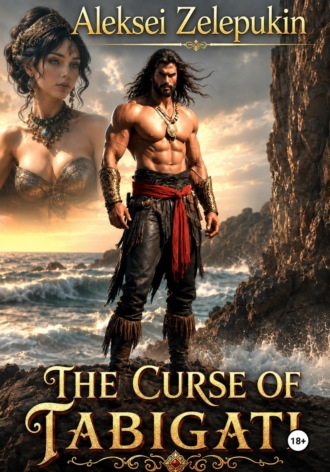
The Curse of Tabigati

Алексей Зелепукин
The Curse of Tabigati
Prologue
The crush in Ostos’s market square was unimaginable. The fragrance of fruit mingled with the scent of freshly planed boards from the scaffold and the unforgettable smell of newly spilled blood, sharp and vicious in a warrior’s nostrils.
Though morning had barely begun, the heat was already unbearable. The white sun had baked the paving stones and brought sweat to the skin of the townspeople gathered to witness the execution of the accursed pirates.
With a perfumed cloth covering his face, the blue-eyed northerner forced his way almost to the barrier—close enough to make out the condemned man’s face.
A konung stood upon the platform, prince of the northern lands. Even now, upon his knees, he retained a warrior’s majesty and his fearlessness before death.
The copper karnays blared. The doira drums began to beat. The murmur of the crowd died away. Even the donkeys and mules in their pens beside the stalls fell silent.
“Your last words, wretch,” roared Yusuf Bey, ruler of the city. He wore a green satin robe girded with an expensive belt of golden plates, and a broad saber hung at his side.
The konung merely spat with relish and favored the bey with a contemptuous stare.
Several warriors hauled upon ropes, bending the northern chieftain nearly double. Yusuf Bey planted one foot upon him, forcing the konung’s head against the massive stump that served as the block.
The yataghan whistled through air and flesh.
The fair-haired head struck the basket with a dull thud.
The berserker only clenched his teeth at the death of his konung. It was time to leave. He had seen everything that brought him to the market, and there was no reason to remain. Besides, stooping and hunching to conceal his towering height and powerful build had become unbearable beneath the fury and helplessness boiling in his soul.
Shoving aside hapless peasants who celebrated the northern pirate chief’s death, the Norseman hurried from the square, silently swearing vengeance for his leader.
He swore by the Lord of Flame and in the name of the Faceless One worshiped in these lands, as hot as the furnaces of Hell.
A single tear vanished into the northerner’s shaggy fair beard.
“They will pay. They will pay for everything,” the warrior whispered like a prayer.
But the moment he passed the butcher’s rows, his gaze caught a painfully familiar silhouette.
It is her.
The thought flashed through his mind. The berserker called the girl’s name, and she turned.
“Alive…” the eastern beauty whispered, almost soundlessly. Tears glistened in her eyes—whether of joy or sorrow, he could not tell.
“Alive. Me come for you,” the northerner said in the language of the Sultanate.
Chapter One
“Long, long ago, at the dawn of the Age of Man, when humanity had only begun to conquer the reaches of the Earth and primeval magic still held great power, wondrous beings inhabited the world. Djinn. Ifrits. Gods and demons walked its surface, preparing Great Yer for the children of Adam. The Great Mother Tabigati personally supervised her servants and judged their work…”
The nursemaid’s voice was monotonous, and the text itself—heard dozens of times before—held no interest for her charge.
The black-eyed young maiden, whose long dark-blond hair was arranged in two braids, fidgeted upon the sofa and continually let her attention wander to whatever was happening beyond the large glass window.
“She approved the forms of the animals and their sizes and devised a purpose for each. Peace and harmony reigned upon the Earth. The Great Creator watched over all through the Eye of Heaven with which He enveloped His Creation. His firstborn disappointed their creator, and He banished them from heavenly Jannat, though He commanded Tabigati to care for them…”
At that moment, a small gray-brown bird landed on the branch outside the window and began searching the leaves with great seriousness.
The girl smiled.
How she longed to trade places with the little creature, spread her wings, and fly beyond the house of Ostos’s ruler.
“Zamira! This is an extremely important text. You must do more than know it—you must memorize it.”
The nursemaid was deeply angered by the girl’s inattention. But after a long breath, she merely turned the page and continued.
“Tabigati sought to create upon Yer a garden like Jannat. But Iblis challenged the Father, determined to prove that humanity was unworthy of such honor. Unfortunately, Tanati the Almighty, the Great Creator, granted Iblis his chance. The gates of Tartarus opened upon Yer, and Iblis’s faithful servants poured forth, defiling Tabigati’s creation. Yer’s face was scarred by waterless deserts, towering mountains crowned with volcanoes that spewed lava, and stinking, impassable swamps.
“Tabigati harbored resentment toward Iblis for what he had done to her garden. She resolved to protect the children of Adam with all her strength. One day, she witnessed the Dark One’s servants luring the first among equals—the great Arnar, forefather of the future sultans’ dynasty—into an ambush. She chose to aid the mortal and saved the future ruler of humankind, who was still a young man then.
“Iblis flew into a rage and unleashed his demons upon Tabigati’s own creations. Thus were werewolves and ghouls brought into the world.”
“And there are evil sorcerers and ubyr werewolves who serve their dark queen, Almauz-Kampyr!” the girl blurted, trying to conceal her indifference.
“Zamira, do not confuse ancient legend with nursery terrors.” The nursemaid threw up her hands and shook her head disapprovingly. “Child, please concentrate. Your father will have me flogged to death—or worse, set the dogs upon me—if you fail the history of Tabigati. I beg you, have mercy.”
Zamira turned toward her and ostentatiously rolled her eyes. Then she gave a doomed sigh, settled more comfortably upon the sofa, and arranged her face into an expression of interest.
“The Great Mother and Iblis gathered their armies and met in mortal combat. Their powers were equal. Then Arnar brought the armies of humankind to the Ukbyr Plateau and tipped the scales of victory toward Tabigati. But the damage to Yer was immense. Pangaea, once whole, broke apart into several continents.
“Tabigati came to love her helper with the purest love of which she was capable. She carried the families of Arnar’s clan to the safest fragment of Yer—Aiza—and filled it with animals and edible plants. The people lived and prospered, but their happiness did not last.
“Arnar revered Tabigati as a mother. But when he came before her leading his beloved by the hand, Tabigati learned jealousy. In a fit of rage, she burned Arnar and the woman carrying his child to ashes. Once she understood what she had done, she prayed to the Heavenly Father, Tanati, and begged Him to restore the murdered pair to life.
“But the law of the world is harsh. Life for life. Death for death. Not even Tabigati could violate it. The Creator heard her prayers but left the choice to Arnar. The man chose to preserve the life of his beloved, while Tabigati herself became Faceless.
“An immortal could not die. She condemned herself to an eternal dialogue with Iblis, guiding the dead into his realm. Thus Tabigati lost her name, and mortals began calling her Death. Yet death has always terrified humankind, and so the Great Mother became the Great Faceless One.
“When Iblis learned of the pregnancy of Aisha, beloved of the first sultan, he appealed to the Father against the injustice of the exchange. He had returned three souls from his realm and demanded the lives of Arnar’s unborn children in payment.
“But Tanati rejected the Lord of Flame’s claim, for the woman Arnar loved was the daughter of Iblis himself—the great demigoddess Sigrun. The Creator discerned the trick and spared Belmek in reward for his father’s selflessness and former deeds.
“This drove the god of the northerners into a fury. He resolved to claim the soul of the unborn Aisha at any cost. Then Tabigati placed her sign upon the girl—a mark in the shape of a winged dragon—declaring that the child belonged to her and that she alone might command the girl’s fate.
“In retaliation, the enraged Iblis demanded that the girl serve his mistress and swear a vow of chastity. Tanati accepted the claim and raised the first Temple of Tabigati—the Great Faceless One—upon Mount Aysinush at the very heart of Aiza. Yet He also granted great Tabigati a path by which she might escape eternal imprisonment in the realm of the dead.
“Thus the prophecy was born, and Aisha became Tabigati’s first High Priestess.
“Ever since, a girl bearing the Faceless One’s mark has been born in every generation of Arnar’s descendants. But only one will complete the initiation and succeed the High Priestess…”
The servant turned a page of the sacred book and noticed from the corner of her eye that her pupil—the daughter of the honorable Yusuf Bey—was once again staring out the window instead of listening.
“Zamira? Zamira, you are ignoring me again. How many times must we do this? What has gotten into you?”
The girl started guiltily. Her cheeks flushed when she realized she had once more drifted into her fantasies.
“You’ve read me this story more times than anyone could count,” she said in her defense and rose to her feet. “I’m far more interested in the initiation itself. And Tabigati’s song is beautiful, but whenever I sing it, a terrible longing grows inside my soul…”
The girl wrapped her arms around her shoulders, closed her eyes, and began to sing:
I ask you—love me forever,
even when the rains stand in our way.
Even if love beneath the moon cannot last,
do not believe it.
Just love me.
The little schemer knew that the sacred song melted her nursemaid’s heart and turned her iron nature to candle wax. The nursemaid knew it too. The gray-haired woman smiled, caught once again by her young mistress’s trick.
“What are you plotting now? Remember, only a chaste virgin who bears the mark may undergo the trial. Iblis’s servants will do everything in their power to break the line of service.”
“What is it like to be intimate with a man? Have you ever had a man, Akhneya? And you’ve never told me about the trial itself. What awaits me?” Zamira asked.
The nursemaid looked away, feeling a deep pity for her charge and fearing for the girl’s life.
“Tabigati is Mother Nature. The trials will be bound to the elements. The first is water. The chosen maidens will be submerged in the sacred river, and the one who surfaces last will prevail.”
“But I can’t swim!” the girl cried as fear slid over her body on cold, sticky tentacles.
“There is no need to swim. You must simply not fear the water.”
“Why didn’t you tell me before? I could have practiced.”
“Chastity,” the woman pronounced firmly, raising one index finger.
“Oh, Nurse, enough of that. I’m going to the lake.”
“But—”
“No buts. I want to try. Otherwise, you’ll have to tell me about intimacy. I need to know what to beware of. Men are so treacherous. How am I supposed to preserve my virginity—much less my chastity—if they’re as cunning as Iblis himself? And if you argue, I’ll complain to Father, and he’ll replace you with someone more accommodating.”
“I have devoted sixteen years of my life to raising you. I love you as though you were my own,” the offended nursemaid stammered, clutching her heart, though she knew Yusuf Bey’s daughter’s unruly nature perfectly well.
“I don’t want you replaced. Don’t be angry. I’ll be quick, I promise. And when I return, I swear I’ll learn the final verse of Tabigati’s song and read two more chapters. By the way, can a chaste virgin produce milk?”
“No, she cannot,” the woman sighed, surrendering to the irrepressible girl’s will.
“Then you do know what it’s like to be with a man, Akhneya?”
“Go bathe. I’ll bring the towels,” the nursemaid replied, closing the book.
“No need. Rest. I’ll take them myself. You’re the finest nursemaid in the world!” Zamira shouted.
She slipped through the door and raced headlong down the corridor.
The young girl’s heart beat fast and loud, anticipating something fascinating and forbidden. The unknown frightened the goddess-marked maiden, yet drew her with irresistible force—for forbidden fruit always seems the sweetest.
Chapter Two
It was a scorching summer noon. The brilliant sun beat down without mercy. Chilla—the season of fiercest heat. Even upon the tapchan beneath an old, spreading plane tree, the air was unbearably close.
Maruf, well past his youth, had just finished his midday meal and was drinking tea. He watched his only son, Alisher, wielding a ketmen in their small plot as he helped his mother tend the garden.
The youth was broad-shouldered and tireless, handling the heavy tool like a child’s toy. Alisher was only seventeen, yet many grown men might already have envied his strength. Ordinarily, he earned extra money as a porter at the local bazaar, but the local qadi had forbidden trade during the midday hours because of the heat.
After a while, a gray-haired woman in colorful clothes approached the tapchan. Her household work completed, she brought her husband a flatbread and a little qurt.
“Don’t forget to take this with you.” She placed the bundle carefully at one corner of the platform. “Would you like more tea?”
The man tore his gaze from his son, who continued working in the vegetable patch, and turned toward his wife.
“Thank you, but no. I must be going.”
The woman sighed and began gathering the dishes onto a tray. Once an irresistibly beautiful eastern maiden, she had lost none of her dignity with age.
“Fatima, tell our son I need his help in Master Yusuf Bey’s garden,” Maruf said.
The plate of flatbreads nearly slipped from her hands.
“No man under fifty is allowed to cross the threshold of Yusuf Bey’s household. The punishment is ten strokes of the cane upon the soles of the feet,” she exclaimed, reminding her husband of the inevitable penalty should their son be caught.
“The irrigation channels have dried. The water has fallen. The master’s roses are withering. If I cannot put it right, I will lose my head. I cannot manage alone. You know Yusuf Bey’s temper.”
“Oh, Maruf. I’ve begged you a hundred times to leave that place. You would be better off joining a caravan. At least I could rest from you while you traveled, and the money would be better.”
“Yes, and the basmachi and bashi-bazouks would attack more often. Do you wish me dead?”
“And what is this? Either our son gets the cane across his feet or you get an ax across your neck. Desert brigands are more merciful than your Yusuf Bey.”
“What good is protesting when nothing can be changed? I need Alisher’s help. Will you let him come?”
“Of course. If they take your head, how am I supposed to manage the household alone afterward? Don’t forget the bundle. Be careful there, and watch our son. He may look grown, but he is still a child inside.”
“Thank you, my joy,” the gardener whispered.
He kissed his wife on the cheek and began gathering his things with a groan.
Yusuf Bey’s garden was magnificent, a true oasis of paradise. It had been established by the great-grandmother of Ostos’s present ruler.
The little city stood at a fortunate crossroads of caravan routes. Northern caravans and merchants from the east alike found shelter and rest there. Ostos’s bazaar overflowed with wares. Traders hurried to sell perishable goods and replenish their provisions and water.
In time, a wall was built around the impromptu market, and permanent counters appeared. Stables and workshops followed. From early morning until late at night, the place hummed. The ringing of smiths’ hammers mingled with the cries of mules, the neighing of horses, and the whisper of khan-atlas silk.
The town grew, and with it grew the treasury of the bey who ruled these lands.
Once, even the sultan himself visited Ostos, but the landscape displeased him.
The resourceful mistress of the household—the first wife of Yusuf Bey’s great-grandfather—explained that the city lacked water. No one now remembered how she won the sultan’s favor, but a month later an army arrived at Ostos.
The terrified residents prepared themselves for death. Instead, the sultan’s warriors dug a lake beside the little Anktara River. Then, under the direction of the present ruler’s great-grandmother, they planted a sumptuous garden. Soon caravan drivers themselves were bringing exotic plants to Ostos as gifts for its ruler.
The garden became a wonder—a new Eden, as the northerners called it, or a reflection of Jannat. Unlike its divine twin, it lacked only beautiful houris and peri.
Its roses rivaled the flowers that had once grown in the sacred garden. Every ruler without exception had taken pride in them, which was why Maruf worried so deeply.
The enormous wooden buckets were light enough for Alisher compared with the merchants’ bales he carried at the market. And only the chosen few were permitted to see the garden’s wonders. Inspired by such unprecedented beauty, the youth carried load after load of water from the pond.
Only the bushes of divinely white roses—white as clouds in the heavens—remained to be watered when Alisher heard wondrous singing along the path.
His footsteps became silent, his movements cautious. Like a wild snow leopard, young Alisher crept through the thickets, afraid of startling the enchanting peri with the bewitching voice. Surely only such a magical creature could sing so freely in this garden.
The water reflected the silhouette of a woman while the voice continued a melody unknown to the porter:
I ask you—love me forever,
even when the rains stand in our way.
Even if love beneath the moon cannot last,
do not believe it.
Just love me.
Holding his breath, the youth stepped closer.
A maiden of impossible beauty stood naked to the waist in the water, washing her luxuriant, waist-long hair. Her lips seemed softer than rose petals, and eyes the color of a warm summer night gazed dreamily into the distance.
Love me when morning
suddenly enters your home.
Do not forget me for even a moment;
remember me, though grief grips your heart.
I ask you—love me forever,
even when we are sometimes apart…
The song flowed above the lake’s ripples, and birds joined the enchantress’s voice.
The young man lowered his gaze and saw upon the peri’s small, still almost childlike breasts nipples the color of buckwheat honey.
Alisher swallowed nervously and stood entranced by the young singer’s unearthly beauty.
I ask you—love me forever,
even if another stands beside me.
I ask you—love me forever.
Never dare forget.
I ask you—love me forever,
though the years may pass.
Let every candle gutter out.
Let them tell you I have died.
I ask you—love me forever,
for even as I died,
I still loved you…
The song’s final words pierced the youth’s soul. Tears filled his eyes, and the bucket slipped from his hands.
The girl cried out and sank into the water up to her throat, though the lake’s crystalline clarity did little to conceal her nakedness.
Alisher remained motionless, unable to tear his gaze from her snow-white breasts and the dark mark of a winged dragon between them.
“Who are you? Come out and show yourself at once,” the beautiful stranger commanded in a voice that allowed no disobedience.
The gardener’s son meekly stepped onto the shore.
His cheeks burned with embarrassment. Excitement spread through his body in an unfamiliar yet pleasant current, stirring his youthful blood.
“Pick up the towel and hand it to me.”
He obeyed without protest, still admiring the beauty’s charms.
“Haven’t you stared enough, shameless creature? Turn around this instant so I can leave the water.”
Alisher was genuinely ashamed of his brazen behavior. Reason commanded him to obey, but his heart rebelled.
The stern gaze of her black eyes neither frightened nor repelled him. It drew him closer and filled his soul with warmth and rapture.
“Did you hear me? Are you tired of living? Why are you silent? Are you mute?”
“No, I only… I…” His tongue seemed to have forgotten every word, or perhaps they were lodged together in his throat.
Alisher stole one final glance at the beauty, turned his head, and extended the towel toward her.
“Lost the power of speech?” The peri’s tone softened, curiosity entering her voice.
“You’re simply so beautiful. I… forgive me, most radiant peri,” he breathed, trying to master the emotions raging within his chest.
“Truly?” the girl asked playfully as she took the towel from his hands.
She stood so close that Alisher felt her breath upon his chest. He squeezed his eyes shut, though not from fear.
He desperately wanted one more glimpse of the girl’s fragile figure, as if some ancient master had carved her from ivory.
“What is your name, at least, you statue?” Zamira asked mockingly, deeply pleased by the impression she had made upon the strange youth.
“Ali… Alisher. Son of Yusuf Bey’s gardener,” he stammered, still struggling against the desire to open his eyes.
“How did you get in here? Men are forbidden to enter the garden. I could tell my father, and he would cut off your head.”
Alisher drew a deep breath, realizing he had mistaken the girl for a peri. He sank to one knee and bowed his head. His gaze came to rest upon the charming feet of Ostos’s ruler’s daughter.
“If I am to die anyway, allow me one last look at you before my death, beautiful lady,” he said, summoning his courage.
The girl snorted with amusement.
“That is all you ask before dying?” Zamira narrowed her eyes suspiciously.
“Yes, my lady,” he answered firmly.
“You are brave and honest, gardener’s son. Very well. Rise and look.”
Without wasting a heartbeat, he straightened and looked at her.
She stood before him wrapped in nothing but a towel, and Alisher drowned in eyes as dark as a moonless night, as clear and bottomless as fissures in the western mountains.
“Do you like me?” the beauty asked playfully.
“Beyond reason. Thank you, my lady. I am ready now to accept punishment for my insolence.” He bowed his head obediently and lowered himself to one knee again.
The young man’s honesty and courage touched the girl’s heart, and Zamira realized she did not want Alisher to die.
“I won’t tell Father what happened, and I assume you won’t chatter about it either. Let it remain our secret. As punishment for your offense, you will come here in the evenings, tell me about the city, and answer my questions. Agreed?”
The youth’s heart nearly burst with happiness. He would see her again. Let the garden guards break the soles of his feet—Ali longed to behold her beauty once more, even at the cost of his life.
“As you wish, black-eyed one.” He nodded, already knowing that he would fulfill any desire of Yusuf Bey’s daughter at any cost.
“Then every Friday, after the holy man sings from the minaret, I will wait for you here. Now go.” She pointed toward the path leading out of the garden.
“But, my lady… If I don’t bring the water, the white roses will wither, and my father will lose his head.”
“Very well. Draw the water and leave without looking back. Turn around even once, and you will lose your head after all,” Zamira commanded capriciously, though the gardener’s son’s words had sunk deep into her soul.
Yusuf Bey’s daughter desperately wanted him to look back after filling the buckets. Not because she wished him dead. Zamira merely longed to feel the warmth of Ali’s admiring gaze once more.
She even dropped the towel deliberately and made no hurry to pull the sun-warmed fabric of her clothing over her body.
Alisher remembered her threat but could not resist turning around.