



Полная версия
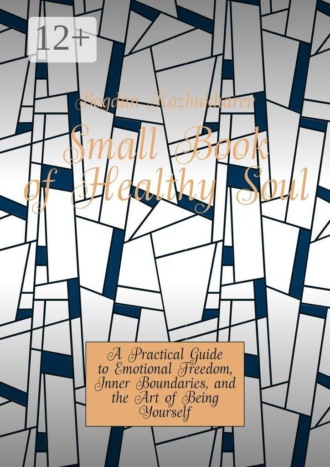
Small Book of Healthy Soul. A Practical Guide to Emotional Freedom, Inner Boundaries, and the Art of Being Yourself

Small Book of Healthy Soul
A Practical Guide to Emotional Freedom, Inner Boundaries, and the Art of Being Yourself
Bogdan Kozhukharev
© Bogdan Kozhukharev, 2026
ISBN 978-5-0070-7733-0
Created with Ridero smart publishing system
SOUL HEALTH
A Book for Those Who Are Tired
— —
INTRODUCTION: WHAT IS A HEALTHY SOUL?
Imagine your soul is a room.
It has windows, doors, walls. Sometimes you air it out, sometimes you clutter it with junk, sometimes you lock yourself in and let no one in.
A healthy soul is not “a room that’s always clean.”
It is the ability to:
· notice that the room is dirty,
· name what exactly is wrong,
· pick up a cloth and clean (or call someone for help),
· and not be afraid that it will get dusty again tomorrow.
You don’t have to be ideally healthy. That’s impossible.
The soul gets sick like the body: it catches colds, gets bruised, breathes heavily in crises.
Soul health is not a finish line. It’s a direction.
— —
THE ANATOMY OF SOUL HEALTH
What You Can Do Yourself — and Where You Need a Doctor
Main idea:
There is a boundary between what you can do for yourself and where it’s dangerous without a specialist.
— —
Soul hygiene is what you do for your psyche as regularly as you brush your teeth.
It includes:
· 10 minutes a day to ask yourself: “What am I feeling? What do I need?”
· Crying when sad.
· Screaming into a pillow when angry.
· Taking a walk without your phone.
· Saying “no” when you don’t want to do something.
— —
When soul hygiene doesn’t work — you need a psychiatrist.
Red flags (don’t wait, see a doctor):
· Symptoms (melancholy, anxiety, insomnia) last more than 2—3 weeks without improvement.
· You can’t work, sleep, eat, or communicate.
· Thoughts appear: “I don’t want to live,” “everything is meaningless.”
· The world feels unreal, you hear voices or see things that aren’t there.
· You start drinking, overeating, cutting yourself to cope with the pain.
This is not weakness. It’s like breaking a leg — you go to the doctor, you don’t just endure it.
— —
Symptoms of a healthy soul (where we’re heading):
1. Flexibility — I can be firm when needed and soft when appropriate.
I admit mistakes and change my mind when new facts emerge.
2. Contact with myself — I know what I’m feeling right now and what I want.
Not “how it should be,” but “how it is.”
3. Ability to cry and rejoice — without guilt and fear.
Tears are not weakness — they are release. Joy is not danger — it is fuel.
4. Contact with reality — I distinguish facts (“I wasn’t invited”) from interpretations (“they hate me”).
5. Ability to be alone — I don’t fall apart in solitude.
And the ability to tolerate uncertainty — I don’t know what tomorrow will bring, and that’s okay.
— —
Practice: “Pulse Diagnostics”
Rate yourself on a scale of 1 to 10 (1 = everything is fine, 10 = critical):
· My mood in the last 2 weeks: ___/10
· My sleep: ___/10
· My energy: ___/10
· My anxiety: ___/10
· Thoughts of death or meaninglessness: ___/10
If at least two items are above 7 — don’t wait. See a psychiatrist (online, anonymously).
If all items are 1—4 — you’re in the zone of soul hygiene, you can continue working on your own.
— —
THE RIGHT TO FEEL
The Soul Is Made Sick Not by Feelings, but by the Ban on Them
Main idea:
You have the right to feel everything. Even what was forbidden in childhood.
— —
The Alphabet of Feelings — how to tell one from another:
Feeling What it is Healthy expression
Anger Energy, a signal: “my boundaries are violated” “I’m angry because… I’m asking you to…”
Resentment Frozen mixture of sadness and anger “I feel hurt when… I would like…”
Shame “I am bad” (an attack on identity) Accept yourself: “I make mistakes, but I am not a bad person”
Guilt “I did something bad” (an attack on an action) Apologize, fix it, draw conclusions
Loneliness/longing A reaction to loss (has an object, has an end) Experience it, cry, remember
Depression An illness (no object, no gaps, lasts for weeks) See a psychiatrist
— —
Practice: “A Date with Sadness”
Set aside 30 minutes when no one will interrupt you.
Sit down, put your hand on your chest.
Ask yourself: “What am I sad about?” — and write down the answer.
Don’t try to “fix” the sadness. Just breathe into it.
If you feel like crying — cry. Tears are not weakness. They are the release of pain.
— —
Practice: “Anger Without Destruction”
If you feel anger, don’t suppress it.
But don’t direct it at people either.
Go to an empty room, take a pillow and beat it.
Tear paper. Scream into the pillow.
Write an “angry letter” to the person who made you angry — and don’t send it.
After that, you’ll feel lighter.
— —
The Emotional Container
Imagine your emotions are water.
If you don’t have a container, the water floods everything around.
If the container is too small, you overflow and explode.
The task is to build a container large enough to hold emotions until you decide what to do with them.
How to build it:
· Notice early signs of overflow (clenched jaw, rapid breathing).
· Take a pause (“Stop, I’m stepping out for 5 minutes”).
· Breathe in a square (inhale 4, hold 4, exhale 4, hold 4).
· In the evening, “release steam”: write, scream, stomp.
— —
DIALOGUE WITH THE BODY
The Soul Lives in the Body. If the Body Hurts — the Soul Screams
Main idea:
The body cannot lie. It remembers everything you didn’t say, didn’t cry out, didn’t release.
— —
Map of Bodily Symptoms (where feelings hide):
Emotion Where it lives in the body
Fear Stomach, lower back, chest, throat, cold hands/feet
Anger Jaw, neck, shoulders, fists
Resentment Throat (lump), chest, between shoulder blades
Guilt Shoulders (heaviness), lower back, eyes (hard to look)
Sadness Chest, sinuses, diaphragm
Forbidden joy Chest constricted, incomplete breath
— —
Practice: “Body Interview”
Choose one part of your body that hurts or is tense.
Place your hand on it.
Ask questions (mentally or out loud):
· “What are you feeling right now? Describe in one word or image.”
(For example: “shoulders — stone slab,” “stomach — cold void.”)
Конец ознакомительного фрагмента.
Текст предоставлен ООО «Литрес».
Прочитайте эту книгу целиком, купив полную легальную версию на Литрес.
Безопасно оплатить книгу можно банковской картой Visa, MasterCard, Maestro, со счета мобильного телефона, с платежного терминала, в салоне МТС или Связной, через PayPal, WebMoney, Яндекс.Деньги, QIWI Кошелек, бонусными картами или другим удобным Вам способом.