Полная версия
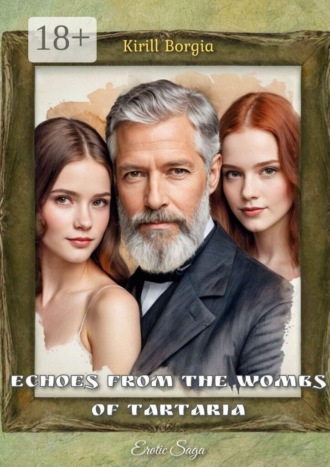
Echoes from the Wombs of Tartaria — 1

Echoes from the Wombs of Tartaria — 1
Kirill Borgia
“Wisdom cometh not only with the turning of years, but with the remembrance of lives once lived and long buried.” — from the old tongue, long forgotten
Cover designer Fooocus
© Kirill Borgia, 2026
© Fooocus, cover design, 2026
ISBN 978-5-0070-2122-7 (т. 1)
ISBN 978-5-0070-2123-4
Created with Ridero smart publishing system
Prologue
“Curious choice, sir. Such fine silver hair… And that beard — why, it’s almost royal,” the barber murmured, brush in hand, stirring the dye like a cautious apothecary mixing poisons.
The man in the chair remained silent at first. His reflection, blurred in the mottled mirror, showed a broad forehead under receding strands, deep-set eyes the colour of river silt, and a mouth that looked as though it had once smiled easily but now did so only from habit. He lifted his gaze, met the barber’s in the glass.
“I am travelling south,” he said quietly, “and in the south, I shall begin again.”
The barber chuckled, not unkindly. “We get many of your kind through here. Men who shear away the past. A mistress with a husband and a revolver. A misdeal in cards. An overfriendly treasurer. It’s always one of those, give or take a bottle.”
He dabbed the brush into the thick paste, then paused.
“But you — no, not like the others. You’ve the look of someone leaving not just a city, but a name.”
No answer came. Only the dull buzz of the clippers, the sound of the blade whispering along the scalp like a secret.
Outside, the station’s loudspeakers groaned a delayed announcement. Somewhere, the scent of oversteeped tea mingled with coal smoke and damp wool. The man’s overcoat steamed faintly at the shoulders. He had not removed it.
“South, eh? Kazan? Astrakhan? Or further still — one of those towns with names that taste like honey and dust?”
The man closed his eyes. “Further.”
The barber shrugged and dipped his brush again, now with the focus of a priest anointing a reluctant convert. With one hand, in slow, deliberate strokes, he began darkening the client’s once-silver beard, turning the regal frost into the coarse shadow of a younger man’s defiance. With the other, he guided the clippers across the scalp in smooth, methodical passes, each stroke peeling away the last traces of age and memory. Tufts of grey hair drifted to the floor in silence, mingling with the sharp, bitter scent of ammonia.
“Well,” he said, half to himself, “I hope the lady’s worth it. Or the loot. Or whatever past you’re hoping this new colour might fool.”
There was a pause. Then a dry smile.
“There is no lady. And nothing to bury,” the man said. “Only something long forgotten… that must be unearthed.”
The barber raised an eyebrow but said nothing more. The clippers whirred again, chewing through time. Soon, the silver was gone, replaced by a severe ash-brown, efficient, unsentimental — the kind of colour that left no footprint, no shadow, nothing for memory to clutch at. The sort of colour that disappeared in a crowd.
Outside, a whistle blew. A long, drawn-out sound like a yawn across centuries. The man stood, paid, and gathered his hat.
He stepped into the station mist, now not quite himself.
But not yet someone else.
Date of Birth
The narrow corridor echoed faintly with the tap of the attendant’s boots before the gentle rap on the door interrupted the compartment’s quiet.
“Will you be requiring dinner service, sir? Or perhaps expecting company tonight?” the conductor inquired, his eyes briefly assessing the solitary occupant.
The man stirred from his reverie, glancing up with a measured calm. “I travel alone,” he replied simply, voice low but carrying a quiet command.
The attendant’s gaze flickered, a subtle nod acknowledging the unspoken — two seats purchased, yet only one passenger. Status, wrapped in economy but spoken in silence.
“Very well, sir. I shall prepare accordingly.”
The door closed softly, leaving the man once more to the soft rocking of the train and the slow, steady hum of the rails.
He waited until the conductor’s steps had faded into the rhythmic clatter of the corridor before reaching into the inner pocket of his travelling coat. From a slim leather case he withdrew a small sheaf of papers — worn, faintly scented of coal dust and tobacco. His fingers, still bearing faint traces of dye at the nails, unfolded the official booklet with care.
The Imperial passport opened stiffly, its pages buckled at the corners. His gaze moved slowly over the printed lines, his own name emerging like a stone from a thawed riverbed.
Surname: Zorich
Given name and patronymic: Yarosvet Alexeyevich
Rank or estate: Collegiate Assessor, Civil Service
Year of birth: 1831
Place of birth: County of Arzamas, Nizhny Novgorod Governorate
Occupation: Retired archivist, Ministry of Internal Affairs
Marital status: Unmarried
Faith: Orthodox Christian
He paused here, the corner of his mouth lifting — not in mockery, but in something quieter. A rueful softness. Christian, yes… by ink. And by silence.
He turned the page.
Distinguishing marks and appearance:
Hair grey, full, worn long. Beard thick, same colour.
Eyes grey-brown.
Height above average.
Build firm.
Speech measured.
No visible scars or deformities.
A man who had once been one thing, and now had made himself another.
He closed the passport slowly, slipping it back into the case. The train’s motion grew more insistent, a soft jostle like memory knocking at his shoulder. Somewhere beyond the pane, beyond the soot-streaked glass, the south was waiting.
And so was the past.
It was not the change in appearance that troubled him — not really.
That could be explained, after all. Men dyed their hair; men shaved their heads; men wore spectacles when they no longer needed to, or stopped wearing them though their vision blurred like melted wax. Vanity, illness, grief, devotion. A dozen reasons fit for a dozen fates. No stationmaster, no district inspector would raise an eyebrow at such things. If they did, they would interpret them through the lens they understood best — romance, crime, ruin, escape. Not truth.
But the true fracture lay not in the dates or descriptions, but in what was absent — and what no ink could confess.
He stared once more at the date: 1831, County of Arzamas. A precise line. A year that sat obediently in its place, pinned to the paper like a dead moth.
And yet, the man whose hands now held the passport looked no older than forty-five. Perhaps less, if the carriage lighting were kind. According to the document, he had been born sixty-five years past. A detail no conductor would question aloud, though any sharp eye might pause, if only for a beat. The conductor had addressed him with instinctive deference — not the overplayed politeness one grants to infirmity, but the clipped reserve given to men still in full command of themselves. That alone would have been enough to raise a silent question.
But the deeper crack lay not in the dates, nor in the ink, but beneath them — in a silence too old to name. For the man whose name appeared on that page had buried his parents, Alexei Zorich and his wife, Velina, more than a century ago. He remembered the scent of pine resin on his father’s hands, the lull of his mother’s voice — long extinguished, long mourned, yet now as close as the weight of the paper in his palm.
He had wept, once, at her grave. Then he had lived on.
The date in the passport was wrong, yes. But not in the way it would appear. It was not too early. It was far, far too late.
There were no clerks left alive who remembered entering that name. No priest who had inked it into the registry. No neighbours to say what sort of child Yarosvet Alexeyevich Zorich had been — solemn, bright-eyed, strange.
All of them, long beneath the earth. He alone had remained.
Not unchanged. No, not that. His features had softened over the years, not from indulgence, but from long acquaintance with silence. The voice, once crisp, had settled into a gentler register — still firm, but less inclined to interrupt. His hands no longer bore the calluses of youth, yet moved with the economy of someone who had laboured, and remembered how not to. But the thread had never snapped. Not fully.
What had once been called memory had become something else.
And now, it seemed, it was time to follow that thread once more — into the south, into the heat, into the names that had been stolen and buried in ash.
He opened his eyes. The passport lay still in his hand, patient, mute.
He slipped it back into its case. Then folded his arms across his chest, and listened to the soft chant of the rails beneath him, as though the earth itself were humming some old lullaby he had not heard in many, many lifetimes.
Name the Name
The village lay quiet beneath a soft, lavender dusk, the kind that stretched long shadows from the low timber houses, where smoke from cooking fires curled lazily upward, twisting like the memories that cling to old wood. It was the mid-eighteenth century in Russia, a time suspended between the fading echoes of old world rituals and the hesitant stirrings of change. The land itself seemed to breathe with the slow rhythms of seasons and faith, each day a prayer spoken in the rustle of birch leaves, the distant tolling of church bells, the murmur of voices raised in ancient hymns.
Here, in this small pocket of the vast empire, lived a boy unlike the others. While most of the village children answered without hesitation to names as common and worn as the paths they ran — Sergey, Petr, Ivan — he bore a name that was a curious melody to their ears: Yarosvet. It was a name that set him apart, an outlier in the familiar chorus of boyhood calls.
From an early age, this difference had nestled in his chest like a quiet question that neither grew louder nor found easy answer. The name felt heavy and bright all at once — strange as the flame of a candle in a dark room, both a guide and a reminder of distance. He noticed how, when others gathered in rough laughter and games, his name would ripple among them like a thread pulled too tight, the sound unfamiliar, almost foreign.
One afternoon, while the sun hung low and golden over the fields, Yarosvet approached his father, a man whose face bore the steady marks of seasons spent in hard labour and quiet resolve. The man’s hands were calloused but gentle, and his eyes held a calm patience, as though the burdens of life were bricks he laid carefully each day, without haste or complaint.
“Father, the boy began tentatively, “why do the others — like you — have names like Ilya or Ivan, but mine is… different? Why wasn’t I given a name like theirs?”
The father looked down at him for a long moment, his gaze steady and without impatience. “Your mother gave you your name,” he said simply, as if that should explain everything.
The answer, however, unsettled more than it settled. Yarosvet’s brow furrowed in thought, the sound of distant church bells mingling with the faint rustling of the leaves outside. That evening, seeking the deeper meaning his father had not offered, he went to his mother.
Her hands were soft and warm, weathered like old leather yet full of life. The room was dim, the flicker of the hearth casting shadows that danced like spirits on the walls. She looked at him with eyes that seemed to hold stories older than the village itself.
“Mother,” he asked quietly, “why did you give me this name? What does it mean?”
She smiled then, a slow, almost sad smile, as if recalling some long-forgotten song. “A name is more than a word, Yarosvet. It is the soul’s first breath, the spark that sets a man’s path alight. It carries the weight of blood and earth, the voice of the ancestors speaking through time.”
She paused, her gaze drifting toward the window where stars began to prick the darkening sky. “Most names here are common because they come from elsewhere — names taken from foreign tongues, names that do not sing the language of our land. Those who carry them wander without roots, like leaves caught in a stranger’s wind, never quite belonging.”
Her voice grew quieter, more intimate, as if sharing a secret guarded fiercely by the past. “But your name, my son, is fire and light. It comes from the very heart of this soil, from the ancient words that speak of strength and dawn. It is a name that will not let you forget who you are, no matter how far you travel.”
The boy felt a strange warmth spread through him, as if the name had shifted from being a simple sound to a living thing — a flame that danced beneath his ribs, steady and sure. It was a name that set him apart, yes, but also bound him to a destiny written deep into the bones of the land.
Yet even in that warmth, a seed of unease took root. The other boys called him strange. The world outside the village seemed vast and indifferent to the weight of a name. And though his mother’s words lingered like a hymn, Yarosvet could not yet see the full measure of what it meant to carry a fire that both illuminated and burned.
As the night deepened and the stars spilled across the sky like scattered silver coins, the boy lay awake, listening to the quiet hum of the earth and the distant echoes of the church bells. In the stillness, he imagined the long path ahead — one lit by the stubborn flame of his name, drawing him onward through shadows and light, through the dusty roads of an empire that was both home and wilderness.
There, in the silence between heartbeats, the first threads of his fate began to weave themselves — threads that would bind him to a story older than memory, a journey into the heat of the south and the secrets buried beneath ash and time.
Time passed the way rivers pass through woods — steadily, almost silently, wearing down stones not by force, but by patient touch. The boys he had once chased through fields and splashed with in spring brooks grew broad in the chest, slow in the joints, and bowed in the eyes, as if the years had begun whispering to them in a different tongue — one of duties, burdens, and nights spent half-sleeping beneath the press of roofs they now owned.
Their voices grew deeper, coarser, roughened by tobacco and responsibility. They spoke more of debts and grain, of fathers-in-law, of aching backs and colicky infants. In gatherings, the laughter became more restrained — not extinguished, no, but trimmed, as one trims the wick of a lamp so it does not burn too bright, too fast.
And Yarosvet? He remained.
It was not merely that he had no children tugging at his sleeves or wife waiting with tired affection at the gate. His face, his gait, the very cadence of his breath seemed untouched by the years. While others thickened and greyed, he still wore the outline of twenty-five, the kind that poets claimed in ballads and village girls measured suitors against — not consciously, but with a kind of wistful expectation that rarely found fulfilment. His skin, though often wind-bitten and sun-warmed like any man’s, lacked the sallow weariness that crept into his friends’ cheeks. His eyes had not dulled; they remained sharp, not with youth’s recklessness, but with its clarity.
This did not go unnoticed.
At first, it was a source of camaraderie. “Yaroshka,” they would call him, slapping his back after drink, “will never change. He’ll dance at our grandchildren’s weddings with a girl on each arm.” There was laughter then, but beneath it — something quieter. A shifting.
As the years lengthened, the gap widened. Men who had once sworn they would never be tamed were now arguing with wives over which son should inherit the plough. Their tempers shortened, their silences lengthened. And when Yarosvet entered a room, when his boots fell silent on the floorboards and his glance swept around with that same unhurried poise — it stirred unease.
Not hostility. Not yet. But a distance. The kind that grows not from betrayal or envy, but from the quiet instinct that some boundary of nature, unspoken and ancient, has been transgressed — gently, perhaps, even unconsciously, but unmistakably.
He noticed it first in the eyes of the women.
Those who were once girls — braiding each other’s hair, giggling behind hands when he passed — were now matriarchs with greying temples and slow steps. And their daughters, who now cast sidelong glances and whispered his name with the same breathless awe, did not see him as their fathers’ contemporary. No — they saw him as a man just ripening into his prime.
He, too, looked. He would be less than honest with himself to deny it.
The glances of the young women struck him not with pride, but with a kind of aching sweetness. There were many he had held affection for — genuine, sincere affection that made his heart stir and the world soften. He loved easily, but not shallowly. Some had hair like the inner silk of chestnuts; others moved with a grace that made one forget conversation. Their laughter, their cleverness, the curve of a brow or the way they pressed a finger to their lips when thinking — each opened something within him. And always, always, he meant to choose. To settle. To stand still.
But that was the trouble.
When every spring brings another bloom, when the world keeps offering a fresh sweetness, and when your soul, like your face, refuses to age with the others — how does one stop? When your friends must choose before their hair greys, before their knees stiffen, before their chance runs out — you do not have to. And so, perversely, you don’t.
Choice became his cage. The very abundance of life’s invitations left him, ironically, untouched by all of them. Like a man at a feast who samples every dish but finishes none, not out of gluttony, but because he fears that to choose one is to close the others forever.
And so he remained unmarried, unrooted, drifting not from place to place — no, he never wandered far — but from affection to affection. A steady flame to all, and yet never quite burning with one.
There were whispers, of course. Not cruel, but persistent. “Why is Yarosvet still alone?” some would ask, their eyes searching his face as if the answer might be written in the smoothness of his skin or the calm of his mouth. “He’s waiting for someone,” others would murmur. “Someone special. Maybe someone who’s not born yet.”
He never explained. He never argued. Sometimes he would smile, distant, as if the question itself was a leaf blown past his shoulder by the wind.
And perhaps it was.
For in the quietest places of his heart, beneath the layers of time and memory, he suspected that even if he gave his love — fully, truly — to some fair creature of the moment, it would not stop the river of years. She would age, and he would not. Her laughter would falter, her hands grow spotted and slow, and he… would remain.
To love, for him, was to prepare for mourning.
And so he remained silent — a man with the face of twenty-five, the eyes of fifty, and the heart of one who had already buried the spring more times than he could count.
Of course, he did not remain forever the youthful shade of twenty-five. Time, in its subtle cruelty, does not abide one’s wishes; it bends and warps even the most steadfast illusions. When he stood over his father’s grave, weathered and solemn, he might have been mistaken for a man of thirty-five — his features sharper, his shoulders broader, yet shadowed by a weariness that no youth could feign. That day, the scent of pine resin lingered heavier in the air, mixing with the bitter tang of fresh earth, and the solemn hymns sung by the priest felt both foreign and achingly familiar.
Twenty years later, when he laid his mother to rest beneath the same ancient soil, his reflection in the polished silver cross looked closer to forty. The corners of his eyes had begun to carry faint creases, not deep but persistent, like the first furrows carved into a once-virgin field. His hair bore the salt of early greys, though he fought them with careful rinses and powdered powders — a modest defiance against the slow reclaiming hand of age.
Yet by then, most of his companions — those boys with whom he had once run barefoot through rye fields, shouting the names of the wind — had long followed their parents into the earth. They had passed beyond the sight of the living, leaving behind wives thick with sorrow, sons shaped by their fathers’ hands, and daughters weeping at graves that grew mossy and forgotten.
But he remained.
In a world shifting and folding upon itself, he was a solitary remnant of a time others had surrendered to. His bed — once empty save for the chill of loneliness — became a strange refuge where generations met in passing. The granddaughters of those long-gone friends, both married and unmarried, sought solace or distraction in the quiet strength of his presence. Their eyes, wide with stories untold and promises whispered in the dark, spoke of desire tangled with regret. They saw in him not just a man but an anchor in a world unraveling too fast, a steady flame against the creeping cold.
He did not chase them as a man might pursue the fleeting warmth of youth. Nor did he bind himself with vows or promises. Instead, the encounters were gentle — moments carved out of mutual loneliness and the unspoken understanding that life’s course often leaves hearts adrift, seeking harbor wherever they might find it.
Yet even as his flesh settled into the lines and shadows of middle age, something within him resisted the full surrender. The mirror, at times, reflected a man touched by time but not conquered by it. There was a paradox in his bearing: he carried the weight of years in the depth of his gaze, yet moved with a grace untouched by the slow tremors of age. A quiet power hummed beneath his calm exterior, a rhythm not of this earth, or at least not of its common reckoning.
It was as if his very nature was split between two worlds — one bound by the ticking clock of human frailty, the other governed by a different, stranger measure. And so he stood between them, a sentinel not just of his own passing years, but of secrets deeper than memory, and time’s own hidden fractures.
The past and the present wrapped around him like the rails beneath the train — endless, inevitable, and softly humming the lullabies of all that had been lost and all that still waited to be found.
Of course, such a strange existence could not remain unexplored by the restless curiosity of youth, nor by the growing questions of a man caught between time’s steady march and his own lingering stasis. In those quiet moments between dusk and dawn, when the household settled into its familiar rhythms and shadows grew long against the flickering candlelight, he sought answers — as much from the silence as from the voices of his parents, while they still breathed.
His father, Alexei, was a man of few words and many smiles — a man who measured life in glances and unspoken understandings rather than in explicit truths. When asked why the boy seemed to resist the years, why he lingered like a shade untouched by the common fate of man, his father only chuckled softly, eyes gleaming with a secret amusement. The elder Zorich’s lips would curl into a knowing grin, as if privy to a jest played by the cosmos itself, and then his gaze would drift away, lost among the worn wooden beams of their home.