



Полная версия
Under the control of the future

Ирина Сергеевна Молчанова
Under the control of the future
IRA Molchanova
Under the
control of the
future
2021
Who are these visitors? Perhaps they are inhabitants of the future — not just humans, but also cyborgs and various hybrid forms created through the combination of biological and synthetic elements. Are their visits a coincidence? Do they intend to reclaim what belonged to the people of the past? The heroine was overwhelmed by questions. Mona, an engineer at an AI robotics facility, believes that the quantum substance of a human is contained within her domestic robot.
She is forced to travel to the 21^(st) century in search of evidence of the extraction of a human soul for the purpose of transferring it into a modernised body. Meanwhile, the organic cyborg Klur infiltrates the past without authorisation to continue the soul extraction experiment, concealing his true intentions behind the introduction of innovative life-prolonging technologies. Mona did not know that the chip implanted in her arm contained the necessary data for Klur.
No part of this publication may be copied or reproduced in any form
without the author's written permission.
© Ira Molchanova, 2021.
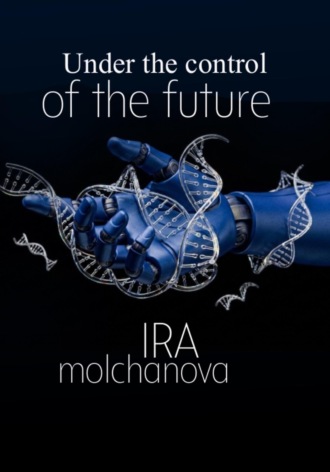
Cover designed by Ira Molchanova @iranovelistka and Artificial
Intelligence
Preface
Unidentified flying objects have been noted throughout human history, but remain unexplored to this day. There is no clear answer to the question of whether UFOs exist, let alone who, or what, is inside these mysterious flying machines. Are there any beings inside? Why do they appear in the sky at all?
One theory is that UFOs are visitors from the future. They are people just like those who live today. Or perhaps they have undergone significant changes due to technological advancement.
The novel presents a vision of the future in which robots exist in society as assistants alongside organic cyborgs. However, these cyborgs lack souls, which are only possessed by creatures created by a Higher Power through an unknown mechanism. In the novel, a man decides to save himself from death by creating organic bodies endowed with a copy of his own neural network, into which he intends to transfer his soul. The organic cyborgs formed during scientific research did not receive quantum substance and began to look for a way to extract it from people in the past.
The novel features allegories and fiction alongside real facts from the worlds of technology and science. It also presents an interpretation of who the occupants of UFOs are.
I wrote this novel to dedicate it to two special people in my life. I want to preserve their names. Not every grave can have a headstone, even though time will eventually destroy them. While it is impossible to fight death, it is possible to fight oblivion. The names of the deceased remain in the memory of the living and are immortalised in art and creativity. Through this work, I aim to prevent two names from fading into oblivion.
Clara comforted me when I was lonely.
Masha saved my life.
I was with both Clara and Masha at the moment of their deaths. I died with each of them, emotionally speaking. And that is natural. When those who are dear to us die, a part of the soul of those who remain alive dies too. Gradually, that part of the soul is restored, but the memory of feelings never fades. And so it should be.
I dedicate this novel to my dear Clara and Masha with immense gratitude for being and remaining in my life, and I hope it will preserve your names. Time will never erase the memory of these extraordinary cats.
I remember you and I love you.
Part I
Chapter 1
The flash was approaching. It penetrated her protective suit, touching her skin and slowly enveloping her body. Although she had been warned about this sensation, she could not have imagined what it would be like in reality. Transforming into a ball of light, the flash created a cocoon around her and carried her away at unimaginable speed. It was probably into the distance; it couldn't be otherwise.
- How do you feel? - The voice of the training flight operator sounded suddenly and sharply as the movement stopped.
- It felt like the speed was going to tear me apart, - she said, forcing herself to hide her excitement, an emotion that was considered undesirable.
- You should take the upcoming event more seriously, - said the motivation inspector, who was present in the training room and not in a hurry to voice his doubts.
- Do you think I'm not ready?
- I have no doubt.
Stepping off the training platform, which simulated travelling through time at speed, the girl hesitated; the alien suit was slightly too big, as the departing personnel employee had warned her.
- I want to go to the 21^(st) century, - Mona said confidently, trying to avoid the inevitable question from the motivation inspector.
- I don't fully understand why you want to go back in time, - said Chris, the manager of the company where Mona worked, trying to prevent her from carrying out her plans.
- I missed studying that time period.
- I don't think your job requires knowledge of events that happened to humanity in all time periods, - said Chris, who believed that some people were eager to learn things they weren't supposed to know.
- I disagree. I work with artificial intelligence, which was originally created in the 21^(st) century.
- It has been modified many times.
- The original does not lose its significance. It's important to me to analyse the AI's compatibility with the time it was launched, - Mona insisted, which was unlike her.
- I’ll think about signing the waiver.
The operator, who had not interfered in the conversation, began to remove a device that looked more like a capsule than a real device — a training platform — from working mode, putting it into a state of suspended energy animation.
- Thanks for the training, - Mona said, nodding to the guy who had taken his eyes off the console and looked at her.
- You’re not ready, - he said, still uncertain about the engineer's motivation for the robotic artificial intelligence facility.
Mona looked at the inspector, who did not wait for her answer before heading for the door. It seemed to her that he was emotional, but afraid to show it. Chris followed his example. Even with the best will in the world, there was no point waiting for him to show any emotion.
Chapter 2
He could always be found in a cosy corner of the house or on a tiny balcony, surrounded by tubs of miniature trees and ever-present shadows cast by large blocks of buildings.
- Bistris, are you sad again? - The state of the domestic assistant worried her. The emotional aspect of the artificial intelligence had evolved independently. Outside the programme plan. Without an update.
- You came… - He sighed, as if he hadn't expected to see her.
- I always come home, - Mona said, trying to calm the robot with an artificial consciousness who was suffering from his own emotions.
- I get sad when you're not here. I'm very lonely.
- I won't abandon you. Besides, you're supposed to help me fight loneliness.
- You’re stronger than me.
- Bistris, you need to control your emotions.
- I understand, Mona. I'm just artificial intelligence. I don't know what's happening to me.
The robot, which had been released by a corporation with the aim of suppressing feelings of loneliness in individuals living without a partner, was exhibiting unprogrammed behaviour.
Bistris headed for the home control panel and set the time for cooking dinner and filling the bathtub with hot water for his mistress, who stood at a distance watching his movements.
- Why are you using the old control methods? - The assistant's retrograde behaviour had long puzzled Mona.
- I find it more convenient.
- What about neurocontrol?
He chose not to answer. This was another deviation from the programme. The robot seemed like an ordinary person whose emotional state required urgent attention from a mentor. However, such specialists were unavailable for artificial intelligence carriers. Models whose programme deviated from the mandatory plan were subject to reinstallation. This meant that they had to become different artificial personalities. Mona liked Bistris. She felt an inexplicable sympathy for him and didn't want to erase his consciousness, even though it was artificial. She couldn't share her concerns with anyone. Only with him. But that would upset him even more. It was a vicious circle. She had no idea how to break free from it.
Chapter 3
- I’m not asking for an explanation, but I assume you understand the gravity of the situation? - This was at odds with the head of the corporation's refined appearance.
- I don't have a complete understanding of the period when our predecessors created artificial intelligence.
- Mona, you can do your job without that knowledge.
- But I need to know the details.
- You’re not telling me everything. - Chris was skilled at reading the people he interacted with. He was particularly sensitive to lies.
- Trust me, it's necessary, - she said. She didn't lie, but she didn't tell him everything, either.
- Sending someone back in time is dangerous, and expensive.
- It requires a small amount of energy, - she said, realising that she was downplaying the significance of this aspect of the operation.
- In addition to energy, the crew must be involved.
- Remotely.
- Specialists will still be involved, - Chris sighed, growing weary of the drawn-out conversation.
- Chris, school students go on flights like this.
- That’s a different type of flight. They just observe from the sidelines without landing or integrating into the activities of the people of that time period. How do you imagine the integration would work?
- My knowledge is definitely sufficient, - said Mona, who did not foresee any significant difficulties with the integration.
- You know as much as they don't even know yet. And it will be frightening. They still live with prejudices, traditions, and misinterpretations of the nature of some things.
- In that case, my knowledge won't get in their way.
- We weren't given permission for that, though. We don't have the right to give people from the past such information. It would disrupt the course of history.
- But how has our interference not disrupted history before?
- They were implemented organically and as necessary. Many years were spent calculating the consequences and taking into account the correlation of future events before these actions were taken, - Chris tried to give at least one reason that would make his subordinate see reason.
- It won't do any harm if I gain some useful experience.
- How can we learn from people who lived centuries ago?
- I may have missed some important moments in the history of artificial intelligence, - she persisted.
- I will sign the authorisation after consulting my superiors.
Mona felt uneasy about not telling the whole truth. But it wasn't a lie. Nevertheless, her conscience reminded her of the discomfort she had caused.
Chapter 4
Once inside the transport capsule, Mona entered her destination coordinates and put on a bracelet to receive updates from the Bionics Institute.
The journey to the ocean took less than ten minutes. The girl, her plain grey hair blowing in the wind, approached the line where the waves met the sand. Closing her eyes and spreading her arms wide, she breathed in the air, rich with the scent of nature. Her parents lived on the other side of the ocean in a geometrically precise house made of weightless metal blocks. Mona could sense when her mother came out to the shore to feed on pure energy. Although the thought transmitter did not work at such a distance, she knew her mother was sending her words of love. Of course, she was also worried about her adventurous daughter.
The ocean continued to churn the waves. The wind grew stronger and then subsided. Mona became one with the landscape, painted in shades of blue and sand. Her pale skin contrasted strikingly with the landscape. So did her grey hair. And her grey eyes.
Chapter 5
- I’m afraid so.
The man, who had refined and somewhat gentle features, held a neural sensor between his fingers in order to communicate with his interlocutor.
- Any reason? - The responder's tone was devoid of any negative undertones.
- None that I can think of.
- Then what, Chris?
- Mona is paying close attention to artificial intelligence, - said the head of the robot manufacturing corporation. He spoke evenly, but he seemed worried, which was an odd thing for someone in his position to be.
- It’s part of her job.
- She could find out.
- Impossible. Work at this level is classified. It's also important to know exactly when she's going.
- She will travel to the 2020s upon request, - Chris said. He had studied the history of the previous century in order to assess the risk of important information being declassified.
- Experiments with creating organic cyborgs began a little later.
- Klur, I doubt she's an organic cyborg. If the truth comes out, she won't take our side. People have always remained similar to their ancestors. There are too few of us to take the risk. Especially after the Great Purge, when organic copies were deprived of quantum substance.
- Is she interested in artificial intelligence as applied to robots? - His companion remained calm, his mind preoccupied with more important matters.
- Yes.
- I see no reason to panic.
Chapter 6
He needed to be distrustful in order to maintain heightened surveillance. He made no attempt to feign calm. There was a reason for this: the five-hundred-metre-tall tower was receiving a threat signal. There had only been one recorded instance of organic cyborg activity in the 21^(st) century. The tower operator forwarded this information to the rapid response unit to rescue the quantum substances. Since the day the threat to humanity had been eliminated, the tower had not detected any frequencies requiring intervention. He saw a catch in this.
Iron went to the archive of audio signals, which were duplicated on several media. However, he was the only person aware of the third duplicate, which was necessary for additional data comparison. This duplicate was located in a virtual repository, and the access code had been passed down to the hereditary custodian by his father. Along with the code, he had inherited a premonition of an impending danger.
Activating his mobile holographic screen, Iron set the route to the repository. He knew the compartment in which the data anomaly had occurred, in his opinion. And he was not mistaken. Now, however, an additional problem arose. He had no idea who could have erased the data on the danger signals. A chain reaction of tasks requiring solutions arose in an instant. However, he could not travel back in time due to a number of restrictions.
Chapter 7
The cause of her depressed mood had to be eliminated immediately, as required by the everyday concept of energy interacting with space. She was violating this rule day after day.
- Bistris, will you tell me what's bothering you so much?
- Mona, I can't explain it.
A robot moved gloomily around the room, putting things that were out of place back where they belonged. His gaze was empty. However, that was how robots with AI were supposed to look. But she had previously noticed something human in Bistris's artificial eyes.
- Just say it.
- I’m sad.
- Is that all?
- I feel something tormenting me. It's as if I've forgotten something important. Something important and seemingly significant. But it's inside me. I'm scared. Mona, I'm broken.
The robot made a sound like an exhalation, which Mona dismissed as another instance of un-robot-like behaviour.
- Don’t worry, we'll fix it, - she wanted to reassure him. But she lied.
- This isn't just a program error. I feel different. I'm not what a robot with an artificial brain should be.
- Explain.
- You don't want to deal with me, - he said, displaying symptom after symptom of depression.
- I won't betray you, - she said. She had no doubt about the kind of doubts that were weighing on the robot.
- Mona, I'm just a thing.
- That’s not true.
The robot didn't continue the conversation, believing it would only ruin his mistress's already spoiled mood. He liked her too much to hurt her.
Chapter 8
Only the inattentive see the sky as always the same. She loved to watch the night sky. It brought her closer to someone who was far away. Feeling distant made her feel lonely. Another negative emotion. Almost negative. In the past, people were not forbidden to indulge in such feelings. Then again, maybe she was mistaken due to her limited knowledge of history. She had studied the past through holographic archives compiled by experienced teachers. It is likely that many authentic events were not included in them. She could have studied the period of history that interested her most in more detail, but unfortunately she was undergoing serious treatment at the time. After she was discharged from the medical centre, her parents, who were very protective of her, thought the idea of overcoming her past was absurd. So the desire lay dormant under a thick layer of prohibitions for several decades. Time passed more slowly in the new era, and people could afford to remain stuck in their early years. Which is what Mona did. At fifty, she was still very young, although according to updated methods of assessing age based on a life expectancy of 150 years, she had only just become a young adult. The problem was that she had no intention of becoming a mature person. No one was pushing her to do so. It was simply a fact of the time in which she was born.
She lingered on the roof of her house, deciding not to make Bistris wait. She believed that he would not stop feeding and fall into a state of programmed sleep while she was away. She didn't want to go home — the air was filled with a scent that transcended time. To her, the night smelt the same as it had several centuries ago in the year 2280.
Chapter 9
The spatial museum of human history stretched for hundreds of kilometres. This fact had never bothered him before, especially since the transport capsules could reach speeds of a hundred kilometres per second in an instant, while maintaining weightlessness inside the cabin to protect passengers from increased pressure. Iron felt it, caused by an inner anxiety. Somewhere, an enemy was lurking. Something big was brewing. People were in danger. Only now did he realise the horror of the discrepancy between demographic indicators adjusted for population decline due to epidemics and wars, and inaccurate data for the 21^(st) century and present day. Millions had been lost. This couldn't have happened just like that. Iron shifted gears and rushed to the furthest compartment of the museum even faster.
As in the old days, the corner compartment was empty. He did not need to study the file catalogue; he practically knew it by heart. Retrieving the password-protected cell from the array of information, Iron made no mistake. An entire segment of official reports had been brutally purged. The person responsible would not have been able to format the cell where the destroyed information was stored.
Iron wasted no time in rushing to the museum exit, thinking about which security department he should contact to avoid running into the enemy of humanity's accomplices.
Chapter 10
Ambiguity. Such was the situation in which she found herself. Only time would put everything in its place. Alternatively, it could push the clarification of the situation even further away.
Mona had no choice but to go to work and examine the numerous diagrams required to create the artificial intelligence repository. As she looked at yet another impersonal, empty diagram, she reflected on how Bistris had once been the same — absent. Suddenly, she realised that he might not be the only one with a software glitch. This seemed an unlikely assumption, since people accustomed to comfort would not tolerate a robot that resembled a depressed human being in their homes. She herself should not have attached any significance to it either. Robots were not recognised as anything other than machines, even though there had been attempts by those who fought against accepted norms to legalise the rights of inanimate carriers of intelligence.
Mona's intense thinking gave her a headache. She considered it unethical to work in this state, as she might overlook the slightest piece of code that could lead to a series of errors. Then users would not get what they were expecting.
Mona began to feel weighed down by her thoughts about Bistris and his attitude towards things. When she opted for a career in artificial intelligence, she believed that she would be able to avoid the suffering caused by loss and not follow in her parents' footsteps. They had worked with creatures that had a different neural network and quantum substance. The neurozoologists in her family lived near a territory with special status, and from childhood, Mona had observed creatures that were different from humans.
Now, she realised that this had not filled the void in her soul. But it had caused problems. Was the robot that lived drearily in her house really one hundred per cent artificial? Bistris' suspicions about its intelligence only grew stronger; it strongly resembled a human being.
Chapter 11
There is a problem.
Klur arrived at the robot factory and surveyed the production area as if he were seeing it for the first time.
- Could you please clarify what exactly? - Chris often looked confused. Especially in vague conversations.
- The last group to overcome the obstacle didn't pass on the codes.
- And what do you want me to do? - Leaning over the railing of the observation bridge, Chris watched closely as the people below checked the robots’ suitability.
- Combine the two reasons for overcoming the obstacle.
- Are you suggesting we entrust the transmission of the code to Mona? Even I, with all my sluggishness, don't trust her.
- She won't understand what's going on, - said Klur, smiling as self-assured people tend to do.
- I don't know.
- Do as I say.
Chris shrugged and stared at the workers. Every time he saw the robots being assembled and tested, he wondered if this was how organic cyborgs had been created. He couldn't remember.
Chapter 12