


Полная версия
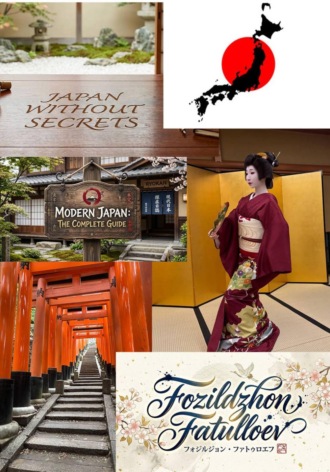
Japan without secrets. Modern Japan: The Complete Guide
In Japan, there's even a term called the "red leaf front." It's an informal term used to describe the gradual progression of autumn tree color from north to south. Leaves begin to change color first in the northern regions and mountainous areas, then the process gradually moves to central Japan and eventually reaches the southern territories. As a result, different parts of the country can experience different stages of the autumn landscape over the course of several weeks.
For many people both within and outside the country, this period becomes a veritable travel season. Tourists and Japanese people alike plan trips to mountainous regions, ancient cities, parks, and temples specifically to coincide with the peak foliage coloring. Popular routes become especially popular during this time, as the combination of red, orange, and yellow hues with traditional architecture creates a distinctive and recognizable Japanese visual style.
Unlike cherry blossoms, which bloom for a very short time and often depend on precise weather conditions, autumn colors last significantly longer. This makes travel more predictable and gives tourists a better chance of seeing beautiful scenery even with slight changes in their travel dates. Therefore, many consider autumn a more reliable season for travel planning, especially if nature and visual experiences are the goal.
Winter
Japan is very heterogeneous, and it is the climate that makes it different depending on the region.
In the north of the country, especially in Hokkaido, winter is truly harsh by Japanese standards. Temperatures there typically range from -5°C to -15°C, and can drop even lower in the mountainous regions. Snowfall here is consistent and deep, making the region considered one of the best in Asia for winter sports and ski resorts.
In central Japan, including Tokyo, Kyoto, and Osaka, winters are much milder. Average temperatures typically range from 3°C to 10°C. Severe frosts are rare, snowfall is infrequent, and it usually melts quickly. The weather is typically dry and sunny, making the cold less noticeable than in countries with high humidity.
In the south, for example in the Kyushu region and especially in Okinawa, winter hardly feels like a typical winter. Temperatures there often hover around 12°C to 18°C, and snow is virtually nonexistent. It's more of a cool season than a cold one.
Why winter feels different
It's important to understand that the perceived temperature in Japan depends not only on the temperature but also on humidity and wind. For example, +5°C in dry Tokyo can feel more comfortable than +10°C in humid countries.
The benefits of winter in Japan
Winter remains one of the quietest seasons for travel. There are fewer tourists, queues are virtually nonexistent, and accommodation prices are often lower than during the spring and fall peak seasons. Central cities are convenient for exploring, as the weather is stable and predictable.
A distinct advantage is the atmosphere. Winter churches, illuminated streets, hot springs, and mountain views create a very tranquil and visually pristine experience.
Snow festivals
Snow festivals in Japan are among the most spectacular winter events in the country, transforming the cold season into a major cultural phenomenon. The most famous of these is held in Sapporo, Hokkaido, and is calledSapporo Snow Festival.
Today this event is known throughout the world, but its beginning was quite simple and even accidental.
How the Snow Festival Came to Be
The festival's history begins in 1950. Japan was undergoing a period of recovery after World War II, and schoolchildren and students in Sapporo decided to create a small exhibition of snow sculptures in the city's Odori Park.
They built several snow figures—animals and simple compositions. It was more of a local pastime than a large-scale event.
But the event unexpectedly attracted the attention of city residents. People liked the idea, and in the following years, participation grew. Gradually, the festival became organized and later grew into a national and international event.
Over time, not only local residents, but also military personnel, artists, architects, and even teams from other countries joined in.
What's happening at the festival today?
The modern Sapporo Snow Festival is no longer just a sculpture exhibition. It's a massive winter exhibition spread across several venues across the city.
The festival's main feature is the giant snow and ice sculptures. Some are so large that they reach several stories in height. Among them are replicas of famous buildings, castles, temples, anime characters, historical figures, and even entire urban scenes.
Creating such sculptures requires a tremendous amount of effort. Sometimes a single large composition requires several weeks of work and thousands of tons of snow. Entire teams are involved in the process, working almost like construction crews, only instead of concrete and steel, they use snow and ice.
Festival atmosphere
During the day, the festival looks like a huge snow city, where you can walk among the sculptures, examine the details and take photos.
But it's especially impressive at night. When the lights are turned on, the ice figures glow from the inside and outside. The light reflects off the surface of the snow and ice, creating the feeling of being inside a fantasy world or a movie set.
At this moment, the city turns into a space that seems simultaneously real and unreal.
Legends and cultural meaning
Unlike sakura or momiji, snow festivals don't have ancient religious roots. They're a modern tradition, but over time, their own cultural meaning has developed around it.
For residents of Sapporo and Hokkaido, snow isn't just weather, it's a part of life. Winter here is long and snowy, and instead of viewing it as an inconvenience, people have learned to turn it into art.
Therefore, snow festivals can be seen as a symbol of human adaptation to nature: instead of fighting with snow, we create beauty from it.
Why the festival became a global event
Over time, the festival has become international because it combines several things at once:
art
architecture
winter nature
mass participation
visual effect of scale
It's also great for tourists: it's a limited-time event that can be planned in advance.
Chapter 3
What you need to know before buying a ticket
Visa
A visa is the first real "filter" anyone faces when traveling to Japan. It's important to understand one thing right away: Japan isn't a visa-free country for most CIS countries, so a trip almost always begins not with choosing a hotel or an itinerary, but with preparing the necessary documents.
And here's where many people make their first mistake: they think a Japanese visa is just a formality. This is not the case. The Japanese visa system is very careful, strict, and focused on verifying the purpose of the trip, financial stability, and the logic of the itinerary.
How Japan views tourists
When you apply, Japan actually asks three questions:
Why do you want to come to Japan?
Do you have a realistic travel plan?
Will you be able to financially support your stay and return back?
If at least one of these points looks questionable or “vague”, the likelihood of refusal increases.
Therefore, a Japanese visa is not a “questionnaire”, but a small dossier about your trip.
What does the process look like in practice?
A visa is usually obtained in advance through a consulate or visa center (depending on the country of application). Tourists must gather documents confirming:
purpose of trip (tourism)
route
place of residence
financial solvency
The most important thing isn't just the availability of documents, but their logical coherence. For example, if you declare a 10-day trip but don't have a clear itinerary or proof of accommodation, this raises questions.
Key documents (the essence, not the bureaucracy)
To put it in layman's terms, you need to prove three things:
that you are really going to travel?
that you have money for the trip?
that you will return home?
Typically the following are used for this:
passport
statement
photo
travel program (itinerary by days)
proof of accommodation (hotels or invitation)
financial documents
It's important to understand that even if you have money but don't have a logical route, it can work against you.
A subtlety that is often misunderstood
The Japanese visa is very "logical." This means the consulate looks not only at the documents you provide but also at how coherent your story is.
For example:
If you write that you want to see Tokyo, Kyoto, and Okinawa in 3 days, that seems unrealistic.
If you don't have a clear place to live, the question arises of where you will be
If there is no financial justification, there is a risk that the trip will not be secured
That’s why sometimes they refuse not because “something is wrong,” but because “the trip story looks unconvincing.”
Risks and common mistakes
The most common mistake is trying to "simplify" documents or submit incomplete information. This almost always leads to problems.
The second mistake is presenting a trip without a well-thought-out itinerary. Many people underestimate the importance of a travel itinerary, but it's precisely this that demonstrates that the trip was truly planned and not just a random occurrence.
The third error is unreliable or inconsistent data. The Japanese system is very sensitive to inconsistencies.
Timing and reality of the process
Visas aren't issued instantly. You usually need to submit your documents well in advance, several weeks before your trip. Sometimes the process takes less time, sometimes longer, depending on the season and the consulate's workload.
It is important to remember that before your trip, it is better not to leave everything “to the last minute,” because Japan is a country where planning plays a key role.
Advantages of the Japanese visa system
Despite its strictness, the system has one advantage: if you've prepared properly, the process becomes fairly predictable. A Japanese visa isn't a "lottery" if you've completed everything logically.
Also, having received a visa once, in some cases it is easier to obtain repeat visas.
Cons
The main drawback is the demanding approach to detail. Documents cannot be treated formally or superficially.
The second disadvantage is the need to prepare the route and confirmations in advance, which takes time and preparation.
Passport
In a strict and practical sense, Japan is a country where a passport is not just a formality, but directly determines how easily a person can enter the country.
It is important to distinguish between two issues: which passports allow entry without a visa and which do not.
1. Which passports allow you to enter Japan without a visa?
Japan has a visa-free regime with a number of countries for short-term tourist trips (usually up to 90 days).
Main groups of countries with visa-free entry
Europe
Almost the entire Schengen area and a number of European countries, including:
Germany
France
Italy
Spain
Netherlands
Sweden
Norway
Finland
Poland
Austria
Belgium
Switzerland
Czech Republic
Portugal
Greece
Hungary
Denmark
Ireland
United Kingdom
and other European countries
North America
USA
Canada
Asia (partially)
South Korea
Singapore
Malaysia
Brunei
Hong Kong
Macau
Taiwan
Thailand (depending on passport type and agreement terms)
Oceania
Australia
New Zealand
Latin America (partially)
Brazil
Argentina
Chile
Mexico
Peru
Uruguay
and a number of other countries in the region
Conclusion on visa-free travel
If your passport belongs to one of these countries, you can usually travel to Japan without a visa as a tourist, but the final decision always rests with the border guard upon entry.
2. Which passports cannot be used to enter without a visa?
If the country is not included in the list of visa-free agreements, then a visa is required.
This applies to most countries:
Tajikistan
Uzbekistan
Kyrgyzstan
Turkmenistan
Pakistan
India (visa required in most cases)
most African countries
a significant part of the Middle East countries
An important principle
Japan does not rate passports as “better” or “worse.”
The decision is based solely on interstate agreements.
If there is no agreement, a visa is required.
If so, visa-free entry is possible.
3. Passport requirements (critical details)
Even if you have a visa or visa-free entry, your passport must meet basic requirements.
The passport must be:
valid for the entire duration of the trip
preferably with a shelf life (often at least 6 months is recommended)
in good physical condition
with readable data and a photograph
with enough free pages for stamps
Common problems
A common mistake is underestimating the condition of a passport.
Problems may arise if:
the passport is damaged
the pages are torn or badly worn
the photo or data is difficult to read
the validity period is too short
Even if you have a visa, this may result in denial of entry.
4. Key practical conclusion
There are three levels of access for Japan:
1. Visa-free countries
Entry is possible without a prior visa, but subject to border control.
2. Countries with a visa regime
Pre-arrangement of a visa at the consulate is required.
3. Border control
Even with a visa, the final decision on entry is made by the Japanese border guard.
Insurance
Travel insurance is one of the most underrated aspects of a trip to Japan. Many tourists treat it as a mere chore or even try to save money, but in reality, it's often the difference between a minor issue being a mere inconvenience or a very expensive situation.
It's important to understand one simple thing: Japan has high-quality healthcare, but tourists pay for it and often have to pay on site. Even a routine doctor's visit or examination can be expensive, and in serious cases, the costs can quickly mount to thousands of dollars.
Why Insurance in Japan Is Really Important
Japan is a safe country, but the risks for tourists are not related to crime, but to domestic and medical situations:
heat stroke in summer
injuries during walking and hiking
cold or infection
food reactions
injuries in the mountains or on excursions
flight delays due to typhoons or weather
Even a simple situation like a hospital visit can incur an on-site fee. Therefore, insurance here serves as financial protection, not a formality.
According to travel estimates, the average cost of travel insurance for Japan is approximately$28 per day, and a typical trip costs about$400–500 per policyIn broader surveys, the range can range from approximately$46 to $150+ per week, depending on the coverage and age of the tourist.
What expenses does insurance cover?
Good travel insurance usually includes:
emergency medical care
hospitalization
transportation to the hospital
sometimes - medical evacuation to another country
compensation for trip cancellation or delay
loss of luggage or documents
In some cases, medical evacuation coverage can be very expensive, as transportation from Japan to another country is one of the most expensive parts of treatment.
How much does insurance really cost?
Prices depend on the level of coverage:
Basic medical policies are cheaper
Extended packages with evacuation and trip cancellation are more expensive
According to market estimates:
Minimum options can start from around tens of dollars per trip
The average comfortable level is about $50–150 per week
Full-fledged extended plans - higher, depending on age and activity
It is also important to keep in mind that insurance usually accounts for a small percentage of the total trip (approximately 2-6% of the travel cost).
Which companies are most often chosen by tourists?
According to an analysis of sales and popular travel plans for Japan, the following insurance companies are commonly found:
IMG
Tin Leg
Travel Insured International
They are among the most frequently purchased items among travelers.
Also frequently mentioned in expert ratings:
Allianz
AXA
World Nomads
They are usually chosen for their balance between medical coverage, reliability and ease of registration.
How to choose the right insurance
The biggest mistake is choosing insurance based solely on price. In Japan, it's more important to look at the policy's contents.
When choosing, you need to consider:
1. Medical coverage
It should be high enough because medical services for foreigners can be expensive.
2. Medical evacuation
This is one of the most important points. In complex cases, transportation can cost tens or even hundreds of thousands of dollars.
3. Activity coverage
If mountains, skiing, hiking or active walks are planned, this should be included separately.
4. Ease of payments
Some insurance policies are more complex when it comes to processing compensation. This is more important than it seems, because in real-life situations, speed is crucial.
Insurance Features Specific to Japan
There are several important nuances:
The tourist usually pays for the treatment himself first
then the insurance company will reimburse the costs
Some clinics require a payment guarantee
In serious cases, insurance may interact directly with the hospital.
Natural risks should also be taken into account: typhoons, earthquakes, and transport delays are sometimes included in extended packages.
Common mistakes tourists make
The most common problems:
buying the cheapest insurance without checking coverage
lack of medical evacuation
ignoring active recreation (mountains, sports)
taking out insurance after the trip has already begun
misunderstanding of payment terms
Mobile communications
Prices in Japan depend less on the carrier and more on the connection type: eSIM, physical SIM, or pocket Wi-Fi. Carriers (Docomo, au, SoftBank) often operate internally, while tourists purchase ready-made packages through intermediaries or through tourist plans.
1. eSIM (the most popular option)
This is currently the most convenient format for tourists.
Approximate prices:
5 days: approximately 10–20 USD
7-10 days: approximately 15-35 USD
15–30 days: approximately 25–60 USD
What influences the price:
unlimited or traffic limit
speed (there are “cut down” cheap versions)
partner operator (Docomo is usually a little more expensive, but more stable)
Important point:
“Unlimited” often means:
After a certain volume, the speed decreases.
2. Physical SIM card
A slightly less convenient, but still popular option.
Approximate prices:
7 days: 15–30 USD
10–14 days: 20–45 USD
30 days: 30–70 USD
Peculiarity:
often sold at airports
sometimes only internet (no calls)
may require a passport upon purchase
3. Pocket Wi-Fi (mobile router)
Very common in Japan, especially for tourists and groups.
Approximate rental prices:
1 day: 5–10 USD
7 days: 35–70 USD
14 days: 60–120 USD
30 days: 90–180 USD
Additional costs:
pledge (sometimes)
fine for loss of device (may be 100-300 USD)
Why the price is higher:
because you are renting a physical device with unlimited internet.
4. Roaming (the most expensive option)
Approximate prices:
1 day: 5–15 USD (sometimes more)
7 days: 30–100+ USD
30 days: may exceed USD 150–300
Problem:
limited speed
unstable quality
high price per gigabyte
5. Hidden costs that are often not talked about
Here's where tourists most often make mistakes:
1. “Unlimited” with speed limitation
After 1-3 GB per day or a certain volume, the speed drops to a level where cards and video work slowly.
2. Activation and delivery
Some eSIM services include fees for:
activation
QR code
SIM card delivery (if physical)
3. Loss of Pocket Wi-Fi
This can be the most expensive risk, with fines reaching several hundred dollars.
6. How to choose the most profitable option
To put it simply:
One person, short trip (up to 10 days)
→ eSIM (15–30 USD)
One person, 10-20 days
→ eSIM or SIM (25–60 USD)
Group of 2-5 people
→ Pocket Wi-Fi (split the cost)
Budget option
→ SIM with limited data (cheaper, but less convenient)
Internet in Japan is not expensive by global standards, but it is important to understand the structure:
You pay for the format, not the operator.
"unlimited" is often conditional
The cheapest option is not always the most convenient
Internet
The internet in Japan is one of the strongest elements of the country's infrastructure. It's fast, stable, and accessible almost everywhere, but it's structured differently than many tourists expect. It's not just the availability of the network that matters, but also how it's used in everyday life.
1. The overall picture of the Internet
In Japan, there are three main connection methods:
mobile Internet (SIM, eSIM, routers)
free or public Wi-Fi
home Wi-Fi in hotels and accommodations
In large cities, the internet is almost always stable, and mobile operator coverage (Docomo, au, SoftBank) is considered one of the best in the world.
2. Free Wi-Fi: Where is it really available?
Free Wi-Fi exists in Japan, but it often requires registration and doesn't always work perfectly.
Main locations:
Airports
Wi-Fi is available immediately upon arrival at all international airports. This is the standard connection point for tourists.
Railway stations
Many major stations in Tokyo, Kyoto, Osaka and other cities have free Wi-Fi, especially in tourist areas and transportation hubs.
Cafes and restaurants
Chains like Starbucks, McDonald's, and some other establishments offer Wi-Fi, but often require registration via email or phone.