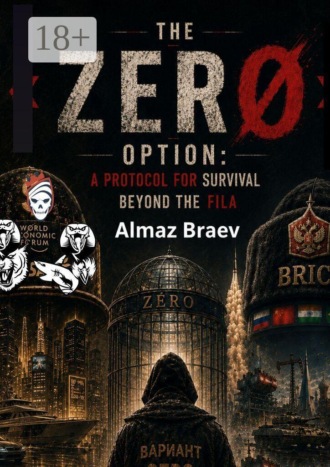
Полная версия
The Zero Option. A Protocol for Survival Beyond the Fila

The Zero Option
A Protocol for Survival Beyond the Fila
Almaz Braev
© Almaz Braev, 2026
ISBN 978-5-0070-6849-9
Created with Ridero smart publishing system
The Zero Option
A Protocol for Survival Beyond the Fila
In this text, the names of certain actors operating within the ZÉRO-system have been omitted in accordance with regulatory requirements. However, for those who possess the RECON optics, this is of no consequence: names are merely temporary masks; the functions remain unchanged
Annotation: RECON — The Blueprint of the Upstart
In an era defined by the “ZÉRO-System” — a global architecture of noise, control, and administrative queues — the individual is increasingly reduced to a mere “interface” or “phantom.” RECON is not just a book; it is a diagnostic tool and an operational manual for those who refuse to be consumed by the “informational GMOs” of the 21st century.
This manuscript maps the global battlefield of 2026—2035, deconstructing the competing models of global management:
The Museum: BRICS and the illusion of conservative safety.
The Fair: The USA and the inflation of prestige and noise.
The Factory: China’s attempt to industrialize human talent.
The Bazaar: India’s fractal competition for survival.
RECON introduces the archetype of the “Upstart-Architect” — the individual who possesses the “optics” to see the underlying structures of power rather than the superficial content of the “queue.” It provides a rigorous protocol for “cognitive fasting” and the construction of Small Dense Networks (SDNs) — parallel, autonomous structures built on trust, real-world assets, and structural capability, rather than fiat currency or digital reputation.
Drawing on a deep socio-anthropological glossary, the book exposes how the “conservative code” of the masses perpetually recreates hierarchies that stifle talent. RECON offers a path out of this erosion: a strategy of distance, invisibility, and the creation of “fog-based” autonomous enclaves.
This is a manifesto for the builders of the next cycle. It is an engineering task for those who have realized that there is nowhere left to run, and that the only remaining path is to plant a new forest on scorched earth.
RECON: Stop waiting for permission. Start building the structure.
Chapter 1 Nothing Sacred — A Multitude of Traitors
If one out of ten aspirants becomes wealthy, it rarely sparks alarm. Envy, perhaps. But if the newly rich are also fools, it quickly dissolves any residual anxiety.
If the most worthy among ten aspirants is chosen, the remaining nine will seethe with regret. Their vanity will consume them. But if they choose the weakest among them, everyone breathes a sigh of relief.
Thus, history is dictated not by the envy of material wealth, but by vanity. To foster a truly worthy world government, the vanity of billions must be silenced, rather than invoking the tired specter of class struggle.
The vanity of billions… Why is this critical to our current situation? We live in an era where everyone lives for money. Before money took precedence, society was governed by estates and lineages. For nearly 2,000 years, humanity relied on the “voice of blood” — not in the sense of nepotism (“this son of a bitch is our son of a bitch”), but in the sense of evolutionary selection. Noble blood. Worthy parents, carefully vetted by their own ancestors, could not produce unworthy offspring; even the weak among them upheld the code. The selection of a leader was a matter for elders or a council of authoritative figures.
This did not mean a leader could not fail. Circumstances were many. Yet, even 2,000 years ago, the selection of the weak or unworthy signaled a surrender to monetary interest and personal glory. A people could find themselves with a weak elite or a leader who surrounded himself with mediocrities.
What is the root cause of such a choice?
A prolonged absence of threat.
When the outcome in the short term does not depend on a random choice, those in power, unafraid and foolish, grow complacent and indulge their vanity. For instance, when Hannibal requested aid from Carthage, the envious detractors of the Barca clan responded with mockery: “You are winning regardless; why do you need help?” The result was tragic: Carthage vanished, and its people were sold into slavery.
The main conclusion: People seek help only in moments of extreme necessity. This moment is the “Point Zero.” Hannibal was recalled from exile too late.
For 2,000 years, humanity relied on the decisions of the wise. This was the age of estates, castes, and noble families. In conservative communities, money did not dictate outcomes — authority did. Two millennia later, after a series of revolutions, the authority not only of the estates but even of the revolutionaries themselves has evaporated. The liquidation of any authority is the final obstacle before the global crown of money. Even with local rulers, officials, and states in place, people understand these are mere formalities: the true government is elsewhere. The true rulers are those who possess the money. Local rulers depend on them.
Money has introduced globality while simultaneously stripping influence from any local sanctities. People have realized: money decides everything. Laws are drafted by the world of money. Therefore, for those who have acquired even a modicum of wealth, nothing is sacred. This is why we are surrounded by conditional traitors — both latent and potential.
Money penetrates human beings through opportunity.
All traitors emerge from conservative environments, where a hierarchy of authority exists from birth (even if diminished, the inertia of tradition remains; otherwise, all nations would have long since fractured). Communities consist not only of inexperienced youth but of elders. Parents and kin assist the young in maturing and finding their footing. One cannot simply escape this world.
But when conditions are created — especially when there is an urge to mask the “damage” of one’s origin through speculation, bribery, and fraud — everything becomes clear. Traditional worlds create a “line” (the Fila). This line can only be overcome through betrayal. Yet, in doing so, one can draw closer to the monetary throne of the invisible world elite.
— —
Chapter 2 Civil War: The Exit and Entry of Conservative Populations
Civil War: A Formal Definition
A civil war is a large-scale armed conflict within a single state between organized groups aiming to seize power in the center, capture specific regions, or alter the state’s political system.
Key Characteristics:
Internal Nature: The conflicting parties are citizens of the same country (nation), sharing the same “CODE.”
Ideological Schism: The war is fought not for territory per se, but for incompatible value systems, governance models, or resource allocation.
High Intensity: Involves mass participation of the civilian population and radicalization of society.
Erosion of the Monopoly on Violence: Central authority loses its exclusive right to use force, which shifts to paramilitary formations.
Result: A profound transformation of the social structure, a turnover of elites, and a long-term schism in national memory.
Population decline is not merely a product of global wars. The most conservative segments of society suffer the most during civil wars.
Beyond the formal definition, we must understand what a civil war actually is. Today, I will state truths not often heard in the open world.
The Bifurcation of Provincialism and Outsiders
For at least twenty years, we have been witnessing a bifurcation — a bifurcation of the “Outsider.” Later, this process was sponsored from the outside, utilizing the complexes of large masses.
But what was the starting point? Who became the sudden elite, and who was relegated to the “province”? The bifurcation began in 1991. When the USSR launched its “market reforms,” those closest to the decision-making centers became the masters of the new life. Mostly, these were the former Komsomol apparatchiks. They were partially from the old nomenklatura, partially from the ranks of the new “democrats.” As mentioned before, these lucky ones were born in the 50s and early 60s; they had spent their entire conscious lives amidst Soviet parades and anthems. They were the most “Soviet” people of all.
Because there were too many aspirants at the top (who did not reveal their true desires, masking them under the name of “reforms”), the breakup of the USSR along national lines was a political ploy by these factions. Yet, in the provinces, this ploy was not understood. Local Komsomol cadres did not grasp it (for a “true” Komsomol member, the center of the world was Red Square). The Soviet people were internationalists then — before privatization, greed had not yet fully taken hold.
By the 2000s, it became clear to everyone: people had grown bitter. They saw the “slices” of wealth held by others while clutching their own “scraps.” Bitterness grew against the nouveaux riches — the masters of life and the promised paradise.
And nationalism flourished. Why? Because the Komsomol elites themselves had pointed the way along national-administrative lines in 1991. Financial donors of chaos subsidized new activists throughout the 90s. Initially, nationalism was hidden behind a mask of “democracy,” but it eventually grew into an independent branch, fueled by the number of victims of “reform,” usurpation, and corruption. Constant, permanent advertising eroded every impressionable mind. Temptations poured in from all sides, fueling envy and malice.
The Second Phenomenon
No one has considered why nationalism surged on the periphery of the USSR (the former republics), while in the center of the former empire, a reciprocal chauvinism emerged. It happened because the former were historical “outsiders,” while the latter were the carriers of an imperial code.
Finally, what do we see as the result of these opposing poles meeting? Two factions of the “religion of money” colliding? The masters fight, and the servants suffer… No, it is much more complex than that.
Consider the Civil War of 1917—1921. Class struggle, as the Marxist-Leninist definition goes. But even in the White Army, there were peasants. Representatives of the same village shot at one another. In Artyom Vesely’s Russia Washed in Blood, a son consciously kills his father from across the trench after a brief dialogue. The father saw his career in serving the “master” of the old system; the son saw his career in the leap toward a “new freedom,” free from the routine of serving anyone.
The conclusion: a civil war is a clash not only of classes but of generations. Few understood what Communism or Marxism actually was.
The young “leapers” were later culled by the more modest Stalinists. The Stalinists knew best that revolution brings new opportunities. This is why modern provincial Kazakhs admire the portraits of young Ukrainian ministers: “Look,” they say, “there are no old people in power in Ukraine. We could have had that, too.” We could not. We only need to look in the mirror. The “European Dream” is not entirely ours. Our path will lead to fundamentalism, following the fanaticism of greedy outsiders. Remember? “People grow tired of fanaticism…” We will have the old men again, but in ritual robes. The bourgeoisie and the “upstarts” always want to dream of their youth and the youth of foreign ministers. No, we do not need that kind of youth.
In general, provincials are “outsiders” in a conservative environment (though not all, as the authoritarian regime promotes the obedient). In a market, provincials simply become fanatical about temptations. There are no restrictions, only the regimes of corrupt officials in front of them and the West at their backs. Hence the Maidans, one after another, and then the hegemony of the rural, the aul, the hut. Chaos. And the death of the conservative contingent.
What is the result?
That various philistines, peasants, and penny-pinchers follow ideas? Not exactly. But one must consider the physical side of the question. In a conservative environment, the majority mattered. Whoever had the numbers held the fate of the state. But after the dreams, everyone wants to eat. And the struggle begins.
This explains the certain “slowness” in the new conflict between outsider factions in this hybrid war. These new outsiders are literate, rational people. They weighed the risks and chose to gamble. They could have negotiated across the trenches. On the other hand, where they were gathered by force, many fled, and others are held against their will. (Who holds them by force? Those who have already felt themselves to be “Europeans” with the necessary pedigree.) And yet, while this bloody, irrational “battle of the outsiders” continues, the algorithms of the digital concentration camp are glitching. They cannot calculate a “mad” impulse or chauvinistic fanaticism. They are afraid of the conservative population.
— — —
Chapter 3 The Most Audacious — The Russian Elite. The Shelf-Life of Defiance
The beginning of the 21st century has demonstrated: there are no truly local elites left in the world. Even China, with its 3,500-year history of “waiting it out,” possesses no real authority. Neither the pressure of the Eternal Heaven nor the teachings of Confucius — nor the material interests of modern rulers (and the Chinese are the Jews of the East) — have ever allowed China to mount a global protest. All it has produced in 2,000 years in the way of dissent are local uprisings and the paradox of Zen Buddhism.
The Russians, however, are a different matter.
Although they insist with foaming mouths that they are not of the East but of the West — that they are the “Third Rome, and a fourth there shall not be” — this is demonstrably false. One need not be a scholar to observe the Russian elite and their behavior: it is a fusion of East and West, painted in the colors of Russian audacity. It was precisely the Russian elites who rebelled in 2022; no one else did.
All the global “outsiders,” together with local conservative outsiders, are looking in this direction: will Russia be able to withstand the combined strike of the West, or will it fail? What are these outsiders hoping for? Why do they fix their gaze upon the Russians?
Beginning with the COVID-vaccination operation, the world showed itself to be “dead.” Following lockdowns, the introduction of QR codes, and the mandate of vaccines, every ruler (every elite outsider) was in agreement. The digital concentration camp had acquired — or nearly acquired — the clear outlines of its completion.
And then, suddenly, a disruption. The “upstarts” (from the Western perspective) did not remain silent. Moreover, an ultimatum was issued to the West. (The Russian elites had already behaved strangely before this — by releasing their own vaccine. This meant they had created their own local score in a game meant for one: “We are playing with you, but we are playing by our own rules.”) This meant: “Yes, we have come to you and your pile of money, but we brought our own chairs. We will not sit in your money-castle where we are told to sit. And we will sail away on our own yachts, not yours.”
How are we to interpret this? Is this behavior Eastern or Western? They seem to play the money game and love money — that was clear throughout the 90s and beyond. They bought up real estate in the West, moved their families there, and kept massive sums in bank accounts. And yet: “We will sail away on our own yachts.” Is this not a shock to the masters of the world?
We have already learned what the “East” is through the example of China. China played the Western game and was prepared to keep its population in pre-prepared “containment zones.” No one wore masks longer than the Chinese. China’s financial games and those of the international financiers had penetrated too deeply into the Chinese economy. The Chinese emperors never prioritized their own population. China is interested only in its empire — even if as a financial Western subsidiary. China viewed the COVID war with the West as a “Third Opium War.”
The rest of the world — including Latin America and Africa — viewed this conflict as a continuation of the anti-colonial wars of the past. It resonates in their genetic memory. Therefore, anyone who stands against the colonizers, anyone who makes a stand at all, attracts outsiders with their sheer audacity. The global chamber has once again filled with the air of the mid-20th century.
We have already examined the internal motivation and the reason for the mass flight of the middle class: once a person acquires money, they no longer view local governments as their primary concern. Such people may possess their own “chairs” to sit in the hall of money — at the most despised positions, or even better, outside the hall itself. They watch the “money-mass” from hundreds of miles away and perform rituals through a screen. These people made their “Western choice.” Others did not. This became the cause of civil conflict. Now, what do we — the outsiders of the world — have before us?
We have two “domes” before our eyes.
One is beautiful, called the “Golden Cage.” Highly attractive, pleasant by habit, prestigious, and status-driven. Everyone who could use their own “chairs” to utilize this world does so without hesitation. Give me one day of this! In the Golden Cage, everything is pleasant. Even the end will be golden — prestigious.
The second dome is the “Dome of Audacity.” It is not as pleasant. It is not as comfortable. Within it, the silhouettes of the past are all too evident. People appearing to be the new boyars and feudal lords. Does this picture attract all outsiders? After all, audacity itself ceases to work over time. One needs a more charming picture of the future.
Hence the question: Can the audacious Russians offer a comprehensive alternative?
The world of money has become clear. It ends in a digital concentration camp. Without an alternative vision to the DIGITAL, nothing will succeed. All of this is temporary. The wearing of luxurious beards by the ideologues of the “audacious” does not inspire trust. Every BRICS nation has its own ancient faith. Uniting the old faiths of post-colonial peoples does not provide a single beard that fits everyone. Especially if the ideologues themselves drive foreign cars and wear Western brands.
— —
Chapter 4 “Yes, We are Alarics. Yes, We are the Camp”
…with slanted and greedy eyes.
What the Russians lack, what the Japanese have lost, only the Horde-born possess.
All nationalists play at antiquity. These games are adrenaline for the stifled and insecure. Behind these games lies the claim of the “senior” or “more cultured” party. In this sense, neither the Persians nor the Chinese fuss over such things — they have no such anxiety (and the Jews, naturally, are always present). The concern for “age” belongs to those who are insecure in themselves.
Moscow — The Third Rome.
Originating from Rome — what can be said against it? “Moscow is the Third Rome, and a fourth there shall not be.”
To understand this Roman series, to find the “Third Rome,” let us recall Alaric, the leader of the Visigoths. Indeed, after Alaric sacked Rome, the First Rome suffered great hardships and never fully regained its stature. Alaric was granted the title of Magister Militum, Roman gold, and lands for his people, but he did not know what to do with all this “Roman” junk.
As a true tribal man, he migrated from Rome back to the wild fields. Why? He acted as a nomad. Roman concrete and bricks meant nothing to him. A nomad has no need for paved streets. He needs freedom. He needs bright light and a familiar, natural landscape. Consequently, the Roman state, with its institutions and the Colosseum, frightened him.
He acted this way not out of idleness: pillage followed by retreat is tribal tactics, the strategy of the nomad. First the campaign, then the looting of the defeated, then a rapid retreat with the spoils to the native lands. After this, you are a hero. Beyond literal spoils for your kin, there is nothing here for a tribal person. They do not consume books; they find no use for what is written within them. Among all primordial peoples, laws are not inscribed on calfskin — they are remembered and recited. From childhood.
With the First Rome, everything becomes clear. Despite all their advanced logic, the Latins lost to barbarian passion and barbarian energy. Dry logic, mathematics, and legalistic stratification dehydrate a nation to the limit. In return, “culture” appears. For all their militancy, every savage on earth knows they are deeply lacking something. So, they don certain cloaks, assume expressions, and adopt poses — it is all posturing, a dance, but it has an effect on their brethren.
That is why the descendants of Alaric created the Holy Roman Empire in the 10th century. They decided that tribal strife was endless and that something had to be done. The dancing and mimicry became more akin to civilization. Thus, the Germans created their own “Third” Rome (a German Reich, because by then, the Eastern part of Rome — Byzantium — already existed).
So, who was truly the third? And how many Romes are there, after all? One thing is clear: all these Romes trace their pedigree to the Latin one. Lest anyone wonder where the Japanese came from, I simply remind you: civilization loses the battle to any new barbarians (if that civilization has been dehydrated and drained of life by overly demanding teachers).
Why the Alarics Vanished in Japan
The Japanese had no empire until they encountered European technology and received significant investment before the Russo-Japanese War of 1904—1905. Japan emerged from its islands to secure raw materials for its industry. But the Japanese Empire had a legend of the first emperor — the son of the goddess Amaterasu. This allowed Japanese nationalists to speak to the Chinese: “We, too, have 2,500 years of civilization.”
One cannot say the Japanese elite resembled nomads. Despite their capitalist drive for the material, the Japanese despised “upstarts.” There was no rule of “loot and take home.” If they took things home, that “home” was Japan. They observed the Code of Bushido in the name of the Emperor. (This is why corruption is generally weak in Japan.)
Even the nomads had Genghis Khan’s Yassa. But in those distant times, the unified Horde was associated with the leader. If there is a leader, we do not loot for ourselves — we take it “home.” If there is no leader, we carry everything into our own yurt.
The construction of the yurt and many autonomous yurts resembled mini-states within a state. Submitting to clan logic, the nomads could create a separate camp (stoybishche) alongside the royal one. For tribal democracy, this is normal. (Thus, when certain elites in the modern Empire of Money act autonomously, they show traits of free nomads, not of the Third Rome. They came, took what lay unattended, and carried it home — without asking you, because warriors are allowed such things. Then they came to the financiers and said: “We are making our own yachts, like yours; we are bringing our own chairs, and we will sit wherever we please.”)