Полная версия
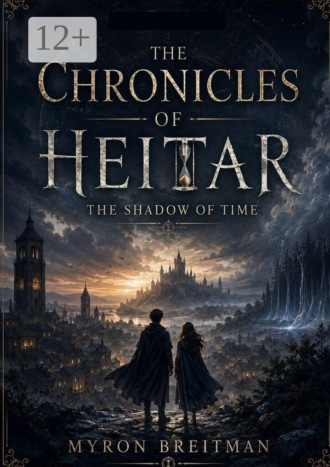
The Chronicles Of Heitar — The Shadow Of Time

The Chronicles Of Heitar — The Shadow Of Time
Myron Breitman
© Myron Breitman, 2026
ISBN 978-5-0070-6447-7
Created with Ridero smart publishing system
Chapter One — Shadows in the City
Dusk fell upon the city of Heitar the way a dying man exhales his last breath — slow, inevitable, and heavy with the accumulated weight of everything left unsaid.
It came from the east, creeping along the cobblestones first, pooling in the sunken gaps, filling the cracks with something darker than absence. Then it rose, climbing the weathered walls the way water rises in a flooded cellar — patient, purposeful, unstoppable. By the time it reached the rooftops, the sky had surrendered. Not to night — not quite yet — but to that threshold hour between what is and what might be, that liminal gray belonging to neither world and therefore belonging to both.
Heitar was a border city, the last inhabited outpost before the kingdom of Eleinor dissolved into contested borderlands and, beyond those, into the ancient wilderness no cartographer had ever dared map in full. Its cobblestones were uneven underfoot, lifted by centuries of frost and neglect. Its buildings leaned against one another like very old men sharing a bench. Markets sold practical things — rough cloth, root vegetables, tallow candles. Its people had the particular look of those who had given up expecting anything astonishing and learned to be grateful for anything warm.
But dusk changed it. In dusk, Heitar stopped being a city and became something else — a stage, perhaps, or a memory of one. The merchant stalls folded away. The children disappeared inside. And the city stood revealed as it truly was beneath all that daily commerce: old. Desperately, profoundly, impossibly old. Older than the kingdom it served as border to.
The lantern at the corner of Throughway Alley was the first sign that the evening was something other than ordinary. It hung from its iron bracket like a question mark, swinging in a wind no one felt on their skin, the flame inside pulsing — rhythmically, deliberately, as if signaling to someone standing at the far end of the alley who never came.
The smell hung over everything like weather. Wet wood softened to its cellular core by a week of autumn rain. Old smoke from a hundred kitchen fires. The mineral sharpness of cobblestone after rain. And beneath all of it, barely perceptible — something else. Something cold, and faintly metallic, and very old.
Here, at the edge of the magical kingdom of Eleinor, reality wore thin. The people who had lived in Heitar for generations knew it as a physical fact, something felt in the molars on certain nights. The membrane between what was and what lurked was thinner here. Things could come through that had no business being among the living.
Most nights, they didn’t.
But this was not most nights.
Their house stood on the northern hill.
It was the sort of house that had once been important and had since become merely significant — three stories of dark stone, windows that rattled when the wind changed, a roof repaired so many times in different materials it had achieved a kind of patchwork dignity. It sat at the place where the cobblestones ended and the uneasy plain began, that stretch of flat wind-brushed land that ran to the horizon without apology, without tree or landmark.
At the northern edge of the plain, barely visible on the best of days and invisible on all others, the Forgotten Forest began.
Not that anyone called it that in daylight conversation. In daylight it was referred to obliquely, if at all — a direction, a horizon, a vague darkness noted in peripheral vision and then consciously unregistered, the way you might notice a stranger watching you from across a crowded market and choose, very deliberately, not to look back.
The house had been in their family for generations. Once it was inhabited by scholars, keepers of old knowledge, mages who chose solitude over the company of courts. Those people were long gone. What remained was their furniture, their books, their accumulated strangeness, and two young people who had inherited all of it without a great deal of warning.
Kaen and Merissa. Brother and sister. The last of a line almost no one remembered.
He was twenty-two that autumn, lean and dark-haired, with the posture of someone who had spent too much time leaning over books — a slight forward cant to the shoulders, a tendency to hold his head at an angle as if perpetually listening for something. He had their father’s jaw and their mother’s eyes — gray, with that unsettling quality of seeming to hold more light than the conditions of any given room should allow.
She was nineteen, and looked nothing like him except in the eyes. Where he was angular and still, she was motion and curve — expressive hands, a face that kept almost no secrets, a way of sitting that involved some part of her always in slight motion. Her dark hair fell loose around her face.
That evening she sat on the windowsill with a wool blanket around her shoulders, watching the city below. He sat at the reading table by the fire, surrounded by books in the particular organized chaos of someone for whom disorder had become a system. The book in his lap was old — genuinely old — the typeface the kind that seemed to move slightly if you looked at it long enough.
He read. She watched. The fire crackled. The lantern outside pulsed.
Then Merissa said, very quietly:
“They didn’t come back again.”
Kaen looked up from his book. He set it carefully aside.
“Who?” he asked. Not because he didn’t understand, but because putting a fear into language makes it slightly less capable of moving through walls.
“Airis and her mother. They weren’t at the market. The neighbors say the door to their house is open, but inside there’s nothing. Everything is in its place. Except them.”
He was quiet.
“Everything in its place,” he said eventually. “Except them.”
“Except them.”
He crossed the room, joined her at the window. Outside, the street was empty in a way that streets are not usually empty — not the emptiness of people having gone inside, but the emptiness of a place from which something essential has withdrawn.
“This is the fifth,” he said, counting the way you count something you don’t want to be counting. “In the past two weeks. Always at night. Always without any trace. No one heard anything. No one saw anything.”
“As if they were erased,” Merissa said.
“Yes.” He put his hand on the cold glass. “Erased. That’s the word.”
They stood together, watching the lantern pulse.
“Do you hear that?” Merissa asked.
“Hear what?”
“The silence.”
He listened — and understood immediately, because it was the kind of silence not merely absent of sound but actively maintained. A silence that had been imposed. No dogs. No wind in the eaves. No distant cart on distant cobblestones. The world had gone still.
As if holding its breath. As if waiting.
They ate supper in the kitchen, at the old table with the ring stains and the one leg replaced with a slightly different wood — endearing honesty in a piece of furniture. She had made stew, and there was bread from the day before, slightly stale, which was fine because slightly stale bread held up better in stew.
They ate without speaking much. They had a long-developed language of comfortable silence — the fluency in not-speaking that develops in people who have been each other’s primary company long enough to distinguish silences that mean something from silences that mean nothing. This silence was neither comfortable nor fraught: the silence of two people processing the same information and not having anything useful to add to each other’s processing.
After supper, Merissa washed and Kaen dried — a division of labor established through silent negotiation and never renegotiated since. There was something almost ceremonial about it on evenings like this. The warm water, the rough ceramic, the familiar movements. These things were in their place.
The clock struck midnight.
He heard it from the back porch, where he had gone to stand in the dark and look at nothing in particular. The kitchen light was warm through the window behind him. Somewhere inside, Merissa was settling into sleep — he had heard her on the stairs, the familiar pattern of her footsteps, then the soft click of her door.
He should have been asleep too.
He stood on the porch instead, in the dark, in the cold, in the silence.
The wind from the plain brought things. Usually it brought the expected: grass, soil, the mineral cold of autumn approaching winter. Tonight it brought something else — a metallic edge, like copper or like blood, cold and slightly sweet.
His hand found the amulet at his throat.
It was old, a simple disc of dark metal on a chain with a symbol etched into it — something between a stylized eye and a knot. His father had worn it. His father’s father before him. It had been passed to Kaen when he was too young to understand what was being passed, only that the passing was serious and that the weight of the metal against his skin was warm in a way that metal should not have been.
It was warm now. Not hot. Just present. Alert. The way a watchdog’s ears lift before it growls.
He did not turn around immediately.
He should have.
He heard the sound from inside the house before he could react — not a footstep, not a crash, but a displacement. As if the air inside had shifted because something had shifted within it, and the air had rearranged itself around the new thing the way water rearranges around a stone dropped into it.
“Merissa,” he said, barely more than an exhale.
He turned.
On the threshold between the kitchen and the hallway, there was something.
It was difficult to describe because it resisted description. Not a form so much as a formedness — a density, a gathering, a mist that had achieved sufficient internal agreement to approximate the shape of a standing figure without actually being one. Taller than a person by half again. No face, no features in the place where a face would be. And yet presence — the quality of taking up more space than its physical dimensions should account for. The air around it shivered, very slightly, as if reality was consulting rules it hadn’t anticipated.
It moved without touching the floor. Not floating — more like flowing, water finding paths of least resistance. It flowed toward him.
He had no time for fear, which was perhaps fortunate. What he had was instinct — a deep, bone-level, pre-verbal recognition that what stood before him was not of the ordinary inventory of the world, and the only appropriate response was to act immediately.
He was a mage of time. He had been one since childhood — the first manifestations strange and frightening, small impossible things, moments stretching, objects moving back to where they had been moments before. His mother had recognized it and taught him, carefully and partially, what she knew. The rest he had taught himself from books and from patient and occasionally painful experimentation.
What he did now was reflex: he reached into the flow of time around the thing and grabbed it, the way you grab a rope.
The world changed. He felt it rather than saw it — a sudden new density to the air, time thickening around the entity like amber forming around an insect. Its flowing movement slowed. Became labored. Each increment of progress costing something.
It was not enough.
He could feel, even as he did it, that it was not enough. The entity slowed but did not stop. It continued toward him, fighting the temporal drag with patience rather than strength — as if slowing it was merely a delay, and the delay meant nothing to something that thought in centuries.
And then — from the hallway above, from the direction of the staircase — came the sound of a door opening.
The second entity appeared at the base of the staircase. He had not heard it arrive. It was simply suddenly there, the way something is there in a dream, present without the inconvenience of arrival.
A third appeared in the doorway to the back porch, cutting off his exit.
Three of them.
The thought in his head was very clear and very simple: they came for her. Not for him. He didn’t know how he knew this, but he knew it with the certainty of something understood below the level of argument.
“Wake up!” he shouted, throwing all pretense at quiet away. “Merissa, wake up!”
He released the coiled temporal energy abruptly, rerouted it as a pulse radiating outward through the room — not elegant, the magical equivalent of throwing something large and blunt at a problem. But it bought him four seconds, maybe five, in which the three entities recoiled, momentarily disrupted.
He was already moving. Up the stairs, two at a time, hand on the banister, and then the door at the end of the hall was opening and Merissa came through it with her eyes not quite fully awake but her body already knowing, already recognizing the wrongness the way a sleeping animal recognizes the wrongness in its environment and wakes with its muscles already tense.
Her eyes, when they focused on him, became immediately clear.
“How many?” she said.
“Three. Downstairs.”
She was already pulling at the air around her with both hands, gathering the substance her magic worked with — illusion, misdirection, the manipulation of perceived reality. The air in the hallway became subtly different, dense with possibility.
“They don’t see,” she said. “Not yet. Give me thirty seconds.”
He turned to the top of the stairs.
He could hear them coming — that terrible non-walking, that flowing movement translated to the creaking of the staircase beneath weight that was not quite the right kind of weight. The house was protesting their presence.
Merissa’s illusion took hold. Where there had been one hallway there were now many, stretching off in directions the architecture didn’t support, each ending in a different kind of darkness. The entities paused — whatever their mode of perception was, it could be confused.
The first entity paused at the second step.
The second, behind it, paused on the landing.
The third walked through the illusion as if it wasn’t there.
Merissa made a sound — surprise, and something under surprise, something that landed with the force of a recognized fear. The third entity had moved through her working as if the illusion were not matter but not-matter, as if her magic had failed to register as something worth responding to.
She had not known they could do that.
“Go,” she said, and her voice was extraordinary in that moment — steady, flat, entirely controlled, saying exactly what it needed to say and nothing else. The kind of voice that appears only when a person has no room left for anything except what is necessary.
He went. Down the stairs, past the first two entities — the temporal pulse he threw ahead wasn’t enough to scatter them but enough to slow them by the second or two he needed to be through the hallway and into the street. He felt the house shaking behind him — not from wind, not from structure, but from the particular resonance of two incompatible magical forces attempting to occupy the same space, reality groaning at the strain.
The rain hit him immediately. The kind that doesn’t build but starts at full force — cold, dense, deliberately unhelpful. The cobblestones were black with it. The lantern at the corner had gone out.
He turned back toward the door.
Merissa came through it running.
They ran.
There is a quality to running in genuine fear different from any other kind of running — no relationship with form or efficiency, the body doing what the body does, something at a lower level than thought deciding direction and obstacle avoidance, managing the extraordinary cooperation of dozens of muscles without any input from the conscious mind.
They ran through the rain, through the empty streets of Heitar, through the silence that still held the city in its inexplicable grip. Not a dog barked. Not a window opened. The city was absent — not sleeping but absent, the way a crowd is absent when something has told it, through some collective wordless communication, to be elsewhere.
The shadows ran with them. He registered this in peripheral vision first and then had it confirmed by the feel of his amulet — the warmth had intensified to something approaching uncomfortable. The things behind them were not keeping distance. They were not rushing either. They were maintaining a precise and terrible proximity, close enough to be felt, far enough to permit the illusion of escape.
His sister was beside him. Her hand found his wrist in the dark and held it.
He thought of the Temple of Hours. The thought arrived fully formed, as if it had been waiting for this particular moment. The Temple of Hours, which stood on the far side of the city, which was old — older than the city, certainly, older than anything currently standing in it — built by time-mages who had preceded everything, which was still consecrated to its original purpose even if no one worshipped there now, even if the current caretaker was an old man who did not speak.
“The Temple,” he said, between breaths.
She understood immediately.
He adjusted their direction, angling through a back alley that would save them half the distance at the cost of some light, and she followed without question, and behind them the shadows followed too, maintaining that precise and patient distance.
Just before they turned the final corner, Merissa looked back.
Once. Only once.
Their house — visible from here still, on its northern hill — was disappearing. Not burning, not collapsing. Dissolving at the edges, the stone walls softening into the surrounding darkness, becoming indistinguishable from it the way a photograph left in sunlight becomes indistinguishable from the paper it’s printed on. Gradually, without drama, without sound.
Being absorbed.
She turned away and ran.
The Temple of Hours was ancient beyond reckoning — older than the city, older than the name of the kingdom. Its stones were enormous, fitted without mortar in the manner of things built by people who understood that permanence is not achieved through adhesion but through proportion. The iron gate stood open, as if the temple had decided long ago that whatever was worth keeping out would not be stopped by a gate.
Inside: old wax and cold stone and something beneath both — a faint mineral warmth, the residue of very old magic embedded in the walls, patient and quiet and entirely unlike what had been pursuing them through the rain.
They pushed through the inner door and into the main hall and the shadows did not follow.
The threshold held them. He could feel it — the precise moment at which the pursuit stopped, that particular quality of pressure lifting, the silence inside the temple its own kind of silence: old and deliberate rather than imposed. He leaned against the wall and listened to his own breathing.
Merissa closed the door.
For a long moment neither of them spoke.
Then, from somewhere in the interior, a light appeared — small, carried, moving with the unhurried pace of someone for whom urgency had ceased to be relevant some decades prior. An old man. One eye, a covered lantern, a robe mended so many times it was difficult to determine what it had originally been. He looked at them both without surprise, as if their arrival had been expected.
He set the lantern on the floor. Went to a side door, opened it, and waited.
There was food inside. A fire already built. Blankets. A room beneath the dome, with the crack in the stone that let in a thread of sky, dark now but present.
He left them there without a word, because he did not speak. Words would have been unnecessary. What he had provided was enough: shelter, warmth, and the profound reassurance of walls older than what had followed them here.
Outside, invisible in the rain, the Forgotten Forest breathed.
And in the morning, everything would begin.
Chapter Two — The Forbidden Book
Dawn in Heitar never arrived the way dawn was supposed to arrive.
In other cities — cities that hadn’t spent centuries positioned at the seam between the known world and what lay beyond it — dawn came with something like generosity. A gradual warming at the horizon. A softening of dark to gray to something approaching gold. A sense of the world choosing, slowly, to be visible again.
Heitar’s dawn was not like that. It came the way a judge enters a courtroom — without ceremony, without warmth, without any interest in whether those assembled were glad to see it. It pressed through the clouds rather than parting them, colorless and precise, illuminating without improving, revealing without consoling. The kind of light that showed things as they were rather than as they might be wished.
That particular morning came with additional weight — a quality of aftermath, like the smell that lingers in a room where something irreversible has happened. The lantern at the corner of Throughway Alley hung dark and still, its iron bracket empty as a sentence ending in the middle.
The creatures were gone.
They had departed — receded, whatever the appropriate word was — sometime in the deep of night, before the first suggestion of dawn. Kaen had known they were gone the moment it happened, though he couldn’t have explained how. The particular quality of pressure their proximity had created simply lifted, the way a migraine lifts: all at once, without transition, leaving an absence that was almost worse than the presence had been, because absence has no edges to brace against.
In the room beneath the dome of the Temple of Hours, Merissa had finally surrendered to exhaustion and slipped into sleep. He had watched it happen — the way her breathing changed, the way the small persistent tension in her jaw released, her hands uncurling from whatever they had been holding in the waking dark.
He had not slept.
He sat by the dying fire and held the dark green book in his lap. Understanding was not the problem. The problem was accepting — allowing the information to be simultaneously true: that he and his sister were described in a prophecy in a temple neither of them had entered before last night, described with specificity that could not be coincidence, that the things which had come to their house were connected to this prophecy, that the Forest on the northern horizon had been waiting for them specifically and personally and with patience that made the concept of waiting seem almost quaint.
He looked at the sleeping face of his sister.
He thought: our parents knew.
Not revelation — more like recognizing a face you have known for a long time in a context where you don’t expect to see it. Of course. They had always known. The house on the northern hill. The books in the study, accumulating their silent influence. The amulet. The particular way his mother had looked at the Forest on clear days — not with the incurious avoidance most of Heitar’s inhabitants had perfected, but with something more complicated. More informed. A look that contained history and decision and something very close to grief.