Полная версия
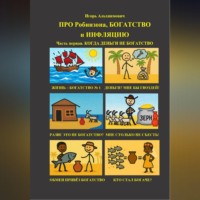
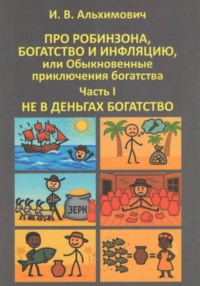
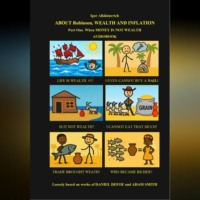
ABOUT Robinson, WEALTH AND INFLATION. Part One. When MONEY IS NOT WEALTH.

Игорь Альхимович
ABOUT Robinson, WEALTH AND INFLATION. Part One. When MONEY IS NOT WEALTH.
Contents Of Part One.
Preface.
Chapter one. Money is not wealth.
Chapter two. Every Robinson wants to know
where the wealth is.
Chapter three. No sweet without sweat.
Chapter four. Time and gunpowder are in incredibly
short supply.
Chapter five. I can’t eat that much!
Chapter six. Muscles for brains?
Chapter seven. Exchange arrived!
Chapter eight. I want!
Chapter nine. Can I?
Chapter ten. A pot for a fish? Not enough!
Chapter eleven. Exchange lives from seven to forty-two.
Chapter twelve. No wealth to be seen! I’m off!
Epilogue.
Author’s Note.
Preface
The English writer and publicist Daniel Defoe, back in the distant year of 1719, showed, using the example of the life of Robinson Crusoe, what real wealth is and how it is created.
What was hidden between the lines of a novel about a man's life on a desert island was reflected 57 years later in An Inquiry into the Nature and Causes of the Wealth of Nations, published by the Scottish economist Adam Smith.
So it is not surprising that the discoveries about the isolated island economy made by the fictional characters in this story are, in one form or another, based on the findings of the "father of economics."
Like Robinson's adventures, adventures of wealth began on a desert island.
Chapter one.
Money Is Not Wealth.
To understand the nature of wealth, let's try to look at it through Robinson's eyes. When we hear the word "wealth," we primarily imagine money, gold, and jewelry.
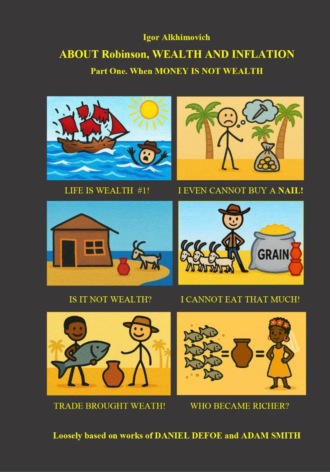
After the shipwreck, the famous Robinson got the ship's treasury — a lot of gold and silver coins. Did he feel rich?
On a desert island, coins can’t be exchanged even for a piece of stale bread. In such circumstances, money is useless.
"What is useless cannot be wealth!" exclaimed Robinson, and pushed the money into the far corner of the cave that had become his temporary shelter after the shipwreck.
This discovery started the economic development of the Robinson’s island.
Chapter Two.
Every Robinson Wants To Know Where The Wealth Is.
What at first site did Robinson consider to be the real wealth on the island? Fresh water, clay, vine, wild goats and wood for construction and fire. Something that would satisfy his basic needs. Something that would help him survive.
Water, earth, clay, forest and goats existed on the island before Robinson got there. We can say that all these natural resources have become a gift of fate, Robinson would not have been able to survive on a desert island.
The shipwreck reminded Robinson that a man's main wealth is his life. Having managed to escape and survive thanks to the gifts of nature, he made a second discovery.
“Useful natural resources are the first source of human wealth, the source of people’s lives”, decided Robinson upon weighing his survival chances of piece of land lost in the ocean.
Of course, one could object to Robinson and point out that useful natural resources are wealth in themselves. But let's not rush into it; let's give him the opportunity to defend his point of view.
Chapter three.
No Sweet Without Sweat.
Robinson was lucky even in his trouble. There were lots of useful natural resources on the island. Moreover, he didn't have to start fighting for his life with his bare hands. The sinking ship gave Robinson weapons, carpenter tools, clothes and other useful things.
He acquired tools, which made it easier to exploit natural resources, turning them into products and items necessary for life. The knowledge of Robinson himself, which contained the experience of many generations of people, helped him.
Robinson hunted, built his buildings and was constantly learning to create necessary thing for survival. He worked and soon he had a hut that was being filled with furniture, cutlery and food supplies. With his labor Robinson created useful things that people usually call wealth.
The time of survival for Robinson ran out quickly. The basic physiological needs of the body were supplemented by the psychological need to accumulate wealth in order to improve living conditions.
Rejoicing at the results of his handiwork, Robinson reflected again that natural resources alone don't make a person rich. "The clay underfoot is just mud. It won't turn into a pot by itself. And a goat won't cook itself," he said, pulling a piece of hot meat from a clay plate.
Thus, over dinner, Robinson formulated his third most important discovery:
“All human wealth was created by labor. Labor is the second source of wealth”.
Chapter four.
Time And Gunpowder Are In Incredibly Short Supply.
Going to work every day, Robinson was faced with the limitation of another important useful resource. Unexpectedly, this resource turned out to be working time. There are only twenty-four hours in a day, some of which should be allocated to food, sleep and rest.
The limited working time physically creates a limitation for the wealth that is created by labor.
For example, hunting took a lot of Robinson's time and effort. First, it was necessary to track down a herd of goats, then make a well-aimed shot, and then drag the prey to the hut through the hills and valleys.
The meat also needed to be cooked, preferably in suitable crockery, which also took a lot of time to make. Robinson dug clay, prepared pottery mix, and molded pots. And then most of them cracked when fired in hot coal.
The sad arithmetic of working hours destroyed Robinson's hope for a quick improvement in his living conditions.
But time expenditure is still half the trouble. Supplies of gunpowder and bullets were rapidly thinning. For Robinson gunpowder was an irreplaceable resource, and hunting could soon become impossible.
What did Robinson do? He turned to experience of previous generations. He built a corral and put goats in it. He moved from hunting to raising livestock and gained a readily available source of meat, skins and milk.
Конец ознакомительного фрагмента.
Текст предоставлен ООО «Литрес».
Прочитайте эту книгу целиком, купив полную легальную версию на Литрес.
Безопасно оплатить книгу можно банковской картой Visa, MasterCard, Maestro, со счета мобильного телефона, с платежного терминала, в салоне МТС или Связной, через PayPal, WebMoney, Яндекс.Деньги, QIWI Кошелек, бонусными картами или другим удобным Вам способом.