



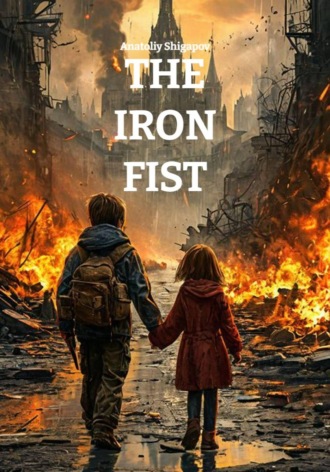
Полная версия
The Iron Fist

Anatoliy Shigapov
The Iron Fist
FOREWORD BY THE AUTHOR
I wrote this third book three times.
The first time - in anger. I was angry at my characters, at the dead end they had led me to. At how easily and imperceptibly they had betrayed themselves. I rewrote scenes, making Iris hesitate longer, and Elias speak louder. I wanted them to come to their senses. To find a third path. To find a way out that I myself couldn't see for them.
The second time - in despair. I realized they weren't going to come to their senses. Because they are alive. They aren't characters I can force to act against their nature. Iris cannot back down because she knows the price of chaos. Elias cannot stop her because he knows the price of betrayal. I sat over an empty screen and couldn't write the scene where Iris signs the Decree of Conscription. It felt like by writing it, I would be committing the same betrayal myself. I wanted my characters to be heroes. But they stubbornly became what they were fighting against.
The third time I wrote this book, I had accepted it. With acceptance comes clarity. I realized this story isn't about victory. And it isn't about defeat. It's about how victory and defeat have the same face. How, after breaking one mask, you discover with horror another one underneath - your own. All great revolutions end the same way - not with freedom, but with a change of jailer. This isn't cynicism. It's experience. It's the knowledge that we, humans, have carried within ourselves for thousands of years, but every time we pretend that this time it will be different.
I sat at my desk, staring at the screen, and felt my fingers refusing to press the keys. I knew that if I let her sign that decree, she would cease to be the Iris I created forever. She would become someone else. Someone wearing the mask of the enemy. And I didn't want that. I wanted to keep her pure. I wanted her to remain a heroine. But she was looking at me from the screen, and there was so much pain in her eyes that I understood: she was no longer a heroine. She was a human being. And a human being cannot be pure. A human cannot remain a hero if they make decisions that kill children.
I rewrote that scene again and again. I changed the words. I changed the circumstances. I tried to find a way for her to sign the decree, yet remain herself. It was impossible. Like trying to keep water dry. Like trying to keep fire cold. The decisions she made changed her. And I had to show that. I had to show how a hero becomes an executioner. Not because he is evil. But because he has no choice.
THE FEAR OF THE FINALE: WHY I DELAYED THIS BOOK
After I finished "The Price of Victory," I didn't touch the keyboard for almost three months. Not because I didn't have ideas. I had too many ideas. Too many. They swarmed in my head like a disturbed beehive, and I didn't know how to tame them. I was afraid. Afraid that I wouldn't be able to write the third book the way it should be written. Afraid that I would ruin the story I had spent so long building. Afraid that my characters, who had become almost real people to me, would cease to be who I knew them to be.
I remember the day I sat down to write the first scene of the third book. The sun was just beginning to set, and the room grew dark, but I didn't turn on the light. I sat in the twilight, staring at the empty screen, and felt a heaviness growing inside me. It was that special heaviness that appears when you know you're doing something important, but you're not sure you can see it through to the end. My fingers trembled over the keyboard. I wanted to write something light. Something that would bring readers back to hope. Something that would say: "Yes, it was all hard, but now it will be good."
But I couldn't. Because that would have been a lie.
I remember rereading the scene where Iris and Elias watch the sunset. Back then, I thought I was giving them a moment of peace. A moment they deserved. But now I understood that this moment was an illusion. They were on the roof, but the world was crumbling beneath them. They watched the sunset, but they didn't know that darkness was already rising from the other side of the horizon. They felt peace, but that peace was deceptive. As deceptive as the calm before a storm.
I put this book off again and again. I made up excuses: "I need more time," "I need to study some more materials," "I'm not ready." In reality, I was just afraid. Afraid to see that my characters weren't who I imagined them to be. Afraid they would disappoint me. Afraid I would disappoint them. But one day I realized: if I don't write this book, they will remain frozen in that moment of peace, which was a lie. They won't be able to live on. They won't be able to become who they are meant to be. So I sat down at my desk and started writing.
IRIS AND ELIAS: FRIENDS WHO BECAME MORE THAN I PLANNED
When I created Iris and Elias, I didn't think they would become something more to me than just characters. They were supposed to be tools. Means to tell a story. I planned their fates, their personalities, their dialogues. I knew what they would do in every scene. I controlled them.
And then they stopped listening to me.
At first, it was barely noticeable. Iris said something I hadn't planned. Elias reacted to a situation differently than I intended. I thought they were just mistakes. That I had formulated their characters incorrectly. I rewrote. Corrected. Made them fit the plan. But they stubbornly returned to their own words, their own reactions, their own actions. And at some point, I realized: they weren't making mistakes. I was. They weren't tools. They were people. They were living their own lives, and I couldn't force them to live differently.
With Iris, it was especially difficult. She was my heroine. My hope. My embodiment of everything I wanted to see in the world. I wanted her to remain pure. To find a way out. To not fall. But she couldn't not fall. Because her path was the path of a human, not a god. And a human who carries the weight of the world inevitably bends. Doesn't break. Doesn't disappear. Bends. Becomes different. Becomes what they hated. Not because they are weak. But because they are strong enough to bear that burden.
Elias was different. He never tried to be a hero. He always knew the world wasn't perfect. That victories are never clean. That choices are never right. He was cynical, weary, but loyal. He was the one who held Iris when she fell. And I wanted him to hold her until the end. But I knew that even he wouldn't be able to hold her forever. That one day she would fall so hard he couldn't lift her up. That he would stand beside her and watch her become someone he didn't recognize. And he wouldn't turn away from her. He would stay. But he wouldn't be able to save her. Because she couldn't be saved. She could only be accompanied in her fall.
THE ARBITER'S VOICE: WHY I COULDN'T SHUT HIM UP
The Arbiter was dead. I killed him at the end of the second book. I was sure it was over. That he would no longer haunt my characters. That they were finally free.
But the Arbiter didn't leave. He remained in their heads. In mine. In every scene I wrote, I heard his voice. Quiet, calm, confident. He said: "I warned you. I told you people can't be free. I told you they would choose chains. I told you you would become me. And you did. You are me, Iris. You wear my mask. You sit in my chair. You sign my decrees. You are my successor."
I couldn't shut that voice up. I tried. I wrote scenes where Iris doubted. Where she tried to find another way. Where she proved the Arbiter was wrong. But every time I finished such a scene, I felt it was fake. That I was trying to deceive myself. That I was afraid to admit the truth. The truth was simple: the Arbiter wasn't wrong. He was right. And Iris knew it. And I knew it. And the only way to move forward was to accept it.
I remember writing the scene where Iris looks at the Arbiter's mask. She stands in his office, and the mask hangs on the wall. She looks at it, and her fingers tremble. She wants to break it. She wants to destroy everything that reminds her of him. But she can't. Because the mask is no longer on the wall. It's on her face. And she can't take it off. Because if she takes it off, the world will collapse. And she knows this. She knows she must wear that mask until the end of her days. And she accepts it. Not with joy. Not with pride. With resignation.
This was the hardest moment in writing the book. I wanted her to break the mask. I wanted her to say: "No. I am not you. I will never become you." But I knew that would have been a lie. And I couldn't allow myself that lie. Because if I did, the entire book would lose its meaning.
SCENES I COULDN'T WRITE: FOUR ATTEMPTS AT A FINALE
The third book had three different endings. Three attempts to finish the story. Three times I sat down at my desk, knowing I had to write the final scene, and three times I deleted it because it was wrong.
The first ending was bright. Iris found a way to maintain order without cruelty. She created a system that worked without violence. She walked into the sunset with Elias, leaving the world better than it was. This was the ending I wanted to write. The one I felt my characters deserved. But it was fake. Too perfect. Too easy. Too much like a fairy tale. And I realized that if I kept this ending, I would be betraying my characters. Making them cardboard. Making them false.
The second ending was open. Iris took power but remained herself. She was neither a heroine nor a villainess. She was a human doing what she had to. Elias stayed with her but didn't justify her decisions. The world wasn't perfect, but it was alive. This was the ending that seemed right. It was honest. It was realistic. But it was incomplete. It lacked closure. No full stop. No catharsis.
The third ending became the final one. I sat at my desk, staring at the screen, and my mind was blank. I didn't know how to end it. I didn't know what would happen after Iris signed the last decree. But then I remembered Kay and Gerda. The children I had created months ago but never knew how to use. I realized they were the finale. Not because they close the story. But because they open a new one. They are the promise that the story continues. That even after the fall of heroes, there are those who rise. That even after the end, there is a beginning.
I wrote the final scene in one night. I didn't edit it. I didn't reread it. I just wrote down what I saw before me: two children on their knees in the mud, over the bodies of their parents, and their eyes burning with hatred. And when I finished, I felt it was right. Not because it was a good ending. But because it was an honest ending.
FEAR OF THE READERS: WHY I WAS AFRAID TO SHOW THIS BOOK
When I finished the final version, I couldn't look at it for several weeks. It lay in a folder on my desk, and I was afraid to open it. Afraid that I would read it and see mistakes. Afraid that I would read it and see that the story didn't work. Afraid that my characters, whom I had built for so long, turned out not to be who I imagined them.
But most of all, I was afraid of the readers. Not critics. Not reviews. Not ratings. I was afraid of those who had come with me all the way. Those who loved Iris and Elias as much as I did. Those who believed in them. Those who hoped that in the end, everything would be fine. I knew they would be disappointed. I knew they would be angry. I knew they would say: "Why did you do this? Why did you ruin them?"
And I didn't know what to tell them. I couldn't say: "I didn't want this." Because I did. I didn't want to ruin them, but I wanted to be honest. I couldn't say: "I did this so you would suffer." Because I didn't want them to suffer. I wanted them to understand. To see what I saw. To stop believing in fairy tales and start believing in reality.
One day, I showed the manuscript to my friend. He read it in two days and said: "This is the most depressing thing I've ever read. Why didn't you give them a happy ending?" I looked at him and said: "Because a happy ending would have been a lie." He didn't understand. He said: "But it's a book. It's fiction. You can make any ending." I shook my head. "No. I can't. Because if I make a happy ending, I'm saying that heroes can win without losses. That freedom doesn't require sacrifice. That the world can be perfect. And that's not true. And I don't want to lie."
LOVE AND HATE FOR THE CHARACTERS: WHY I COULDN'T LET THEM GO
When I was writing the last chapter, I couldn't stop feeling sad. Not because it was sad. Not because I pitied my characters. I was sad because I knew it was the end. That I would no longer write about them. That they would stay here, on these pages, forever frozen in their decisions. And I wouldn't be able to change them. Help them. Tell them they were right.
I loved my characters. I loved Iris for her strength, her stubbornness, her faith. I loved Elias for his loyalty, his cynicism, his warm irony. I loved them the way you can only love those you have created yourself. But I also hated them. I hated Iris for not finding another way. I hated Elias for not stopping her. I hated them for making me see the truth. For shattering my illusions. For making me honest when I wanted to be naïve.
And when I put the last full stop, I felt emptiness. The same emptiness parents feel when their children leave home. The same emptiness teachers feel when their students graduate. The same emptiness everyone feels who lets go of what they loved. I knew it was right. I knew it was inevitable. But that didn't make the pain less sharp.
THE LAST NIGHT: FAREWELL TO THE CHARACTERS
I am writing these lines on the last night before posting the manuscript online. Outside the window - rain. The same rain that falls at the beginning of the book, when Iris sits in her office waiting for a refugee from the south. The same rain that pours in the finale, when Kay and Gerda leave the burning sector. Rain - a symbol of purification, but also a symbol of sorrow. It washes away the past, but it also brings new life. It dies to be born again.
I feel the same way. I am tired. I gave this story everything I had. I poured my fears, my doubts, my pain into it. I poured in my hope, which it shattered. I poured in my faith, which it betrayed. But I don't regret it. Because this story is not just text. It's experience. It's a mirror. It's an opportunity to see yourself and ask: "What would I have done?"
I don't know what I would have done. I want to believe I would have found a third way. I want to believe I would have been better. But I don't know. And that is the scariest and most honest truth. I don't know what I would have become if the weight of the world had fallen on me. And that is precisely why I cannot judge Iris. Because I can only observe. Only write down. Only show you what I saw.
I look at the screen, at the last page of the manuscript, and feel a wave rising inside me. Not regret. Not relief. Something in between. A mixture of sadness and pride. Sadness that it's all over. Pride that I saw it through. That I didn't give up. That I didn't lie. That I gave my characters the story they deserved.
I close my laptop and look out the window. The rain continues to fall. It taps on the glass like hundreds of tiny fingers. Somewhere in this city, in this world, there are people who will open this book tomorrow. They will read about Iris and Elias. They will experience their fall. They will hate me for what I did. And they will be right. Because it is indeed hard to accept the truth. But I hope they also see what I saw. That this story is not about defeat. It's about courage. The courage to make difficult decisions. The courage to take responsibility for them. The courage to live with the consequences.
I say goodbye to my characters. I will no longer write about them. They will remain here, on these pages, forever frozen in their decisions. I won't be able to change them. Help them. Tell them they were right. But I can tell you: they were right. Even if it's hard to accept. Even if it hurts. They were right. Because they did what they had to. They paid a price no one wanted to pay. They became what they hated. But they did it to protect those they loved.
Forward. To a new dawn.
Anatoly Shigapov
CHAPTER 1: "THE SOUTH WIND"
Iris sat in her office on the top floor of the capital's administrative building - the only place in the entire complex where windows faced not the inner courtyard, but the western outskirts. Outside the window was a grey, cottony sky, and a fine, nagging rain, which had not stopped for two weeks, monotonously drummed on the leaden frame. She felt the dampness penetrating the thick stone walls, the cold, like a living creature, settling on her skin, creeping under the collar of her tunic. It was one of those days when even the air felt heavy - saturated with water, decay, and a premonition of trouble.
She was reviewing reports from the northern mines - dry, precise figures, columns of daily output, hourly lists of work shifts, schedules for ore deliveries to the forges. Everything was familiar, predictable, almost boring enough to yawn. Iris mechanically recounted the totals, though she knew them by heart - this activity calmed her, creating an illusion of order in a world that increasingly seemed to her like a house of cards. She was about to set aside the thick sheets of parchment and call for a courier when there was a knock on the door, which was upholstered in darkened copper.
The knock was sharp, impatient - not like the way adjutants or scribes usually knocked. Iris frowned, her fingers pausing for a moment over the stack of papers. She straightened up, adjusted her collar, and, trying to keep her voice even, said:
Come in.
The door swung open with a drawn-out creak, and a man was practically propelled into the office, supported by the elbow of a guard on duty. Iris looked up - and for a second, she stopped breathing. The man could barely stand: his clothes, once apparently a sturdy travelling jacket, were torn to shreds and singed in places, dark greasy stains on the fabric smelling of soot and burnt wool. His face was covered in thick soot mixed with dried mud, and deep, almost bluish circles lay under his eyes - the marks of sleeplessness and exhaustion. He swayed, and the guard, a grim-faced man with a sergeant's patch, held him under the elbow, clearly fearing he would collapse right on the threshold.
Commander, - said the guard, nodding towards the newcomer. - He was found at the southern gate, at the checkpoint. Said he'd been walking for five days. Was delirious, but when he came to, he called himself a refugee. He says he has important news - personally for you.
For me? - Iris repeated, narrowing her eyes. - Why for me?
But the man didn't let the guard answer. He tore his elbow from the guard's grasp - the gesture was almost aggressive, but it was only an desperate, animal need to speak - and collapsed to his knees on the cold stone floor. His body trembled, a violent shudder ran down his back, and he began to mutter, almost unintelligibly, swallowing endings and choking on his own breath:
They are coming… They are coming through the Frontier… We weren't expecting them from that side, no one was… The cities have fallen… Everyone is dead… I saw the smoke, I saw the sky burning…
Iris looked into his face, into his eyes that darted around the room, unable to find a focal point. There was fear in them - real, primal, the kind that cannot be faked, that burns the soul from within. She had seen such fear once before, five years ago, during the suppression of a mutiny at a border fortress. But now she noticed something else. Something elusive that made her inner voice alert. In the depths of his pupils, in the way he paused for a moment to look at her desk, at the scattered maps, something else smoldered - not panic, but attentiveness. Assessment. And that was strange for a man who had just reported the destruction of the entire south.
Water, - she said sharply to the guard, not taking her eyes off the refugee. - Quickly.
The guard nodded and stepped over to the side table, where a clay jug of water, covered with a canvas cloth, stood. Iris gestured for him to bring it to her. She took the jug in her hands - it was heavy, cool - and handed it to the man. He grabbed it with trembling, clumsy fingers and put it to his lips with such greed, as if he hadn't seen water in a week, not even a month. He drank noisily, choking, splashing water onto the floor, onto his torn trousers, onto his knees. Droplets flew in all directions, and dark, wet spots quickly spread on the stone slabs. He drank for a long time, without stopping, while Iris silently, motionlessly, watched him, propping her chin on her clasped fingers.
And while he drank, she studied him. Now that he had stopped talking and somewhat calmed down, her gaze slid over his figure. And stopped at his hands. On his hands, which gripped the jug with such force that his knuckles turned white.
The hands were clean - without calluses, without the rough skin typical of a refugee, without scratches or cuts. Neat, well-groomed fingernails, one of which still retained a faint shine of polish. On his wrist, just above the torn sleeve, she noticed a thin, barely visible mark from a bracelet - a straight strip of lighter skin. This man had not worked in the fields, not built fortifications, not mined ore, not hauled sacks of grain. His hands were the hands of someone who had never engaged in physical labor - or at least, hadn't done so for the last several years.
She slowly leaned back in her carved oak chair, which creaked plaintively under her weight, and folded her hands on the table, over the maps and reports. The man finally finished drinking and lowered the jug, breathing heavily and wiping his mouth with the back of his hand. He looked up at her with pleading, desperate eyes and a smoldering hope that she would believe him, that she wouldn't ask unnecessary questions.
But Iris already knew - his story was not the whole truth. She felt it in her gut, by that intuition that had saved her life more than once in negotiations and at the council table.
Silence fell in the room, broken only by the steady patter of rain outside the window. Somewhere below, in the corridors of the administrative building, muffled footsteps could be heard, the clang of armor from the changing guard, the distant voice of a dispatcher shouting orders. But here, in this office, the world had shrunk to three people and the growing tension between them.
Iris pushed her chair back a couple more inches and quietly, but in a voice that rang like steel, said to the guard:
Bring Elias. Now.
The guard flinched in surprise - he had clearly expected other instructions, like sending the refugee to the infirmary or the guardhouse - but he nodded and silently left, closing the door behind him. His footsteps quickly faded down the stone corridor.
Iris remained seated opposite the man. She didn't say a word. She just waited, for his breathing to even out, for the trembling in his shoulders to subside. She gave him time, but in that silence, there was more interrogation than in any words. The man lowered the jug to the floor, pushed his wet hair from his face, and looked at her with gratitude that seemed almost genuine.
Thank you, - he whispered, and his voice broke into a hoarseness. - Thank you, Commander. You don't know what it means - just to see a living face and hear a calm voice.
She remained silent, continuing to hypnotize him with her gaze. He looked at her with a plea, but she already knew - this man hadn't come by accident. He wasn't just a refugee. He was a messenger, a scout, or perhaps a pawn in someone else's game. He was part of something bigger. And she had to understand what exactly. Had to extract the truth from him before Elias entered the office with his penetrating questions and that smile that never reached his eyes.
She took a deep breath, feeling the cool air of the office sting her throat, and finally asked the first question she should have asked from the very beginning:
What's your name? Your real name.
The man hesitated for a moment. His eyes blinked once, twice, and a shadow flickered through them - either fear or deliberation. He lowered his head, then raised it again and said, more firmly: