


Полная версия
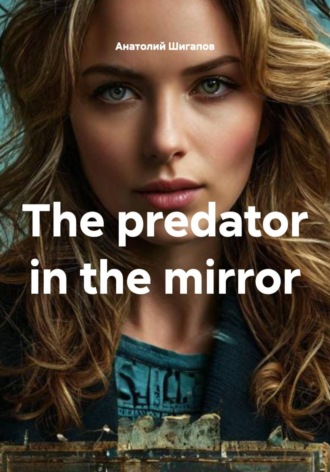
The predator in the mirror

Анатолий Шигапов
The predator in the mirror
A Psychological Thriller
Dedication
To my sister, who is five years older than me.
To the one whose palms still remember the warmth of my childhood hands. To the one who stood between me and the world, when the world was too big, too loud, too scary for a little boy just beginning to live in it.
I remember how you held my hand on the first day of school-your fingers were confident and warm, and I knew that as long as you were near, nothing bad could happen. I remember how you sat by my bed when I was afraid of the dark, telling stories of brave knights and kind dragons until sleep carried me off to safe, distant lands. I remember how you tied my shoelaces, wiped away tears from skinned knees, shared the last piece of chocolate because you knew I loved it more than anything in the world.
You taught me to read at night, when our parents thought we were long asleep. You showed me the stars and said each one was a soul watching over us, protecting us. You were my quiet refuge, my first shield, my most reliable person in this huge, incomprehensible world.
Years have passed. We grew up, our paths diverged, life threw us in different directions, testing our strength, making us fall and rise again. But in every fall, in every rise, in every word, in every line, in every breath of this book, there is you. Your care, your tenderness, your unconditional love, which shaped me long before I learned to write. You live in every one of my characters, in every woman's smile, in every moment of warmth amidst the cold.
This book is full of pain, loss, darkness, and despair. But there is light in it, too. And that light is you. You taught me that even in the deepest darkness, you can find a kindred soul. You showed me that love is stronger than fear, that family isn't always about blood, it's always a choice, and you chose me long before I learned to choose for myself.
Thank you for everything. For the nights you stayed awake, listening to my childhood fears. For the days you shared your last, thinking nothing of yourself. For the years you believed in me, even when I didn't believe in myself. For being my sister-not just by blood, but by spirit, by choice, by love.
I looked for you in every person, until I understood: you were always inside me. You are the part of my heart that remembers what home is. You are the part of my soul that never gives up.
I found you once, and I will look for you again and again, in this life and the next. Because people like you aren't lost forever. They become the stars that guide us home.
With love, endless tenderness, and gratitude that you exist in this world and in my life, Your younger brother.
Author's Note to the Reader
Dear Friend,
You are holding this book in your hands. Perhaps you bought it in a store, intrigued by the cover. Perhaps someone gave it to you, saying, "This is worth reading." Perhaps you borrowed it from a library, drawn by the title. Or maybe you just opened a file on your device, looking for something to fill an evening. I don't know how this book came to you. But since you're here, since you're reading these lines, it means a connection has already been forged between us. Thin, invisible, but real.
I want to talk to you, before you dive into this story. To talk the way old friends do before a long journey they're about to take together.
This book wasn't born from cold calculation. Not from a desire to write a bestseller, to meet reader expectations, or to fit into current literary trends. It was born from questions that haunted me for many years. From late-night reflections, from conversations with myself, from those moments when you're alone with the silence and suddenly hear within it the voices of those you loved and lost.
I asked myself: what makes us who we are?
We're used to thinking our personality is shaped by events. Birth, growing up, career choices, meetings and partings. But the longer I live, the more I understand: it's people who make us. Those who were there in childhood, holding our hand when we were afraid of the dark. Those who came to help when we fell and scraped our knees. Those who believed in us when we didn't believe in ourselves. And those who left, leaving behind an emptiness that nothing can fill.
I thought about my family. About my parents, who are no longer here. About my sister, who was always a beacon for me in the darkest times. About those whom fate scattered to different corners, but whose voices I still hear inside me. And I understood: memory is the only thing we truly have. Everything else can be taken away. Money, home, work, even freedom. But memory stays with us until our last breath. And it can also become the most terrible curse, if what you remember is unbearable.
This book is about memory. About how it shapes us and how it destroys us. About how we try to run from the past, but it always catches up. About how sometimes the only way to survive is to forget. And sometimes the only way to become yourself is to remember.
I wrote this story for those who have ever felt lost. For those who searched for their place in the world and didn't find it. For those who lost loved ones and found them again-perhaps not physically, but in their hearts. For those who know that family isn't always about blood, but always about choice.
There have been moments in my life when I acutely felt that I didn't know who I was. That my past was a fog where ghosts wandered. That people I considered family could turn out to be strangers. And strangers, the closest ones. These feelings, these fears, these hopes I poured into my characters. Alice, Lina, David, Miranda, Alex-they aren't invented by me from start to finish. They are assembled from fragments of real people I've met, from their stories, their pain, their victories. They are like a mosaic, where each shard is someone's real life.
This is a psychological thriller. There will be murders, secrets, the dark corridors of a psychiatric hospital, basements where the truth is hidden, and people ready to do anything to conceal that truth. There will be tension that takes your breath away. There will be moments when you want to close the book and never open it again, because it's scary. There will be scenes that make your heart clench.
But above all, this is a story about love. The kind of love that is stronger than fear. That makes you stay silent for ten years to protect those you hold dear. That drives you to commit crimes to save. That forgives even when forgiveness seems impossible. That doesn't die, even when the body dies. That lives in memory, in the heart, in every cell of your being.
I've often thought: why do we love reading such dark stories? Why are we drawn to suffering, pain, despair? And I came to the conclusion: because only through darkness can we see the light. Only by losing do we understand the value of what we have. Only by going through hell do we learn to appreciate heaven.
This book is about forgiveness. About how hard it is to forgive those who have hurt us. And about how necessary it is to do so in order to live on. Because hatred corrodes the soul faster than any illness. Because anger is heavier than any burden. Because only by freeing ourselves from them can we breathe freely.
And this book is also about choice. About how every minute, every hour, every day, we make choices. Who to be, who to be with, who to fight for, who to protect, who to betray. And from these small choices, our greater destiny unfolds.
I don't know what you're going through right now, dear reader. Maybe you're happy and looking for a thrill. Maybe you're sad and want to share your sorrow with someone who will understand. Maybe you just want a distraction from everyday routine. But I believe that if you've read this far, you're looking for something important. Something that will resonate in your heart.
I don't promise easy reading. This book will require courage. It will make you think, maybe cry, maybe get angry. Maybe you'll argue with the characters, judge them, not understand their actions. Maybe you'll see yourself in them. And that's normal. Because good literature is always a dialogue. A conversation between author and reader, between characters and reality.
But I promise you one thing: this book will not leave you indifferent. It will enter your life, settle in your thoughts, return to you at the most unexpected moments. You'll remember Alice when you realize you're also searching for yourself. You'll remember Lina when you face injustice. You'll remember David when you lose someone important.
And if that happens-then I didn't write it in vain.
I also wrote this book for those who have ever felt lonely. Because there's something frightening and simultaneously attractive about loneliness. It's a state where you're left alone with yourself and finally hear your true voice. My characters are often lonely-even when they are together. They carry their loneliness like a cross, but in the end they understand: true loneliness is impossible if you have the memory of those you love.
This book is also about home. About how home isn't a place. Not walls, not a roof over your head, not an address in your passport. Home is the people who wait for you. Who accept you as you are. Who warm you even from a distance. My characters search for home all their lives and find it where they least expect it.
I want to thank you in advance. For picking up this book. For reading these lines. For being willing to spend your time on a story I imagined. It's a huge responsibility and a huge honor-to know that someone out there, in another city, another country, another world, is experiencing the same emotions I felt while writing.
And if this book touches you, if it makes you think, if for even a moment you feel what my characters felt-then it was all worth it. All those sleepless nights, all the doubts, all the drafts thrown in the trash, all the moments of despair when it seemed like nothing was working out-it was all for this moment. For this meeting with you.
And now-goodbye. Or until we meet again? Because, as you already understood from the epilogue, the story of the Novak and Wood families is not over. Too many threads remain unraveled, too many questions unanswered, too many shadows waiting for their time. Perhaps we will meet again on the pages of a new book. Perhaps fate will grant us another journey into this dark, yet so vibrant world.
But that will come later. For now-forward. Into the darkness, into the mystery, into the past that won't let go. The door is open. Behind it, those who lost themselves to find each other are waiting. If you're ready-enter.
With hope that you find something important for yourself in this story,
Anatoly Shigapov
ATTENTION
Dear Reader,
Before you turn this page and dive into the world of Predator in the Mirror, I want to pause you for a few minutes to say a few important words. This is not just a formality or a nod to tradition-it is a conscious necessity, born from respect for you, for the reality we live in, and for the themes addressed in this book.
On Fiction and Reality
Everything you are about to read on these pages is a work of fiction. From the first line to the last. All characters-Alice, Lina, David, Miranda, Alex, Dr. Harrison, and others-are entirely imaginary. Their personalities, actions, thoughts, feelings, and fates are products of my imagination. Any resemblance to actual persons, living or dead, or to actual events, organizations, or locations is entirely coincidental and unintentional. I did not know, nor could I have known, any real-life counterparts, and if any coincidences occur, they are merely a trick of fate that could not have been foreseen.
The psychiatric hospital "Safe Harbor" described in the book does not exist in reality. It is a composite creation, built for the purpose of the narrative. The treatment methods mentioned in the novel-electroconvulsive therapy, the use of tranquilizers, patient isolation-are depicted within the context of a specific story and are not recommendations for practice or a reflection of real medical procedures. I have the deepest respect for the work of psychiatrists, psychologists, nurses, and all staff in psychiatric facilities who save lives every day, help people cope with severe conditions, and guide them back to a normal life. Real psychiatry bears no resemblance to the horrors sometimes portrayed in books and films, and I urge you not to project fictional images onto reality.
On the Book's Purpose and Goals
This book is a psychological thriller. Its primary goal is to entertain the reader, to draw you into a world of mysteries and secrets, to make you empathize with the characters, and to evoke strong emotions: fear, anxiety, hope, and the joy of discovery. I aimed to create a tense narrative that keeps you on edge from the first page to the last. But it's crucial to understand: everything that happens to the characters stays on the pages of the book.
I am in no way advocating for any of the actions described in the novel. I do not promote violence, vigilantism, breaking the law, overthrowing any existing order, or any form of revenge. My characters make terrible mistakes, sometimes crossing the line, but they do so within a fictional plot, driven by fictional motives. In real life, justice must only be pursued within the bounds of the law. No personal grievance, no amount of pain, no injustice gives anyone the right to take the law into their own hands. That is what courts, law enforcement, and social support systems are for. If you feel you have been a victim of injustice, please seek out professionals-do not try to solve problems the way my characters do.
On the Influence of Books on Reality
I believe literature has the power to change people. A good book can make you think, can open your eyes to something important, can help you through difficult times. But literature should not become a manual for action. Reading thrillers is a safe way to experience intense sensations without leaving your comfortable chair. It's a chance to live someone else's life, someone else's fears, someone else's victories, all while remaining safe.
If, after reading this book, you feel anger, a desire for revenge against those who have wronged you, or suspicion towards those around you-please, stop and think. These are just emotions, stirred by fiction. Do not carry them into your real life. Do not let literary images dictate your actions. You are stronger than any book, you are smarter, you are capable of separating truth from fiction.
On Mental Health
This book touches on difficult themes: the loss of loved ones, violence, mental disorders, prolonged isolation, and suicide. If you are experiencing such difficulties in your real life, if you feel like you can't cope, like your world is falling apart, like there's no way out-please, do not face these thoughts alone. Seek help. There are people and organizations ready to support you. Psychologists, therapists, crisis hotlines, support groups-you are not alone. Your life is valuable, and any hardship can be overcome when you have someone willing to help.
Different countries have their own support services. Find them, write down the numbers, save them in your phone. Sometimes, one call can save a life.
On the Characters and Their Actions
My characters are not role models. They make mistakes, they suffer, they fall, they get back up, and they make mistakes again. They do things that might make you judge them, feel frustrated with them, or even anger you. That's normal. Literature exists so we can argue with characters, disagree with them, and see their weaknesses. But remember: they are just literary characters. Their path is not your path. Their choices are not your choices. You can learn from their mistakes, but you should not repeat them.
In Conclusion
Read, empathize, be afraid, and rejoice along with the characters. Let this story sweep you away, transport you to another world, and make your heart beat faster. But when you return to reality, leave all the fears and anxieties on the pages of the book. Live your own life-the real one, full of color, opportunities, and love. Cherish the people around you. Take care of yourself.
And remember: this is only a book.
With respect for you and the reality we share,
The Author
PART ONE: MIRROR IMAGE
Chapter 1. Bloody Signature
"Every murder has a signature. Sometimes it's the handwriting, sometimes a gesture, sometimes the silence. But the scariest signature is the one you leave in your own memory." – From the diaries of Special Agent Alice Wood
Autumn in New York greeted the morning with a gray, heavy sky that hung low over the rooftops of Manhattan, as if it intended to crush the city with its humidity. A light drizzle fell, and the asphalt gleamed, reflecting the yellow lights of taxis and the red tails of brake lights. In this light, even the skyscrapers looked like sets for a noir film-fitting, but unreal, as if an invisible director could say "cut" at any moment, and it would all vanish, leaving only emptiness and the smell of ozone behind.
Alice Wood had been standing by the yellow police tape for twenty minutes. She didn't move, just stared at the body lying on the lawn of a small park between buildings on the Upper East Side-a place usually reserved for walking expensive dogs and sipping takeout lattes while discussing the latest news from Wall Street and children's successes at prestigious schools. Now there were no dogs, no lattes, no idle chatter. Just the indifferent rain, washing blood into the withered grass, and people in blue windbreakers with "NYPD" on their backs, moving slowly and deliberately like ants around a disturbed anthill.
Alice wasn't wearing a windbreaker. She stood in a black coat, soaked through, but she didn't feel the cold. In ten years with the FBI, she'd grown accustomed to such mornings-the smell of wet earth and blood, the indifferent hum of the city behind her, the faces of the dead staring silently at the sky. But she couldn't get used to this face. It clung to her, made her glance back again and again.
The woman was young-about twenty-five, no more. Long dark hair spread out on the ground, absorbing the moisture and growing darker, almost black. Her eyes were open, staring into nothing-at that gray sky indifferently raining down on her. But the worst part was her mouth. It was twisted into an unnatural, frozen grimace that vaguely resembled a smile. Not a smile of peace, not a smile of relief-a smile full of bitter irony, as if in the last moment of her life she'd seen something that made her smirk at her own death.
"Who found her?" Alice asked without turning. Her voice sounded dry, like she was striking sparks from flint.
"A janitor from the nearby office building, at six a.m.," replied a detective who'd walked up. Marty Cole had worked with her for three years, and in that time they'd learned each other well enough to dispense with small talk. Marty was one of those cops who did everything by the book but managed not to get in the way of profilers-a rare quality Alice valued more than professional skills. "He was on his way to work, saw legs sticking out from behind the bushes. Called the cops. We were here in seven minutes."
"Seven minutes," Alice repeated thoughtfully. "That's enough time for the killer to get away. If he even left."
"You think he might have stayed?" Marty moved closer, also peering at the victim's face.
"Ones like this always stay. Not physically-mentally. They like to watch their work. Admire it." She finally tore her gaze from the face and scanned the surrounding buildings. "Any cameras?"
"Checking now. But this area's a dead zone for surveillance. Wealthy residents don't like being watched. Cameras are only on the main streets."
"Convenient." Alice took a step closer to the body, squatting down. The crime scene techs had finished their initial inspection, and the medical examiner-a woman in thick-rimmed glasses Alice had known for about five years-was waiting for permission to remove the corpse.
"What can you tell me, Dr. Reed?" Alice asked, scrutinizing the wounds on the victim's body.
Marta Reed adjusted her glasses and stepped closer. She was one of those experts who disliked unnecessary words but could see what was hidden from ordinary eyes.
"Death occurred roughly between two and three a.m.," she began, opening her tablet with preliminary notes. "I'll be more precise after the autopsy, but based on body temperature and rigor mortis-two to three hours. Cause of death: multiple stab wounds. Total…" she glanced at her notes, "twenty-seven. Inflicted with great force, but chaotically. Not professional."
"Chaotic, but twenty-seven times." Alice frowned. "That's not chaos. That's ritual. Or rage. Very personal rage."
"Agreed," Marta nodded. "But that's not the most interesting part."
"What is the most interesting part?"
"This."
Marta pointed to the victim's left hand. The wrist was unnaturally twisted, and the fingers were arranged in a strange shape-thumb and index finger extended, the others curled into a fist. Someone had clearly positioned the hand like this after death-the muscles were already beginning to stiffen, and arranging the fingers this way would have required effort.
"A gesture?" Marty suggested, stepping closer. "Some kind of sign?"
"Not just a gesture," Alice said quietly. She pulled out her phone, opened a photo sent from the office that morning just before she left for the scene. "It's a gun. A child's game, you know? When kids make a finger gun and say 'bang-bang.' But in this context…"
She stood and showed her colleagues the screen. It showed a book cover: dark, almost black, with a blurred silhouette of a woman standing on a cliff's edge, and the large red title "The Last Shot." Author-David Morrison. A name known to anyone who'd set foot in a bookstore in the last five years.
"That bestseller?" asked a young patrol officer standing nearby, clearly eavesdropping on his senior colleagues' conversation.
"That same one, which isn't even out yet," Alice corrected, not turning to him. "Release is in two weeks. But I got an alert from the publishing house this morning, even before I came here. Someone leaked them a photo of the crime scene. Or…"
"Or the killer read the book," Marty finished, understanding where she was going.
"Or wrote it."
Alice opened the attached file. It was an excerpt from Morrison's novel-a murder scene the publishers had sent to the FBI marked "urgent" and "confidential." She scanned the lines and felt something cold and sticky stir inside her, the feeling familiar to anyone who had ever encountered true evil.
"She lay on the wet grass, and the rain washed the blood from her face, erasing the last traces of who she'd been in life. He leaned over her, feeling the cold slowly seeping through the soles of his shoes, and carefully, almost tenderly, folded her fingers into a gun-the last gesture no one would understand but him. The smile on her face was his signature. His autograph. He looked at her and thought: now you're mine forever. Now you're part of my story."
"The description matches down to the smallest detail," Alice said, pocketing her phone and feeling her fingers tremble slightly-from cold or tension, she didn't know. "The pose, the rain, even that damn smile. Morrison is either clairvoyant, or…"
"Or he was there himself," Marty finished, and there was something in his voice Alice hadn't heard from him in a long time-fear.
"Or he was there," she repeated, lowering her gaze back to the body. "Or the one who was there read his book. Or wrote it with him. Or…"