Полная версия
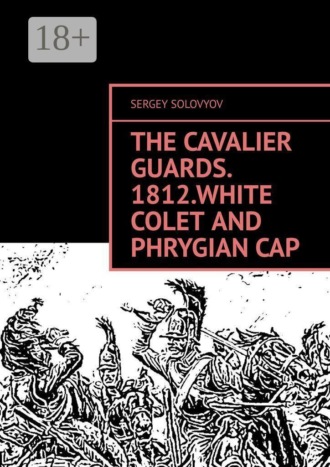
The Cavalier Guards. 1812.White colet and phrygian cap

The Cavalier Guards. 1812.White colet and phrygian cap
Sergey Solovyov
© Sergey Solovyov, 2026
ISBN 978-5-0070-1141-9
Created with Ridero smart publishing system
“We don’t aim to be first but won’t let anyone be better than us’
Introduction
The French Revolution, which happened in 1789, brought not only grief, as the current agitators are trying to declare. Estates were eliminated, and more importantly, estate privileges, slavery in the colonies was destroyed. By the way, as everyone knows, estates somehow exist in Russia now, and this is not a secret for everyone, as well as the love of the privileged layer for flashing lights, and at that time, in the 18th century, it was just a cultural shock all over the world. “FREEDOM, EQUALITY, BROTHERHOOD” And immediately followed attempts to destroy the Republic. This gave rise to wars with the French Republic throughout Europe. The French army was now formed by conscription, universal conscription, a citizen had to serve three years. The officer corps went to the republic from the royal army, and was simply excellent in training, traditions, horizons and excellent courage. As it turned out, these soldiers called up for service turned out to be better than recruits or mercenaries of other countries who had served in the army for many years.
In Europe, Armies were voluntarily contracted or replenished through recruitment.
So, during the fighting, surprisingly, European armies were defeated after defeated. But, the people are tired of wars, in addition, bribery discredited the Republic. People hated the terror of the Jacobins, and they did not like the permissiveness of those who began to pose as new masters. Napoleon, a lucky commander, stood guard over stability. But, the new tax system and new legislation have shown their effectiveness, making it possible to maintain the army and supply it with supplies. Many years of war did not ruin France, although the fighting absorbed huge funds. Russian-Austrian troops were defeated at Austerlitz, and Russian-Prussian — at Friedland and Preisisch-Eylau. Austria and Prussia concluded treaties of alliance with France, and Russia did the same when Emperor Alexander and Emperor Napoleon concluded a peace treaty. In Spain, there was a guerrilla war that ravaged the country and deprived the kingdom of all colonies. Spain was simply overthrown as a first-class state. The twenties and thirties of the 19th century only completed what they had begun.
The year 1812 also came. What was Napoleon’s goal? War, a terribly ruinous thing, and what was the goal of the French? To believe that the French needed earth- just ridiculous, in 19v. there was an excess of similar resources. Furs and firewood? Then what? Napoleon, like Picrocol of the immortal Rabelais, dreamed of defeating Turkey. And not just win, but overthrow, destroy. Napoleon dreamed of becoming the new Constantine the Great, and liberating Constantinople, and creating a New Continental Empire, because he was an idealist who drew inspiration from Roman and Hellenic culture. And he simply could not leave the light of culture and civilization in the hands of Asians. He realized the weakness of the Turkish army during the Egyptian Campaign, easily defeating two Turkish armies. Actually, Dibich went to Istanbul in three months, and Napoleon would not have taken more time. Such a plan existed, and it was presented to the Great Vizier Kutuzov, making peace with the Turks in 1812. Napoleon probably did not want to leave his back open during the war with Turkey, thinking that Russia, which became an ally of Great Britain, would attack France. And, Bonaparte decided to withdraw Emperor Alexander from among the possible allies of Great Britain and bind Russia with a binding treaty, and fulfill his dream, equaling Alexander the Great, to conquer India, first defeating and destroying Turkey and Iran, that is, surpassing all the heroes of antiquity.
Having power, oppressing others Laughing And sneering Between the fate of the millstones fallsPrologue
They walked along the Champs Elysees, it was a very young couple. Judging by the clothes, these were farmers who got rich on the supply of food for the army. Wars brought a lot of money to farmers, in return taking the most expensive from unfortunate families. Thousands of sons of French peasants laid down their heads in these terrible wars that bled the country, and the more joyful it is for a policeman, a hereditary Parisian, to see these lovely spouses. The young man looked more like an Alsatian, tall, blond, with long hair in fashion, a handsome, carefully shaved man, apparently, of remarkable strength. A girl, very beautiful, but typical Frenchwoman, brunette, with thin features, barely getting to the shoulder of this Gargantua. Both were dressed in the latest fashion, but not flashy, the man was with a cane in his hands, which often served as a tool against robbers. The woman carried a delicately woven basket in her hand, possibly with an edible one for both. Something elusive seemed familiar to Pierre Darmier in the face of this stranger.
A Parisian furrowed his eyebrows as he recalled that day, the unforgettable day of the Battle of Fer-Champenoise, March 13, 1814
***
Their dragoon squadron was built up, and awaited the command of the regiment commander. The dragoons of Roussel’s division were waiting for orders to go to the aid of Marshals Mormon and Mortier. Horses, because of the long war in the squadron were variegated, not like in the guard, where each squadron had one suit, and large, Danish or Mecklenburg breeds, huge horses. But the Darmier family could not afford to serve in cuirassiers for their son — they would have to buy a helmet at their own expense, or even an expensive cuirass.
The belt of the helmet cut the chin of the young man, and experienced warriors only laughed at Pierre.
— Nothing, but you don’t need to shave… — Charles laughed, — and so the bristles will be erased on the belt.
— Maybe he’ll become like Cossak, let go of his beard, Gaston said he was on the left.
— That they, that cupids (as the French called the Bashkirs, Tatars and Cheremis, who fought with bows and arrows). See — funny, then no laughing matter. Barely escaped near Maloyaroslavets, — added the oldest of them, Henri, — even worse if we run into the Cossacks. They own peaks better than Lancers. Therefore, take care of your loaded pistols and guns. None of you young people can handle all one thing with them on sabers.
Everyone fell respectfully silent. Charles also participated in the Battle of Leipzig, like Henry, and the rest were only recently drafted into the army, only in that unhappy year. Basically, everyone was very young.
The squadron badge roared above them, and the trumpeter was ready to give a signal. The squadron commander stood on the right, examining the formation of his riders, built three in depth, the sergeants sat in order in ranks. Horses, not people, you cannot make them stand motionless, so they stepped from place to place, some tried to leave the ranks. Behind them was another squadron of the same dragoon regiment. While everything was not bad, the cores did not fly over them, despite the cannonade rumbling nearby. Suddenly a messenger jumped, and the trumpeter gave a signal at the sign of the commander.
Two squadrons on a trot went on the attack to cover the linear infantry, retreating from the Russian cavalry. Skirmishers and flankers galloped forward, taking out short guns on the move. Pierre, holding the saber at the ready, held the reins of his horse with his left hand, so that he would not break free and overtake his comrades on the left and right. I looked with hope at the dragoon gun, hoping for it now more than a beautiful saber. A number of dragoons walked with a combined mass with a front width of three hundred meters. The young Frenchman only squeezed his jaws tightly, remembering the lessons of sergeants on dressage, and when he, just called up by the scriptwriter, was taught to stay on horseback in the arena, and only then, in the equestrian ranks.
Ahead, at Counter, shots crackled, and dragoons with unloaded guns at the saddle were already rushing back and to the flank, taking their places in the back rows. On the field, Pierre saw one of his own, huddled on the ground and holding his stomach, with a fragment of a Cossack peak in his belly, and two killed Russians. The horses were not visible, most likely they galloped away, frightened by the shots. The dragoons drove around the dead and wounded, and then they heard the roar of hooves on the right, the commander began to quickly wrap the formation, so that the right-flank ones held the horses, and the left-flank ones spun, and they did not have time to send the horses to the quarry, so the speed was less than that of the Russians. And not just Russians.
A squadron of the tsarist guard, cavalry guard regiment flew into ordinary dragoons. Pierre recognized these guardsmen by the collars of the collars, thick red. Yes, their horses were head and shoulders above the horses of the French horsemen! Logging began. Pierre, bent, missed a broadsword over his head, and flew further, to the second row of Russians, and his horse ran into the opponent’s horse, and hit his chest, so much so that he sat down on his back legs, well, did not fall. Young Darmier clung to the horse’s mane, and managed to raise his saber, beating off the blade of the broadsword. The Russian galloped further, Pierre already got another, from the third row of the squadron.
Blow, beating, slope, his horse spins quickly, helping the rider. But the fencing of the riders is fleeting, and the Russian, having recaptured his saber, has already swung his broadsword, but at the last moment he only hit the Frenchman’s helmet with the hilt, and Pierre fell off his horse. The Frenchman tried to get up, but the noise in his head was incredible, and he was unable to get up, slowly trudged to the bushes. Several dead were lying nearby, the dragoon raised two carbines, throwing them on his shoulder. But neither their own nor the Russians were already visible nearby.
***
That March day, 1814, to him a Parisian policeman, was not easy to remember. But he survived, and he forever remembered the face of that Russian who spared him that day. He was indistinguishably like that farmer. There are many Russian soldiers left in France, and who knows, maybe it’s him?
Darmier was not used to doubting or cowardly, and all the fit, resolutely approached this pair.
— Monsieur, let me address you. Better frankly, I will not harm you, — said the Frenchman, looking up, — are you from the Russians remaining here?
“Exactly, Monsieur,” replied a stranger with an obvious accent, “I am now a French subject.
“Another question, were you at the Battle of Fer Champenoise?” asked Darmier not so firmly.
— Yes, I served in the cavalry guard regiment. My name is Fedot Andreev, non-commissioned officer.
— Pierre Darmier, at your service, Monsieur. You kept me alive when you could have easily killed me. And why did you do that?
“I didn’t want to. And so he killed a lot of people, why pour extra blood?
His wife, pale, clung tightly to her husband’s hand, as if trying to protect this giant.
“He’s done no harm here, Monsieur policeman. You can’t accuse him of anything, “the young woman said, looking into the eyes of the policeman.
“Madame,” and Pierre took off his hat, “rather I owe my life to your husband. Let me introduce myself — Pierre Darmier — and he easily bowed, shaking his head a little, holding the headdress in his hand.
“Sabine Andre,” the woman introduced herself, crouching slightly in a bow.
The paint returned to her face, she turned charmingly, and now released her husband’s hand.
— Are you looking for something? See you off? — suggested Darmier.
— Sabin wanted to buy something from fabrics, soon after all holidays, I wanted to appreciate the instrument on wood. Workbench with vice, a couple of files, clamps. I made the carpentry table myself.
— Are you a blacksmith?
— Wheeler, well, baskets, and straw hats raft, — and he laughed, — did not think that hats would sell so well. They brought, and wheels, and baskets — they bought everything at once, all the goods, I didn’t even believe it, — the giant smiled in kind.
“I know everything here,” Darmier recalled the good shops, “I will guide you.” But maybe watch the Champs Elysees? Here you can drink good coffee, I treat.
— Everything is unusual, — Fedot frowned, — some are sitting in the bar here, — the Russian is unclear.
— You understand, Pierre, my husband at home, in Russia was a slave, a serf, — Sabin added an unclear and incomprehensible word for a Parisian.
— In France, even blacks are not slaves, — Pierre frowned, — even during the republic, slavery was prohibited.
“And in Russia people are sold and are not ashamed to write about it in the newspapers,” the woman said, swallowing her words, “Fedot showed me a piece of paper. There was an advertisement for the sale of his sister.
“Damnation,” burst out at the Parisian policeman, “and he faithfully did that he stayed with us,” and he added, calming down, “All the more look at our beautiful places. Now this is your homeland, Fedot. There is Mr. Laurent’s wonderful coffee shop on the Champs-Élysées. It’s going to be a great crowd.
“Let’s come in, Fedot,” Sabine asked her husband.
— Why not? Monsieur André agreed.
The establishment was not far away, they walked a hundred steps and Pierre opened the doors and led new acquaintances inside. They sat at the table, with a beautiful tablecloth, ordered coffee and beautiful rolls. The Darmier family also kept a bakery, but here they served just beautiful things, from thin seeded flour. Soon they brought a coffee pot, cups and pastries, all on a tray. Russian is already used to living in France, but elegant dishes attracted his attention. He curiously examined the service, and especially the excellent painting of the cup.
“Very beautiful,” he said.
Sabine poured the fragrant hot coffee over the cups, there were fresh croissants nearby, and they had a good snack. Most of the tables of this beautiful cafe were occupied, and foreigners were sitting here. The Russian looked attentively at the full, if not fat foreigner, and grinned, and his usually friendly face darkened with hatred. A complete stranger, apparently also recognized Fedot, and abruptly jumped up, went to their table.
— You will come with me, Fedot — said the stranger, grabbing his shoulder, — to Russia.
— If you were a master, — the hero answered, grabbing the noble’s sleek fingers with his iron hand, and bending a little, so that an unpleasant crunch was heard, and the fat man fell to his knees.
“You are a policeman,” the master shouted, turning to Darmier, “detain my serf.” He’s my man!
“Monsieur,” the policeman replied politely, “this is decidedly impossible.
— How so! — shouted the Russian nobleman, — this is my property! And he grabbed my hand!
— Msier, France is a free country, and you grabbed Monsieur André by the shoulder, and he is entitled now to challenge you to a duel.
— I call you, Mr. Telnov, — Fedot firmly said, — we will fight on pistols.
— I don’t wish to fight with a slave, — the master answered with a curling mouth, — it against my honor.
— I repeat, Monsieur, — Darmier skillfully hid anger, — there are no slaves in France. And by refusing to fight, you will lose your honor, no one here will accept you into their home like a coward. And a pathetic slave trader.
“He escaped from the army! He’s a deserter!
“Fedot Andre came to us, my father and me, when the hostilities were over,” Sabin said, “and I called him.
— Who is she! — shouted Telnov.
“She is served by his Majesty King Louis XVIII, like Monsieur Andre,” Pierre said barely restraining his rage, “and I ask you to be nicer with the lady, you are not in your slave-trading Russia.
Kolesnik and serf
Telnov estate
Fedot, having become almost an adult, worked for a long time with the foreman Ivan, it was already evening, and the student at the end of the working day, swept the chips from the workbench and desktop. The master collected window frames and doors, and wheels for carriages and simple peasant carts. The master’s student was not alone, their master decided to create a wheel workshop, so a lot of masters were required. The plans of the landowner Telnov were grandiose.
— Well, Fedot, understand how to build frames? How did your corner go? — the master instructed, drumming his fingers on the workbench with his right hand.
— Yes, I applied the elbow, but still, the wrong work came out. Crooked and oblique, — the student answered sadly, shrugging.
— That without a right angle you can’t put such work in a pigsty, — said the master, smiling slyly, and scratching his gray beard, — without an intelligent stand and without strings — all this is a bad job. They won’t take all one thing to a good house. The tree, the mother is cunning, he always plays, breathes. Therefore, the frame is not put in the house right next to it, and carpenters and masons can make the opening inaccurately, and it is necessary to do it with a gap, then the platbands and tow will close everything. Learn, Fedot, you are the best with me. It is better to sit on the quitrent at the master than to break on the corvee. Therefore, the frame is needed for a week, or even two in clamps leave, and make only from dry, aged wood, so that it would lie for three years under a canopy.
— You say everything exactly, Ivan Ivanovich, — Fedot yielded, nodding his whirlwind white head.
And the young man always called the mentor by name, there were no surnames for serfs, only names, and there were no documents either.
— Barin sensed a lot of money, since he decided to drive the wheels. How many wheels do you need for the army? And guns, and carts, do not count everything, and far wheels. Convoy and food carts, well, for the townsfolk, for carriages and carts, so our goods are worthwhile, we will not disappear, we will get enough kalachs.
— Yes, who salts cabbage and corned beef for the army, and our Georgy Petrovich decided to get rich on wheels.
— The old master is not bad, but Evgeny Georgievich… ‘the youngster added quite quietly.
— Keep quiet, otherwise the skin will be pulled off to the ridge with a whip, — the master frowned, — how do you live? Stayed with my sister only together…
— Nothing, we cope…
— Look, and take it, — said the master, looking back and put two rubles in the young man’s hand.
— So much? ‘he did not believe.
“Keep quiet more. Do you understand what I’m talking about?
“I will not say a word, Ivan Ivanovich,” the young man hastily nodded, but fortunately no one heard them.
— That’s not foolish, Fedot. A good master will not disappear anywhere. And you are all on fists, but on sticks at the fair you amuse people. Will you hurt your hand, what will you do? — the man spoke sternly, — and how much did you get when you beat that black one on your fists?
— Twenty kopecks, — the young man sighed, — and a pound of gingerbread, a colorful scarf. I treated my sister and made her happy.
“That’s it. It’s time to go home. — the master added, putting the kiyanka in the tool box — it gets dark already. And by candlelight you can’t do anything. Yes, and take care of your horse, so that no one would see. Otherwise, the master will want to determine you in the grooms or coachmen. Do you need this? Open the doors and in the livery of the drany in front of the bars to walk and bow endlessly?
— You are right in everything, Ivan Ivanovich. Thank you for your wise lesson, for your kind attention.
— Go, or home Fedot, oh you didn’t remember anything… — the master hung his head only out of grief, and began to remove the tool further, rake chips into a bucket with a brush.
Fedot went home, joyful with unexpected luck. So much money fell into your hands! Wheels are expensive goods, it was not for nothing that they and the master made twenty more pairs, and then at night they took them out and sold them to the merchant. And the merchant risked if Telnov’s people recognized, burned the merchant to death with whips, and did not see that he was a free person.
Yes, at least it’s dark in the yard, but it’s light in the heart, they will pay the capitation, the tsar’s money, all for the fact that Fedot was born a peasant, but a quitrent to the landowner. Here is their house, the windows are covered with a bull bubble, but the fire is burning, his sister, Martha, is waiting. The house is small, as is customary for peasants to put landowners. Log house, yes, read three rooms, and in winter in the far corner and the nurse cow winters. There is also a horse, but the cart is old. Summertime is a cow in a barn. There are four more sheep, and in the coop with a dozen laying with a rooster. The garden is broken, cabbage, beets and carrots will be born, thank God. Everything is like people — no worse, and no better.
They say that in the North, and in the Urals, ordinary Russian people live richer, without landowners, and these are non-schismatics. Although in the neighboring province, Kostroma, read all the schismatics, and everyone lives better than them.
Fedot opened the gate, their dog ran up to meet, fawns, meets the owner. The young man stroked the dog, he wanted to be more serious, and his eyebrows frowned like his father. Yes, the young man was only fifteen years old, and his sister was fourteen. He cleaned his boots with a broom in the canopy (only an apprentice, but you won’t disappear with Ivan Ivanovich), not everyone in the village has one, and opened the door to the living room.
— Good evening, sister, — he greeted, looking around the table.
There were already prepared clay plates and mugs, wooden spoons. The table is scraped out, and the hut is clean, Martha is a needlewoman. But he also tried, took care of her as best he could. And she is dressed cleanly, and the shirt cloth is purchased, and the sundress is elegant, and she does not just clean her hair with tape, but with good braid.
— Sit down, cabbage soup is ready, and the porridge has sung, — said the girl affectionately, — tired for the whole day, prayed?
— How are you, Martha alone cope? — the brother was surprised, — and cook food, and the house is in order, and the cattle are fed.
— Yes, I’m nothing, I’m keeping up somehow.
— Everything will be fine sister, money earned, there is something to pay tax, the headman all debts now we will give. We have two rubles.
— How good, — Martha smiled, and her tired face lit up with a smile, — otherwise Kuzmich tortured me — where is the money, and where is the money.
The young man took off his cap, hung it on a wooden peg in the wall, sat down at the table.
“Now everything will be fine,” said the young man firmly.
The girl took the pot out of the oven with a grab, and began to lay a large spoon of cabbage soup on the bowls. Lean, on dried mushrooms, but smelled great. There was also sour cream in the market, so they did not starve. They didn’t sip from the common bowl, everyone had their own here. For cabbage soup and porridge, good, millet, with linseed oil. Fedot ate everything without leaving a grain. Washed down with kvass.
— Well, you see how good everything is, — the sister said.