



Полная версия
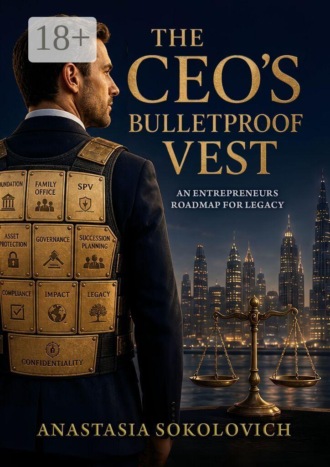
The CEO’s Bulletproof Vest. An Entrepreneurs Roadmap for Legacy
• Reputational Damage: Through media leaks and public scandals.
• Management Chaos: The firing of key executives and paralysis of strategic decision-making.
• Operational Gridlock: Freezes on corporate rights and the blocking of critical deals and transactions.
2. High-Profile Divorce Cases: Lessons from the Titans
2.1. Jeff Bezos and MacKenzie Scott
In 2019, the founder of Amazon settled his divorce with a transfer of $38 billion in stock to his former wife. This significantly diluted his ownership stake and forced a redistribution of voting power and influence within the company’s leadership. The divorce was triggered by his new relationship with Lauren Sánchez. While one can only admire Bezos’s commitment to his new chapter, his case serves as a stark lesson on the importance of proactively shielding the enterprise you built.
2.2. Rupert Murdoch and Wendi Deng
For 14 years, Rupert Murdoch and Wendi Deng were at the helm of the News Corp media empire. Their divorce led to protracted legal battles in the US and Australia, creating reputational harm for the entire business. Murdoch’s subsequent marriage to Elena Zhukova in 2024 at the age of 92, reportedly introduced to him by his third wife, underscores a pattern: for titans of industry, the heart does not consult the balance sheet. His previous divorces, particularly with Deng, demonstrate how the absence of clear agreements can turn a global empire into a public courtroom drama.
These examples reveal a profound truth: for true visionaries, no business loss compares to the loss of love. When powerful emotions take the lead, even billionaires are willing to divide their fortunes to remain true to their hearts. They live by their own rules and, in their own terms, they ultimately win.
This is precisely why the architecture for protecting your family, your heirs, and your business — from prenuptial agreements to trusts and foundations — must be designed in advance, long before the “unexpected storm” or the “new spring” in your heart arrives.
Remember, love can enter your life at any moment. A pre-established system to guard your legacy will then operate flawlessly, protecting what you built while allowing you to live fully.
When a powerful, genuine connection is formed, even the largest fortunes can become secondary. A billionaire whose name is on the Forbes list experiences the same vulnerability and passion as anyone else. In the face of true love, stocks, real estate, and funds fade into the background.
This is why Jeff Bezos agreed to a $38 billion settlement and a corporate restructuring — his new life with Lauren Sánchez was worth more than any accumulated capital. The same holds true for Rupert Murdoch, who at 92, prioritized his commitment to Elena Zhukova over billions and public scrutiny. For him, the paramount goal was to honor his personal feelings.
These cases prove that when a man falls deeply in love, he stops counting dollars and percentage points. He is willing to restructure holding companies, amend corporate charters, and rewrite marital contracts to have the right woman by his side. For him, even management control and structural privileges can lose their meaning — because love cannot be traded or valued on a stock exchange.
This undeniable reality is exactly what makes a predictable and reliable legal architecture so critical. Prenups, trusts, and wills must be considered WELL BEFORE your heart charts a new course. And the best time to secure the future for ALL your heirs is now.
Why Successful, High-Achieving Men
Are Not Victims of Abuse
Enduring abuse is not about strength. It’s about an internal capitulation.
And true winners do not capitulate to their feelings.
They are not afraid of them.
They do not run from love if it arrives “off-schedule.”
They do not betray their chances at happiness — even when fate offers them unexpectedly, in mid-life, at the most complex period.
Because a man of true strength understands: this is not a mistake. It is a test. A chance to become more alive, more honest, more profound.
Such men do not choose partners based on “convenience” or “habit.”
They do not stay with those who merely manage the household.
They do not confuse comfort with true partnership.
They are not seeking silence at any cost — they are seeking someone with whom they can speak openly. With whom they can be silent. With whom they can build.
This is precisely what makes them winners.
Because at the most difficult crossroads, they make not the “convenient” choice, but the authentic one.
Not for the sake of image, but for the sake of essence.
Now, the most important question.
If you recognized yourself in these words — or, conversely, realized you are living the opposite scenario — ask yourself directly:
If you have become a victim of abuse, are you ready to stop it?
Are you ready to call things what they are?
To admit that what you have is no longer a union, but mere survival?
That you are enduring not for a greater meaning, but out of fear?
That what holds you is not love, but inertia?
Because if you continue to tolerate abuse — even if it’s hidden, psychological, veiled — you are not just losing yourself.
You are losing your strength.
The very same strength you need to win in business conflicts.
To prevail in corporate wars.
To defend your company, your mission, your team, your product.
A man who has betrayed himself in one union cannot be strong in another.
You can hire the best lawyers and build the perfect strategy.
But if inside, you have surrendered — if you fear conflict, fear pain, fear speaking the truth — you will not withstand the pressure.
No legal contract will save you if you lack an inner foundation.
This is why mature victory begins with a single decision:
To stop tolerating what destroys you.
Not at home.
Not in business.
Not within yourself.
The Price of Divorce: The Cost of “Love,
The Adult Version”
When a relationship collapses, especially for an entrepreneur, it rarely ends with just a broken heart. Divorce is an exhaustive process — financially, morally, and strategically.
First, the finances: up to 50% of assets can be lost, plus penalties, payouts, and exorbitant legal fees. But money isn’t everything. Reputational damage often hurts more: leaks of personal information, insider details, public scandals — and suddenly, market capitalization drops, partners distance themselves, and investors freeze.
Next comes operational gridlock: contracts stall, accounts are frozen, banks refuse service. This is followed by a management crisis: key employees lose direction, turnover begins, and control weakens.
Finally, the most irreplaceable loss: time. While a CEO spends months and nerves on litigation, opportunities vanish: deals fall through, IPOs are derailed, promising projects are lost.
For an entrepreneur, a divorce is always more than a personal drama. It is an economic blow. Sometimes, a critical one. Without a pre-designed system of protection, even the most visionary CEO can lose control overnight over what he built for decades. Not because he was betrayed, but because he failed to prepare.
Prenuptial agreements, trust structures, share buy-back mechanisms — this is not paranoia. It is elementary maturity. It is not protection from love, but protection in the event of love’s transformation. When things are good, the documents don’t get in the way. When difficulties arise, they are your salvation — and can even save the relationship itself.
Not every breakup begins abruptly. Not every collapse is accompanied by loud fights. Sometimes, relationships deteriorate slowly. Almost imperceptibly. And everything looks as if “nothing terrible is happening.”
Until it does.
The Inheritance Trap: How a CEO Unknowingly Disinherits His Children
and Grandchildren
Many entrepreneurs live under an illusion:
“My assets will go to my children after I’m gone. I’m their parent. I built all this myself.”
The reality is this:
If you lack a proper will or a prenuptial agreement, your children, especially from previous relationships, will be left not just without the business or the apartment, but without any legal claim to it.
In our practice, we have seen cases where stepchildren from a last marriage ended up with controlling stakes because they were the direct heirs of the surviving spouse, while the biological children and grandchildren from previous marriages were left with NOTHING.
A Typical Scenario (Illustrative):
• The Founder had a complex personal life: four marriages, resulting in six biological children from the first three and two stepchildren from the fourth.
• There was no comprehensive estate planning: no will, no trusts, no prenup specifying the separation of business assets.
• Under standard inheritance laws, a large portion of the marital estate passes to the surviving spouse. Upon their death, it goes to their direct heirs.
• Result: After the Founder’s death, his fourth wife inherits a major portion of the business. This stake then passes directly to her son — the Founder’s stepchild — while his own biological children are effectively disinherited from the core family asset.
How to Avoid This:
1. A Will with precise distribution of shares among all children, specifying exact percentages.
2. A Trust or Private Foundation to ensure corporate rights are independent of the standard order of inheritance.
3. A Prenuptial Agreement that excludes business ownership from the communal marital property.
4. An Integrated System (Family Constitution + Family Office + Will) to lock in the succession mechanism and protect every descendant — biological or otherwise.
Without these measures, even a large and successful business can be inherited by those you never intended, leading to decades of disputes and losses for both the family and the company.
The Core Problem:
In many jurisdictions, inheritance law is not designed to protect the “family legacy” as a whole. It is designed to protect the “last surviving spouse” and follows a rigid statutory order. We can debate the merits of the law, but a mature leader operates within the current reality.
The Classic Outcome:
• All assets are formally held in the spouse’s name.
• The husband (and father of children from a prior marriage) passes away.
• There is no “inheritance” to claim. Formally, everything belongs to the wife.
• The children from the previous marriage receive exactly zero.
No court can help them if the proper documents were not in place.
International Perspective: Where Is It Better to Be a CEO’s Heir?
Many imagine inheritance like in the movies: the family gathers, a will is read. Reality is far more complex, especially without a will and with significant assets.
• In many developing countris, if there is no will, the system can become a free-for-all. The law provides an order, but in practice, it leads to courts, disputes, and emotional pressure. If assets were formally held by a spouse or partner, even proof of your financial contribution may not be enough to reclaim them for your bloodline.
• In Civil Law countries (e.g., France), the law strongly protects children. They automatically receive a mandatory portion of the estate (“legitime”), even if the will excludes them. The system prioritizes blood descendants, which is fair to heirs but can be restrictive for business structuring.
• In the U.S., the principle of Estate Planning reigns supreme. Whoever is named in the will and trust documents inherits. Through strategic planning, an owner can dictate exactly who gets what, considering taxes and legal risks. You can leave everything to a spouse, a partner, a foundation, a university, or even your dog. If done correctly, disputes are nearly impossible.
• In the UK, there is more freedom than in France but less absolute than in the U.S. While you can write a will favoring anyone, courts can intervene if a claimant (e.g., a dependent child or spouse) can prove the will is unfair.
The moral is simple: if you are a CEO with heirs and any capital, a will is not a luxury. It is the minimum standard of responsibility. Otherwise, your legacy becomes the catalyst for a protracted family war.
The Immediate Action Plan:
Minimum:
→ Draft a clear and fair Will.
→ Explicitly state the shares for your children (do not be afraid to show your love for them in legal documents).
Better:
→ Execute a Prenuptial or Postnuptial Agreement (specifying what belongs to whom).
→ Define the “division of assets’ during your lifetime.
Maximum:
→ Create a holding structure through a trust or foundation in a stable jurisdiction.
→ Transfer the business not to a person, but to a structure with rules that will govern it for the next 50 years.
The prenuptial agreement:
the contract of a mature entrepreneur
Everything an entrepreneur builds is more than a business. It is his life. His energy, years of labor, risks, decisions, and sleepless nights. The tragedy for a CEO, therefore, often begins not with a tax audit, but with a conflict at home. With the person he considered his closest ally.
Great divorces always begin with great love. And the stronger the love, the more painful the war if it comes. This is precisely why a prenuptial agreement is not a legal formality. It is an act of respect — for your life’s work, for your family, and for yourself.
Why Prenups are a Global Business Norm:
In countries with mature business cultures, proposing a prenup is not an insult. It is a sign of responsibility toward yourself and your partner. In the UK, Germany, the U.S., Singapore, and the UAE, such contracts are standard for entrepreneurs, investors, and anyone owning intellectual property or international assets. It is part of the culture of protecting one’s life’s work and, simultaneously, of protecting the marriage itself. An agreement on the shore is always more honest than a battle in court.
Key Provisions for a CEO’s Prenup:
• Separation of Property: Clearly defining what remains individual vs. marital property.
• Business Ownership: Shielding company shares and equity from being considered marital assets.
• Intellectual Property (IP): Protecting brands, patents, and copyrights.
• Spousal Support: Pre-defining the terms of any potential spousal maintenance to avoid protracted battles.
• Confidentiality & Jurisdiction: Specifying that disputes will be resolved under the laws of a chosen, neutral jurisdiction and that the terms remain confidential.
The Power of a Prenup in an International Context:
The enforceability of a prenup varies, and a global entrepreneur must be strategic:
• Germany & France typically show high respect for contracts signed with legal counsel, making them predictable jurisdictions.
• The UK & Switzerland give judges more discretion to intervene if they deem the agreement fundamentally unfair.
• The U.S. varies by state, with some (like New York) being very enforcement-friendly and others (like California) scrutinizing them for fairness and full disclosure.
Choosing the Right Jurisdiction:
The choice of law in your agreement is critical. The most enforceable agreements have a “real connection” to the chosen jurisdiction, such as:
• The location of your primary assets.
• Your country of residence or citizenship.
• The place where the marriage was formalized.
A well-drafted international prenup might be a “hybrid,” applying English law to your London property and Swiss law to your Geneva bank accounts.
Ultimately, a prenuptial agreement is the cornerstone of the CEO’s Bulletproof Vest. It is the first, and perhaps most important, step in ensuring that your life’s work serves its intended purpose: to build a legacy, not to fuel a conflict.
Conclusion: the prenup is the ceo’s bulletproof vest
It protects:
• Your business;
• Your ideas and intellectual property;
• Your heirs from future conflict;
• Your new chapter, should the marriage cease to be a union of growth.
Most importantly, it is an act of respect for your partner. It is honesty. Structure. Responsibility.
As strong CEOs in our practice say: Love is wonderful. But business requires maturity. And maturity means establishing the rules of the game in advance.
A prenuptial agreement is not protection from love. It is protection from weakness and chance. You did not build your life’s work for it to be dismantled in a courtroom. Every founder dreams of their creation being passed down through generations.
The Bottom Line:
If you are a CEO and you think your legacy will “somehow” find its way to your children, you are living in a fairy tale. The legal realities of inheritance can end that fairy tale quickly, and without a happy ending.
Therefore, the true CEO’s Bulletproof Vest is a comprehensive estate plan.
A Simple Rule for a Strong Person:
“If I truly love someone in this life, I will provide for them — in writing.”
Not with words. Not with promises. Not with vague hopes that “they’ll figure it out.” But through a clear, documented system of inheritance.
So, if:
→ You have children from previous relationships;
→ Your life is more complex than the simple model of “husband, wife, one house”;
→ Your capital is growing faster than your estate plan—
This means only one thing:
→ It is time to draft a will.
→ It is time to execute a prenuptial agreement.
→ It is time to consult with lawyers.
→ It is time to establish order where war could begin.
Because strong people protect more than just assets. Strong people protect their loved ones from unnecessary pain. And if you truly built your business for future generations, then ensure they can inherit that future — not through litigation and conflict, but calmly, with dignity, as human beings should.
This is how it should be in the family of a man who spent his entire life building systems.
And who has always taken responsibility for his decisions.
The Unspoken Threat: When Your Greatest Strength Becomes Your Vulnerability
But there is one topic too often avoided.
It doesn’t appear in financial reports.
It isn’t discussed with lawyers.
Yet, it is the most insidious threat to a mature, strong, and responsible man.
It is not a shareholder dispute.
Not a hostile takeover.
Not even a tax audit.
It is a subtle, internal erosion that begins in the closest of relationships. This is where our next chapter begins: on psychological abuse, emotional exhaustion, and manipulation disguised as love.
When the person beside you is not a partner, but a silent saboteur.
And when your strength becomes your greatest vulnerability.
Psychological Abuse and Subtle
Manipulation: When Love Is a Threat,
Not a Sanctuary
Any rational person understands: the most painful blows to an entrepreneur don’t come from competitors or external enemies. They come from those closest to you. Sometimes, from the closest one. Your partner. Your spouse.
The one you trust the most. The one who knows exactly where you are vulnerable.
And the most vulnerable zone is not even your business.
It is a relationship where you maintain external composure at the cost of internal exhaustion.
This is especially dangerous when you are a person with a strong internal code — conscience, responsibility, a belief that you can “endure,” “explain,” and “turn things around” — and you are paired with someone who employs toxic, abusive patterns.
You don’t yell. You explain.
You hold your ground. You seek compromise. You show respect.
But there is one problem: you are being manipulated.
When Guilt Is a Trap, Not a Virtue
Abuse rarely begins with a scream.
It begins with pressure that looks like concern.
With accusations disguised as worry.
With a subtle twisting of words:
— “You’re always at work” becomes “You don’t love me.”
— “I’m worried” becomes “This is your fault.”
— “I’m tired” becomes “You’re selfish.”
This is especially dangerous when directed at someone who is honest with himself.
Because these are often the very traits that make someone an entrepreneur: a high sense of responsibility, a desire to protect and build, a strong conscience and code.
These are the people who can be wounded through guilt. Quietly. Slowly.
This is why formalizing a relationship is not just legal protection — it is psychological protection.
A prenuptial agreement is not an act of distrust. It is a form of respect for yourself, your work, and the person beside you. It is a way to prevent emotions from destroying what could have been preserved, on one condition: that you act in advance.
A manipulator doesn’t attack head-on. They infiltrate softly, targeting your self-esteem, your sense of duty, your feeling of obligation. Their strategy ceases to be a storm; it becomes the climate you live in.
Examples of these manipulations vary, but the essence is the same:
• “I gave up everything for you.” This is not gratitude. It is a promissory note presented every time you want to step in a different direction.
• “You made me this way.” Her instability is supposedly your fault.
• “You broke me — now you have to put up with me.” As if the abuse is your karma.
• “I endure all of this for the family.” Behind the mask of the victim lies hidden blackmail.